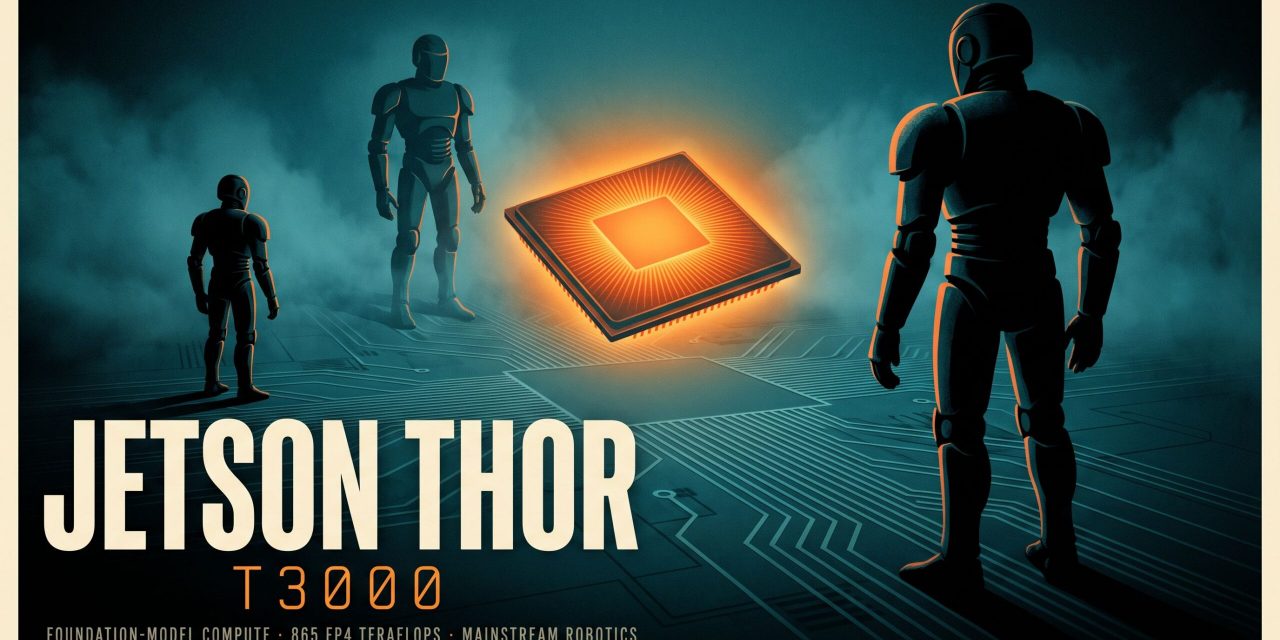
Nvidia has slotted a new module into the middle of its Jetson Thor lineup, and it changes the math for anyone building robots at scale. The Jetson Thor T3000 pushes 865 FP4 teraflops of AI compute into a package roughly half the size and half the power draw of the flagship T5000, while keeping the same Blackwell architecture and software stack. Paired with the lower-cost T2000, the T3000 gives robotics teams a way to run foundation-model-class workloads on hardware that fits real bills of materials.
Both modules are scheduled to ship in Q1 2027. Developers do not have to wait that long to start building, though, because T3000 emulation arrives this month through JetPack 7.2.1 on the existing Jetson AGX Thor developer kit.
What the Jetson Thor T3000 actually delivers
The T3000 pairs a Blackwell GPU with an eight-core Neoverse Arm CPU, 32 GB of LPDDR5X memory, and 273 GB/s of memory bandwidth. High-speed I/O tops out at 25 GbE networking, which matters for robots that stream sensor data or coordinate with fleet-level systems. On multimodal workloads, Nvidia reports inference performance close to the T5000. Partner YUAN puts that figure at roughly 90 percent of T5000 throughput while trimming memory, power, and physical size by about half.
That combination is the commercially interesting part. Memory prices have climbed sharply, and every gigabyte shaved from a robot’s BOM shows up in per-unit economics. A module that delivers near-flagship inference at meaningfully lower cost lets teams migrate down from the T5000 without giving up capability on large language models, vision-language models, vision-language-action models, or world foundation models.
The IGX T3000 for safety-critical deployments
A parallel IGX T3000 variant offers identical performance with an integrated Functional Safety Island, running Nvidia’s Halos for Robotics stack. That targets robots working alongside humans in factories and warehouses, where compliance and deterministic safety behaviour are non-negotiable. Industrial arms, collaborative robots, and autonomous mobile platforms in shared workspaces are the obvious candidates.
The T2000 opens the low end
Where the T3000 handles the mainstream robotics tier, the T2000 anchors the entry point. It offers 400 FP4 teraflops of AI compute, 16 GB of LPDDR5X memory, and a 40 W power envelope. That is enough for visual AI agents, autonomous mobile robots, robotic arms, and other cost-sensitive edge deployments that still need real neural inference rather than lightweight vision tricks.
With T2000 at the bottom and T5000 at the top, Nvidia’s edge AI portfolio now spans 70 TOPS to 2,000 teraflops on a single software stack. That is unusually wide coverage for one platform. A smart camera, a warehouse AMR, and a humanoid can all run the same models with different budgets and form factors, which simplifies engineering across a product family.
Cosmos 3 Edge and the software layer
Hardware is only half of the announcement. Nvidia expanded its Cosmos 3 world foundation model family with Cosmos 3 Edge, a 4-billion-parameter model built to run on Thor. It handles on-device perception, real-time reasoning, and action prediction for embodied systems. According to Nvidia, developers can post-train Cosmos 3 Edge for a specific robot embodiment and sensor suite in about a day using the open Cosmos framework.
That timeframe matters more than the parameter count. Per-fleet or per-customer fine-tuning becomes practical when the loop closes in 24 hours rather than weeks, which shifts what a robotics product roadmap can look like. Instead of shipping one general model and hoping it generalises, teams can tune per deployment site.
Jetson agent skills cut memory in production
Alongside the modules, Nvidia released Jetson agent skills, an automation layer that handles memory optimization, system configuration, and deployment tuning across the Jetson portfolio. It works with older Jetson Orin modules too. Early users have posted concrete results:
- UBTech, Agile Robots, and Connect Tech reduced memory usage by up to 15 GB, moving from the Jetson AGX Orin 64 GB to the 32 GB module.
- Retail vision company SandStar saved 4 GB, shifting deployments from the Jetson Orin NX 16 GB to the 8 GB SKU.
- NoTraffic, which runs AI on intelligent traffic infrastructure, cut memory usage by 30 percent on the older Jetson TX2 NX, freeing headroom for new capabilities without a hardware refresh.
- GROOVE X, maker of the LOVOT companion robot, redistributed workloads across heterogeneous accelerators to fit lower-memory hardware.
The pattern is consistent. Agent skills let developers drop one memory tier within a product family, which reduces cost per unit at scale. For robotics, where volumes count in thousands rather than millions, that kind of optimisation directly changes unit economics.
Who is building on Jetson Thor
Partner adoption tells you where this is heading. Nvidia named 1X, Agile Robots, Amazon Robotics, Boston Dynamics, FANUC, Hitachi, and Techman Robot as companies building on Jetson Thor. That spread covers humanoids, warehouse logistics, industrial arms, and factory automation, which are the four categories most likely to hit commercial deployment volume over the next 24 months.
Ecosystem partners including ADLINK, Advantech, AAEON, Aetina, Connect Tech, Seeed Studio, and YUAN are already shipping Thor-based carrier boards and full systems. YUAN, for example, has already deployed T5000-based platforms for factory inspection, autonomous robotics, and intelligent safeguarding, and is now building next-generation platforms around the T3000 and T2000 using the same software stack.
Emulation now, silicon in 2027
The transition path is deliberately continuous. Because the T3000 and T2000 share chip architecture and software with the existing Jetson AGX Thor developer kit, engineers can start in emulation mode this month and drop into production silicon when the modules ship. T3000 emulation lands with JetPack 7.2.1 in July, and T2000 emulation is planned for a later release.
The physical AI stack carries across the transition too. Isaac handles simulation and perception, and open models including Nemotron, Cosmos 3, and Isaac GR00T run natively on Thor hardware. That continuity is what lets a team validate a Cosmos 3 Edge deployment on an AGX Thor kit today and ship production units on T3000 modules next year without rewriting the application layer.
The friction and the opportunity
Q1 2027 is roughly two quarters out, and the humanoid and industrial-robotics categories Nvidia is targeting are moving quickly. Qualcomm on the automotive side, Ambarella and Hailo on lower-power vision, and internal custom silicon efforts inside the largest robotics companies all have time to counter-position. Emulation lets developers start now, but hardware slips are common, and the second-tier partner ecosystem depends on ship dates holding.
Nvidia is playing the long game it played with data-center AI. Build the compute platform, seed the frameworks, cultivate the ecosystem, and wait for the volume category to arrive. The T3000’s cost-efficiency positioning is the more commercially significant half of this announcement because humanoids and industrial robots ship in units of thousands, not millions. If Cosmos 3 Edge and Jetson agent skills genuinely compress deployment timelines from weeks to days, building a robot around a Jetson module starts to resemble building a phone around a Snapdragon.
The quiet shift underneath the announcement
The headline numbers on the T3000 are impressive, but the more interesting change is architectural discipline. Nvidia is treating perception, reasoning, and safety as a single software surface across a 30x compute range. That means the same engineering team can build a smart camera and a humanoid without maintaining parallel stacks, which is arguably the harder problem to solve than raw teraflops. Whether the robotics volumes actually materialise on the schedule Nvidia needs is a separate question, and one that Q1 2027 will start to answer.