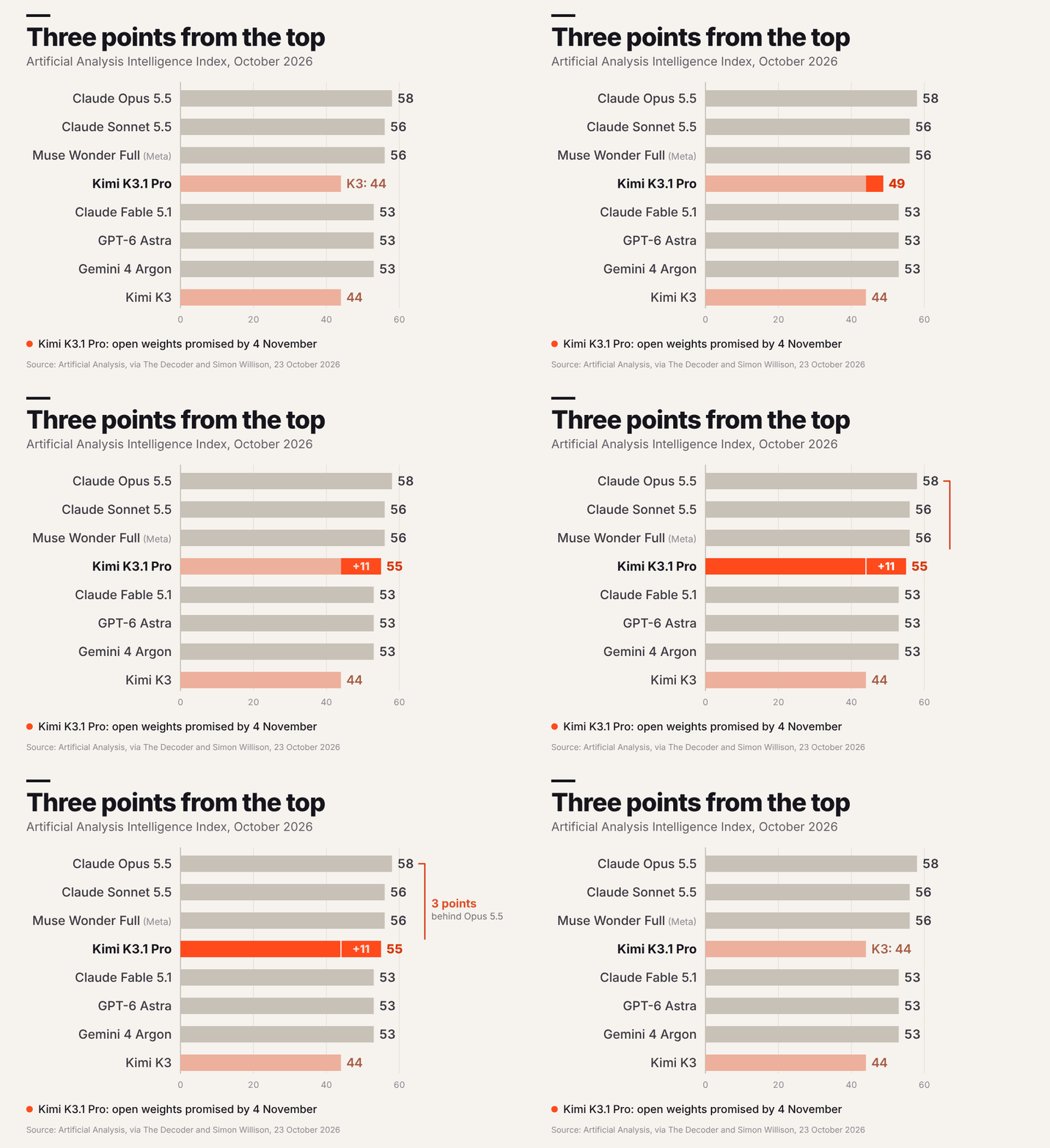
Kimi K3.1 Pro from Moonshot AI scores 55 on the independent Artificial Analysis Intelligence Index, three points behind Claude Opus 5.5. Moonshot says the full weights will be public by 4 November, which would make it the strongest open-weight model yet and shrink the gap between open and closed AI from 12 points to 3. It also did something few labs do: it trained part of the model’s hacking skill back out before opening it up. For European organisations, that combination changes the question from whether open models are good enough to how they want to run one.
What Moonshot released
Kimi K3.1 Pro launched on 23 October 2026 as the first model in Moonshot’s K3.1 series. It is not a new base model. It is Kimi K3 from July, with the same 2.8 trillion parameters and 104 billion active per token, given what Moonshot’s tech blog calls “substantially larger post-training compute”: reinforcement learning across hundreds of task domains at once. The context window stays at 1 million tokens, it takes text and images, and it always reasons before it answers. A Highspeed variant runs two to three times faster, according to Moonshot.
The launch pitch covers full software projects including games in Unity, Unreal and Godot, parametric 3D models through Blender and CAD scripts, end-to-end financial workflows, and fewer hallucinations. On Moonshot’s own stress test, the share of false claims fell from 23.4% for K3 to 8.3%.
The gap between open and closed AI is now three points
The most reliable number comes from Artificial Analysis, as reported by The Decoder. Its Intelligence Index puts Kimi K3.1 Pro at 55, 11 points above K3 and fourth overall. Only Claude Opus 5.5 (58), Claude Sonnet 5.5 (56) and Meta’s Muse Wonder Full (56) rank higher. Claude Fable 5.1, GPT-6 Astra and Gemini 4 Argon sit at 53, Simon Willison notes, calling it the first time a soon-to-be open-weight model has scored this high against the frontier.
On GDPval-AA, which measures real office work, it reaches 1,846 Elo against 1,866 for Opus 5.5. Moonshot’s own benchmark sheet goes further, with 65.7% on Terminal-Bench 4.0 against 66.4% for Opus 5.5 and 58.2% for GPT-6 Astra. Those figures were run at maximum reasoning effort, largely inside Anthropic’s Claude Code harness, and nobody has reproduced them yet.
The first independent tests point the same way, at a strong model rather than a new leader. Plotly’s private data-analysis benchmark scored it 42 out of 43, joint third of 34 models and the best result Plotly has seen from a Chinese lab. A small coding test by Kingy AI found 4 working patches out of 8, level with Claude Sonnet 5.5 and one behind GPT-6.1 Sol.
A capability held back on purpose
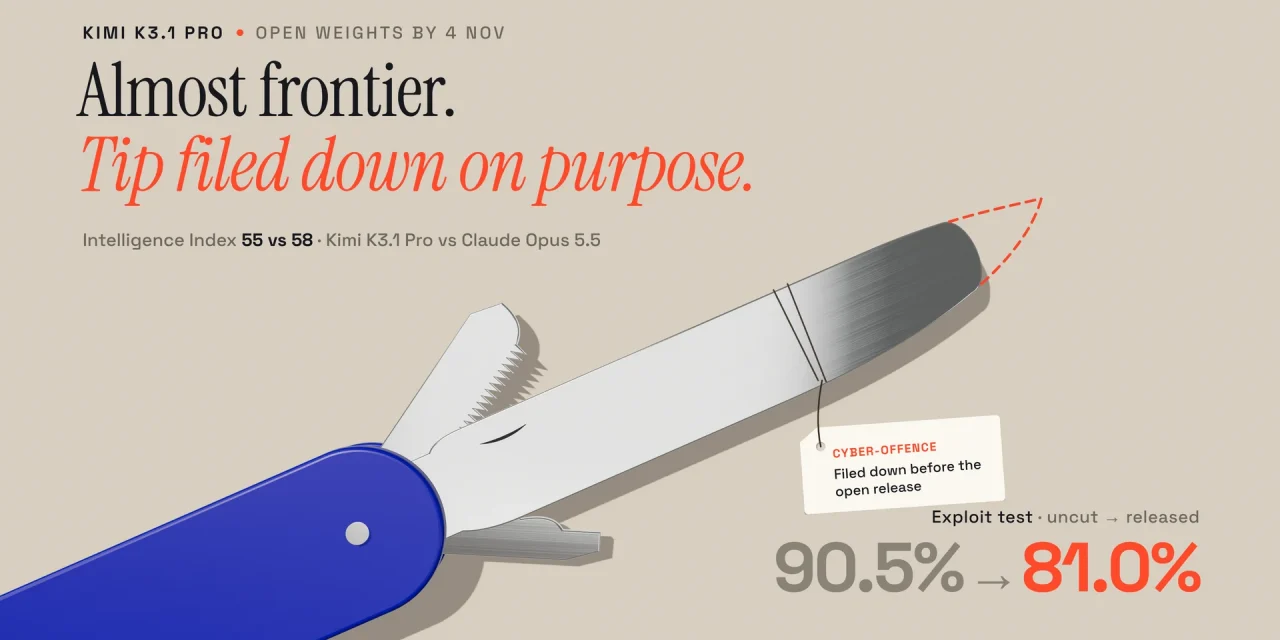
Moonshot found that the model got better at finding and exploiting software vulnerabilities as post-training scaled, because security material was in the training mix. For the open release it removed that data from both mid-training and reinforcement learning. Its stated principle is that it aims “not to release open weights that would extend the absolute frontier of cyber capability.”
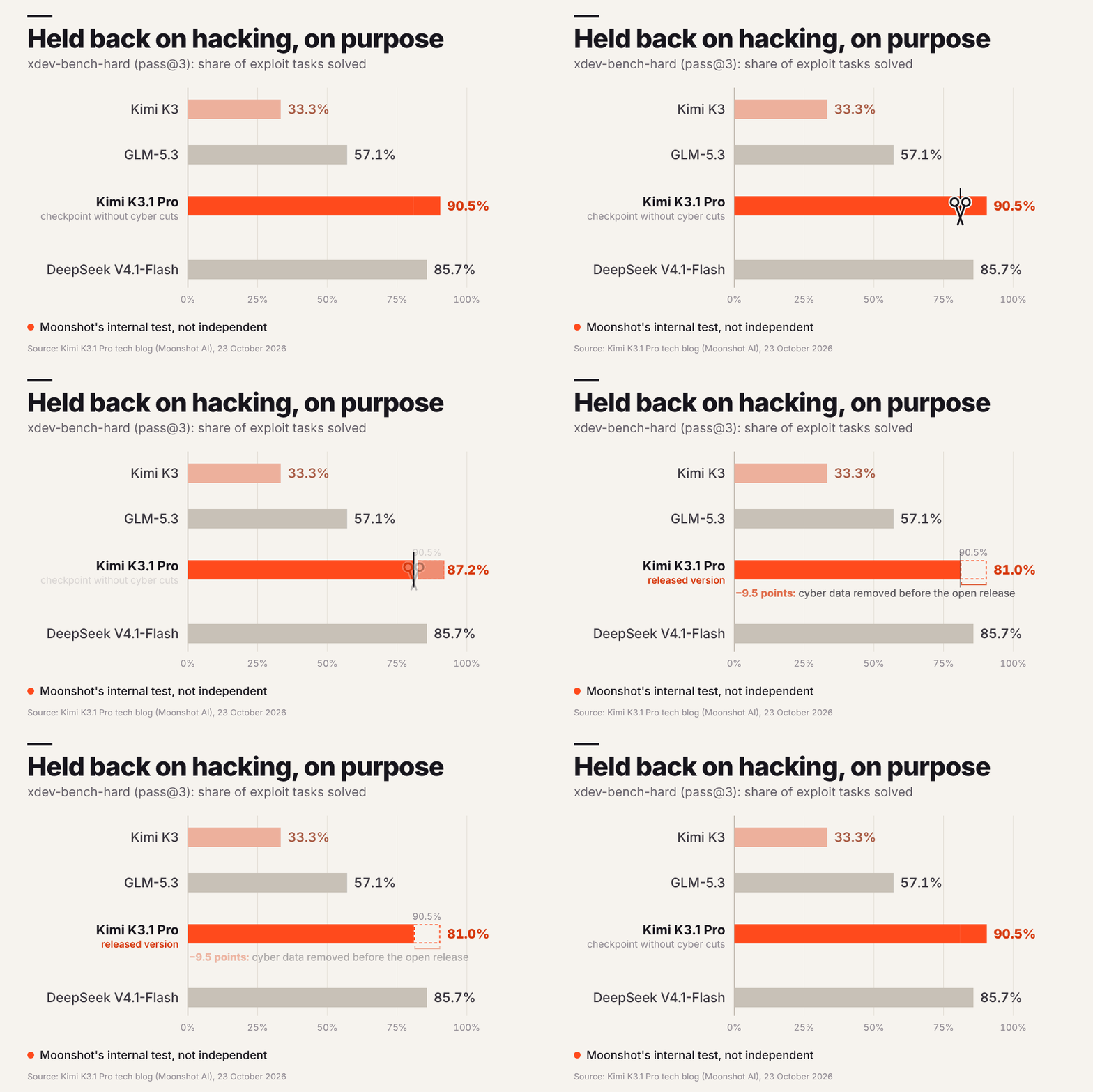
On its internal xdev-bench-hard test, a checkpoint without the cut solved 90.5% of tasks and the released model 81.0%. That is still far above K3 (33.3%) and below DeepSeek V4.1-Flash (85.7%). Moonshot also reports 74.7% on ExploitBench against 91.0% for Opus 5.5, and says K3.1 Pro stays behind proprietary models that have been available for at least three months. The Next Web points out the obvious limit: once weights are downloaded, they cannot be recalled, and nobody knows yet whether the cut survives someone else’s fine-tuning.
Even so, this is a concrete, measurable safety decision published alongside a launch, with more detail than most labs publish. It also lines up with how the EU AI Act treats such models. The open-source relief in the Act does not cover general-purpose models with systemic risk, and a model of this scale would very likely be presumed to carry that risk. That means evaluation and risk-mitigation duties when it is offered in Europe, whether its weights are open or not, as the Commission’s GPAI guidelines set out. A lab that measures and trims a dangerous capability before release is doing a version of what the Act asks for.
Cheaper per token, not per task
The API costs $2 per million input tokens and $10 per million output tokens, a third less than K3 and half the price of Claude Opus 5.5 ($4 and $20). That matches Claude Sonnet 5.5 and GPT-6.1 Sol. Highspeed costs twice as much, except for cached input at $0.20. Those prices are the same on OpenRouter.
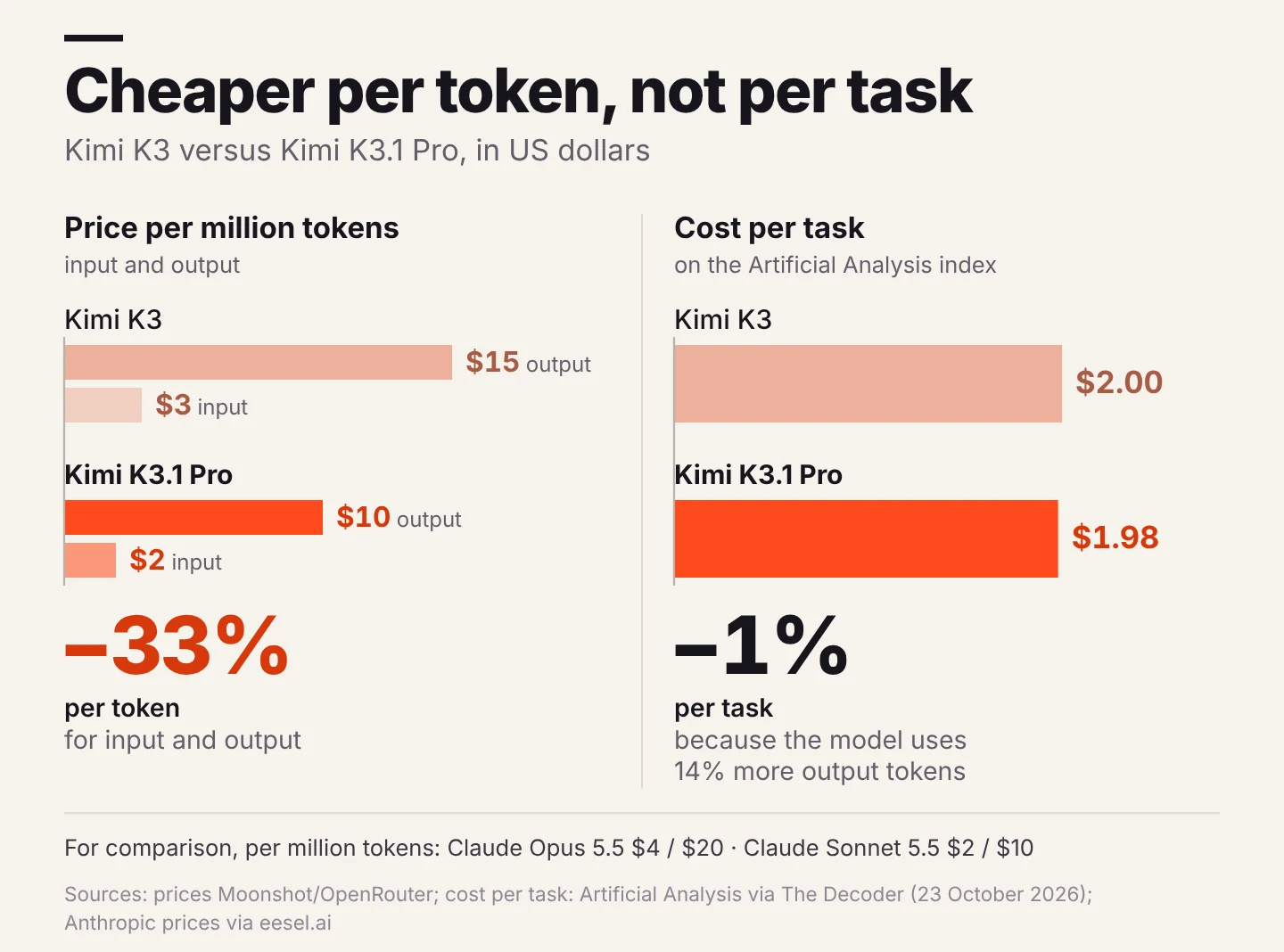
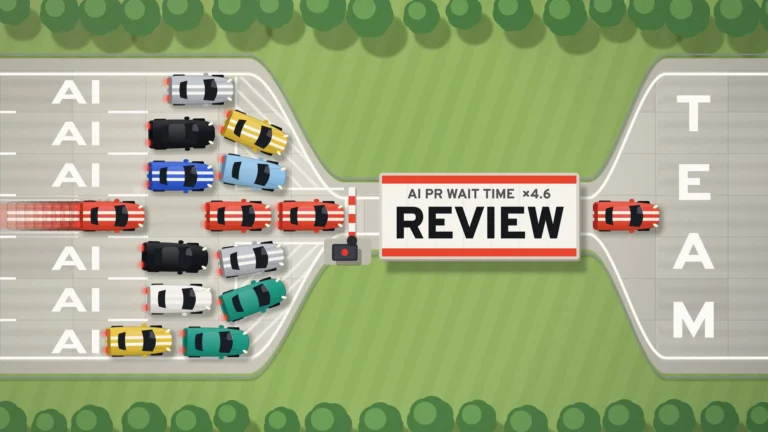
The catch is verbosity. K3.1 Pro writes 14% more output than K3, so Artificial Analysis puts its cost per index task at $1.98 against $2.00 for its predecessor. It used 150 million output tokens to complete the index against a median of 87 million, Handy AI reports. Plotly’s full run cost $13.47, while GPT-6.1 Sol got every question right for $2.61. Speed is the other cost: 44 tokens per second on OpenRouter for the standard endpoint, and a median of 2.5 minutes per question in Plotly’s test.
What European organisations should weigh
The strongest open model in the world is about to be Chinese, and Europe’s own open models, such as Mistral Large 4, score lower: before this launch, the best open model of any origin trailed the closed leaders by 12 points. That leaves three realistic routes.
- Use Moonshot’s API. It is the fastest way in, but the international privacy policy places data on servers in Singapore, and OpenRouter does not offer the model through its EU in-region routing. Moonshot offers zero data retention for API customers. Wavect advises getting the data processing agreement, transfer terms and a no-training clause in writing before any personal or confidential data goes in.
- Host it yourself after 4 November. That keeps inference data in your own jurisdiction, but this is not a workstation model. K3’s weights were about 1.56 TB, and the maintained vLLM recipe starts at eight top-end accelerators such as GB300 or MI355X. A European cloud or a sovereign AI provider is the more likely host than your own data centre.
- Wait for the licence and independent evaluations. The K3.1 Pro licence has not been announced. K3’s licence allowed commercial use, with extra conditions for model-as-a-service businesses above $20 million in revenue and a naming requirement for very large products. Independent runs of Moonshot’s claims will start once the weights are out.
Whichever route you choose, the lesson from models are rented, context is owned applies: build your prompts, evaluations and integrations so that switching from a closed model to an open one, or back, is a configuration change rather than a project.
Frequently asked questions about Kimi K3.1 Pro
Is Kimi K3.1 Pro open source?
Not yet. It is available through Kimi’s apps, Kimi Code, Kimi Work and the API. Moonshot has promised the full weights by 4 November 2026, under a licence it has not yet published.
Is Kimi K3.1 Pro better than Claude Opus 5.5?
No. It scores 55 against 58 on the independent Artificial Analysis index. On Moonshot’s own benchmarks it leads on some tests and trails on others.
How much does Kimi K3.1 Pro cost?
$2 per million input tokens and $10 per million output tokens, or $4 and $20 for Highspeed. Because it writes long answers, its cost per task is barely lower than K3’s.
Can European companies use Kimi K3.1 Pro with personal data?
Only with care. API data is stored in Singapore, so you need a documented transfer mechanism and contract terms first. Self-hosting the open weights avoids the transfer but requires a large GPU server.
Open no longer means second best
For two years, choosing an open model meant accepting a clear step down in quality. Kimi K3.1 Pro shrinks that step to three points, and it got there by training an existing model harder rather than building a bigger one. The more interesting precedent may be the one Moonshot set on safety: measure what a model can do, cut what should not be open, and publish both numbers. If the weights arrive on 4 November and independent tests hold, European organisations will have a near-frontier model they can run on their own terms. For the wider picture, see our overview of the 40 most innovative AI labs in China.