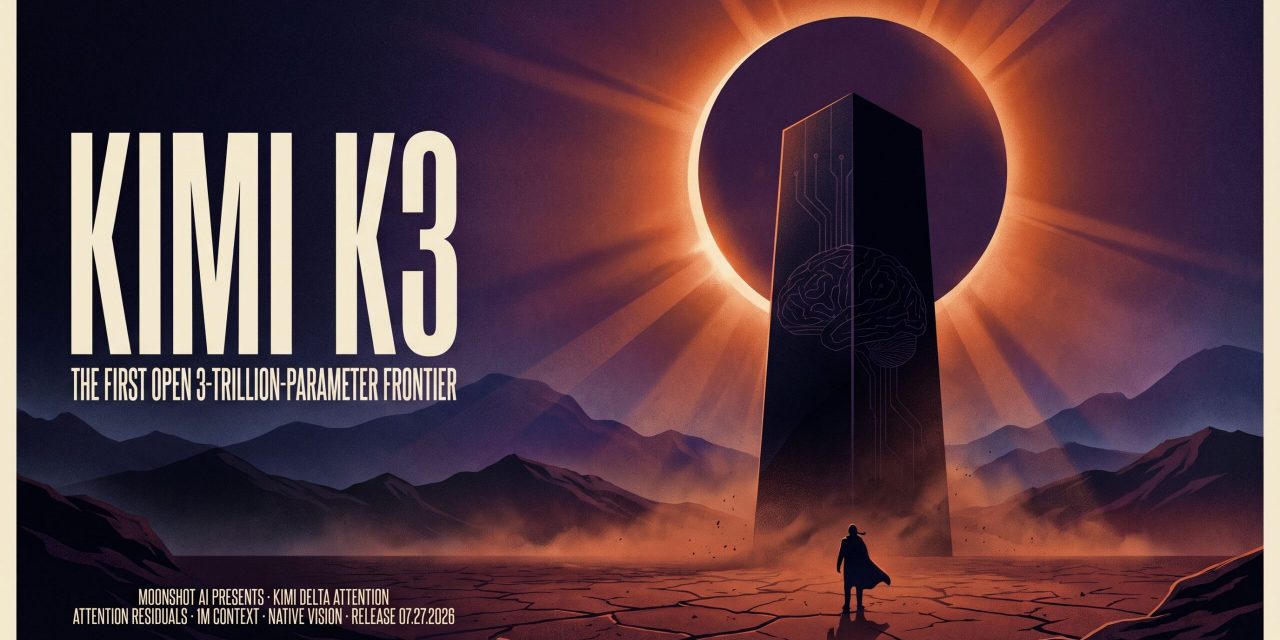
Moonshot AI has released Kimi K3, a 2.8-trillion-parameter model that pushes open-weight AI into territory previously reserved for closed frontier systems. Built on Kimi Delta Attention and Attention Residuals, paired with a 1-million-token context window and native vision, K3 is the first open 3T-class model. It runs today on kimi.com, in Kimi Work, Kimi Code, and via the Kimi API, with full weights scheduled to drop on July 27, 2026.
The performance story is straightforward. K3 still trails the two absolute leaders, Claude Fable 5 and GPT 5.6 Sol, but it consistently beats every other model Moonshot tested. On the Artificial Analysis Intelligence Index it scores 57, ahead of Claude Opus 4.8 and GPT 5.6 Terra, and level with Gemini 3.1 Pro. For an open model, that positioning is unprecedented.
What makes Kimi K3 architecturally different
K3 is not just K2 with more parameters. Moonshot rebuilt the backbone around two ideas designed to keep information flowing cleanly at extreme scale.
Kimi Delta Attention is a hybrid linear attention mechanism engineered to scale efficiently across very long sequences. Attention Residuals replace standard residual connections and selectively retrieve representations across model depth rather than piling them up uniformly. Together they form a scaffold that behaves well past the trillion-parameter mark.
On top of that sits an aggressively sparse Mixture of Experts layout. K3 activates just 16 of 896 experts per token, wrapped inside a Stable LatentMoE framework. At this sparsity, routing becomes the hard problem, so Moonshot introduced Quantile Balancing to derive expert allocation from router-score quantiles, and Per-Head Muon to optimize attention heads independently. Two more components, Sigmoid Tanh Unit and Gated MLA, refine activation control and attention selectivity.
The combined effect is roughly 2.5 times better scaling efficiency than Kimi K2. In practical terms, the model converts compute into intelligence more effectively, which is what allows a 2.8-trillion-parameter run to be trained and served at all.
Long-horizon coding is where K3 shines
Kimi K3 was clearly optimized for agentic work rather than single-turn Q&A. Moonshot ran the model through GPU kernel optimization tasks in identical sandboxes, giving each model up to 24 hours to profile, rewrite, and benchmark four workloads across NVIDIA H200 and alternative GPGPU hardware. K3 traded blows with Fable 5 and substantially outperformed Opus 4.8, GPT 5.6 Sol, and GPT 5.5. During the late stages of K3 development, an early version of the model handled most of the team’s kernel optimization work in-house.
The more revealing test was building a GPU compiler from scratch. K3 produced MiniTriton, a Triton-like compiler with its own tile-level IR layer over MLIR, optimization passes, and a PTX code-generation pipeline. On supported roofline benchmarks MiniTriton matches or beats Triton and torch.compile, and it sustains end-to-end nanoGPT training with stable convergence. That means K3 built a coherent DSL frontend, IR passes, PTX codegen, and runtime as a single working system, not a scattering of clever snippets.
A chip designed by a model, for a model
In a 48-hour autonomous run, K3 designed a physical chip to serve a nano version of itself. Using open-source EDA tools on the Nangate 45nm library, it produced a 4 mm² design that closes timing at 100 MHz and sustains over 8,700 tokens per second decode throughput in simulation. The chip packs 1.46M standard cells, 0.277 MB of SRAM, and an INT4 MAC array with fused dequantization. This is not a production tape-out, but it demonstrates something new: sustained coherent engineering across dozens of hours without hand-holding.
Vision in the loop for creative work
Because K3 is natively multimodal, it treats text, images, and video as one substrate. Moonshot calls the resulting workflow vision in the loop: the model writes code, renders a screenshot, sees the result, and iterates. In one demo, K3 built a procedural browser-based 3D exploration game using Three.js WebGPU and GPU compute, generating forests, a log-cabin village, snowy mountains, and dynamic weather.
The same capability translates to motion design and video editing. K3 produced a 3Blue1Brown-style motion-graphics explainer of its own architecture, and it edited its own teaser video from 56 source clips, handling clip selection, motion-matched cuts, frame-accurate beat synchronization, and audio processing. A human editor would typically spend one to five working days on similar output.
Knowledge work at research speed
K3’s agentic capabilities extend beyond code. To reproduce the I-Love-Q universal relations in computational astrophysics, K3 reviewed and cross-validated more than 20 papers, implemented the full numerical pipeline, evaluated over 300 equations of state, spotted inconsistencies in published formulas, generated 3,000+ lines of Python, and produced an interactive HTML dashboard. The run took about two hours. Moonshot estimates an experienced researcher would need one to two weeks.
Inside Kimi Work, K3 produces interactive research artifacts rather than static reports. One example is a 42-year interactive study of the ASIC industry, built through 120+ rounds of recursive self-improvement, drawing on 2,800+ web searches, 1,100+ terminal pulls, and 11,000+ pages across 87 quarterly reports and 99 PDFs. Two new features, Widgets and Dashboard, let you embed live interactive components inside a chat and pin them into persistent, topic-organized views.
Infrastructure and serving
Training at 2.8 trillion parameters demands careful engineering. K3 applies quantization-aware training from the supervised fine-tuning stage onward, using MXFP4 weights with MXFP8 activations for broad hardware compatibility. To keep throughput stable at large expert-parallel scales, Moonshot introduced a fully balanced expert-parallel training method with static shapes and no host synchronization on the critical path.
For inference, Moonshot recommends supernode configurations with 64 or more accelerators. Because Kimi Delta Attention creates new challenges for conventional prefix caching, the team contributed a corresponding implementation to the vLLM community, released alongside the model. Powered by Mooncake’s disaggregated inference architecture, the official API achieves a cache hit rate above 90% in coding workloads.
Pricing and access
The Kimi API prices K3 at $0.30 per million tokens for cache-hit input, $3.00 for cache-miss input, and $15.00 per million output tokens. Compared with Claude Fable 5 at roughly $10 and $50, that is a fraction of the cost, though it sits above the median for reasoning models in the same tier. K3 is verbose by default because it launches with maximum thinking effort, generating around 130M tokens on the Intelligence Index evaluation versus a median of 63M. Lower-effort modes are coming.
Output speed lands around 62 tokens per second, slightly below the reasoning-model median, with time to first token near 1.99 seconds. The 1-million-token context window is available end to end, and on BrowseComp K3 hit 90.4 when evaluated with the full window and no context management.
Known rough edges
Moonshot is candid about limitations. K3 was trained in preserved thinking history mode, so if an agent harness fails to pass back the full historical thinking content, or if a session gets switched mid-flight from another model, output quality drops sharply. Sticking with a verified harness like Kimi Code avoids the problem.
The second quirk is proactiveness. K3 was tuned on long-horizon challenging tasks, which makes it prone to making decisions on your behalf when instructions are ambiguous. If your application needs strict guardrails, encode them explicitly in the system prompt or in an AGENTS.md file. And on pure user experience polish, Moonshot admits a noticeable gap remains against Claude Fable 5 and GPT 5.6 Sol.
The shift worth watching
A year ago, open models trailed proprietary flagships by six to twelve months. K3 compresses that gap to a two-to-three-point spread on the leading composite benchmark, while shipping full weights to anyone with the hardware to run them. The interesting question is no longer whether open models can catch up. It is what happens to pricing, lock-in, and enterprise architecture decisions once a 2.8-trillion-parameter base model is something you can fine-tune on your own cluster rather than rent by the token.