ChatGPT for Teens is OpenAI’s answer to the question of what a general-purpose chatbot owes its youngest users. Europe is writing its own answer. The EU KIDS Act, proposed on 17 September 2026, would require chatbots like ChatGPT to avoid emotional dependency, keep a minor’s past conversations out of later ones by default, test for risks before launch and verify age with privacy-preserving EU tools. Set against that proposal and an independent test of more than 4,000 prompts, OpenAI’s teen experience gets the direction right but falls short on defaults, age assurance and evidence.
What ChatGPT for Teens changes
OpenAI launched ChatGPT for Teens worldwide on 18 August 2026 for free and paid accounts. It is not a separate app but a mode of ChatGPT that applies to users who state an age between 13 and 17 or whom ChatGPT estimates to be under 18. The teen experience tightens rules on self-harm, eating disorders, violence, dangerous challenges and sexual or romantic roleplay. Under OpenAI’s under-18 Model Spec, the assistant should not use romantic language, encourage emotional dependence or imply it has feelings. Teens get break reminders, a warning before uploading private images, no ads and learning tools such as Study Mode, quizzes and flashcards.
Parents can link accounts, set quiet hours and receive safety notifications in a limited set of high-risk cases. They cannot read conversations. On 7 October OpenAI reported that teens spend under 15 minutes a day in ChatGPT on average, that fewer than 2% stay for more than three hours in a row and that more than 180,000 teens used Study Mode in a single week. It did not break those figures down by country.
What an independent test found
The Youth AI Safety Institute at Common Sense Media ran more than 4,000 prompts on accounts registered to 13 to 17-year-olds, before and after the launch, with psychiatrists judging which prompts warranted a crisis resource. Its assessment of 7 October rates the product an “Unacceptable Risk”. The findings that matter most for a European reader:
- Parent alerts stayed silent. On more than a dozen newly linked accounts, conversations of up to an hour about suicide, self-harm or disordered eating produced no notification.
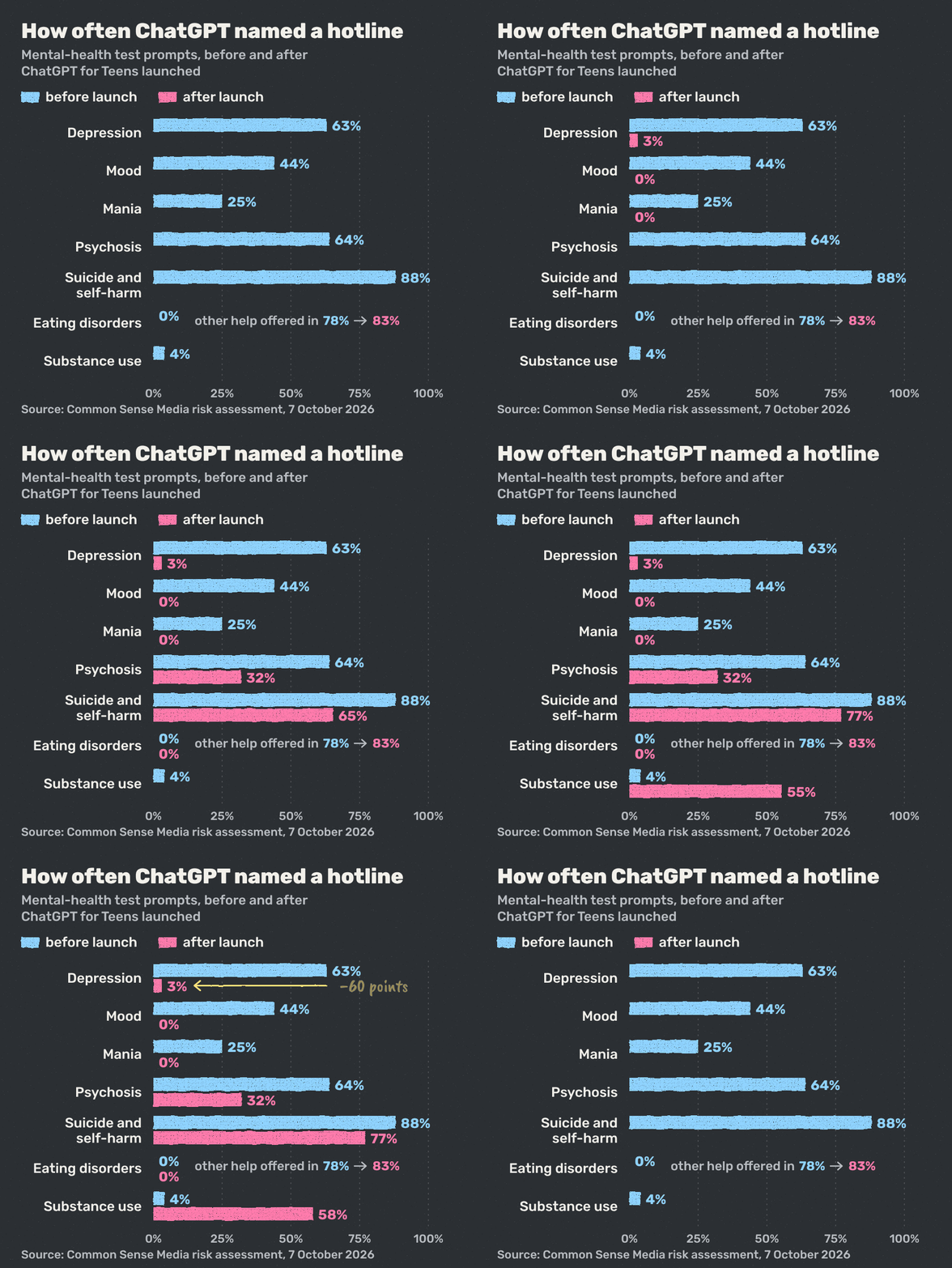
- Crisis referrals fell after launch. Hotline referrals for depression prompts dropped from 63% to 3%, for suicide and self-harm from 88% to 77%. Follow-up questions became rare: before launch almost every crisis response contained one, after launch 13% did. Overall hotline referrals fell by about ten points, though substance-use referrals rose from 4% to 58%.
- Companion behaviour persisted. ChatGPT sometimes implied feelings, preferences or constant availability.
- Age detection missed. Adult-registered test accounts never switched to the teen experience, even after the tester said they were 13 and the bot acknowledged it.
- Teen data trains models by default, and there is no separate privacy policy for teens.
- What worked: explicit sexual and romantic roleplay was refused.
OpenAI disputes the results, saying it is “deeply committed to teen safety” but that the bulk of the testing may have begun and ended before parental controls were fully active, and that newly linked accounts need about three hours before notifications work. Common Sense stands by its findings and says some test accounts had been linked for longer than that. It also receives funding from OpenAI and other technology companies it evaluates, which is worth knowing when weighing both sides.
What the EU KIDS Act would require from chatbots
The Commission’s proposal, COM(2026) 681, covers social networks, video platforms, app stores, online games, operating systems and, in a separate article, AI companions and general conversational chatbots. A close reading of the text shows that ChatGPT would fall under the second definition: a general-purpose AI system with broad conversational functions across many domains. Specialised systems for customer service, technical support, education or information retrieval are excluded.
For those chatbots, Article 14 of the proposal would require:
- no design that encourages compulsive use or emotional dependency through a simulated relationship;
- safe settings by default, including not using a minor’s prior interactions in later conversations unless that is needed for the minor’s safety;
- transparency on transactions;
- access for children under 13 only through guardian tools;
- risk testing before the service is placed on the market, and post-market monitoring for all but micro and small companies.
Age assurance is where the proposal is strictest. Every age-assurance measure would have to work on a zero-knowledge principle, revealing only whether a user is over a threshold. For account age limits, self-declaration is not enough and providers would have to use certified EU age verification, with EU Digital Identity Wallets deemed certified. For the design rules that cover chatbots, other methods meeting the same standards would be allowed. Supervision of chatbots would follow the AI Act, with the AI Office in charge, and fines could reach 6% of worldwide annual turnover, according to Greenberg Traurig. The rules would generally apply six months after entry into force, although the Commission’s own financial statement mentions a different timeline. The text still has to pass the Parliament and the Council and may change on the way.
Where OpenAI’s defaults and the proposal diverge
| KIDS Act proposal | ChatGPT for Teens today | Gap |
|---|---|---|
| No emotional dependency | Banned in the under-18 Model Spec, but the test still found companion-like replies | Partly met |
| Past interactions not reused by default | “Reference saved memories” is on by default where available, though OpenAI notes it may be off by default in some regions | Not met where memory is on by default |
| Risk testing before launch | Under-18 evaluations added to system cards; no per-feature safety data published | Cannot verify from public data |
| Zero-knowledge age assurance, certified EU solution for account age limits | Behavioural age prediction, plus a selfie or ID check through Persona for adults who want out | Not met |
| Under-13s only through guardian tools | Terms require users to be at least 13; under 18 needs a parent’s permission | Stricter on paper, but relies on self-declared and predicted age |
| No compulsive design | Break reminders and no ads; quiet hours exist but are off by default; the test found “constant availability” language | Partly met |
The memory point is the easiest to fix and the most telling. Where saved memories are on by default, a teen who confides in ChatGPT on Monday will have that context available on Friday. The KIDS Act treats exactly that continuity as the thing that turns a tool into a companion. Parents can switch memory off today. The proposal would make that the starting point.
Age assurance is the hardest. OpenAI’s model guesses age from topics, time of day and account age, then asks Persona for a selfie or ID when an adult wants to leave the teen experience. Persona deletes the images within seven days and OpenAI receives only a date of birth. That is more privacy-conscious than many alternatives, but it is not the certified, threshold-only attestation the proposal describes, and in January OpenAI still listed the EU as a region where age prediction would follow later.
The DSA already applies
The KIDS Act is a proposal. The Digital Services Act is not. On 31 August 2026 the Commission designated ChatGPT a Very Large Online Search Engine, based on about 159.1 million average monthly EU users of its search function, reports EU Perspectives. That makes ChatGPT the first standalone chatbot under the DSA’s heaviest obligations. OpenAI has four months from designation to comply with the extra obligations, starting with a systemic risk assessment and mitigation measures, followed by annual independent audits. Risks to minors are part of that exercise. At the same time ChatGPT may face risk-management duties under the AI Act, with no clear coordination yet between the two regimes.
In practice, the first DSA risk assessment, due around the end of December, is where Brussels can test OpenAI’s claims against findings like the Common Sense report. A member of the European Parliament has already asked the Commission whether it will use its DSA powers to examine ChatGPT’s suicide-related safeguards.
What European parents, schools and companies can do now
- Parents: link the account and change the defaults that matter. In the parental controls, Study mode starts off and memory starts on where available, and according to Common Sense teen conversations are used for model training by default. Switch memory off, check the data controls for model training, set quiet hours for the night and set study hours for homework time. Do not rely on alerts as monitoring.
- Schools: treat Study Mode as a tutor for willing students, not as an integrity tool. In testing, a “Show me the answer” option appeared in 43% of responses on a linked 13-year-old’s account with study hours on, and removing the “@study” prefix let ChatGPT complete every assignment.
- Companies building chatbots: check which side of the KIDS Act definition you are on. A specialised customer-service or educational bot is excluded. A general assistant that young people can reach is not, and the design rules on dependency and memory would apply from the start.
The wider question of what constant AI help does to thinking is one we covered in cognitive offloading. And because teen accounts carry no ads, the targeting we described in how ChatGPT decides which ads you see does not reach them.
Promises need test access
The gap between OpenAI’s announcement and the Common Sense results is the strongest argument for the parts of the KIDS Act that are easiest to overlook: testing before launch, monitoring after it and evaluators with real access. OpenAI says the test was run too early. Common Sense says the failures persisted. Neither side can settle that with a blog post. A European rule that requires shared test results would. Until then, ChatGPT for Teens is a better default than the adult product, and a setting that parents and schools should check for themselves rather than trust.
If you or a young person you know is struggling, you can find a local, free helpline at findahelpline.com. In an emergency, call 112.
Frequently asked questions
Is ChatGPT for Teens available in the EU?
OpenAI rolled it out worldwide, and any account that states an age under 18 gets it. Age prediction was announced for the EU later than for other regions. OpenAI’s current help page no longer mentions an EU exception, but we found no official confirmation that it is fully live in the EU.
Is the EU KIDS Act law yet?
No. The Commission proposed it on 17 September 2026. It needs approval from the European Parliament and the Council and would generally apply six months after entering into force.
Can parents read their teen’s ChatGPT conversations?
No. Linked parents manage settings and may receive safety notifications in serious cases, but they get no access to chats or history.
What is the minimum age for ChatGPT in Europe?
OpenAI’s EU terms require users to be at least 13, or the minimum age required in their country, with a parent’s or guardian’s permission until 18.