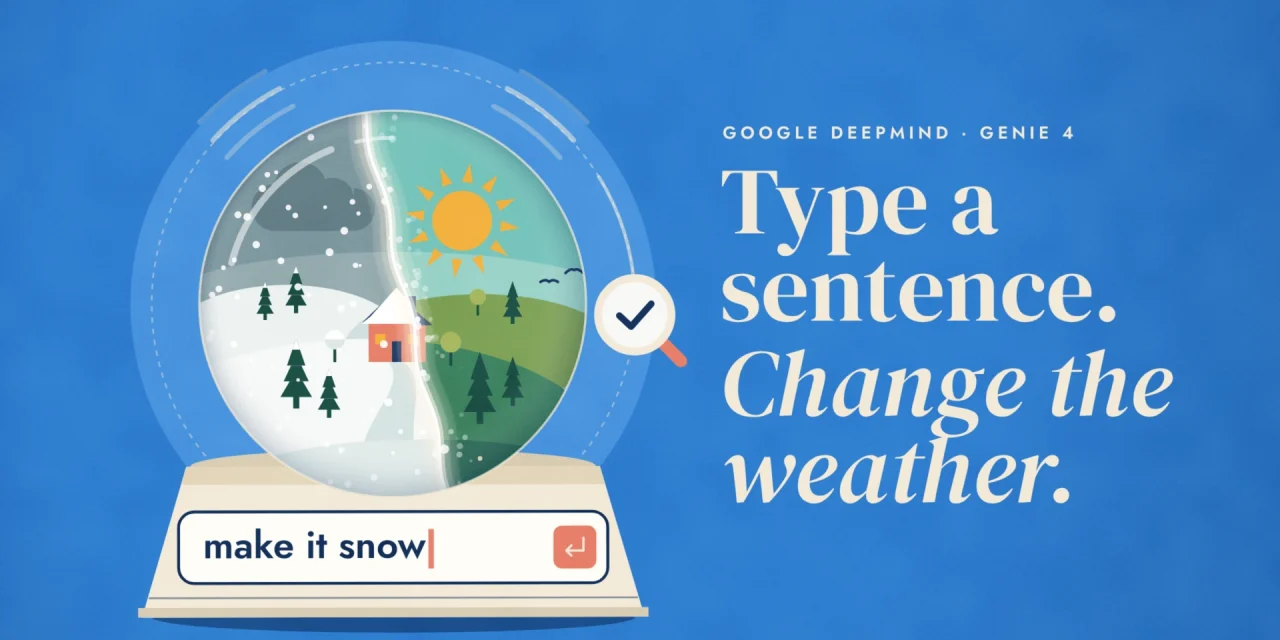
Genie 4 is Google DeepMind’s new world model: it generates an interactive, photorealistic world frame by frame while you walk through it, adds its own sound and dialogue, and lets you change the scene mid-session with a sentence. The bigger news for organisations is the architecture. A Gemini model now plans, checks and corrects what Genie renders, an early version of what Google calls hybrid world models. Genie 4 is a research preview for selected testers, Project Genie, where it goes next, is not available in the EU, and Google has not published a price, specs or benchmarks.
What Genie 4 does
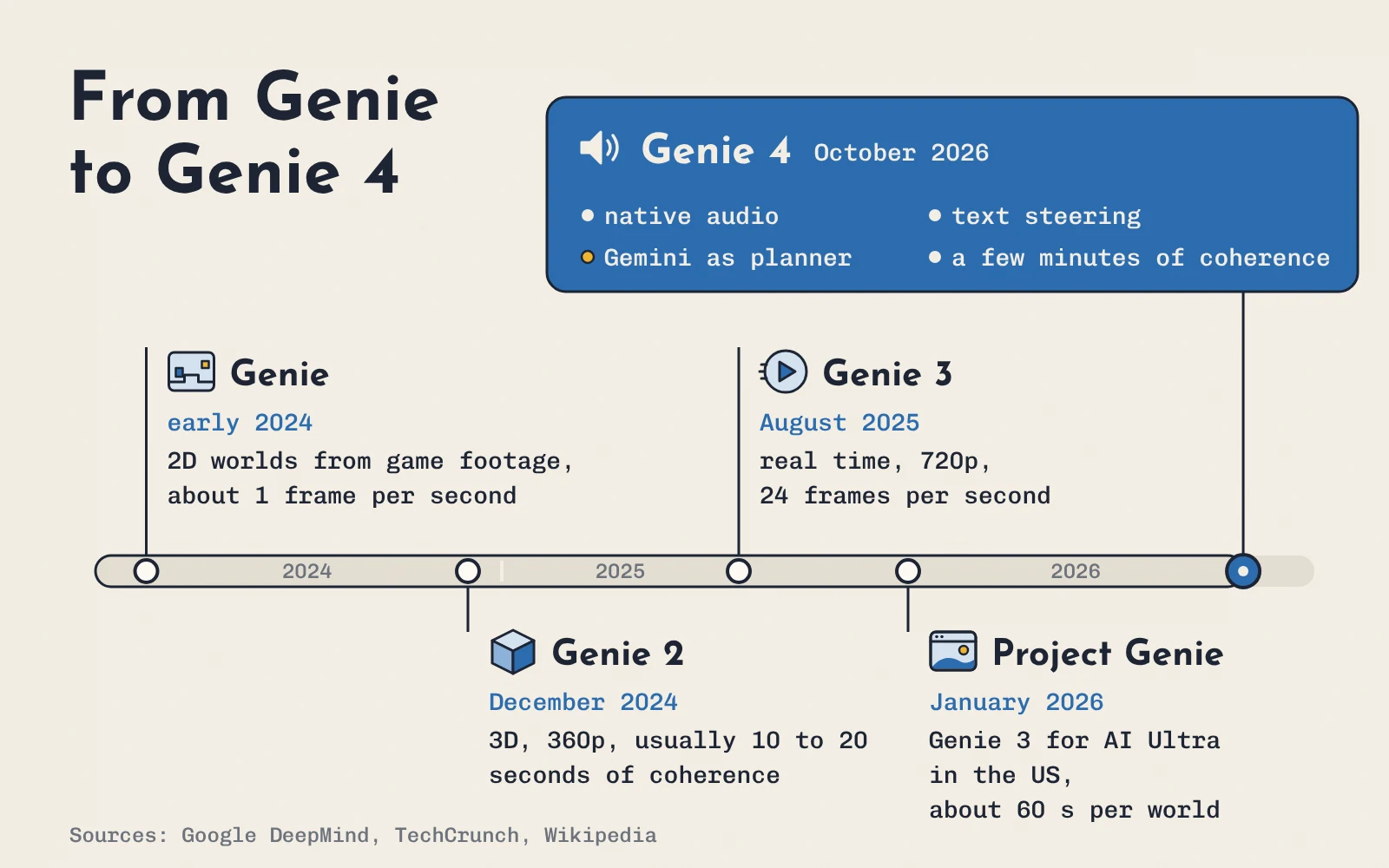
Google DeepMind announced Genie 4 on 27 October 2026. Like its predecessor Genie 3, which ran at 720p and 24 frames per second, it is not a video generator that hands you a finished clip. It renders a world in real time in response to keyboard and text input. Four things are new.
- Native audio. Ambient sound, music and spoken dialogue are generated with the visuals. Characters respond to what you do.
- Real-time steering. You can change the weather, move the camera or add a person or object while the simulation runs.
- More convincing people and physics. DeepMind calls the rendering of humans its most dramatic leap, alongside physics such as collisions and aerodynamics, which TechCrunch describes as better than in Genie 3.
- Longer coherence. TechCrunch reports that scenes stay consistent for up to two minutes, double Genie 3, without saying where the figure comes from. DeepMind’s own model page gives no number and says “a few minutes of continuous interaction, rather than extended sessions”, the same phrasing it used for Genie 3.
Under the hood, Genie 4 builds on Gemini Omni, Google’s multimodal video model, to keep worlds grounded in how things look and behave, and on other Gemini models to keep scenes coherent.
The real shift is the planner watching the world
Gemini 3.8 Flash runs inside the loop as a guiding agent. It observes the scene, breaks a goal into steps, checks the incoming frames to verify each step worked and revises the plan when the world drifts or a user intervenes. Ask for a thunderstorm, for instance, and Gemini could break it into steps such as clouds, rain and lightning, and check each one before moving on.
This is the same pattern that makes AI agents more dependable: one model generates, a second one checks. One developer summed it up as a generator with a checker, and argued that much of the coherence gain comes from that checker rather than from a better memory.
Google frames it as an early step towards hybrid world models. Gemini handles narrative and structure in text and code, while Genie renders how the world looks, sounds and responds. Tejas Kulkarni, a research director at Google, said in a briefing covered by TechCrunch that he expects more hybrid models in which Gemini writes code and text while Genie simulates reality at different levels of abstraction. For organisations, that matters more than the graphics. A world you can steer with language, and that a reasoning model keeps on track, is closer to a simulation tool than to a game.
Where world models create value first
DeepMind’s trusted testers come from the creative industries, journalism, education, gaming and engineering. Their use cases show where the technology is useful today and where it is still a bet.
| Use case | What testers do | How ready |
|---|---|---|
| Previsualisation | Try camera angles, lighting and dialogue live in a “draft mode”, with several takes | Useful now: small errors matter little in a draft |
| Concept and game prototyping | Go from a plain-language idea to an explorable prototype before any engine work | Useful for ideation; no export to game engines announced |
| Archives and education | Turn a single archival photo into a place you can walk through, including floods or wildfires | Promising, but raises disclosure questions (see below) |
| Scenario simulation | Enterprise partners generate “zero-to-one” scenarios | Early, no published results |
| Robots and agents (DeepMind’s own research) | Simulate robot tasks such as the Apollo checkers demo; DeepMind earlier tested its SIMA agent in Genie 3 worlds | Research stage, physics not yet reliable enough |
The robotics demo is the most ambitious. Gemini 4 Argon split a task into steps and passed them to Genie 4 as text, which rendered Apptronik’s Apollo humanoid playing checkers. No physical robot was involved, The Decoder notes. The promise is that robots learn from simulated experience before they touch the real world, a theme we explored in physical AI in the next decade. Waymo already built its own world model on Genie 3 to simulate rare traffic events.
What Genie 4 cannot do yet
DeepMind is unusually candid about the limits, on its model page and in the blog post. Details and objects can drift in longer sessions, after several prompt edits or while navigating. Text in the world is only reliably legible if it was in your prompt. Real locations are not reproduced accurately. Complex physical interactions, audio accuracy and multi-agent interaction remain research problems.
Viewers who went through the demos frame by frame found exactly that. On Hacker News they pointed to a marble bust that fails to topple, a section of a castle that disappears and a man whose left half wears a suit and right half a dress. In the checkers demo, one commenter saw a piece briefly appear to lift off the board, and another heard a clarinet where the prompt asked for a saxophone. For previsualisation that is acceptable. For training a robot, every physics error counts.
Equally important is what Google has not disclosed: resolution, frame rate, latency, model size, pricing, quotas, regions, rights to generated output and data retention. There is no technical paper or model card, and the demos are Google’s own, shortened recordings.
Can you use Genie 4 from Europe?
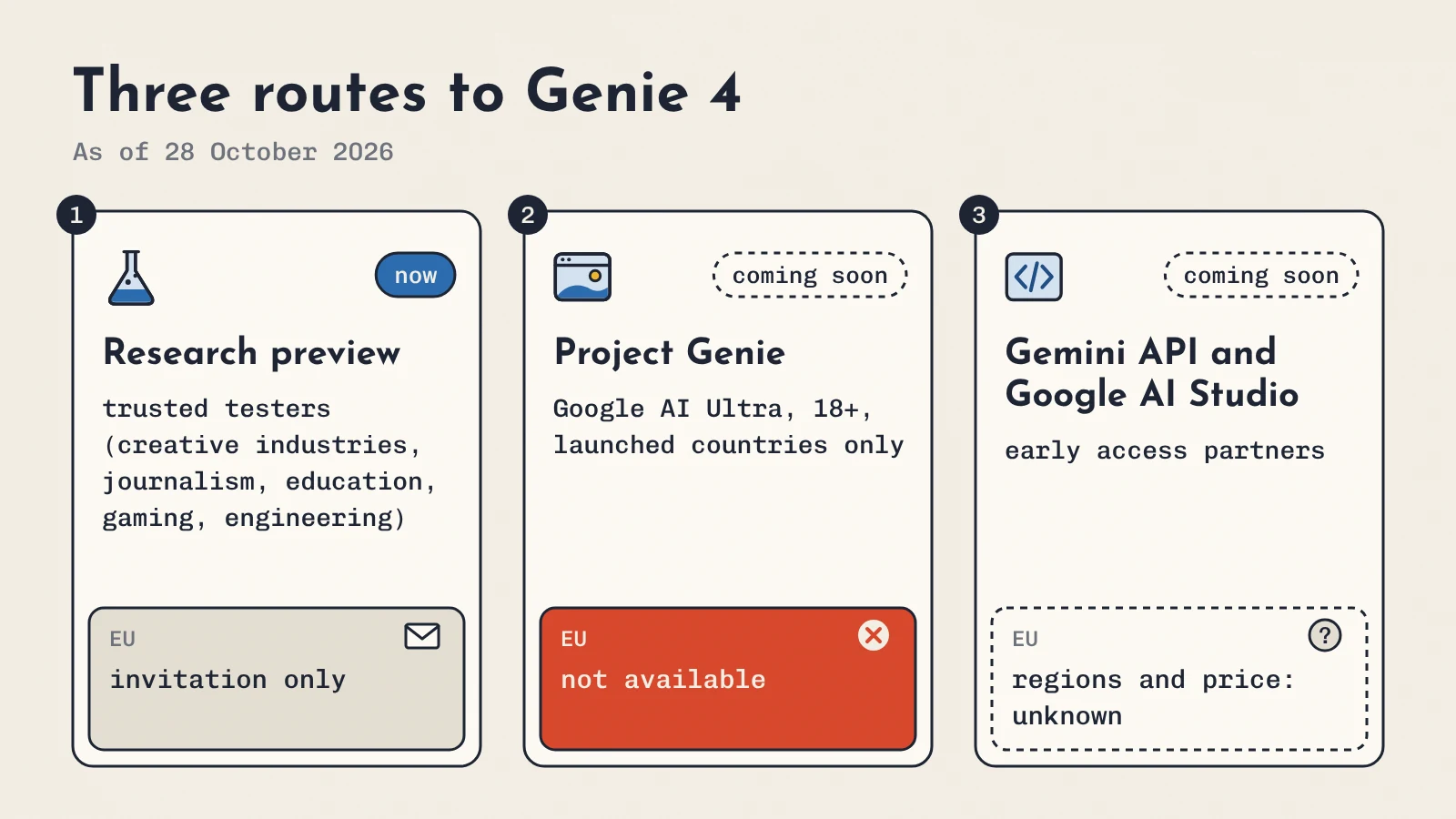
Not yet. Genie 4 is a research preview for trusted testers. Next, it goes to Google AI Ultra subscribers in Project Genie and to early access partners of the Gemini API and Google AI Studio, “coming soon” according to DeepMind.
Project Genie, the web app Google launched on 29 January 2026 with Genie 3, requires users to be 18 or older and on the top Ultra plan, which costs $200 a month in the US according to heise. According to the Google Labs FAQ, it only works in launched countries, and EU member states are not among them. Google has not said whether Genie 4 will change that. DeepMind’s waitlist is for Genie 4 in Project Genie, so it does not help EU users either. For European organisations, the only plausible route for now is early access through the Gemini API or AI Studio, for which Google has not published eligibility or regions.
Synthetic worlds and the EU AI Act
All video and audio from Genie 4 carry Google’s invisible SynthID watermark. That helps with Article 50 of the EU AI Act, which has applied since 2 August 2026. Article 50(2) requires providers of generative systems to mark synthetic audio, images, video and text in a machine-readable way, with a transition until 2 December 2026 for systems already on the market before August, as amended by the Digital Omnibus. That duty sits with Google as the provider.
Your organisation has duties of its own as a deployer. If you publish content that looks like real people, places or events and could pass as authentic, Article 50(4) requires you to disclose that it is AI-generated, with a lighter duty for evidently artistic, satirical or fictional work. Turning a real archival photo of a flood into a walkable scene is exactly that kind of content. Newsrooms, museums and marketing teams that test Genie 4 should agree on labelling rules before anything leaves the sandbox.
Two more points to settle early. Google’s Labs FAQ says it does not claim ownership of what you generate, but also that interactions may be reviewed and used to improve its models unless you switch off history. Enterprise terms for the Gemini API version are not yet known.
A crowded and consolidating market
Genie 4 lands in a market that is moving fast. Runway released GWM Worlds 2 in early September, a playable world model that streams 720p video with audio in real time. AMD announced at the end of September that it will acquire Fei-Fei Li’s World Labs for $8.2 billion in stock. According to TechCrunch, Amazon is in talks to buy Decart and Rivian acquired Third Dimension AI to bring self-driving simulation in-house. Specialised models are appearing too, such as SKY-001 for engineering teams, and Chinese labs ship open alternatives, as our overview of the most innovative AI labs in China shows.
In a May interview with heise, Jack Parker-Holder, then a research lead on Genie (he has since left DeepMind to co-found the world-model start-up Emulate), said that compared to language models “we are in 2021” and, according to heise, expected the field to consolidate around a few big players. The acquisitions suggest that is already happening. For buyers, that is a reason to avoid deep dependency on one closed simulator, the same logic we applied to language models in models are rented, context is owned.
Questions to ask before you pilot a world model
- What is the decision you want to improve? Previsualisation and ideation tolerate drift. Safety testing and robot training do not.
- Can you verify the physics? Ask for evaluations or run your own scenarios with known outcomes.
- Where does it run and where does your data go? Region, retention and whether your prompts and images train the vendor’s models.
- What do you own? Rights to generated worlds, audio and dialogue, and whether you can export anything beyond video.
- How will you label output? Article 50 disclosure rules for anything that resembles reality.
- What does a session cost? Real-time rendering in the cloud is compute-heavy, and no price has been published.
The simulator now has a director
Genie 4’s photorealism will get the headlines, but the planner is what makes it interesting for organisations. A world that a reasoning model can steer, check and correct is the first sketch of a general-purpose simulator. Until Google publishes specs, prices and evaluations, and opens access in the EU, the sensible move is to watch the Gemini API rollout, join the waitlist if you have a clear use case, and prepare your labelling and data rules now so you are ready when access arrives.