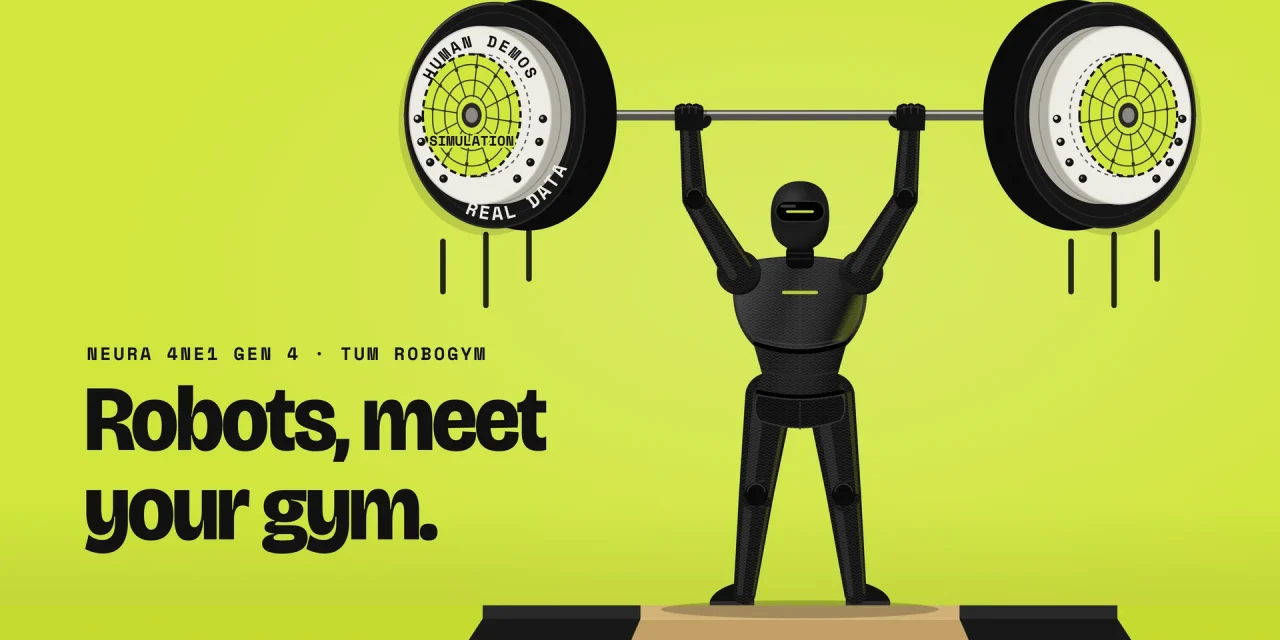
NEURA Robotics unveiled the 4NE1 Gen 4 on 22 October, a humanoid that is 180 cm tall, weighs 80 kg and wears a black textile skin instead of a hard shell. The German company says it is 20% lighter than its predecessor and is being prepared for series production. The more consequential launch happened in the same room: the TUM RoboGym near Munich Airport, where companies from more than ten industries bring their own tasks to train robots. This article covers what is new in the robot, what NEURA has not shown yet, and why the gym model matters for organisations planning their first humanoid pilots.
What NEURA launched in Munich
NEURA, founded in 2019 and based in Metzingen near Stuttgart, presented the robot at the opening of the TUM RoboGym, a training centre it built with the Technical University of Munich at the LabCampus next to the airport. The robot also appeared at NVIDIA GTC Berlin the same week.
It caps a busy month. On 14 October NEURA introduced Neuron AI, its model that adds touch, hearing and memory to robot vision. On 20 October it announced a memory partnership with NXAI in Linz. In June it raised a Series C of up to $1.4 billion led by Tether, with Amazon, NVIDIA, Qualcomm, Bosch, Schaeffler and the European Investment Bank, according to Implicator. If the full round closes, Implicator says that makes NEURA Europe’s most-funded humanoid maker.
The robot: 80 kg, a fabric skin and reflexes in every limb
Most coverage repeats the “20% lighter” line. The product page does give absolute figures, and they are worth setting next to what is still missing.
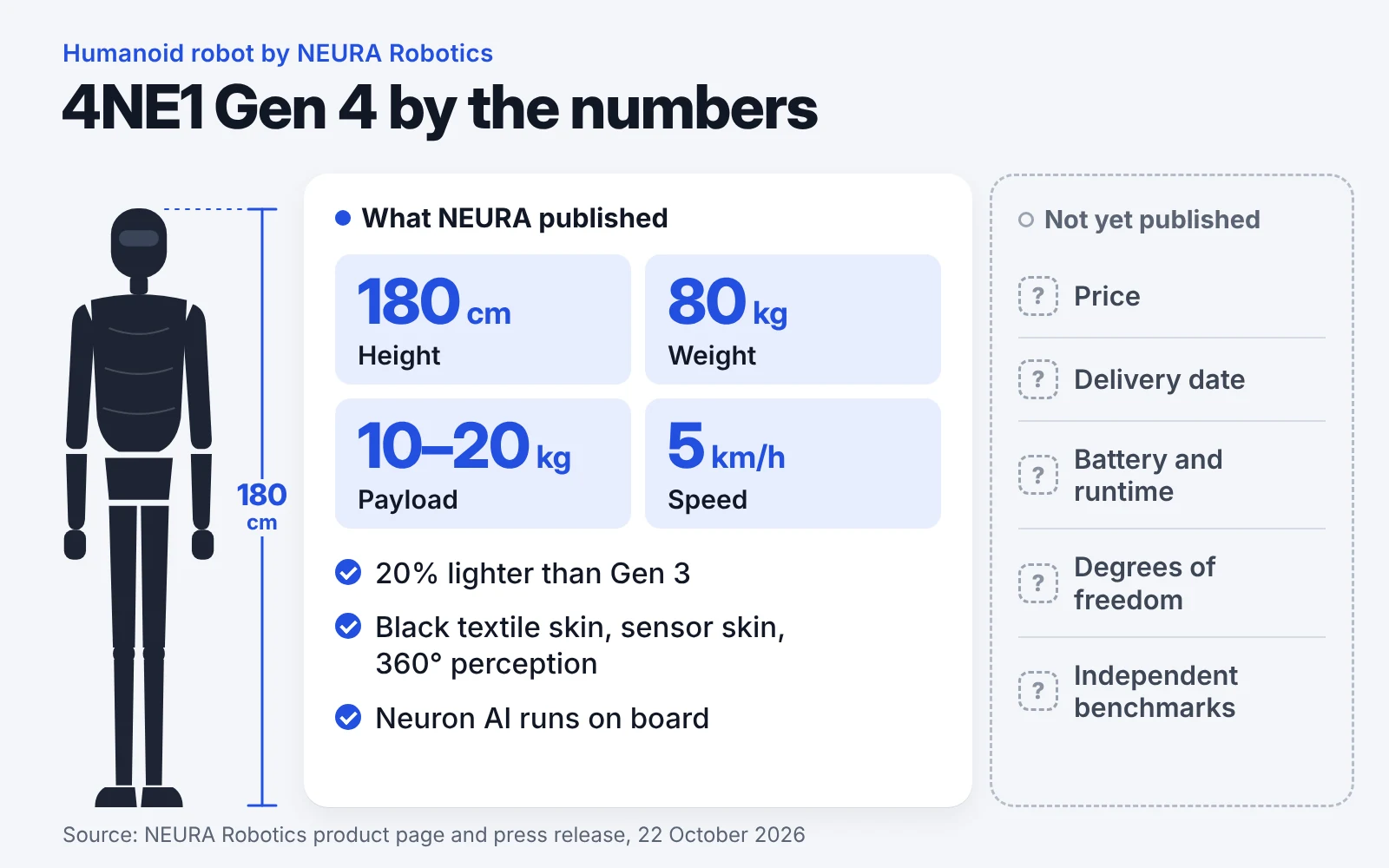
- Weight and build. 80 kg at 180 cm, with a slimmer body. Working back from the 20% claim, the previous generation weighed about 100 kg. NEURA itself has not published a figure for Gen 3.
- Textile skin. A black fabric outer layer replaces the hard casing. NEURA says it makes the robot more approachable next to people and easy to customise.
- Smart Limbs. Each limb handles its own reflexes, so an arm or leg reacts to a bump, a slipping grip or a shifting load without waiting for the central model. Tech Times reports that Qualcomm processors sit in the joints for this. NEURA has not confirmed which chips it uses.
- Hands and payload. New hands are meant to grip more precisely. The robot carries 10 to 20 kg and walks at 5 km/h.
- Variants. A wheeled version for factory floors, a version with a seventh axis for extra reach, exchangeable forearms and remote operation.
Less weight matters beyond the spec sheet. A lighter robot needs less motor torque, uses less energy and does less damage when it falls or bumps into someone. That becomes decisive once humanoids work alongside staff rather than behind a fence. The robot runs Neuron AI locally, without a cloud connection, which keeps production data on site and keeps the robot working during a network outage.
The gym is the bigger launch
A humanoid only becomes useful when it has seen enough examples of a task in real conditions. That data is scarce, and it is what the RoboGym is built to produce.
- Size. More than 2,300 m². Humanoids Daily reports about 48 training cells and roughly 100 robots. According to NEURA these are humanoids, mobile assistants and robot arms, not 100 units of the 4NE1.
- Money. About €17 million over an initial three years, of which NEURA pays about €11 million. NEURA supplies robots, compute and staff. TUM provides space and researchers.
- Who trains there. Companies from more than ten industries, including automotive, pharma, medical technology, packaging, logistics, agriculture and care, have been bringing their tasks since September. Examples include handling cardboard boxes, filling bottles and loading and unloading wooden parts.
- How robots learn. From real robot data, from human demonstrations with data suits, motion capture and teleoperation, and from simulation that generates variations.
- Sharing skills. Through the Neuraverse, a skill one robot learns can be shared with other connected robots. Companies can also keep a skill private, according to NEURA.
Munich is the first node. A second German gym is being built with RWTH Aachen, and NEURA plans more in Europe, the United States and China. Italy’s Generative Bionics is planning a 5,000 m² “Physical AI Data Factory”, but it is not due to open until the fourth quarter of 2027.
For buyers, the model changes the first step of a humanoid project. Instead of buying a few robots and training them on site, an organisation brings a task, its process knowledge and its edge cases to a shared facility and sees what the robot can do before committing capital. It also changes who holds the data. Every task trained in Munich adds to NEURA’s data lake, which is exactly the asset the company is betting on. Organisations should negotiate that point as carefully as the price of the robot.
What NEURA has not shown yet
- No price, no delivery date and no volumes. Series production is “being prepared”.
- No battery capacity or runtime. For a robot expected to cover a shift, that is a core figure.
- No degrees of freedom or hand specifications.
- No independent measurements. The weight saving and better grip are company claims, and Neuron AI has no published benchmarks or technical report. Whether the NXAI memory work runs on Gen 4 is not confirmed.
- A reminder from Computex. In June an earlier 4NE1 running a Qualcomm reference design collapsed on stage in Taipei. Qualcomm blamed a brief communication fault and said the robot followed its planned safe-collapse sequence, Tom’s Hardware reported. It was an older version, but it shows the gap between a demo and months of reliable operation.
What this means for European organisations
NEURA is selling a European alternative in a market where Chinese makers ship the most units and both US and Chinese firms command the highest valuations. On-board inference, a German developer and a training facility inside the EU will appeal to manufacturers wary of sending production data abroad. None of that replaces evidence that the robot does a task reliably. In our view on physical AI in the next decade, logistics and simple handling are the first realistic value cases, and that is where the gym’s example tasks sit too.
Before a pilot, in Munich or elsewhere, ask:
- Which of our tasks fit within a 10 to 20 kg payload and walking-speed cycle times?
- Who owns the data and the skills our tasks generate, can we keep them private, and can we take them with us?
- What is the runtime per charge and how is the battery swapped?
- How many hours of training did it take to reach a stable success rate, and what was that rate?
- Will the version we buy be compliant with the EU Machinery Regulation, which applies from 20 January 2027?
Touch and force sensing is becoming its own investment theme, as the recent $30 million round for Zurich-based Enact Intelligence shows. NEURA is betting that combining that sensing with a shared training ground gets it to useful robots faster.
Frequently asked questions about the 4NE1 Gen 4
How tall and heavy is the NEURA 4NE1 Gen 4?
NEURA lists 180 cm and 80 kg, which it says is 20% lighter than the previous generation. It carries 10 to 20 kg and walks at 5 km/h.
How much does the 4NE1 Gen 4 cost?
NEURA has not announced a price. Figures circulating on some sites are not confirmed by the company.
When can companies buy it?
There is no date. NEURA is preparing series production and lets companies work with the robot in its gyms now. Reservations are open on its website.
What is the TUM RoboGym?
A 2,300 m² training centre near Munich Airport, run by NEURA and the Technical University of Munich, where companies from more than ten industries train robots on their own tasks using real data, human demonstrations and simulation.
Losing weight was the easy part
Losing 20% of the weight and swapping a shell for fabric is an engineering problem one generation can solve. A robot that does a job every day needs thousands of hours of real tasks, failed grips and corrections. With the RoboGym, NEURA has built a machine for collecting those hours, and it is inviting European industry to feed it. The useful metric to watch over the next year is not the next demo video, but the first published success rates from tasks trained in Munich.