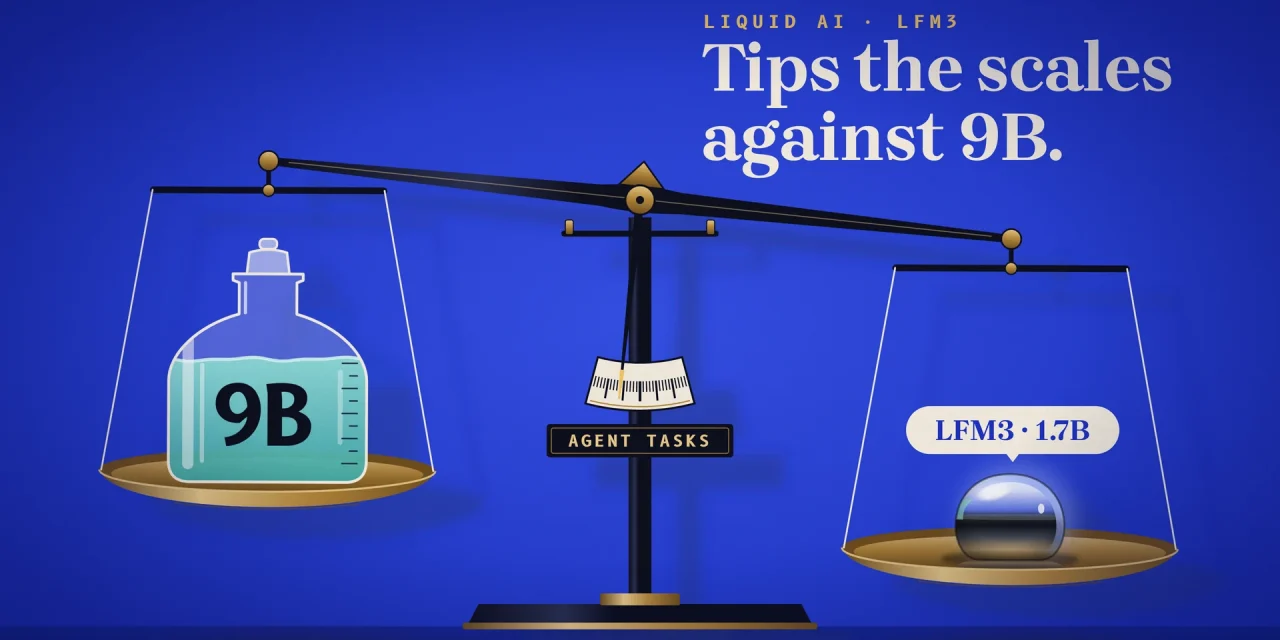
Liquid AI released LFM3 on 27 October 2026: six open-weight models of around 2 billion parameters, all built on one shared base model. The text model, LFM3-1.7B, takes about 1 GB of memory at 4-bit and, on Liquid’s own agent benchmarks, matches models five times its size. That makes local AI agents on laptops, phones and edge devices practical, with data that never leaves the device. Before European organisations build on it, three things deserve a close look: the licence stops being free at $10 million in annual revenue, the text models cover only seven of the EU’s 24 official languages, and every benchmark so far comes from Liquid itself.
What Liquid AI released
Liquid AI is an MIT CSAIL spin-off that raised $250 million in a round led by AMD in late 2024. It builds small models that run on the device rather than in the cloud. Mercedes-Benz is partnering with Liquid on an in-car voice assistant that works without the cloud, targeting first production in North America from the second half of 2026.
LFM3 is the third generation. All six models branch from LFM3-1.7B-Base, trained on 22 trillion tokens. Weights are on Hugging Face in formats for GPU servers, llama.cpp, Apple MLX and ONNX.
| Model | What it does | Context |
|---|---|---|
| LFM3-1.7B | text, agents, tool calling | 256K tokens |
| LFM3-VL-2B | reads images, video, documents and screens | 128K tokens |
| LFM3-Audio-2B | understands and produces speech | 32K tokens |
| LFM3-Omni-2B | text, images, video and audio together | 32K tokens |
| d1-2B | typed decisions on text and images | 128K tokens |
| d1-Omni-2B | typed decisions, also on audio | 128K tokens |
Why a 1 GB agent matters
Most AI agents in organisations today send every step to a cloud model. That means a cost per token, a round trip per action and, for many European teams, a data protection review for every new use case. A model that runs on the device changes all three. Once the hardware is paid for, tokens cost nothing extra. Latency drops. And the inbox, contract or customer file the agent reads stays on the laptop or server where it already lives, which makes data minimisation under the GDPR easier to show.
The architecture is what makes this possible. Of LFM3’s 24 layers, 13 are short convolutions that only look at nearby tokens, five look at a 256-token window and only six attend to the whole context. For a full 128K-token context, LFM3-1.7B needs 1.6 GB of KV cache, against 4.3 GB for Qwen3.5-4B and 5.6 GB for MiniCPM5-2B. Liquid tuned that mix by measuring on 14 device and software combinations, from a Samsung Galaxy S26 Ultra and a Raspberry Pi 5 to Qualcomm’s NPU.
Liquid’s own demonstration shows the scale this allows: it ran more than 300,000 LFM3-1.7B agents in parallel over the Enron email archive. On a single NVIDIA B300 server GPU, the model produces 3.6 billion tokens a day.
How good it is, and where it falls short
In its model card, Liquid compares LFM3-1.7B with five other small models, the strongest being Alibaba’s Qwen3.5-9B. On agent work, LFM3 leads. It scores 38.42 on WebArena-Verified, where an agent completes tasks on websites, against 28.94 for Qwen3.5-9B. On AutomationBench it is 41.29 against 15.10, and it also leads on tool calling (BFCL V4) and instruction following (IFEval). Across all 29 scores it averages 49.37 against 47.24.
One external test points the same way. Software company MacPaw ran LFM3-1.7B and Qwen3.5-2B on 65 everyday tasks on real Macs. LFM3 completed 64% against 48%, used 58% fewer tokens per task and got stuck in under 1% of attempts, against 15%.
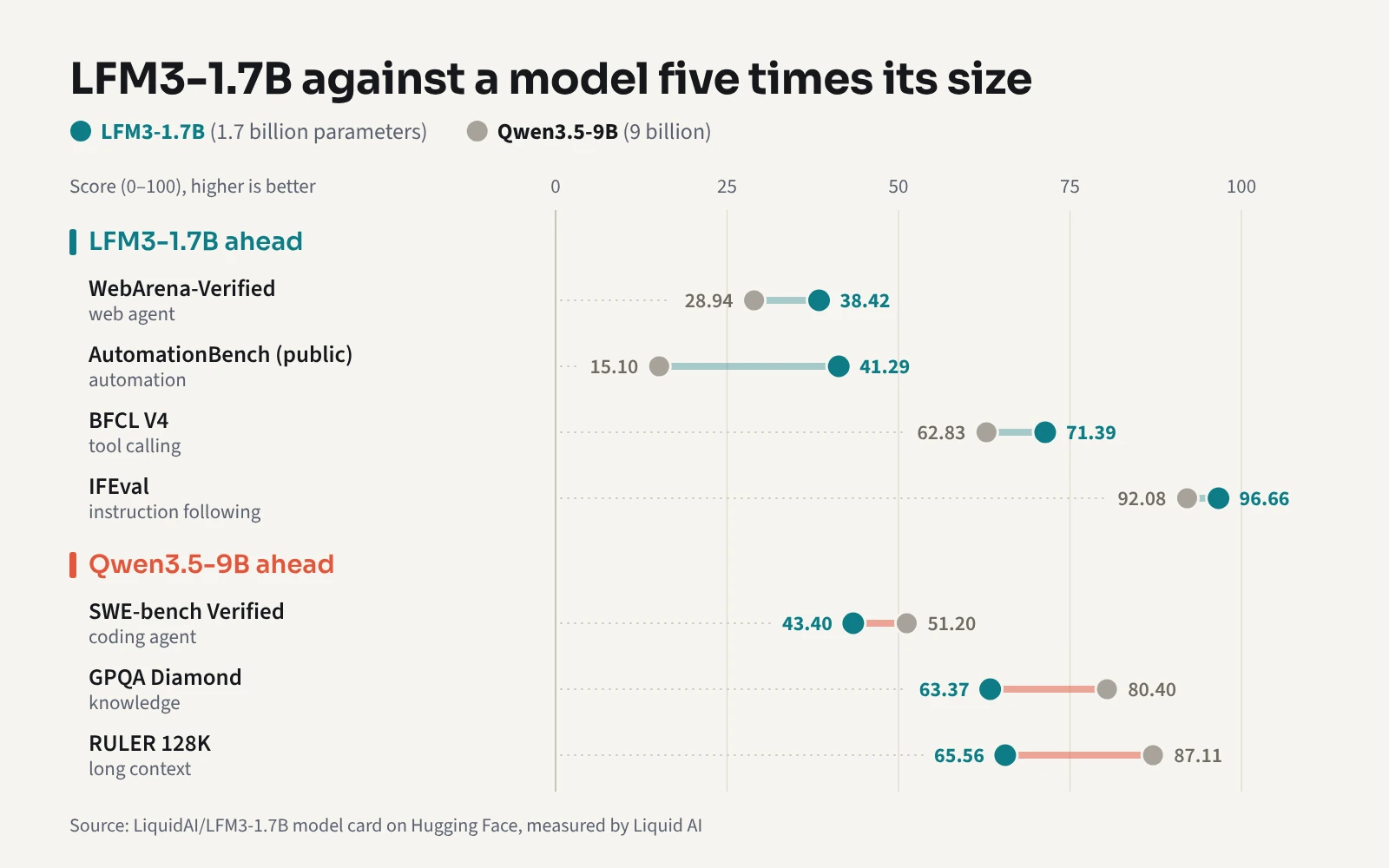
Where knowledge and deep reasoning count, the larger model wins: 80.40 against 63.37 on GPQA Diamond, 51.20 against 43.40 as a coding agent on SWE-bench Verified, and 87.11 against 65.56 on the long-context test RULER 128K. Liquid itself says the model is not meant for agentic coding or complex multi-step reasoning.
The most useful number for risk teams is a different one. On the AA-Omniscience knowledge test, LFM3-1.7B answers only 7% of questions correctly. But of the questions it does not get right, it declines rather than guesses in almost 93% of cases. Qwen3.5-9B does so in 53%. A model that declines rather than invents is a better fit for agents that look things up in your own documents, which is how Liquid wants it used.
All these figures are vendor-reported. One day after launch there are no independent benchmarks yet.
Which European languages it covers
The text model supports 16 languages. Seven are official EU languages: English, French, German, Italian, Spanish, Portuguese and Polish. The vision model, the decision models and the text side of the omni model have the same list. LFM3-Audio and LFM3-Omni go further for speech, with 18 languages that include Dutch, Swedish, Danish, Finnish and Greek.
| Language | Text | Speech (Audio, Omni) |
|---|---|---|
| English, French, German, Italian, Spanish, Portuguese, Polish | yes | yes |
| Dutch, Swedish, Danish, Finnish, Greek | no | yes |
| Other EU languages, such as Czech, Romanian, Hungarian | no | no |
Two caveats apply. “Not listed” does not mean the model cannot handle a language, only that Liquid makes no promise. And even for listed speech languages, the multilingual speech recognition benchmark in the audio model card covers nine languages and leaves out Dutch and the Nordic languages. For a Belgian, Dutch or Nordic deployment, test in your own language first. Liquid ships a notebook that teaches the model a new language from raw text, with Turkish as the example, on a single GPU.
The licence draws a line at $10 million
LFM3 is open-weight, not open source in the strict sense. The LFM Open License v1.0 is based on Apache 2.0 but adds a revenue threshold. Commercial use is free for organisations with less than $10 million in annual revenue. Above that, commercial use is not covered and you need a separate agreement with Liquid. Research and non-commercial use have no threshold, and modified models do not have to be open-sourced.
In European terms, that line sits close to the EU definition of a small enterprise, which allows up to €10 million in turnover. Medium-sized companies, which the EU counts up to €50 million, will usually need a commercial deal. That is not unusual. As with Meta’s Muse Spark Open, “open” weights increasingly come with commercial strings. Above the threshold the licence covers no commercial use at all, including internal pilots, so settle it before you start.
What the AI Act means here
The AI Act does not stop at large models. The European Commission’s guidelines, summarised here by WilmerHale, treat a model as general-purpose when it was trained with more than 1023 FLOP and can generate text. Liquid has not published LFM3’s training compute. A common rule of thumb, six times parameters times training tokens, puts it at roughly 2.3 × 10²³ FLOP, so LFM3 very likely counts as a general-purpose AI model despite its size. That is our estimate, not a figure from Liquid.
For deployers, two practical points follow. First, the provider obligations, such as technical documentation for downstream users, sit with Liquid. Because the licence requires a paid agreement above the revenue threshold, the AI Act’s lighter regime for free and open-source models may not apply, so ask Liquid for its documentation. Second, fine-tuning does not turn you into the provider unless you use more than a third of the original training compute. A few hours on one GPU, as in Liquid’s examples, stays many orders of magnitude below that line. Your obligations as a deployer depend on the use case, as with any model. This is our reading of the guidelines, not legal advice.
What to test in a 30-day pilot
| Question | How to test it |
|---|---|
| Does it handle your language? | Run 50 real tasks in each working language, including Dutch or Nordic text if relevant. |
| Does it fit your devices? | Run the GGUF or MLX version on the laptops or edge boxes you actually own, at the context length you need. |
| Does it call your tools correctly? | Connect it to two or three internal tools and log every failed or wrong call. |
| When should it hand over? | Define which cases go to a larger model, for example when confidence is low. |
| Is the licence covered? | Check your revenue against the $10 million threshold. Above it, even a pilot with a business purpose is commercial use, so talk to Liquid first. |
| Is the documentation there? | Ask Liquid for its AI Act documentation for downstream users. |
Practical tips from first users and Liquid staff on Hacker News: tell the model in the system prompt when no tools are available, because it was trained to live inside an agent harness (one user saw it reasoning about tools on a simple question, though his local server turned out to pass two tools by default). And use the single-modality models rather than Omni when you only need text, vision or speech, since each is stronger in its own domain. Liquid recommends a temperature of 0.1 for chat, tools and agents. For comparison with a larger local model, see Recursive’s Flint.
Small models as the first line, not the whole answer
LFM3 will not replace a frontier model for hard questions, and Liquid does not claim it will. Its value is as a component: the agent that sorts, extracts, classifies and routes, locally and continuously, and escalates only what it is unsure about. One developer on Hacker News already works this way, letting an LFM model label every incoming email and message and passing only low-confidence cases to a larger model. For European organisations that want AI agents without sending every document to a cloud provider, that split is the realistic architecture. It also means the context you build stays yours, whichever model sits on top, a point we made in models are rented, context is owned.
Frequently asked questions
Is LFM3 free for companies?
Yes, for organisations with less than $10 million in annual revenue and for research. Larger companies need a separate commercial licence from Liquid AI.
Can LFM3 run on a phone?
The text model takes about 1 GB of memory at 4-bit. Liquid benchmarked it on an iPhone 17 Pro with a llama.cpp-based app and used phones such as the Samsung Galaxy S26 Ultra during the architecture design.
Does LFM3 support Dutch?
LFM3-Audio and LFM3-Omni list Dutch for speech, the text models do not. French, German, Italian, Spanish, Portuguese and Polish are supported for text.
Is LFM3 a general-purpose AI model under the AI Act?
Very likely. By a common estimate its training compute is above the 1023 FLOP indicator in the Commission’s guidelines. The provider obligations sit with Liquid AI.