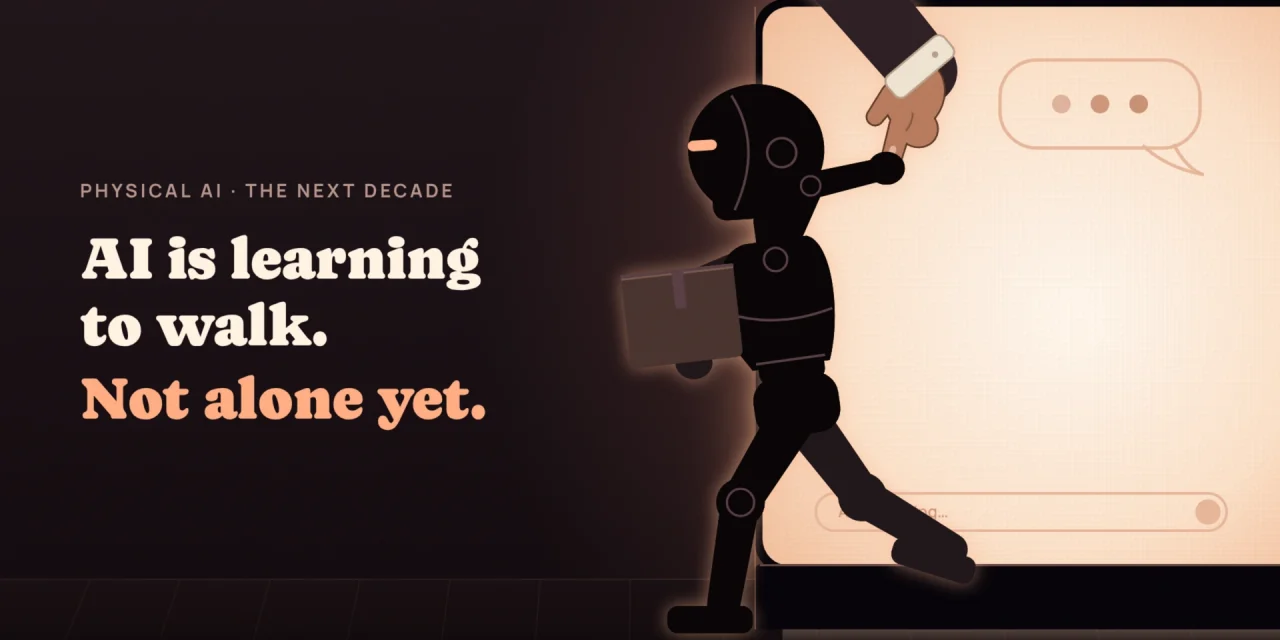
Physical AI is artificial intelligence that perceives, decides and moves in the real world, inside robot arms, warehouse robots, humanoids and self-driving cars. In 2026 it crossed from research labs onto production lines: Google DeepMind now controls a whole humanoid body with one model, Tesla says its first production-quality Optimus robots are coming off a line in Fremont, and humanoid shipments almost quadrupled in a year. Yet Google DeepMind’s newest robot model screws in a light bulb only about one time in three. For European organisations that gap is the whole story of the next ten years. Value will arrive first in structured places such as warehouses, factories and inspection, while homes and open streets come last. The rules, the supply chain and the questions to ask vendors are already taking shape. This article sets out how physical AI got here, where it really stands, and what to prepare for between now and 2036.
What physical AI means, and why it is different from a chatbot
A language model takes text in and gives text back. A physical AI system takes in camera images, touch and motion data and sends out motor commands: turn that wrist, shift that foot, brake now. It has to understand the instruction and also judge weight, distance and what happens if something slips. Three building blocks make this possible today: vision-language-action models (VLAs) that turn an image plus an instruction into movement, world models that let robots practise in simulation (see why AMI Labs is betting on world models), and enough onboard compute to react without waiting for the cloud, such as Nvidia’s Jetson Thor T3000.
The difference with software AI matters for planning. A wrong answer from a chatbot costs a correction. A wrong move from a robot can break equipment or hurt someone. That is why physical AI moves slower, faces stricter rules and needs a different kind of business case.
How physical AI got here in four steps
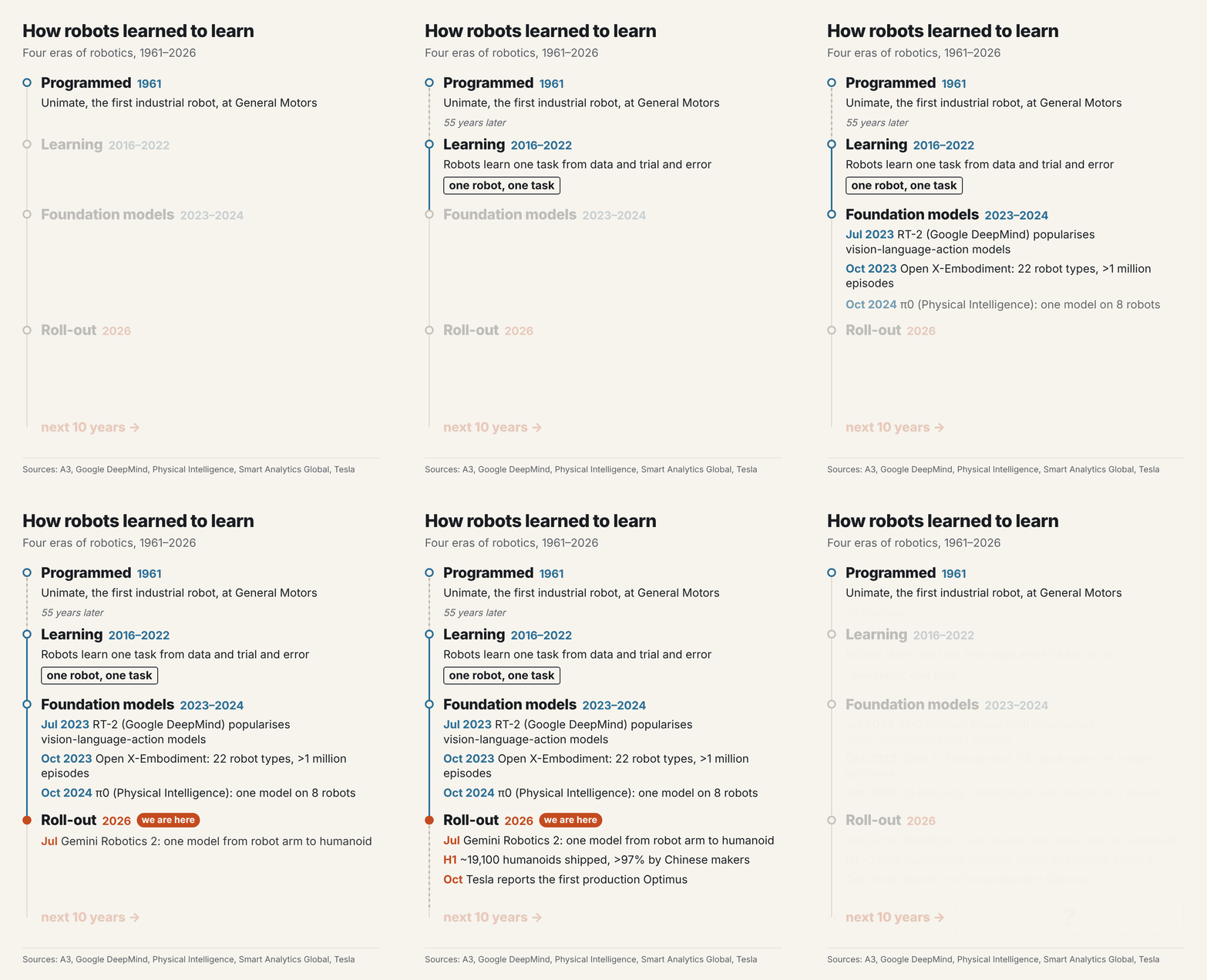
- Programmed, from 1961. Unimate, the first industrial robot, started work at General Motors. For decades robots were fast and precise as long as nothing around them changed.
- Learning, 2016 to 2022. Deep learning let robots learn single tasks from data and trial and error. One robot, one task.
- Foundation models, 2023 to 2025. Google DeepMind’s RT-2 (July 2023) popularised the vision-language-action model and lifted success on unseen situations from 32% to 62%. The Open X-Embodiment dataset pooled more than a million episodes from 22 robot types, and models trained on it did 50% better on average. π0 from Physical Intelligence (October 2024) showed one model working across eight robots.
- Roll-out, 2026. At CES Nvidia’s Jensen Huang said in a press release that “the ChatGPT moment for robotics is here”, though in his keynote he called it “nearly here”, Fortune reported. Gemini Robotics 2 (July) runs anything from a table-top arm to a full humanoid with one model. Robot makers are adding their own models, such as NEURA’s Neuron AI, which brings touch, hearing and memory to vision.
Where physical AI really stands at the end of 2026
- Classic industrial robots are mainstream. More than 600,000 were installed in 2025, up 11%, and 5 million are now in operation, according to the International Federation of Robotics.
- Humanoids are early but scaling. About 19,100 shipped worldwide in the first half of 2026, up 272% year on year, and more than 97% came from Chinese makers, led by AgiBot and Unitree, according to Smart Analytics Global. Its forecast for the full year is around 60,000 units.
- Factories are the first real workplace. Figure’s F.03 started sequencing parts and pulling carts at BMW’s Spartanburg plant in June. Tesla’s Q3 update mentions the first production-quality Optimus robots, but no volumes, price or customer date. In Europe, Hexagon placed its AEON humanoid in the “Humanoid Gym” of Schaeffler, which plans to roll out at least 1,000 humanoids, and Agile Robots says finished Agile ONE humanoids now leave its Bavarian factory every working day, Physical AI Atlas reports.
- Autonomy on wheels already works as a service. Waymo reached 500,000 paid driverless rides a week in ten US cities in March and announced testing in Munich in August.
- Capital is pouring in. About $50 billion went into physical AI across some 500 deals in the first half of 2026, Forbes reports, including secondary investments in companies such as Waymo and Anduril.
How capable are the learning robots? Google DeepMind published task-level success rates for Gemini Robotics 2 on a humanoid with five-fingered hands. They are among the most detailed public benchmarks available.
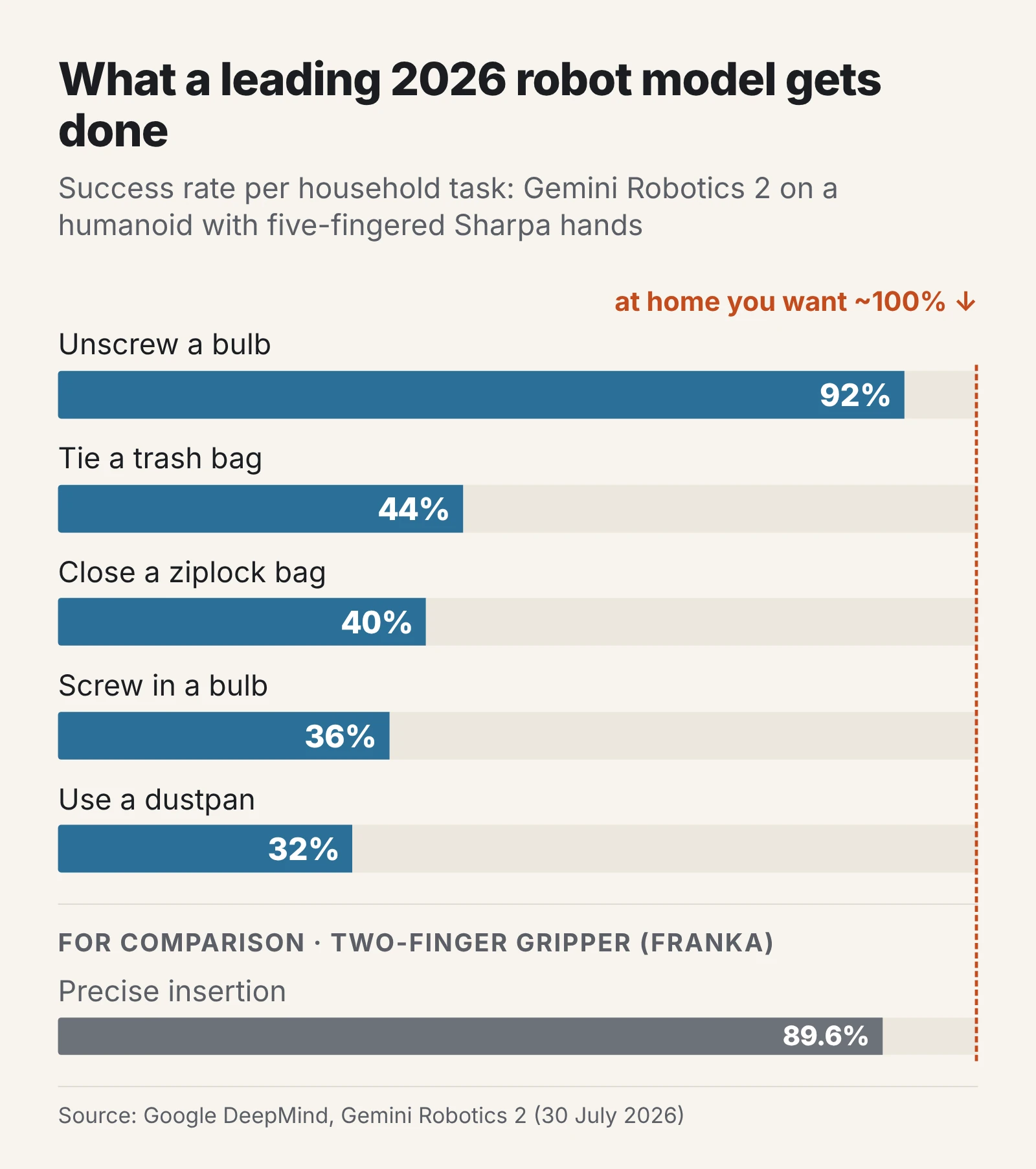
With a simpler two-finger gripper the same model reaches 89.6% on precise insertion tasks. That contrast tells you where to look first: defined tasks with defined parts in tidy environments. A 44% success rate is impressive research and unusable operations.
Why progress will be uneven
Four constraints explain why physical AI will not follow the curve of chatbots.
- Data. Language models learned from text that already existed online. Robot data, images paired with the motions a robot made, has to be collected. Ken Goldberg of UC Berkeley estimates in Science Robotics that the training data of vision-language models equals about 100,000 years of human reading time, while the largest robot dataset is about one year. Simulation, world models, human video and teleoperation are all attempts to close that gap.
- Touch. Robots barely feel what they grip. Rodney Brooks, co-founder of iRobot, told the Boston Globe that robots cannot learn touch while nobody collects touch data, and advised people waiting for household humanoids to “check back in 15 years”.
- Cost and supply. Actuators and mechanics make up about half of a humanoid’s production cost, and more than 90% of magnetic rare earths come from China, TechInformed notes.
- Hidden humans. Many impressive demos are remotely operated. An article on the site of industry association A3 argues for disclosure, noting that, as far as the author knows, no rule requires it. 1X’s NEO home robot builds remote operators into the product, with the privacy questions that come with it.
The decade ahead in three horizons
Forecasts for humanoids alone show how uncertain the pace is.
| Source | Forecast | Made |
|---|---|---|
| Goldman Sachs | About 890,000 humanoids shipped in 2030 and 6.5 million by 2035, and a market of about $138 billion | September 2026, up from 256,000 for 2030 |
| Morgan Stanley | 13 million humanoids in use by 2035, about 1 billion by 2050 | April 2025 |
| Rodney Brooks | Useful humanoids for factories, parcels and chores are about 15 years away | February 2026 |
Banks count in millions, veteran roboticists in decades. What is fairly predictable is the order in which settings open up, from structured to messy.
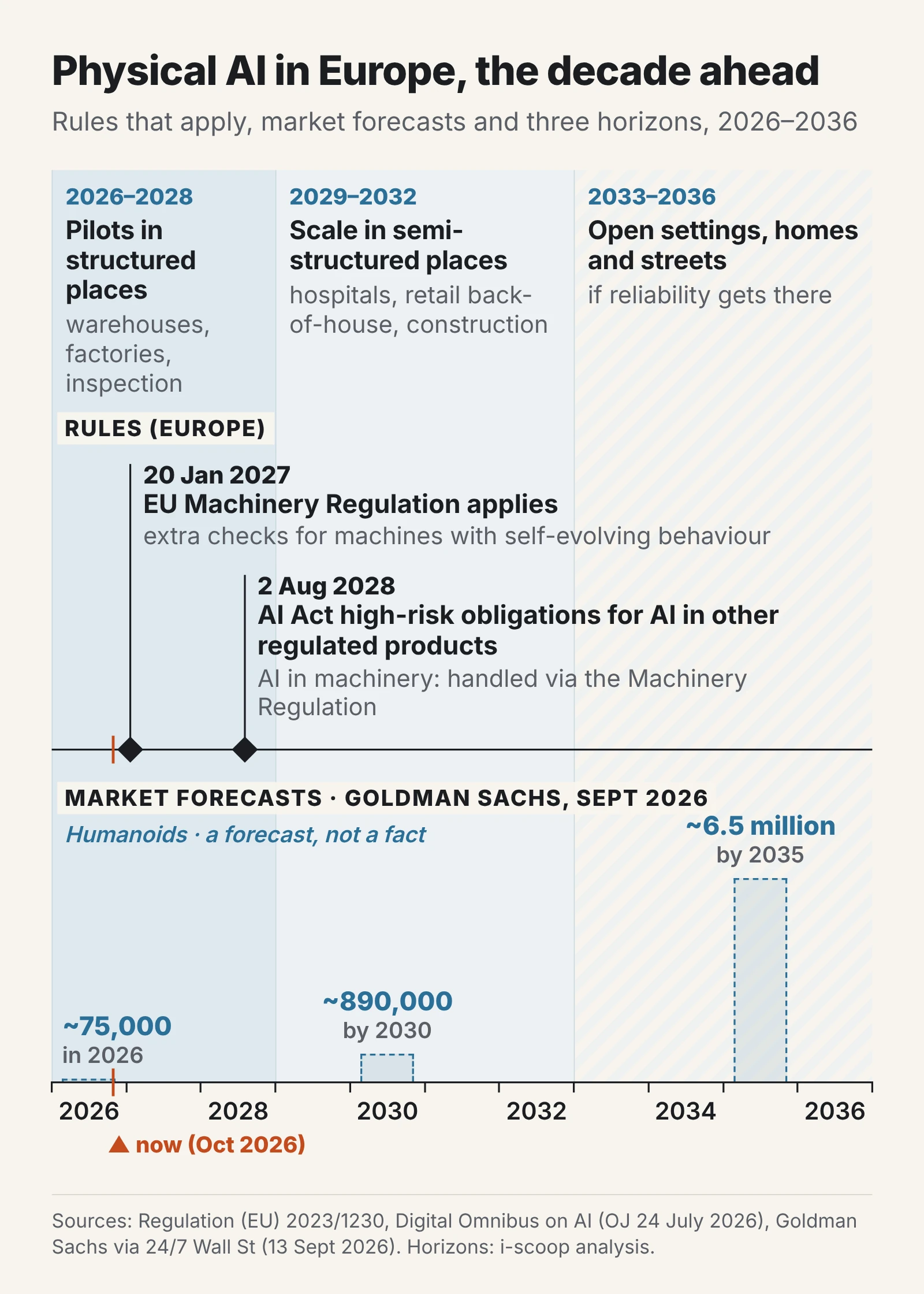
2026 to 2028, pilots in structured places
Learning robots take over bounded tasks in warehouses, factories and inspection: picking, sequencing, moving carts, checking equipment. They work beside classic automation and people, usually with a remote human who steps in when something goes wrong. Most deployments are pilots or robots-as-a-service contracts. This is the horizon in which to build skills and data, not to bet the operating model.
2029 to 2032, scale in semi-structured places
If dexterity success rates move from today’s 30 to 90% range towards 99%, robots spread to settings that are only partly predictable: hospital logistics, retail back-of-house, commercial kitchens, construction and agriculture. Price per hour of robot work becomes the deciding number, including maintenance and supervision. Europe’s rules for AI in machinery will be fully in force by then.
2033 to 2036, homes and open settings, if reliability gets there
A humanoid that folds laundry and unloads the dishwasher on its own needs the reliability of a household appliance. This is the hardest and least certain step. If it succeeds, humanoids become a consumer product category like the car. If it does not, specialised machines will keep winning, as robot vacuums and mowers already have.
The European factor
Europe enters this decade with strong industrial users, respected robot makers such as NEURA Robotics, Agile Robots and Wandercraft, and deep research, but with a clear dependency. More than 97% of humanoids shipped in the first half of 2026 were Chinese, and so are more than 90% of the magnetic rare earths their motors depend on. Recent funding shows Europe trying to build its own stack, from Enact Intelligence’s work on robot touch in Zurich to NEURA’s acquisitions in intralogistics and cleaning robots.
Policy is following. The EU’s Apply AI Strategy launches a European Robotics Catalyst and Robotics Skills Qualification Centres, and the European Innovation Council runs a 2026 challenge called Accelerating Physical AI. For organisations the strategic link is the shift towards Industry 5.0: human-centric, resilient production in which robots take the dull, dirty and dangerous work and people supervise, teach and improve the system.
The rulebook is already written
Unlike the volumes, the main European dates are fixed.
- 20 January 2027: the new EU Machinery Regulation (EU) 2023/1230 applies. Machines with self-evolving behaviour face enhanced conformity assessment, and manufacturers must document safety for future operating states, Osborne Clarke explains.
- 27 July 2026: the Digital Omnibus on AI entered into force. AI embedded in machinery is largely taken out of the AI Act’s direct high-risk rules, and the Commission can set AI-specific health and safety requirements through the Machinery Regulation instead. High-risk obligations for AI in other regulated products start on 2 August 2028, according to Lewis Silkin.
- Standards: ISO 25785-1, still in draft, will be the first international safety standard for humanoid and other actively balancing industrial robots.
- GDPR: robots with cameras and microphones, and remote operators who can see through them, process personal data. Workplace deployments need the same data protection and works council discussions as any other monitoring technology.
What to do now
| Horizon | What to do |
|---|---|
| Next 12 months | Map bounded, repetitive, physically heavy tasks with stable layouts. Run one pilot with a measurable baseline. Assign an owner for Machinery Regulation readiness before January 2027. |
| 2027 to 2028 | Build in-house skills to supervise, teach and maintain robots. Treat operational data from robots as an asset with clear ownership in contracts. Track autonomy rates, not robot counts. |
| 2029 and beyond | Redesign processes around mixed human-robot teams where the economics work. Diversify suppliers to limit dependency on a single country. |
Before you sign with a vendor, ask six questions:
- What share of task time does the robot run without human intervention, measured on site?
- When and how does a remote operator take over, from which country, and what can that person see?
- What is the all-in price per productive hour, including maintenance, supervision and downtime?
- Who owns the data the robot collects in your facility, and may the vendor use it to train models?
- Which safety standards and conformity route does the robot follow under the Machinery Regulation?
- Where do the critical components come from, and what happens to support if export rules change?
Frequently asked questions
What is the difference between physical AI and robotics?
Robotics is building machines that move. Physical AI is the software that lets those machines perceive, decide and learn instead of only replaying programmed motions.
Which industries will adopt physical AI first?
Logistics, manufacturing and inspection, because tasks are repetitive and environments are structured. Healthcare logistics, retail back-of-house, construction and agriculture are likely to follow around the end of the decade.
Does the EU AI Act apply to robots?
Since the Digital Omnibus entered into force on 27 July 2026, AI embedded in machinery is largely governed through the Machinery Regulation, which applies from 20 January 2027, rather than through the AI Act’s direct high-risk rules. GDPR still applies to any personal data the robot processes.
Should we buy humanoid robots now?
For most organisations it is too early to buy at scale. Pilots and robots-as-a-service contracts let you learn and build data without locking in hardware that will improve quickly.
How fast will humanoid robots scale?
Nobody knows. Forecasts range from millions of units by 2035 (Goldman Sachs, Morgan Stanley) to useful humanoids being about 15 years away (Rodney Brooks). Watch autonomy rates and price per hour rather than headlines.
Measure the boring number
Physical AI has arguably moved faster in three years than robotics did in the twenty before, by borrowing the recipe of language models. But the physical world cannot be scraped like the internet, and every new skill costs data that someone has to collect. The organisations that benefit most this decade will not be the ones with the most impressive demo. They will be the ones that know, for each task, how many hours a robot works before a human has to step in, and what that hour costs.