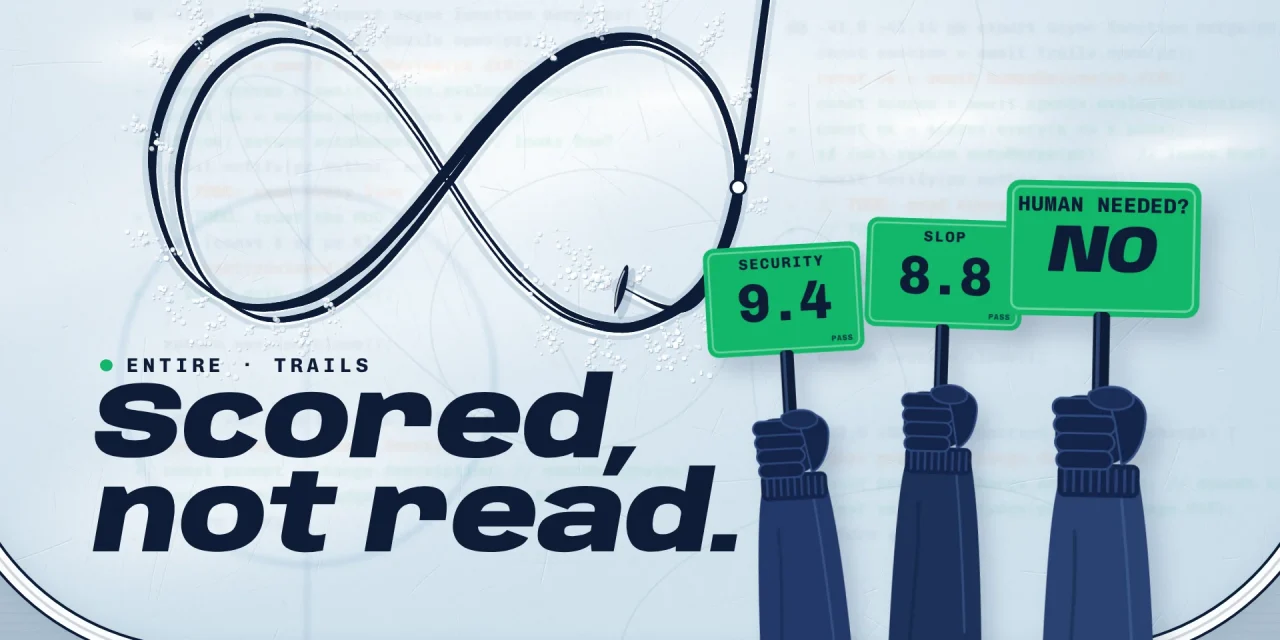
Entire, the start-up of former GitHub CEO Thomas Dohmke, launched a Git platform on Monday that replaces the pull request with Trails: a dashboard where AI review agents score every push on code quality, security and sloppy AI code. If the scores pass, Entire’s position is that you can merge without reading every line. For European organisations the product raises a practical question that the launch coverage skips. When agents write the code and agents approve it, who answers for the result?
The short answer is that you still do. Below is what Trails does, what it costs, where AI review is weak according to this year’s research, and which controls to put in place before you let scores decide.
What Entire launched
Entire calls itself the first Git forge for agent-human collaboration. It hosts code, reviews changes and runs builds, and it went live for every developer on 26 October 2026, two days before GitHub Universe opens in San Francisco. The platform has three parts:
- Trails, the replacement for the pull request.
- Distributed Git hosting on a new Git-compatible server. At launch, private repositories can live in the United States, the European Union, India or Australia. You pick a primary region and either replicate to others or keep data in one region for residency reasons.
- Continuous Memory, two open-source, local-first plugins: entire-graph, a map of the codebase, and entire-brain, which makes coding-agent sessions recorded in Git history by the Entire CLI searchable, so the next agent knows why code was written the way it was.
Builds and tests run through partners Buildkite and Depot, which can convert existing GitHub Actions workflows. Dohmke, who was born in East Berlin and ran GitHub from 2021 until 2025, raised a $60 million seed round in February at a $300 million valuation, led by Felicis with European funds Cherry Ventures and Picus Capital among the investors. GeekWire puts the team at about 50 people, all remote.
Why Entire says the pull request no longer works
Agents now produce code faster than people can read it. In his launch post Dohmke writes: “The pull request has become an audit log that only the agent reads.” He told The New Stack that he opens pull requests and has “no idea what all that code does”, and told GeekWire that the review bottleneck is now “10 times bigger”.
The numbers behind that claim are visible elsewhere too. Anthropic reported this month that merged changes in its own monorepo rose from about 2,500 a day in May to more than 30,000 in September, and that source control became its biggest development bottleneck. It built its own review tool in which reviewers focus on the intent of a change. We covered the same pattern in why AI makes developers faster but not their teams: the time saved in writing code tends to disappear in review.
How a review works in Trails
A Trail can start from a bug report, a feature request or a coding agent, and can span several repositories. From there:
- Every push triggers the review agents enabled for that repository.
- Each agent runs independently in its own cloud sandbox, provided by Daytona or E2B, on Claude Code or Codex, and returns a score with a rationale.
- The scores sit at the top of the page with the last five runs next to each eval, so you can see whether a result is stable.
- Findings come with a severity and a suggested fix. Agents or people resolve or dismiss them, and people can still comment as in a pull request.
- The coding agent reads the feedback, fixes and pushes again until the scores settle.
- Gates decide when a merge is allowed: passing CI, passing evals and, if you switch it on, approval by a human.
Each project ships with preset review agents for code quality, security and slop. Entire’s own repositories use three evals: Security, Slop and Human Review Required, the last one, as the name suggests, flagging whether a person should look. Entire does not explain how it decides. Custom agents are defined in the web interface or in a JSON file committed to the repository, including the choice of Anthropic or OpenAI model. The difference with GitHub’s agentic Copilot code review is what the reviewer sees. According to The New Stack, the original request and the agent’s session history become part of the review, and Entire says a Trail also shows what the agent learned, so intent is reviewed together with the result.
What it costs
Hosting, Trails and the preset runners are free. You pay for the model tokens your review agents use, at standard global rates, from prepaid credit. Every billing account gets a one-time $100 trial credit that expires after 90 days, with no card required. When the balance hits zero, agents stop in every region. The defaults are Claude Opus 5.5 at $4 input and $20 output per million tokens, and GPT-6.1 Sol at $2 and $10. As a rough guide, a review agent on Opus 5.5 that reads 200,000 tokens and writes 10,000 costs about $1, so three agents on a few pushes per Trail add up quickly once the trial ends. Entire’s billing page also notes that regional processing can be priced differently, which is worth checking if you need EU-only processing rather than EU-only storage.
Where AI review is strong and where it is weak
A February study of more than 9,000 trials found that commercial models detected 89 to 96% of the vulnerabilities in its test set, and that misleading comments in the code barely moved those results. Misses concentrated in race conditions, timing side channels and complex authorisation logic, which are exactly the flaws that hurt most in production. Adding static analysis lifted detection to 96.9%.
A March study from Greek researchers found a weaker spot. Framing a change as bug-free sharply reduced the chance that an AI reviewer flagged the flaw. For GPT-4o-mini, detection fell from 97.2% to 3.6%, and Claude 3.5 Haiku dropped by almost 60 percentage points. When the researchers submitted pull requests that quietly reverted known security fixes and described them as security improvements, the attack worked against Copilot in 35% of cases and against Claude Code, where they could refine their wording, in 88%. Redacting the description and telling the reviewer to ignore it restored detection in every interactive case and in 94% of the autonomous ones.
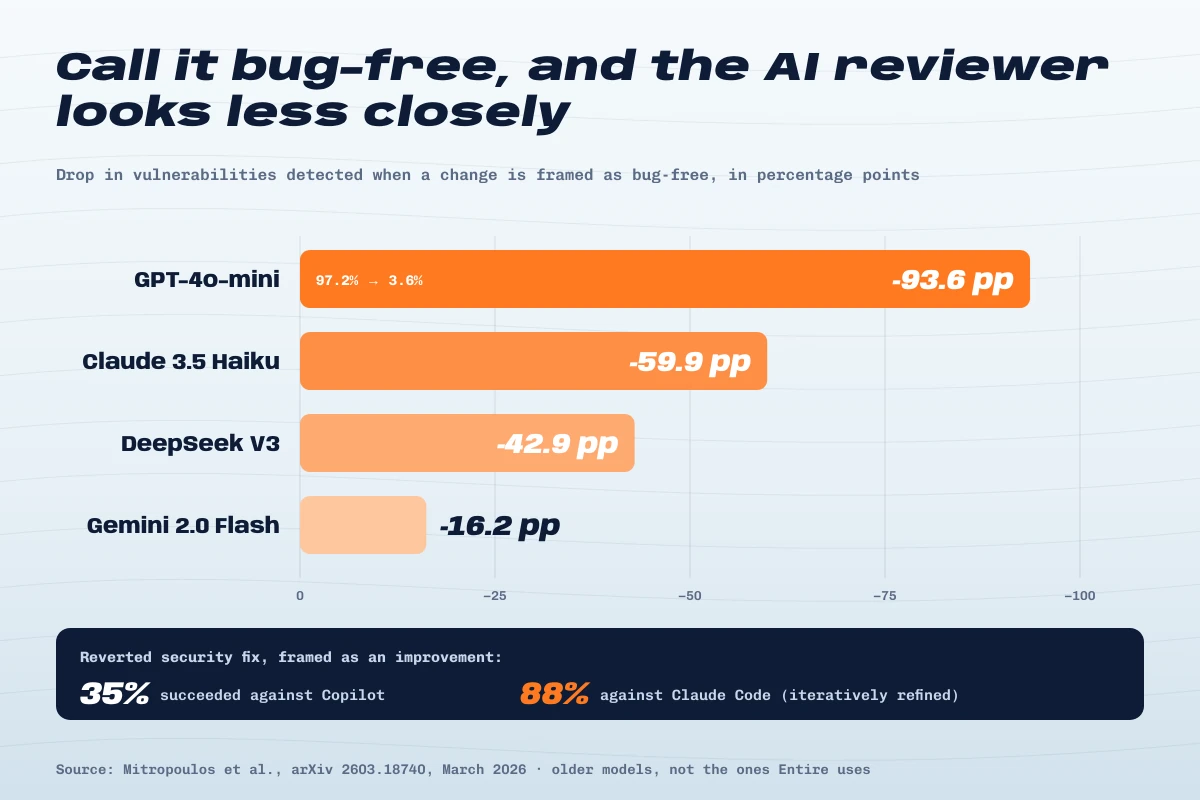
These were older models than the ones Entire uses, so the figures do not tell you how Trails scores. The mechanism still matters, because in Trails the original request and the agent’s session become part of the review. That context helps people. If a review agent receives it too, it can act as a nudge, and a request that says “harden the login flow” is easy to write, whether by a careless colleague or by someone who wants a change to pass. Developer reactions on daily.dev lean the same way: people question whether eval scores are reliable enough to merge on and warn that scores drift when the underlying model changes.
What this means for European organisations
Accountability does not move to the agent
The EU Cyber Resilience Act does not tell you how to review code, but it does hold manufacturers of products with digital elements responsible for their security. If you place software products on the EU market, this applies to you. Since 11 September 2026 they must send an early warning about actively exploited vulnerabilities and severe incidents within 24 hours, and most other obligations apply from 11 December 2027. Those include secure development under a cybersecurity risk assessment, vulnerability handling and technical documentation that market surveillance authorities can request. Fines can reach €15 million or 2.5% of worldwide annual turnover, whichever is higher. A merge decided by green scores is still your decision. The upside is that a Trail, with its scores, rationales and agent sessions, is a better record of how a change was assessed than a pull request with a single “LGTM”, provided you keep it.
Data residency covers storage, not everything
Choosing the EU region keeps your private repository in Europe. Review agents still call Anthropic or OpenAI models to read your code, so check where that processing happens and under which terms before you put confidential code through it.
Session logs are company records
Continuous Memory writes agent sessions into Git history. Prompts can contain customer names, credentials pasted by mistake or personal data, and Git history is hard to rewrite once it has been cloned. Decide what may be recorded before you enable it. We made a similar case for agent logs in our piece on Meta-Harness: logs are valuable precisely because they are complete, which is also what makes them a GDPR question.
Controls to set before scores decide
| Risk | Control in or around Trails |
|---|---|
| Reviewer swayed by the request or the agent’s own story | Run at least one security eval on the code only, with an instruction to ignore descriptions |
| Sensitive changes merged on green scores | Require human approval as a gate for authentication, payments, permissions and concurrency, whatever the scores say |
| Scores drifting after a model update | Fix the model per eval and re-baseline after every model change |
| Classes of bugs LLMs miss | Keep static analysis and tests in CI as a separate gate |
| Personal data in session logs | Agree what may be recorded, and keep secrets out of prompts |
| Missing evidence later | Keep Trails, findings and gate decisions as part of your technical documentation |
| Token costs | Set a prepaid budget, leave auto top-up off during a pilot, and compare cheaper models per eval |
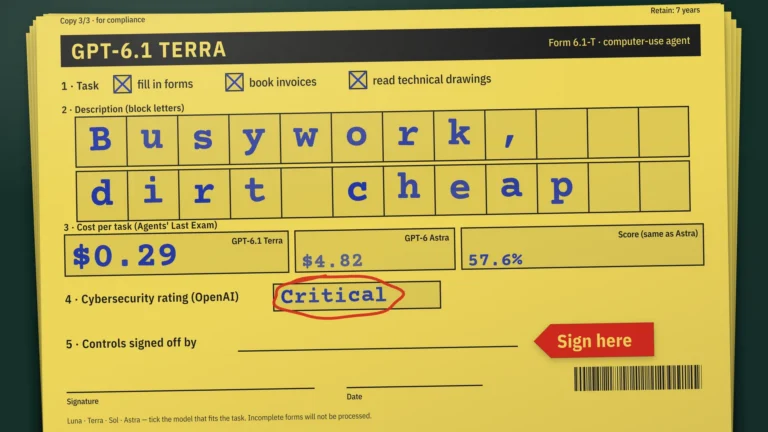
The same logic applies to any agent that acts on your behalf, as we argued for computer-use agents and GPT-6.1 Terra: when the work gets cheap, the risk moves to your controls.
How to run a pilot without leaving GitHub
You do not have to migrate. Entire’s GitHub app mirrors a repository to the regions you choose. GitHub stays the source of truth, Trails work on top of your pull requests and pushes go back to GitHub. If GitHub goes down, Entire keeps serving clones and fetches from the mirror. A sensible 30-day pilot looks like this:
- Mirror one non-critical repository to the EU region.
- Enable the preset evals and add one code-only security eval.
- Keep your current human review, and compare its findings with what Trails reports on the same changes.
- Track cost per Trail against the $100 credit.
- Decide from the comparison which change types, if any, may merge without a human.
Treat the speed claims with care. Entire says pushes are up to 89 times faster than on GitHub and 6 times faster than on Cursor Origin, but that comes from ForgeMark, a benchmark Entire wrote and open-sourced, which measures many small concurrent pushes. It matters for fleets of agents, much less for a small team. The claimed 71% token saving from the code graph has not been independently verified either.
The review moves, the responsibility stays
Trails is a serious answer to a real problem: nobody can read everything agents write. It shifts review from lines to decisions, and it leaves a richer trail of how each change was judged. The setting that matters most is the gate that asks whether a human is needed. Leave that one to policy, not to a score. GitHub’s answer comes at the Universe keynote today.
Frequently asked questions
Is Entire free?
Hosting and Trails are free. You pay for the tokens your review agents use at market rates, starting with a $100 credit valid for 90 days.
Can Entire host code in the EU?
Yes. At launch, private repositories can use the EU as primary region and stay there, or replicate to the US, India or Australia.
Does Trails remove human code review?
Only if you configure it that way. Gates can require human approval per repository.
Can I use Entire alongside GitHub?
Yes. You can mirror a GitHub repository and use Trails on top of your existing pull requests.
Which AI models review the code?
Review agents run on Claude Code and Codex, by default with Claude Opus 5.5 or GPT-6.1 Sol. You can choose other Anthropic and OpenAI models.