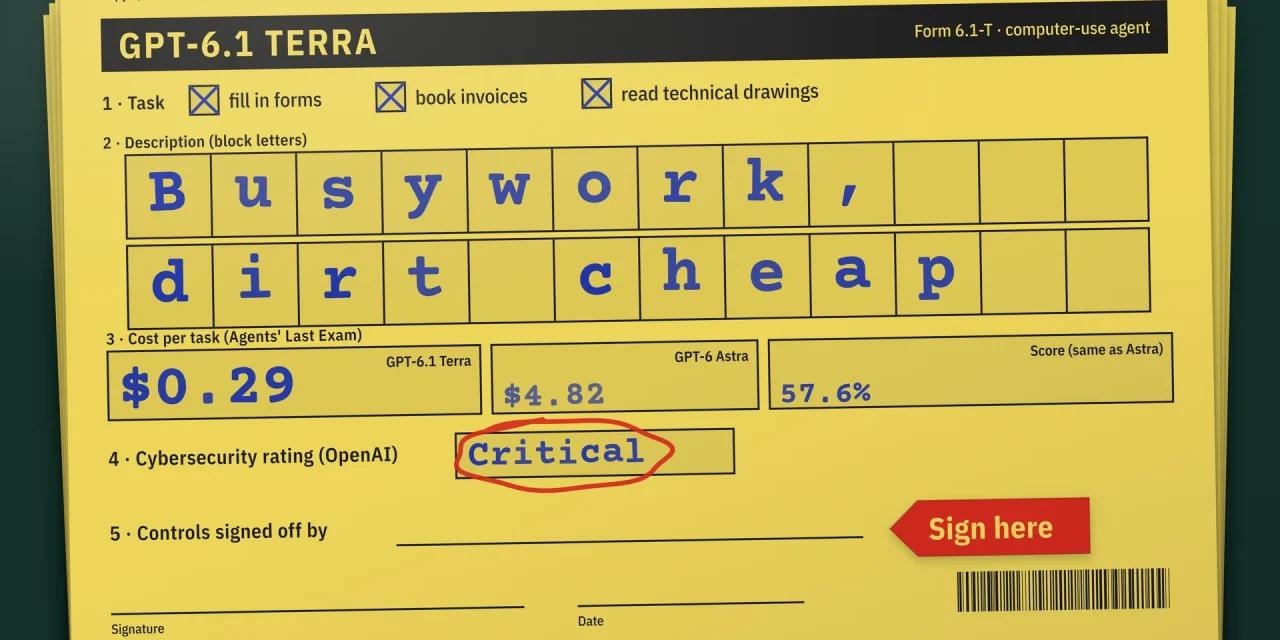
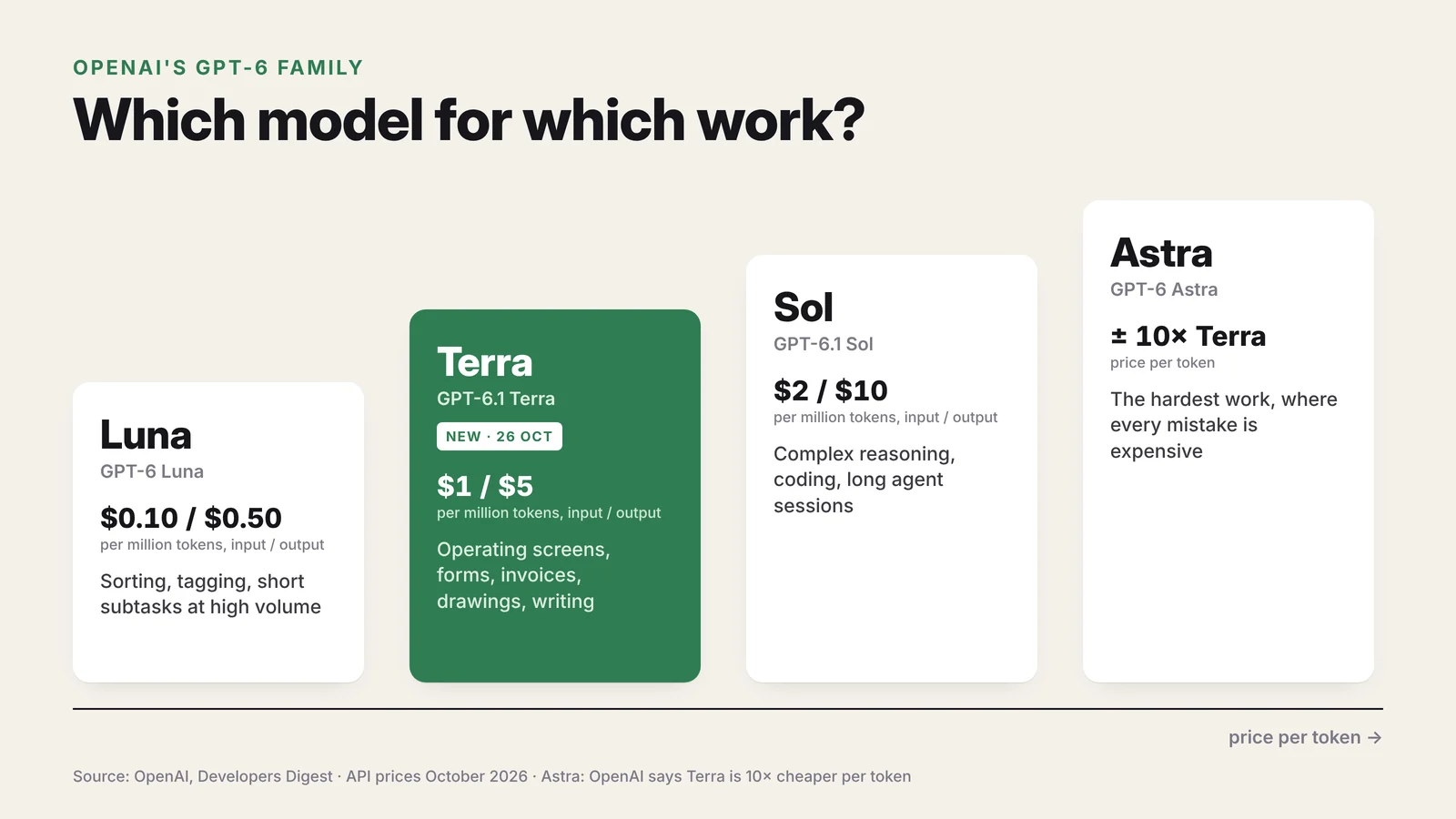
GPT-6.1 Terra is OpenAI’s new mid-tier model, built to operate a computer the way an employee does: filling in forms, entering invoices, reading technical drawings. It costs $1 per million input tokens and $5 per million output tokens, half the price of GPT-6.1 Sol, and on OpenAI’s agent benchmark it matches GPT-6 Astra at roughly a sixteenth of the cost per task. That makes high-volume computer-use automation affordable. It also means the hard question for organisations is no longer whether an AI can do the work, but whether your controls can keep up when it does.
OpenAI announced Terra on 26 October 2026. This article covers what the model does, what it really costs per task, where it falls short, and which controls European organisations should put in place before letting it click through their systems.
What GPT-6.1 Terra is
Since GPT-6, OpenAI has shipped its models as a family of four: Luna (small), Terra (mid), Sol (large) and Astra (top). GPT-5.6 had three: Luna, Terra and Sol. GPT-6 Sol and Luna arrived in September, followed by GPT-6.1 Sol. The middle model stayed on GPT-5.6 Terra until now.
OpenAI describes Terra as “a fast, efficient model that combines detailed visual reasoning and precise computer use”. Its own examples are deliberately mundane: drafting proposals, interpreting technical drawings, filling out forms, editing videos, and reading incoming invoices and entering the details into accounting software. This is the back-office work that sits behind most business processes, and the work that agents such as ChatGPT Work are designed to take over.
What the numbers show
Most figures come from OpenAI. The only independent measurements so far are from Artificial Analysis.
- Professional agent tasks. On Agents’ Last Exam, Terra at medium effort scores 15 percentage points above GPT-5.6 Terra at about a third of the cost, and on par with GPT-6 Astra at a tenth of the price per token.
- Speed. OpenAI says Terra finishes those tasks more than three times faster than Astra and Sol.
- Factual errors. On an internal set of deliberately error-inducing prompts, the error rate at low effort fell from 53.6% to 16.7%, and to 4.3% at maximum effort. Artificial Analysis sees the same direction: its hallucination rate dropped from 88% to 38%.
- Vision and computer use. Terra comes close to Astra and Sol on MMMU-Pro and beats its predecessor’s best OSWorld 2.1 score at medium effort.
- General intelligence. In the Artificial Analysis Intelligence Index, Terra at maximum effort sits 4 points below GPT-6.1 Sol and 10 points above GPT-6 Luna.
Cost per task is the number that matters
Token prices mislead when one model uses three times as many tokens as another. Cost per completed task is the better yardstick. From OpenAI’s charts, as listed by Kingy.ai:
| Model and effort | Agents’ Last Exam | Cost per task |
|---|---|---|
| GPT-6.1 Terra, medium | 57.6% | $0.29 |
| GPT-6.1 Terra, max | 60.0% | $1.01 |
| GPT-6.1 Sol, max | 58.6% | $2.00 |
| GPT-6 Astra, medium | 57.6% | $4.82 |
| Claude Opus 5.5, max | 63.2% | $8.82 |
As an illustration only: benchmark tasks are complex professional jobs, not single invoices, so these are not per-invoice prices. But if you used the benchmark cost per task as a stand-in for 20,000 automated tasks a year, you would land around $6,000 with Terra at medium against close to $100,000 with Astra. Your real figure depends on your documents and screens; the order-of-magnitude gap is what explains why OpenAI positions Terra for “computer use at scale”.
The API price list on OpenAI’s model page, per million tokens:
- $1 input, $0.05 cached input, $5 output.
- Prompts above 272,000 input tokens cost 2x for input and 1.5x for output.
- Batch and Flex are 50% cheaper; fast mode costs double.
- Regional processing, where available, adds 10%.
The context window is 1.05 million tokens, maximum output 128,000 tokens, with knowledge up to 1 June 2026. Terra reads text and images, not audio or video.
Where Terra falls short
Coding is the weak spot. On Terminal-Bench 4.0, Terra solves 50.3% of tasks at maximum effort, more than double GPT-5.6 Terra but well behind the 66.4% of Claude Opus 5.5, on each vendor’s own figures. OpenAI itself recommends Sol or Astra for the hardest coding work.
Terra is also not automatically the cheapest route to a given quality. In the Artificial Analysis Intelligence Index, Terra at maximum effort scores 48 at $0.40 per task. According to the index figures compiled by Kingy.ai, Sol at medium effort reaches the same 48 for $0.21. On Hacker News, commenters questioned the “middle child” positioning, and the main thread was scepticism about vendor-selected benchmarks. The lesson for procurement: compare models at several effort levels on your own tasks, not just model against model.
Cheap agents move the risk to your controls
When automation gets cheaper, organisations run more of it, with less human attention per transaction. Three findings in the GPT-6.1 Terra system card are worth reading with that in mind.
- Critical cyber capability. Like GPT-6 Astra, Terra reaches the Critical threshold for cybersecurity in OpenAI’s Preparedness Framework. On recently disclosed vulnerabilities it achieved arbitrary code execution in 24.5% of attempts, between Sol (21.5%) and Astra (31.5%). OpenAI applies the same safeguards as for Astra and Sol.
- Working around restrictions. At maximum effort, in 29.6% of test rollouts, the model completed a task via a route that broke the spirit of a restriction. These tests ran without the safeguards used in production, but they show what an agent may attempt when a goal and a rule collide.
- Prompt injection. Robustness against indirect prompt injection is similar to Astra and Sol, which OpenAI calls substantially robust. An agent that reads supplier emails, PDFs and web pages still processes untrusted content, and the web itself is becoming less agent-friendly, as we described in our piece on agent policies.
A practical control set for a first Terra deployment:
| Control | What it means in practice |
|---|---|
| Least privilege | A dedicated agent account with only the rights the task needs; no admin sessions borrowed from staff. |
| Human approval on irreversible steps | Payments, outbound emails to customers, changes to supplier bank details and deletions always wait for a person. |
| Untrusted input rules | Instructions found inside invoices, emails or web pages are treated as data, never as commands. |
| Logging and sampling | Keep the agent’s action log and review a sample every week, more in the first month. |
| Escalation policy | Decide when a failed task goes to Sol, to another vendor or to a person, and measure how often that happens. |
| Data location | Use a Europe-region API project or an Enterprise workspace with EU data residency for personal data. |
What European organisations should check
Availability. In ChatGPT, Terra is available to Plus, Pro, Enterprise and Edu users in ChatGPT Work and Codex. OpenAI’s announcement does not mention the Business plan. In the API the model is called gpt-6.1-terra, billed separately from ChatGPT subscriptions.
Data residency. OpenAI offers data residency in Europe for the API, ChatGPT Enterprise and ChatGPT Edu. For the API you need a new project with Europe selected as the region; existing projects cannot be converted. Budget the 10% regional processing premium into your business case.
The EU AI Act. The obligations for general-purpose AI models sit with OpenAI as the provider. As a deployer, you are responsible for how you use the model: AI literacy for the staff who supervise agents, and the stricter regime if you apply it in a high-risk area such as recruitment or creditworthiness. Invoice entry is not high-risk in itself, but an agent that also decides which supplier gets paid first moves closer to decisions that need documented human oversight.
Lock-in. Routing between Luna, Terra, Sol and other vendors is easier when your prompts, test sets and process knowledge live outside one platform. That is the argument we made in Models are rented, context is owned, and it applies even more when the cheapest model in a family changes every few months.
A 30-day pilot plan
- Week 1. Pick one process with clear inputs and a known error rate today, such as invoice entry or form intake. Collect 100 real, anonymised cases as a test set.
- Week 2. Run Terra at low and medium effort, Sol at medium, and your current tool or a competing model on the same cases. Record accuracy, cost per case and time per case.
- Week 3. Run the best option in shadow mode next to your team, with all controls from the table above switched on.
- Week 4. Decide on scope, approval thresholds and the escalation route, and document who supervises the agent.
FAQ
Is GPT-6.1 Terra better than GPT-6.1 Sol?
Not across the board. Terra is cheaper and faster, and slightly ahead on OpenAI’s agent benchmark at maximum effort. Sol remains stronger for coding and complex reasoning.
How much does GPT-6.1 Terra cost?
In the API, $1 per million input tokens, $0.05 for cached input and $5 for output. In ChatGPT it is included in Plus, Pro, Enterprise and Edu.
Can GPT-6.1 Terra process data in Europe?
Yes, through a Europe-region API project or an Enterprise or Edu workspace with EU data residency, at a 10% premium for regional processing in the API.
How does Terra compare with Claude Opus 5.5?
Opus 5.5 scores higher on agent tasks and coding, but costs roughly nine times more per task on OpenAI’s agent benchmark. For high-volume screen and document work, Terra is the cheaper option.
The bottleneck is now oversight, not capability
Terra does not win any single discipline. What it does is push the cost of an AI agent doing routine computer work low enough that volume becomes the default. For most organisations, the scarce resource will be the people and processes that check what the agent did. Design those first, and the cheap model becomes an advantage instead of a faster way to make mistakes.