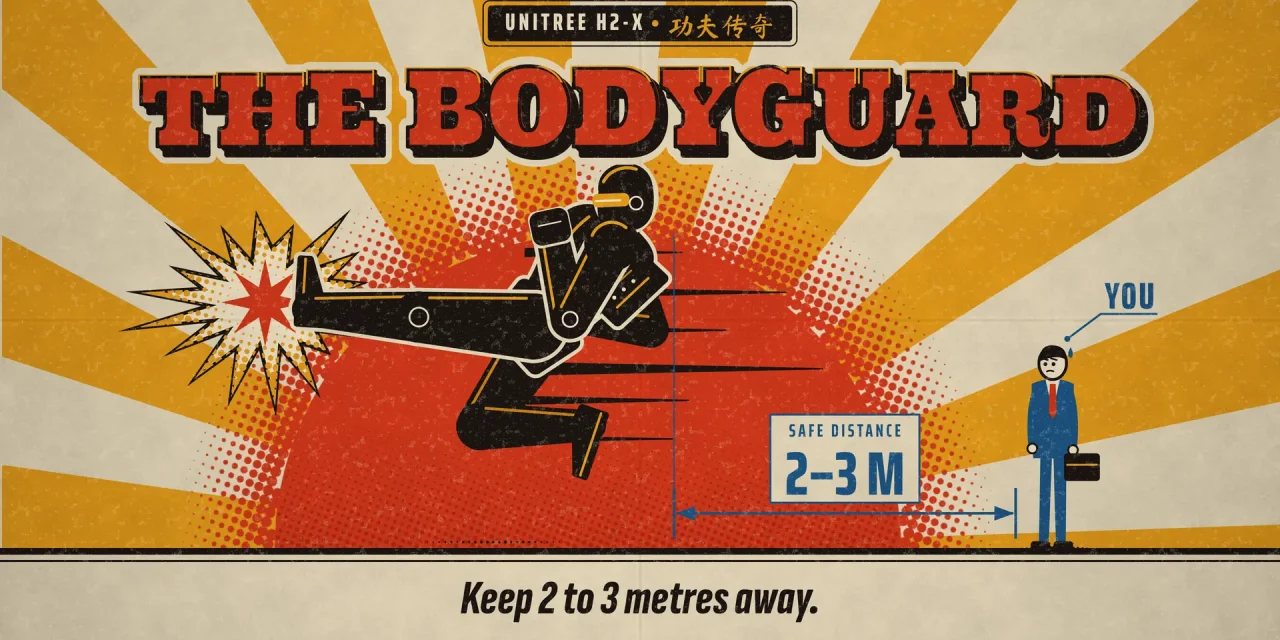
The Unitree H2-X is a 1.8-metre humanoid robot that Unitree unveiled on 21 October 2026 as the “Kung Fu Legend Guardian”, pitched for patrol, personal protection and rescue. The launch is a cinematic video of flying kicks, a four-metre drop and a car being lifted. It comes with no price, no datasheet, no availability date and no statement on whether the robot acted on its own. For anyone in Europe looking at security or rescue robotics, the H2-X is best read as a capability trailer, not as a product you could deploy. Updated on 27 October 2026: a week after the launch, none of those gaps has been filled.
What Unitree actually announced
Unitree posted a video of roughly one minute on X, promising “powerful performance to serve and guard you”. In a scrapyard at night, the robot dents doors and bonnets with knees and fists, performs spinning kicks and backflips, and jumps from a platform marked four metres high, rolling as it lands. Unitree says the footage is not sped up, according to TechEBlog.
Three staged scenes follow: the H2-X steps between a woman and an armed intruder, pushes a pedestrian away from an oncoming car, and raises the front of a car so a dummy can be pulled free. Interesting Engineering describes the intruder’s weapon as a stick and notes that props were used in the rescue scenes. The South China Morning Post calls it a knife and reads the video as a shift towards practical uses for Unitree’s athletic robots. TechRadar calls it more of a tech demo than a consumer product showcase and doubts it will go on general sale.
What is known, and what belongs to the H2
Most specifications quoted for the H2-X are those of the standard H2, from which Unitree says it is derived. No separate H2-X datasheet exists. As of 27 October 2026:
| Item | H2 (official datasheet) | H2-X |
|---|---|---|
| Height and weight | 1.82 m, about 70 kg | not disclosed, part of the 1.8 m H2 line |
| Joint torque, legs and arms | 360 Nm and 120 Nm | not disclosed |
| Arm payload | about 15 kg peak, 7 kg rated | not disclosed |
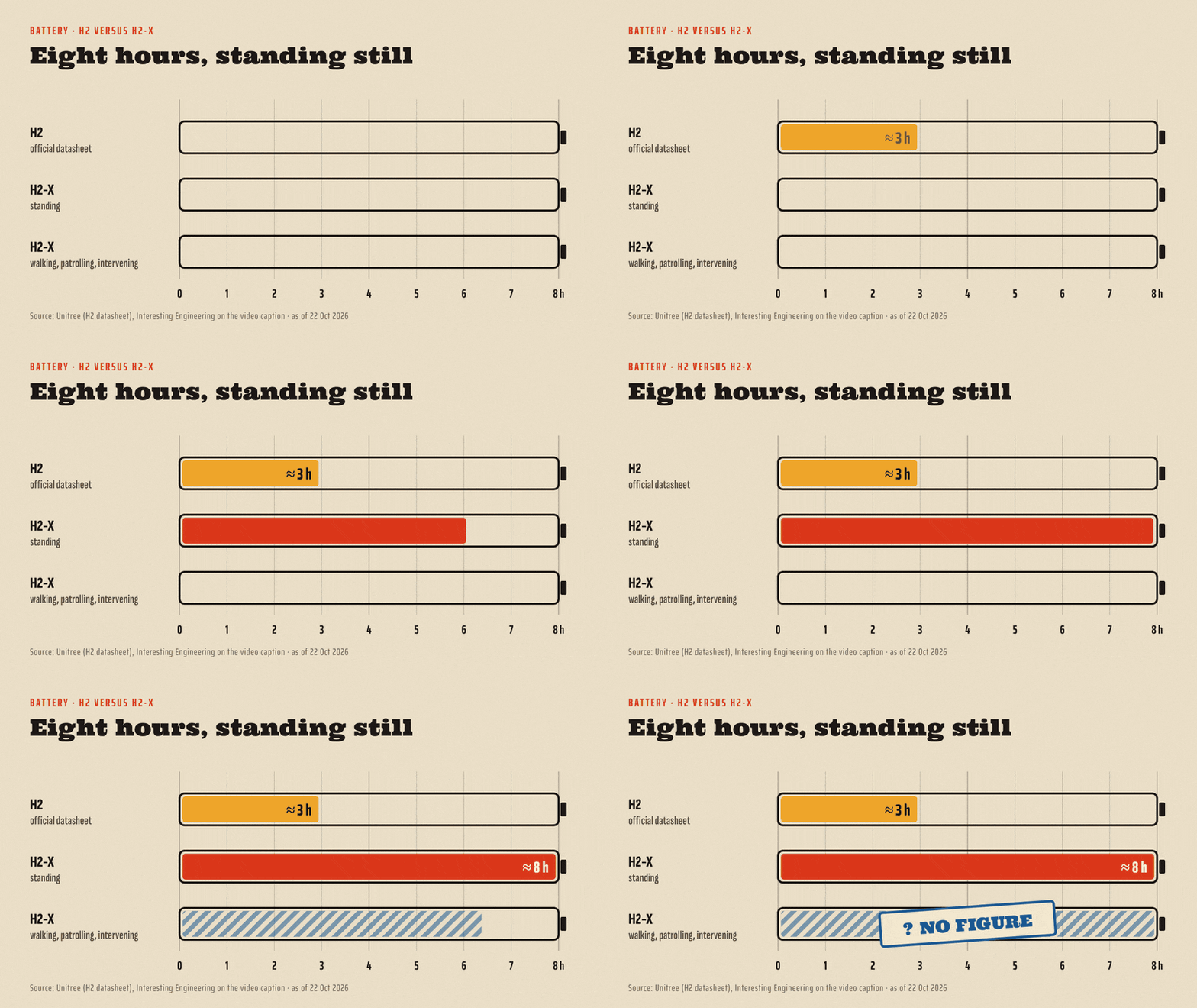
| Battery | 15 Ah, 0.972 kWh, about 3 hours | “about 8 hours”, standing time according to the video caption |
| Price | $29,900 excluding tax and shipping | not disclosed by Unitree |
| Autonomy in the demo | n/a | not stated: autonomous, teleoperated or pre-scripted |
The H2 figures come from Unitree’s product page. The eight-hour claim is the only new number, and it refers to standing, as Interesting Engineering reports. For a guard that mostly waits and must then act at full power, that leaves the important figure open: how long it lasts while patrolling or intervening.
Movement capability is not task capability
Nobody disputes the hardware. A full-size humanoid that absorbs a four-metre jump and keeps its balance shows how far Unitree’s actuators, joints and whole-body control have come. But a bodyguard is defined by judgement, not by kicks. It has to recognise a threat, distinguish an attacker from a friend grabbing your shoulder, and respond proportionately, for hours, around people who move unpredictably.
The video shows none of that being decided by the robot. Gadget Review points out that remote control or choreography cannot be ruled out, and a Chinese tech blogger on Weibo describes the demo as a preset programme, adding that the hardware is ready and the software has to catch up. There are no success rates, no failure rates and no third-party tests.
Then there is Unitree’s own safety advice, repeated at launch: use the robot in a friendly and safe manner and keep two to three metres away. The H2 product page says the same in general terms, warning that the robot has a complex structure and powerful force. A protector you must keep at a distance is a contradiction that only a demo can carry.
Why Europe matters more for a new Unitree model
Since 28 July 2026, new foreign-made humanoid robots can no longer get the equipment authorisation they need to be imported or sold in the United States. The Federal Communications Commission added them to its Covered List, PBS reported. Unitree had its H2 authorised at the end of June, just before the rule took effect, according to Tech-ish, which also cites the IPO prospectus putting the US at 13.3% of Unitree’s 2025 revenue.
Whether the H2-X counts as a new model or falls under the existing H2 authorisation is not clear. If it is new, it would need an exemption to be sold in the US. That makes Europe one of the largest markets still open to whatever commercial version follows, and puts the European rules below in the foreground.
What a European buyer would need to see
Security and rescue robots are not hypothetical in Europe. In May 2026, French drone operator Instadrone presented a customised Unitree G1 for security and search-and-rescue missions in Béziers, Futura reported. Any organisation weighing a machine like the H2-X would face at least four checks.
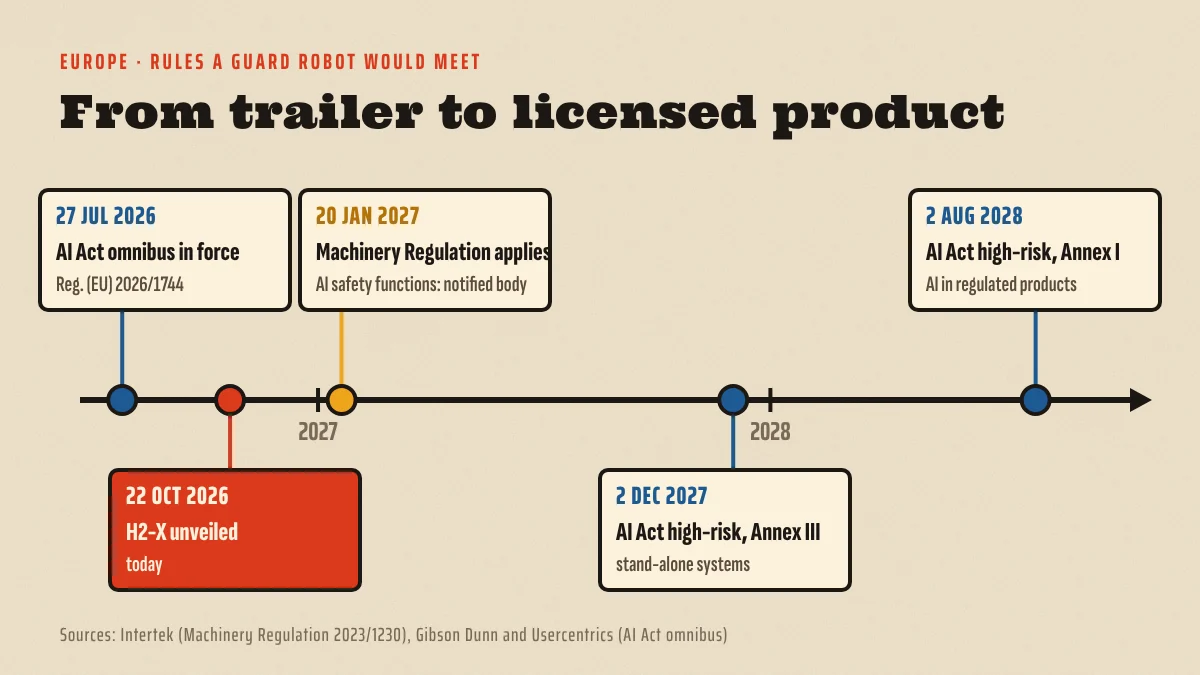
- Product safety. The EU Machinery Regulation applies from 20 January 2027. For machinery with AI-driven safety functions, self-declared CE marking is no longer enough and a notified body must be involved.
- AI rules. Under the AI Act omnibus, in force since 27 July 2026, obligations for high-risk AI embedded in regulated products moved to 2 August 2028, and AI in machinery is largely handled through the Machinery Regulation, as Gibson Dunn explains.
- Security licensing. Personal protection is a regulated activity in many member states. In Belgium, the private security act of 2 October 2017 lists the protection of persons as a security activity that requires a licence from the interior minister, whatever tool the guard uses.
- Cybersecurity and data. In October 2025, Alias Robotics found that the Unitree G1 could be taken over via Bluetooth and sent telemetry, including camera and microphone data, to servers in China every five minutes, Help Net Security reported. That concerned the G1, not the H2-X, but a guard robot sees and hears everything around the person it protects.
Why a kung fu film, and why now
Unitree listed on Shanghai’s STAR Market on 19 August 2026 at 150.8 yuan per share. The stock closed its first day at 845 yuan and touched 1,100 yuan intraday, then fell 55% from that peak by 21 September. Reuters reported that Chinese regulators are slowing the listings of other humanoid robot makers over valuation concerns and that investors are shifting from demonstrations to order volumes, as summarised by Forklog. Our earlier analysis of Unitree’s IPO filing covers the revenue and demand behind the listing.
A spectacular video keeps a listed robot maker in the conversation. It also builds on a habit: the smaller G1 did kung fu routines in 2025, and Unitree robots are a fixture in China’s high-visibility events. Where Unitree sits among China’s AI and robotics players is mapped in our overview of the 40 most innovative AI labs in China.
Frequently asked questions
How much does the Unitree H2-X cost?
Unitree has not announced a price. The standard H2 lists at $29,900 excluding tax and shipping, but that is a different product and not an estimate for the H2-X. A figure of $45,000 that appears on Humanoid Guide is marked as unverified by the site itself and does not come from Unitree.
Can you buy the H2-X?
No sales date or commercial plan has been announced, and the H2-X is not listed among the H2 versions on Unitree’s website. In the United States, a new model would also need FCC authorisation, which foreign-made humanoids no longer get without an exemption.
Is the H2-X autonomous?
Unitree has not said whether the demo was autonomous, teleoperated or pre-scripted.
How long does the battery last?
About eight hours according to Unitree, which the video caption describes as standing time. There is no figure for active work.
Three questions for every robot fight video
The H2-X shows that a human-sized robot can now jump, strike and land with remarkable control. It does not show the part that makes a guard useful. Before a robot like this enters a European site, ask who controls it, how often it succeeds outside the edit, and what happens when it gets something wrong. The progress that will answer those questions is happening elsewhere, in robots that learn shared tasks, like the Unitree G1 pair that learned table tennis doubles, and in models that give robots touch and memory, such as NEURA’s Neuron AI. How those strands come together over the next ten years is the subject of our piece on physical AI in the next decade.