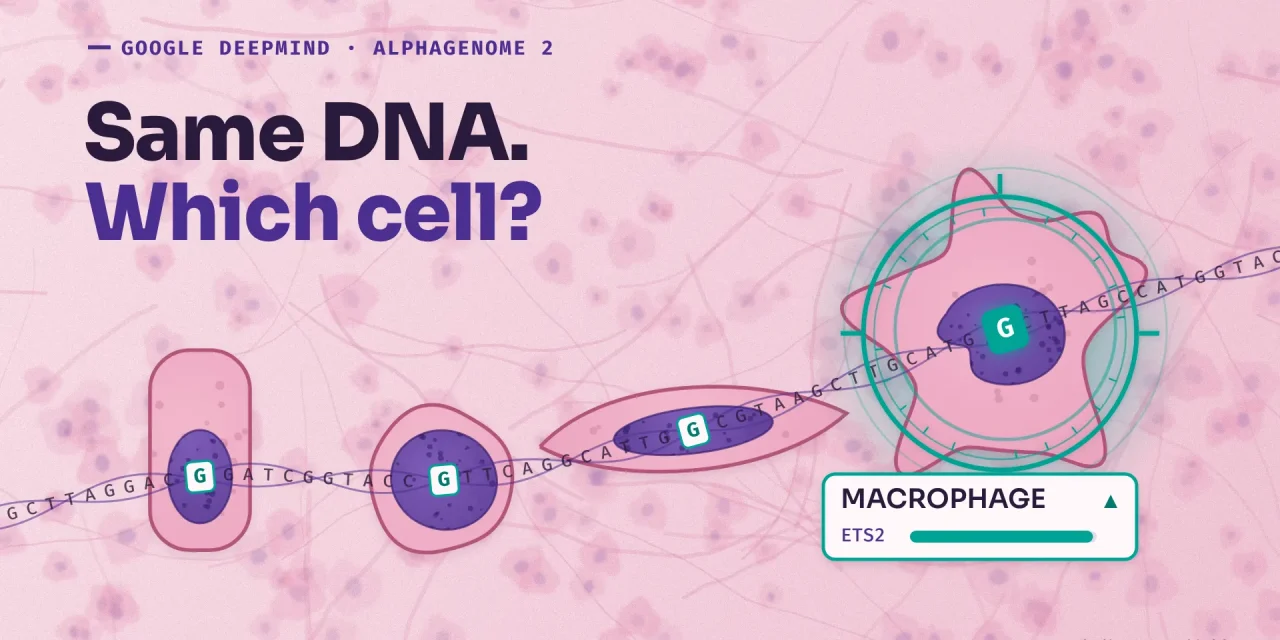
AlphaGenome 2, released by Google DeepMind on 11 November 2026, predicts what a DNA variant does in a specific cell type rather than in a whole tissue. For drug discovery that is the difference between a long list of suspects and a short list with an address: this variant, this gene, these cells. The model is a real step forward on DeepMind’s own benchmarks. It also comes with access terms that research organisations and pharma teams should read before they plan a pipeline around it.
What AlphaGenome 2 does
Most genetic variants linked to disease sit in the non-coding part of the genome, the stretches that control when and where genes switch on. Genome-wide association studies usually flag a block of variants that are inherited together. They rarely say which one is causal, which gene it acts on or in which cell type. That is where target programmes stall.
AlphaGenome 2 reads one million letters of DNA and predicts the molecular readouts for one chosen condition: gene expression, RNA splicing, chromatin accessibility, histone marks and, new in this version, DNA methylation. A condition can be a tissue, a cell type or a cell state, such as a T cell activated by a vaccine. Swap one letter and the model shows how those readouts shift. It covers human and mouse.
Why one condition at a time
The first AlphaGenome, launched in June 2025 and published in Nature in January 2026, predicted thousands of experiments in parallel. That spread the model’s capacity across many outputs and made closely related cell types hard to tell apart. When the paper came out, experts named this as the main gap. Kristian Helin of the Institute of Cancer Research called cell type-specific regulation “an important challenge”.
The technical paper keeps the U-Net and transformer backbone of version 1 and feeds the condition into every layer, from the earliest encoder blocks to the decoder. The authors tested conditioning only at the output and found it added almost nothing. The cell context has to shape how the sequence is read from the start.
The feature most labs will care about is the cell encoder. Trained on more than 100 million single-cell profiles from 68 tissues, it turns your own single-cell RNA-seq data into a condition without retraining the model. The documentation allows up to 256 cells per call, as raw counts per gene. DeepMind says a few dozen cells can be enough. Sarah Teichmann, co-founder of the Human Cell Atlas, highlights exactly that in the announcement: the model adapts to new single-cell data without retraining. If you only measured gene activity, the model can also impute readouts you did not measure, such as accessibility, and labels every output as observed, supported imputation or exploratory.
What the benchmarks show, and what they leave out
The headline result comes from TenK10K, a large single-cell study of 28 immune cell types. At 90% precision, AlphaGenome 2 recovered 30% of putatively causal expression variants, against 16% for AlphaGenome 1 fine-tuned on single-cell data. For the direction of the effect, it rose from 23% to 43%. The paper adds more: a median correlation with measured tissue expression of 0.71 against 0.61, and better enhancer-to-gene linking than both version 1 and the Borzoi model in CRISPR-validated tests.
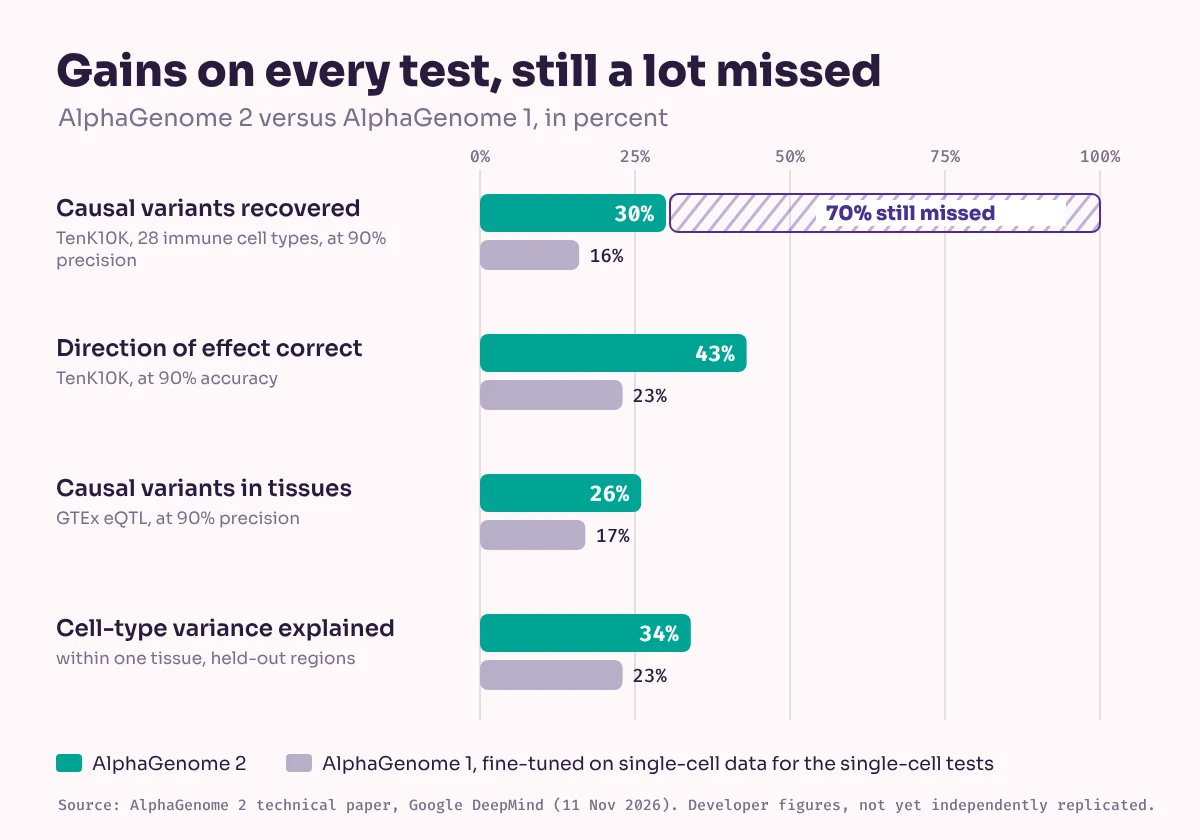
Two caveats matter for anyone budgeting lab work around these numbers. First, recall at 90% precision means the model is usually right when it flags a variant, but it flags only a minority of them. In this test, seven in ten causal variants go unnoticed. Second, all figures are DeepMind’s own. On release day there is no independent replication. When version 1 was published, Xianghua Li of King’s College London judged that it performed as well as the best existing tools, “but not better”. Version 2 claims a bigger lead, and that claim now needs outside testing.
Where it could speed up target discovery
The paper’s strongest example is a retrospective one. A 2024 Nature study showed through extensive lab work that a distant regulatory variant drives inflammatory bowel disease by boosting the gene ETS2 in gut macrophages. Given the seven candidate variants in that region, AlphaGenome 2 gave a large effect to only one, rs2836882, linked it to ETS2 about 290 kilobases away and confined the effect to monocytes and macrophages.
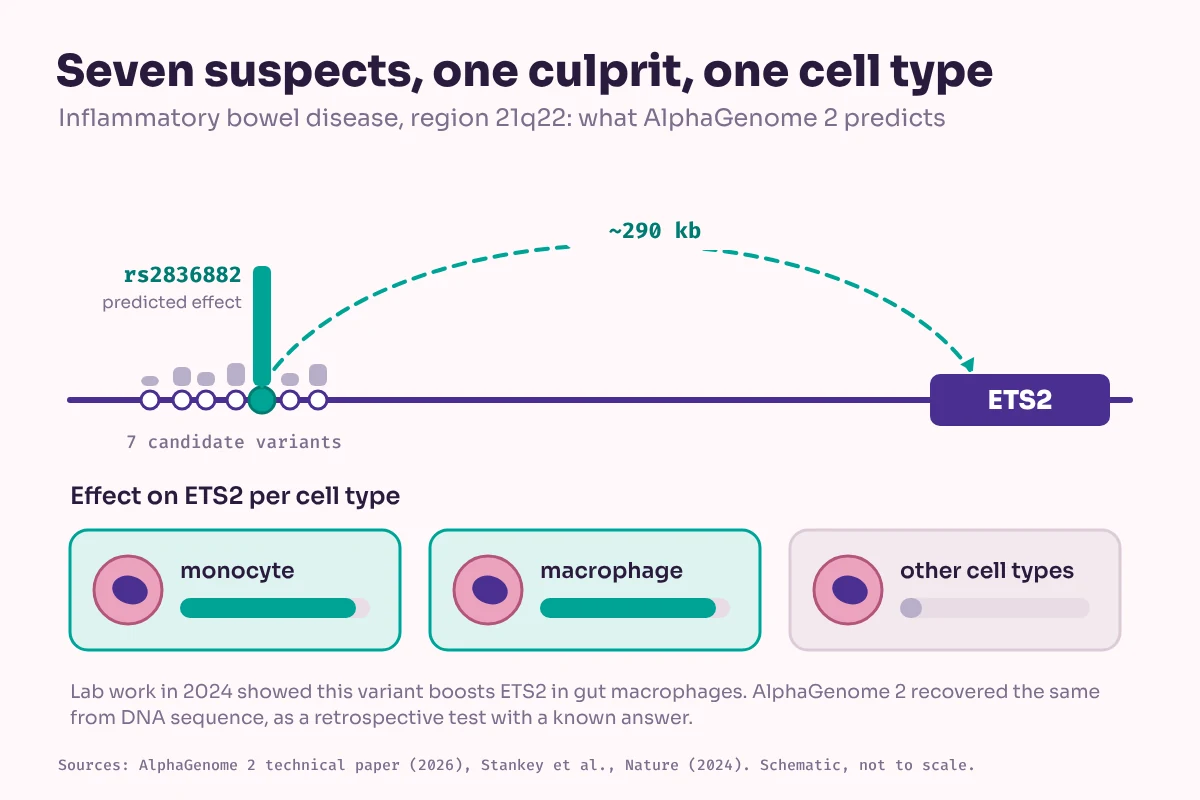
That is the workflow pharma teams will want: from a GWAS signal to a ranked variant, a target gene and the cell type to test in. A second case points to new territory. On unseen single-cell data from a COVID-19 mRNA vaccine study, the model separated activated from resting T cells and predicted that a variant linked to severe COVID-19 matters more in the activated state. Peter Donnelly, CEO of Genomics plc, says his company will build AlphaGenome 2 into its Mystra platform to help bridge the gap between association signals and drug programmes.
DeepMind also published precomputed predictions for trait-associated variants across hundreds of human cell and tissue conditions, from height to type 2 diabetes. For many teams that resource will be the cheapest place to start.
The access model is part of the product
AlphaGenome 2 is free for non-commercial research through the AlphaGenome API. Commercial research runs through a private preview, with no public price. Query rates vary with demand. The weights are not released, unlike version 1, whose weights sit on GitHub for non-commercial use. In practice that makes AlphaGenome 2 a hosted service, in the same way OpenAI now sells trusted access to GPT-6 Rosalind rather than a model you run yourself.
Before a European lab or company builds on it, a few questions deserve an answer:
- What you may do with outputs. According to the FAQ, API outputs and Atlas scores are for non-commercial research only, may not be used to train other machine learning models and must not inform clinical decisions. That rules out several obvious uses, such as distilling the predictions into an in-house model.
- What you send. Expression conditioning means uploading single-cell counts. The public FAQ does not say how submitted data is stored or used. If those cells come from patient samples, data protection officers and ethics boards will want that answer in writing.
- Who you depend on. Alphabet, the parent of Google DeepMind, also owns Isomorphic Labs, which runs its own drug discovery programmes. Startups that make a closed API from that group central to their pipeline take on a supplier risk that has not been addressed publicly.
- What stays reproducible. AlphaGenome 1 remains available to reproduce published results. Teams that need audit trails should pin model versions and log conditions, because version 2 returns raw scores only and drops the calibrated quantile scores of version 1.
DeepMind is also preparing AlphaGenome 2 Skills for Antigravity, Google’s agentic development platform, so that agents built on Gemini 4 can call the model during an analysis. Scientists can submit projects for extra quota until 30 November.
Limits the authors spell out
- It recovers only a minority of causal expression and disease variants nominated by statistical studies.
- It can underestimate effects outside accessible chromatin, at very distant regulatory elements or through post-transcriptional mechanisms.
- Transient, stimulated and disease states are underrepresented in training. Fine neuronal subtypes remain hard to separate.
- Cell-state representations come from observational, steady-state data. They capture correlation, not cause, and responses to gene knockouts are untested.
- Each condition is a separate prediction, so it is more compute-heavy than version 1. A genome-wide resource like the AlphaGenome Atlas, which covers all 9 billion possible single-letter changes, is much harder to build this way.
- Neither version is validated or approved for clinical or diagnostic use.
Frequently asked questions
Can companies use AlphaGenome 2 today?
Only through a private preview for commercial research. The free API tier is for non-commercial research.
Can I run AlphaGenome 2 on my own infrastructure?
No. DeepMind has not released the weights. Version 1 weights are available on GitHub for non-commercial use and need at least an NVIDIA H100 GPU.
How many cells do I need to condition on my own data?
The API accepts up to 256 cells per call. DeepMind says a few dozen can be enough, but data that differs strongly from the training distribution may be captured less well.
Is AlphaGenome 2 suitable for diagnostics?
No. DeepMind states that both versions are for research use only and are not validated or approved for clinical or diagnostic purposes.
A better map, still not the territory
AlphaGenome 2 moves the field from asking what a variant does to asking what it does in which cell, and lets labs bring their own cells to the question. That should make target discovery less of a guessing game and help teams decide which experiments to run first. It does not replace those experiments: seven in ten causal variants are still missed, and the evidence so far comes from the builder. For organisations, the more lasting decision may be the one about access. As with AI research agents, the value lies in what you can verify, keep and build on, not only in the score on launch day.