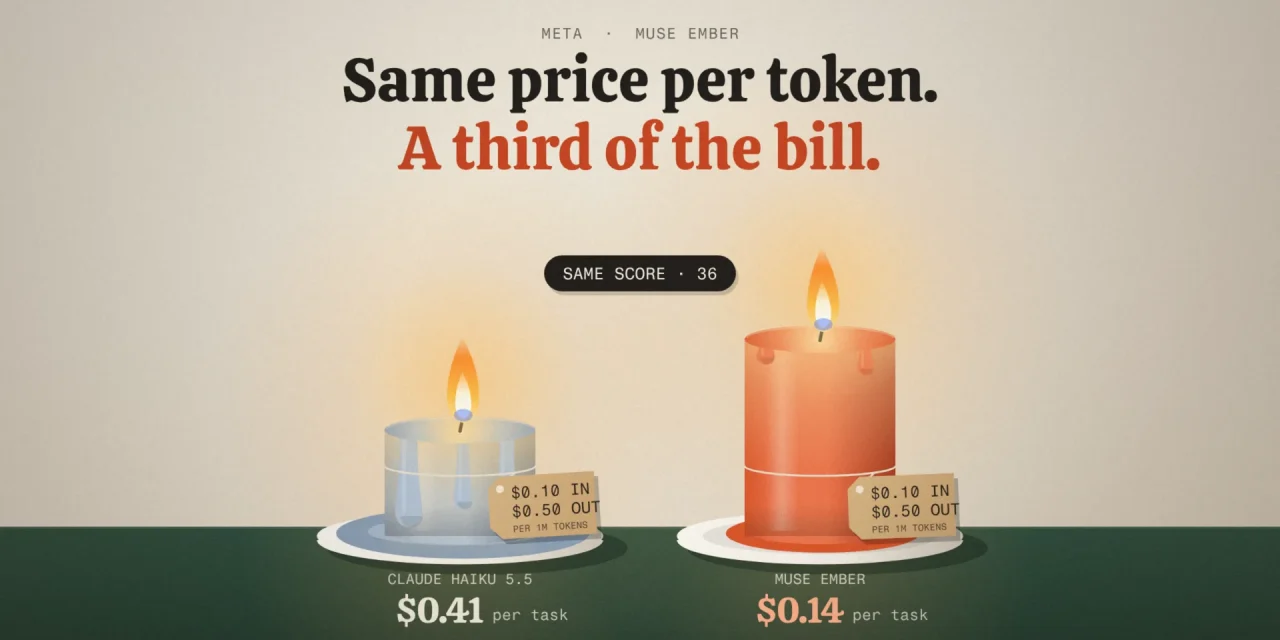
Muse Ember is Meta’s smallest and cheapest AI model, released on 9 November 2026 for the work AI agents repeat all day. Per token it costs exactly the same as Claude Haiku 5.5 and GPT-6 Luna: 10 cents per million input tokens and 50 cents per million output tokens. Per task, it costs about a third of Haiku 5.5 at the same score. The difference lies in how many tokens each model burns and where the price jumps when prompts get long. For European teams, the open question is less the price than where the data goes.
Ember is also a familiar face. Crouton Alpha, the anonymous free model that appeared on OpenRouter last week, was an early version of Muse Ember, OpenRouter now confirms.
What Muse Ember is
Ember is the fourth model under the Muse name, after Spark (April), Glimmer (August) and Wonder (October). Meta Superintelligence Labs did not build it to crack hard problems. It built it to run many small steps cheaply and quickly: calling tools, writing small pieces of code, routing requests, extracting data from documents and summarising long texts.
Meta sums up the division of labour in one line: “Muse Wonder plans, Muse Ember handles the volume.” A large model makes the plan and checks the result, Ember does the execution. Meta also says it is the first model it trained with the help of its largest model, Muse Wonder Full. TechCrunch describes the customer-support split: a heavier model sets the rules, Ember applies them across tens of thousands of cases.
| Feature | Muse Ember |
|---|---|
| Model ID | muse-ember-1.0 |
| Price up to 200,000 input tokens | $0.10 input, $0.50 output, $0.004 cached input per million tokens |
| Price above 200,000 input tokens | $0.30 input, $1.50 output, $0.012 cached input, on the whole request |
| Context and output | 1 million tokens of context, up to 512,000 output tokens |
| Input | text, images, audio and video, according to Meta |
| Reasoning levels | six, from minimal to max |
| Weights | closed, API access only |
| Where | Meta Model API, Muse Code, OpenRouter, Google Cloud (preview) and Oracle Cloud |
Sources: Meta’s model page, Digit, as of 10 November 2026.
Why the same price per token still produces a different bill
A reasoning model thinks before it answers and writes those thoughts out as tokens. You pay for them as output. Two models with the same rate card can therefore send very different invoices for the same job.
Artificial Analysis measures this as the cost per task across its full Intelligence Index, each model at its highest reasoning setting. The figures Fello AI took from that measurement:
- Muse Ember scores 36 and costs $0.14 per task, using 115 million output tokens for the whole index.
- Claude Haiku 5.5 also scores 36 but costs $0.41 per task, using 298 million output tokens.
- GPT-6 Luna costs $0.15 per task with 110 million output tokens, but scores 28.
So Ember combines Haiku’s score with Luna’s cost. Unrounded, Haiku 5.5 is narrowly ahead, 36.2 against 35.8 in Meta’s own chart. Within Meta’s lineup the gap is even wider: Muse Spark 1.3 scores one point higher but costs $2.39 per task, roughly seventeen times more, according to Digital Trends.
Meta’s launch partners report the same pattern. You.com measured 36 to 48 percent fewer output tokens than the open-weight models it compared, with a p95 latency of 2.2 seconds. On OpenRouter, Ember currently runs at around 204 tokens per second.
Where Ember wins and where it falls short
Meta published ten comparisons, each model at its highest reasoning level:
| Benchmark | Muse Ember | Haiku 5.5 | GPT-6 Luna |
|---|---|---|---|
| AutomationBench-AA (business workflows) | 37.8 | 13.9 | 20.2 |
| Coding Agent Index-AA | 46 | 37 | 31 |
| Terminal-Bench 4.0 | 40.9 | 39.2 | 16.4 |
| OSWorld 2.1, partial (computer use) | 69.5 | 68.9 | 50.5 |
| GDP.pdf-AA (long professional documents) | 22.8 | 20.8 | 22.8 |
| FrontierCode 2.0-AA (mergeable code) | 27.2 | 34.9 | 25.2 |
The biggest lead is in business workflows, where Ember scores almost three times as high as Haiku. On FrontierCode, the test closest to code you can merge without edits, Ember clearly loses. If a small model writes pull requests on its own in your pipeline, Haiku 5.5 remains the better pick.
Read the table with some care. According to Fello AI, Meta ran four of the ten rows itself and calls the competitor runs “best-effort”. Artificial Analysis also lists only text and image input, so audio and video have not been independently confirmed yet. On Hacker News, one tester tried all six reasoning levels and found that more thinking did not automatically give a better result. Test which level is enough for each task, because a lower level burns fewer tokens.
Watch the price thresholds on long prompts
All three small models offer roughly a million tokens of context, but none of them charges the same rate all the way. Above a certain prompt length a higher rate applies, and it applies to the whole request:
- Claude Haiku 5.5 becomes five times more expensive above 100,000 tokens: $0.50 input and $2.50 output (Implicator).
- Muse Ember becomes three times more expensive above 200,000 tokens: $0.30 and $1.50.
- GPT-6 Luna keeps its base rate up to 272,000 tokens and charges $0.20 and $0.75 above that.
This is what a single request with 2,000 output tokens costs, without caching:
| Prompt length | Muse Ember | Haiku 5.5 | GPT-6 Luna |
|---|---|---|---|
| 50,000 tokens | $0.006 | $0.006 | $0.006 |
| 150,000 tokens | $0.016 | $0.080 | $0.016 |
| 250,000 tokens | $0.078 | $0.130 | $0.026 |
| 400,000 tokens | $0.123 | $0.205 | $0.082 |
Between 100,000 and 200,000 tokens, Ember is five times cheaper than Haiku. Above that, Luna wins on price, especially between 200,000 and 272,000 tokens. Cached input changes the sums a lot: on Ember it costs just $0.004 per million tokens, so an agent that resends the same system prompt and documents every turn gains a great deal by switching caching on.
Planner and workhorse, the architecture Meta is selling
In its developer blog, Meta shows a concrete example. Muse Wonder planned the port of 16 lexers from the Python library Pygments to Rust, and Ember did the writing. Ember processed 158 million input tokens, Wonder 4.4 million. The whole job cost about $3.96, of which $1.84 went to Ember. Every lexer matched the original on 383 test inputs and 62 held-out files, and the Rust version ran 3 to 7 times faster.
Anthropic and OpenAI sell the same pattern with Opus or Sol on top and Haiku or Luna underneath. What is new is that three vendors now offer a small model at exactly the same price per token. The choice therefore comes down to cost per task and quality on your own steps. If you are setting this up, route by type of step, not by vendor:
- planning, decisions and final review go to a large model;
- extraction, classification, summaries and tool calls go to a small model at a low reasoning level;
- code that lands directly in your codebase goes to whichever model scores best there, today Haiku 5.5 or larger.
Keep your harness model-agnostic. With three small models at the same list price, switching should be a configuration change, not a rewrite. Stanford’s Meta-Harness research shows how much the code around a model matters for the result.
What European teams should check before using Ember
Access is possible on paper, but test it from your own account first. The Meta Model API geographic use policy (updated 12 October 2026) does not exclude the EU, and Meta says the API is available in most countries where Meta AI works and billing is supported. Yet testers in Europe were turned away from Crouton Alpha, Ember’s early version, on 3 November, according to Stealthmodels.
The data terms matter more than access:
- No processor agreement yet. Meta offers no data processing agreement and no EU data residency for the API, Technspire reported in late September. Without one, personal data under Article 28 of the GDPR should stay out.
- No EU routing on OpenRouter. OpenRouter states that Ember is not available through its EU in-region routing.
- A global endpoint on Google Cloud. Ember is in preview there, only through a global endpoint and under Meta’s own terms as a “Separate Offering”, OrcaRouter notes. Support for bad outputs runs to Meta, not Google.
- Not a consumer feature. Ember is not in the Meta AI app or WhatsApp. It is a developer model.
For tests with public or synthetic data, internal prototypes and cost-per-task comparisons, you can start today. For production work with customer data, wait for a processor agreement, or choose a model you can run in a European region, such as Muse Spark Open on your own hardware. If Ember ends up inside a product your customers use, the transparency rules of the EU AI Act for chatbots and generated content apply just as they would with any other model.
Frequently asked questions about Muse Ember
How much does Muse Ember cost?
$0.10 per million input tokens and $0.50 per million output tokens for prompts up to 200,000 tokens, and $0.30 and $1.50 above that. Cached input costs $0.004 per million tokens. Ember is included in all Muse Code subscription plans.
Is Muse Ember open source?
No. Meta keeps the weights closed, as with Spark and Wonder. The open model in the family is Muse Spark Open, which is far larger.
Is Muse Ember the same as Crouton Alpha?
Yes. OpenRouter says Crouton Alpha was an early version of Muse Ember. The free stealth period has ended; you now use the paid Muse Ember.
Is Muse Ember better than Claude Haiku 5.5?
It scores the same on the Artificial Analysis Intelligence Index, costs a third as much per task and wins most agent tests. Haiku 5.5 is stronger on mergeable code, and Anthropic does offer a data processing agreement for its API.
Budget per task, not per token
The price tags of small models have converged on ten cents. The real difference only shows in your own logs: how many tokens does each model burn on your task, at which reasoning level, and how long are your prompts after twenty turns? Run the same tasks through two models for a week and compare the invoices. That will tell a procurement team more than any benchmark, Meta’s included.