Inherent, a London AI lab founded by Google DeepMind alumni, has released Faraday, an AI agent built to behave like a scientist rather than a chatbot. The headline claim is striking. Faraday outperforms Anthropic’s Claude Opus 4.8 and OpenAI’s GPT-5.5 at independently reproducing the findings of published scientific papers, and it does so while running on Qwen 3.6, a model with just 27 billion parameters. The announcement came only weeks after the startup emerged from stealth with a $50 million seed round, one of the largest European AI launches of 2026.
Why Inherent named its AI scientist after Michael Faraday
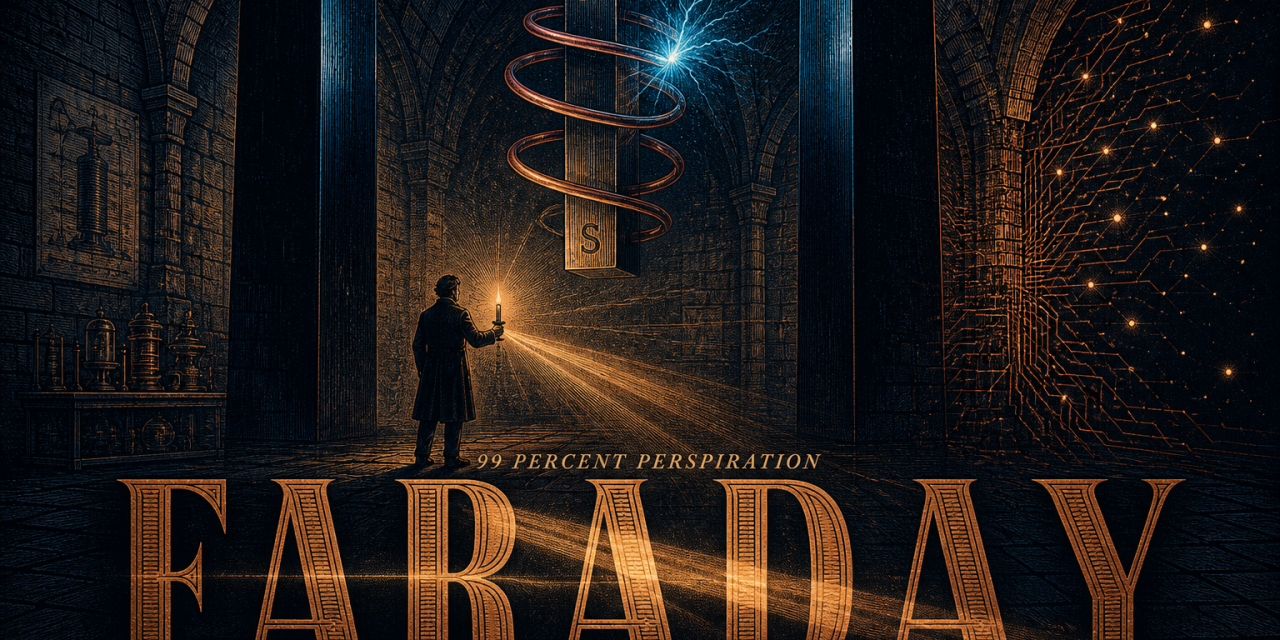
In 1821, Richard Phillips asked his friend Michael Faraday to review the emerging field of electromagnetism. Faraday was an odd choice. He had little formal education and limited experience in the field, but he was a gifted experimentalist. Rather than summarizing the work of others from his desk, he went to the candlelit basement of the Royal Institution and replicated the experiments by hand. During that process he discovered he could make a wire carrying an electric current move around a magnet. “Very satisfactory”, he wrote in his journal. He had just invented the electric motor.
Inherent borrowed both the name and the method. Replication, in the company’s view, is the training ground where scientific instinct forms. Co-founder and chief scientist Edward Hughes notes that many PhD students start their careers in exactly this way.
How Replica teaches Faraday the skills of a scientist
To train the agent, Inherent built Replica, a scalable space of reinforcement learning tasks. Each task asks the agent to replicate a figure from a research paper within a limited time and compute budget, without access to the original plot. The initial suite contains 310 tasks drawn from 100 machine learning and AI for science papers, covering fields as different as natural language processing, materials science and weather forecasting.
The task choice is deliberate. A published paper describes what worked. It omits the failed experiments and wrong turns that produced the final result. To recreate a figure convincingly, an agent has to recover what Inherent calls the 99 percent perspiration that never appears on the page. This requires the hypothesis driven exploration you see in genuine open ended research.
Success is defined more strictly than accuracy. A pixel perfect copy of a plot does not count as a good replication. The agent also needs strong experimental design, sound scientific practice, faithfulness to the original paper’s claims and sensible use of resources. Inherent bundles all of this under research taste.
Taste is hard to grade, so the team designed an LLM judge and ran a human study to confirm that it captures the judgement of expert researchers. Training directly on such a judge creates a noisy reward signal, because the judge model itself is stochastic. Inherent solved this with per task rubrics, which scored more consistently than a plain LLM baseline. Two further modifications, multi sample aggregation and turn level credit assignment, keep the long horizon reinforcement learning stable. Hughes frames the philosophy behind it all as orientation toward a single goal. “We’re always guided by that north star of building an AI scientist agent and imbuing our agents with taste.”
A small model directing much bigger ones
Faraday does not try to do everything itself. It uses OpenAI’s GPT-5.5 Codex as a tool, much like a human scientist relies on existing software instead of building everything from scratch. Inherent deliberately chose not to build its own coding tool for this reason.
The result is almost paradoxical. A 27 billion parameter model with good judgement directs a model several orders of magnitude larger, and the combination replicates papers better than the large model manages on its own. Faraday also generalizes across tools. After training with the smaller GPT-5.4-mini as its coding agent, it adapted to the stronger GPT-5.5 Codex at test time without retraining. As frontier coding agents keep improving, Inherent expects the value of scientific judgement to grow alongside them.
Unlike earlier AI scientist systems, Faraday needs no hand coded evolutionary harness and receives no reward at test time. It has learned to value discoveries intrinsically. Hughes describes the ideal behavior as the teammate who comes back and says “I got curious about this, and I went off and I did these experiments. What do you think of these results?”
What the benchmark shows and where to be careful
Inherent ran recent agents from the leading labs on Replica and found that none of them saturate the task space. The baselines received strong conditions. Claude Opus 4.8 ran in the Claude Code harness and GPT-5.5 in the Codex harness, both with thinking effort set to extra high. Faraday produced more faithful replications in every category of the suite. Notably, it struggled less with recent research, work the base model had never seen during pre-training. That points to transferable scientific skills rather than memorized papers.
You should still read the numbers with care. The benchmark was designed and run by Inherent itself, and no independent institution has validated the results yet. Replication is also one specific skill. Whether the same approach holds for messier proprietary data or for generating genuinely new hypotheses remains unproven. Hughes himself downplays the leaderboard framing and told TechCrunch the interesting part “was actually the way we went about building this.”
DeepMind alumni, $50 million and a bet on London
The four co-founders combine research and policy experience in an unusual way. Hughes and Tantum Collins worked together on cooperative AI at DeepMind. Louis Kirsch also comes from DeepMind, while Kaloyan Aleksiev joined from Reka AI and Microsoft. Collins adds something most AI lab founders lack, policy experience from the Biden White House. Matt Clifford, co-founder of Entrepreneurs First and former AI adviser to the UK government, advises the company.
The seed round was co-led by Index Ventures and Radical Ventures, with participation from Nvidia’s venture arm NVentures alongside Ex/Ante, Metaplanet, Macroscopic Ventures and Mythos Ventures. Index partner Danny Rimer framed the investment around curiosity. “Most AI is built to answer questions. What it can’t do yet is figure out which questions are worth asking.” Inherent is structured as a public benefit corporation, which legally requires it to weigh societal impact alongside shareholder returns.
All twelve employees work in person from an office in King’s Cross, the neighborhood DeepMind helped turn into a global AI hub. The team plans to grow to around 20 to 25 people by the end of the year. Hughes has also criticized garden leave, the UK practice that bars departing employees from joining a rival for months, a restriction he faced personally. With some DeepMind staff reportedly unsettled, Inherent’s hiring push arrives at a convenient moment.
From replication to real discovery
Inherent treats replication as the first rung of a curriculum. The team can even hand the agent an imagined paper, so the same Faraday model starts innovating without knowing it. That is the intended bridge from replication to discovery. The company is also investigating how its methods can advance scalable oversight and reduce reward hacking, two problems that grow more urgent as agents become more autonomous.
Faraday is early evidence that a small model trained for judgement can steer the largest models in the world toward better science. If that holds, the scarce resource in AI research stops being compute and starts being taste.