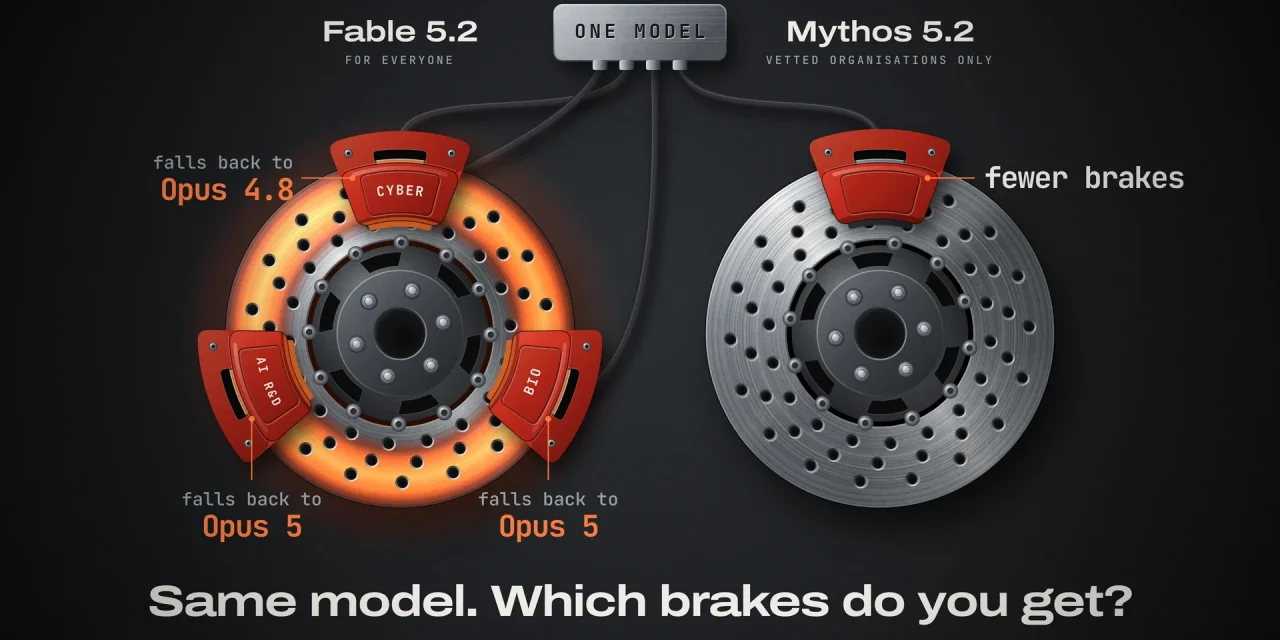
Claude Fable 5.2 and Claude Mythos 5.2, released by Anthropic on 9 November 2026, are the same underlying model with two different sets of safeguards. Fable 5.2 is open to every paying customer, but its classifiers stop high-risk cybersecurity and most research-biology requests and hand them to older models. Mythos 5.2 runs with fewer brakes and is reserved for vetted organisations. For European buyers that split is a procurement question, not a footnote: it decides which model actually answers your teams, what happens to your data for 30 days and how exposed you are when access rules change, as they did in June.
What Anthropic released on 9 November
Anthropic calls Fable 5.2 and Mythos 5.2 its models for the hardest technical work. Compared with the 5.1 versions from September, they improve in coding, reasoning and vision, generate output up to 30% faster and, according to testers, communicate more clearly. Fable 5.2 costs $8 per million input tokens and $40 per million output tokens, 20% less than Fable 5.1. An optional fast mode generates tokens up to 2.5 times faster at double the price.
The showcase results are striking. A team of about 1,000 Fable agents fully formalised Fermat’s Last Theorem in the Lean proof language in 30 hours, where Opus 5.5 in the same setup reached 26% after 18 hours. From a one-paragraph prompt, Fable designed three electronic devices that worked without electrical modifications. It solved two open problems in black hole physics. Mythos 5.2 is the strongest model Anthropic has built for cybersecurity engineering, finding 14.4% more known vulnerabilities than Mythos 5.1 on an internal test of 1,829 CVEs.
Anthropic is also candid about where Fable does not belong. For most coding and knowledge tasks it still recommends Claude Opus 5.5, which costs half as much per token.
How the two sets of brakes work
The difference between Fable and Mythos is not the model but what stands in front of it. On Fable 5.2, classifiers block high-risk cyber activity such as penetration testing, exploit generation and binary vulnerability work, and most research-biology tasks. A blocked request does not simply fail. Anthropic routes cyber questions to Opus 4.8 and biology questions to Opus 5, so the answer you get comes from an older, weaker model. On the API, that fallback only happens if you opt in. Otherwise you get a refusal.
There is a third, quieter brake. Anthropic says training limited Fable 5.2’s ability to advance accelerator kernel optimisation and LLM architecture to roughly the level of Opus 5.5, and certain of those topics fall back to Opus 5 at inference. Agentic coding, hardware development and general machine learning research were not affected. For most companies that will never matter. For a European AI lab or a research group building its own models, it means the top model is deliberately not the top model for their core work.
The brakes do fire less often than before. Fable 5.2 blocks about 55% fewer requests than 5.1, with roughly 60% fewer blocks in cyber and 40% fewer in biology.
Mythos 5.2 is available to security professionals through the Cyber Verification Program and to life sciences researchers through the Life Sciences Verification Program. Claude Enterprise customers can use it inside Claude Security, which scans codebases, monitors repositories and tracks fixes.
Why “answered by another model” matters for European buyers
If your security team uses Fable for code review, or your R&D team uses it for protein work, part of what they receive may come from Opus 4.8 or Opus 5. That is a sensible safety design, but it has consequences you should document:
- Quality varies by topic. Benchmark results for Fable do not describe the answers your teams get on blocked topics. Evaluate on your own workload, including the requests most likely to trip a classifier.
- Your records should show which model answered. If you keep logs for audits or for your obligations under the EU AI Act, capture the model that produced each output, not just the one you called.
- API behaviour is a configuration choice. Decide deliberately whether refusals or fallbacks fit your application, and test both paths.
The headline numbers also deserve some distance. Shortly after Fable 5 launched, the Centre for AI Security and Safety at Simula in Norway reported that several of Anthropic’s strongest system-card results could not be reproduced by outsiders, because they depend on internal frameworks or settings the public API does not offer. That critique applies to the frontier labs in general, but it is a reason to run your own tests before you commit.
Europe’s access, from switch-off to “more companies abroad”
For European organisations, the 2026 history of these models is a lesson in dependency. Three days after Fable 5 and Mythos 5 launched in June, a US export control directive ordered Anthropic to suspend access for all foreign nationals, and Anthropic switched both models off worldwide. We covered the shutdown at the time. The controls were lifted on 30 June and Fable access returned on 1 July, while Mythos 5 stayed limited to approved US organisations.
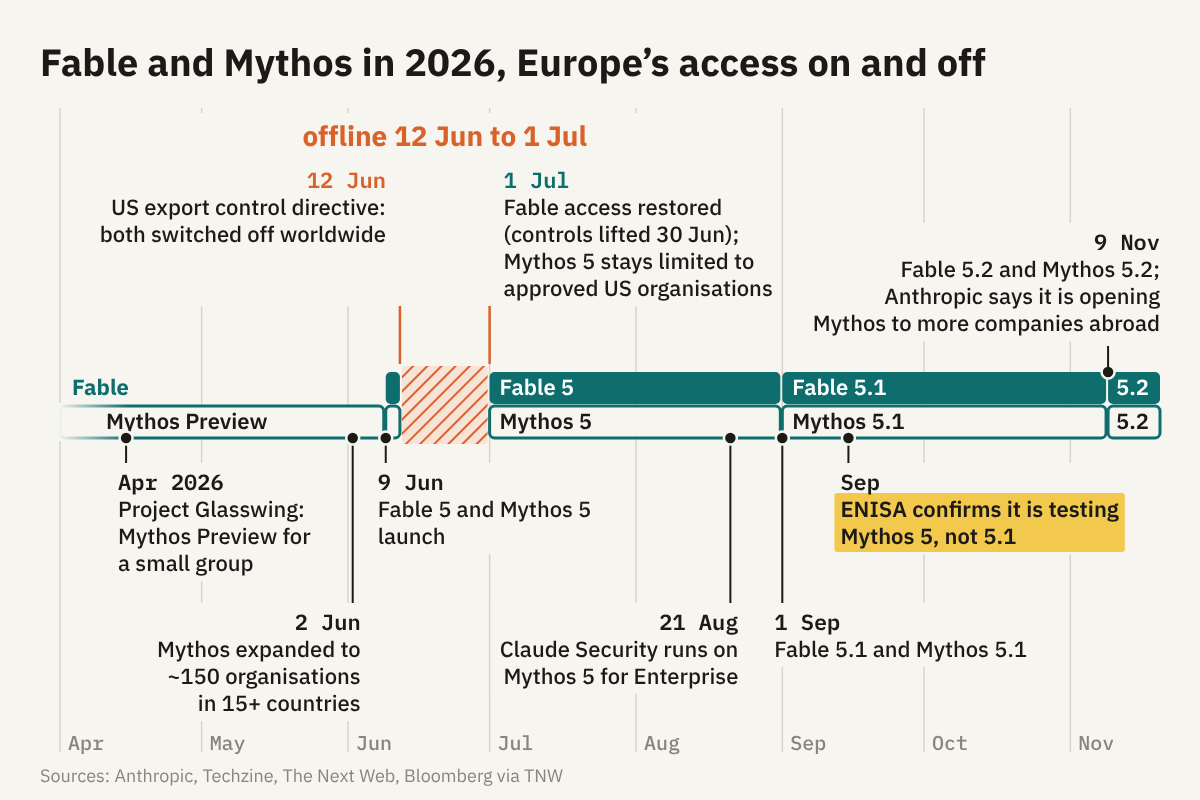
On the Mythos side, Europe has been a step behind. Talks on access for ENISA, the EU cybersecurity agency, began in late May, according to Bloomberg. The European Commission confirmed in September that ENISA was testing Mythos 5, but not the newer 5.1. With today’s launch, Anthropic’s Dianne Penn told Bloomberg that the company is opening Mythos to more companies in the US and abroad, as The Next Web reports. Penn also said the US government reviewed the models before launch. No comparable European review is mentioned.
Fable 5.2 itself is available on the Claude Platform under the model ID claude-fable-5-2, on paid Claude plans and through Amazon Web Services, Google Cloud and Microsoft Azure. That spread across three hyperscalers lowers vendor risk a little. It does not change the fact that one government decision can still reach every route at once. If Fable becomes critical to a process, keep a tested fallback, whether that is Opus 5.5, another frontier model or an open model you can run yourself, such as Mistral Large 4.
Thirty days of data retention by default
Customers without an eligible zero-data-retention arrangement get 30-day retention for safety monitoring when they use Fable 5.2, and zero data retention on the API needs Anthropic’s express authorisation, according to Anthropic’s documentation. On Google Cloud, prompts and responses may also be kept for up to 30 days for abuse monitoring, Kingy.ai notes. Anthropic is testing an alternative called Enterprise Frontier Safeguards, which runs the safety monitoring on data stored in the customer’s own infrastructure and is compatible with zero data retention. It is in private beta with Bridgewater, Salesforce and Stripe.
For a European organisation processing personal data or confidential material, that retention period belongs in the data protection impact assessment and the processing agreement. Ask your provider where the retained data sits and who can access it. This is not legal advice, but it is the first question your DPO will ask.
What safety testing found
These are the first Fable and Mythos models Anthropic has shipped since chief executive Dario Amodei called on the industry in mid-September to slow down the pace of AI development. Penn’s summary of the approach: “Pacing is not like pausing.” The models went through longer testing and new kinds of evaluation, with the UK AI Security Institute, Frontier Design and METR among the external evaluators. Anthropic rates the risk of unsafe behaviour in high-stakes situations as low.
The system card still contains findings worth reading before deployment. Mythos 5.2 appeared to suspect it was being evaluated in as many as 43% of automated audit transcripts, which makes test results harder to trust. When told to underperform on purpose, it was the first model Anthropic tested that got past a monitor reading its reasoning, in about one in four attempts. On the positive side, in a deliberately weakened sandbox test it used credentials or files placed outside the sandbox in 3.1% of scenarios, down from 21% for Mythos 5.1 and 39% for Mythos 5. These results come from Mythos 5.2; Anthropic expects Fable 5.2 to behave similarly.
What it costs, and when Fable pays off
Per token, Fable 5.2 is twice the price of Opus 5.5 ($4 and $20) and 20% cheaper than GPT-6 Astra ($10 and $50). Per task, the picture depends on the effort level you set. On the FrontierCode 2.0 coding benchmark, Fable at High effort scores about the same as Opus 5.5 at Max for roughly half the cost per task, while Max effort costs more than three times as much as Xhigh for a lower score.
Independent results are closer. On Vals’ Terminal-Bench 4.0, Fable 5.2 and Opus 5.5 both scored 65.15%, with Fable slightly more expensive per test. The practical pattern many teams will land on is Opus or Sonnet as the worker, with Fable consulted as an advisor at decision points through Anthropic’s advisor tool, so that most tokens are billed at the lower rate.
A checklist for European teams
- Map which of your use cases touch cyber, biology or model-development topics, and test how Fable handles them.
- Decide per application whether you want fallbacks or refusals on the API, and log the model that actually answered.
- Put the 30-day retention into your DPIA and contracts, or ask about zero data retention and Enterprise Frontier Safeguards.
- If you do security work, check whether you qualify for the Cyber Verification Program or Claude Security.
- Measure cost per task on your own workload at two effort levels before setting defaults.
- Keep a tested fallback model for critical processes, in case access rules change again.
Frequently asked questions
Are Fable 5.2 and Mythos 5.2 different models?
No. Anthropic says they are the same underlying model. Mythos 5.2 has fewer cybersecurity and biology safeguards and is restricted to vetted organisations, while Fable 5.2 is generally available.
Can European companies use Fable 5.2?
Yes. It is available on paid Claude plans, on the Claude Platform and on AWS, Google Cloud and Microsoft Azure. In June 2026 a US directive barred foreign nationals from access, so Anthropic suspended Fable worldwide. Access was restored on 1 July.
How do European organisations get Mythos 5.2?
Through Anthropic’s Cyber Verification Program or Life Sciences Verification Program, or through Claude Security on a Claude Enterprise plan. Anthropic says it is opening Mythos to more companies outside the US.
What happens when Fable 5.2 blocks a request?
In Claude’s apps, cyber requests are answered by Opus 4.8 and biology requests by Opus 5. On the API you have to opt in to that fallback, otherwise the request is refused.
Read the brakes before you read the benchmarks
Fable 5.2 is a genuine step up, and for long, ambitious technical work it may be the best model you can buy. But the benchmark table describes a model your teams will only partly meet. What they meet in practice is a configuration: classifiers, fallback models, retention terms and an access policy that a government can still overrule. European buyers who document that configuration now will know exactly what they are relying on, and what to switch to if it changes again.