Tencent Hy4 Preview is a 770-billion-parameter open-weight language model, released on 28 August 2026 under the Apache 2.0 licence with no regional carve-outs. It is a large step up from Tencent’s previous Hy3 model on coding and agent work, yet Tencent’s own charts show it trailing Claude Opus 5 and GPT 5.6 Sol on most tests. For European organisations the interesting part is the combination: a licence that lets you take the model home, and hosted routes that cannot guarantee your data stays in the EU.
Two months after the launch, testers have put the model through real work and Tencent has announced the next versions. This article looks at what the model is, how to read the numbers, where your data goes and what it takes to run it yourself.
What Tencent released
Hy4 Preview comes from Hunyuan, Tencent’s foundation model team. Tencent calls it its most capable model to date and positions it for four kinds of work: software engineering, office work and analysis, game development and scientific research. The training data was shaped with in-house experts, including software engineers, game developers, finance analysts and security specialists.
The headline specifications, from the launch post and the model card:
- 770 billion parameters, 49 billion active per token. A mixture-of-experts design that routes each token to 8 of 256 experts plus one shared expert.
- A context window of 1 million tokens, up from 256,000 for Hy3.
- Text only. There is no image understanding in this preview.
- Apache 2.0 weights, in full precision and in a smaller FP8 version, on Hugging Face, ModelScope, GitCode and CNB.
Tencent describes the release as an early version with known issues. The model spends longer than necessary reasoning through complex tasks and tends to over-verify its own work.
How big the leap is, and how far the frontier still is
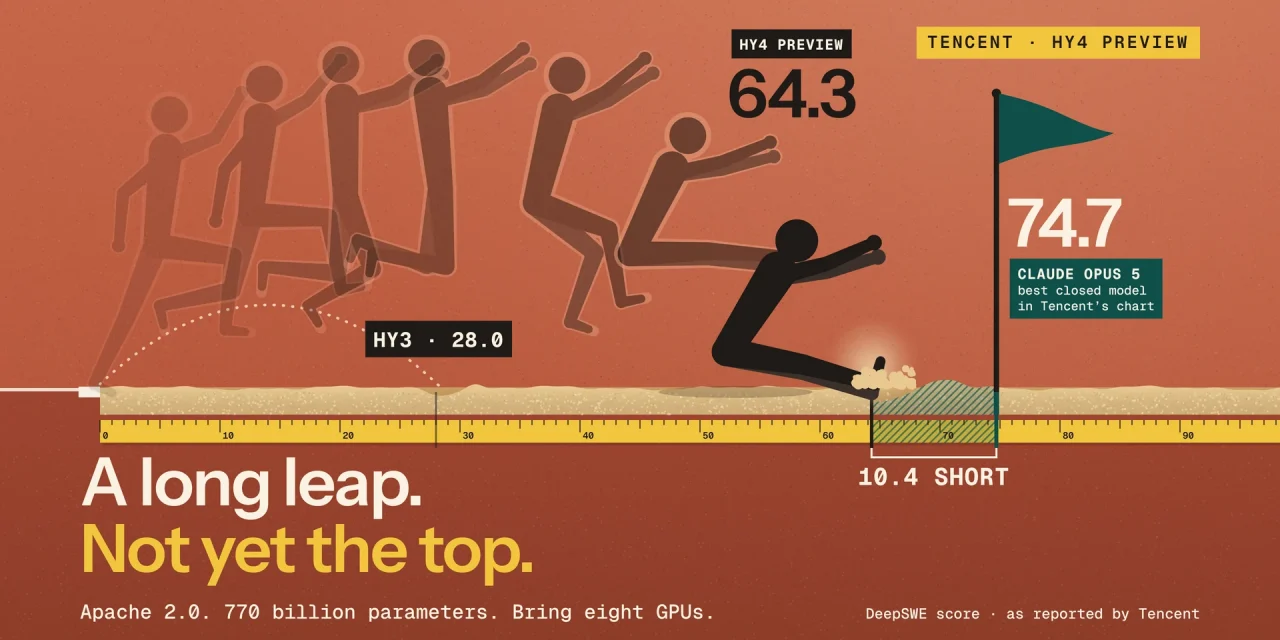
By Tencent’s own measurements, the jump from Hy3 is large. On DeepSWE, where a model resolves software issues on its own, the score rose from 28.0 to 64.3. On Terminal-Bench 2.1 it went from 70.8 to 85.4, and on ProgramBench, which asks for complete programs, from 3.0 to 17.5. Tencent calls it the largest generation-over-generation gain it has measured. A few days after launch, the South China Morning Post reported Hy4 Preview in eighth place on the Code Arena WebDev leaderboard, where Hy3 had been 34th.
The same chart shows where Hy4 stops. Claude Opus 5 scores 74.7 on DeepSWE, 39.5 on ProgramBench and 53.2 on Humanity’s Last Exam without tools, against 64.3, 17.5 and 43.4 for Hy4 Preview. The two scores Tencent labels as official leaderboard results tell the same story. On GDPval-AA, a test of economically useful work, Hy4 reaches an Elo of 1678 against 1831 for Claude Opus 5. On the CritPt physics benchmark it scores 16.9 against 29.1 for Claude Opus 5 and 32.3 for GPT 5.6 Sol.
How to read Tencent’s numbers
Three details in Tencent’s launch post matter.
- Most rival scores are Tencent’s own runs. Results marked with an asterisk in the benchmark table were produced by Tencent with its own harnesses, often Claude Code or its internal scaffold. That covers most of the rival figures. GDPval-AA and CritPt are labelled as official leaderboard results.
- The headline comparison is internal. Tencent had 163 of its own experts rate outputs on 203 engineering tasks. Hy4 Preview averaged 2.99 out of 4, against 2.92 for GLM 5.3 and 2.94 for Kimi K3, with 46.8% wins and 40.4% losses against GLM 5.3. That is a narrow lead in a test Tencent designed and ran.
- The comparison set has aged. Claude Opus 5.5 and Kimi K3.1 Pro have both appeared since August, and we could not find Hy4 Preview on the Artificial Analysis Intelligence Index. There is no independent like-for-like score against the current leaders.
A fair summary is that Hy4 Preview competes in the top group of Chinese open models without leading it. In Tencent’s own chart it also trails GLM 5.3 and Kimi K3 on DeepSWE, Terminal-Bench 2.1 and ProgramBench, and on CritPt it trails every Chinese rival in the table. The closed frontier keeps a clear lead on the hardest tasks.
Two months in, what testers found
Hands-on reports confirm both halves of Tencent’s own description. The Chinese tech site iFeng tested the model in WorkBuddy. It searched a document of roughly 930,000 tokens, the full Three-Body trilogy plus an annual report, in about nine minutes and located the requested passages accurately. A single prompt produced a working to-do app of around 650 lines. The same tester saw the model spend about thirty minutes on a simple question about quicksort’s time complexity, and watched two calls time out under concurrent tasks.
A tester on X who tried it on animations was blunter: “it’s not frontier”, reasoning in the right direction but reaching wrong conclusions. Demand, meanwhile, outran supply. According to 36Kr, WorkBuddy’s task queue was full on day one, peak-hour tasks that took two minutes stretched beyond five, and Tencent had to expand its inference cluster urgently.
A licence without an EU clause
This is where Hy4 Preview differs from several recent open releases. Apache 2.0 allows commercial use, modification and redistribution, and neither the model card nor the GitHub repository mentions a regional restriction. Compare that with Pika H3 Flex, whose licence excludes the EU despite its open weights. A European company can download Hy4 Preview, fine-tune it and run it in its own data centre without asking anyone.
That freedom does not answer the questions an EU buyer still has to ask. We found no system card or dedicated safety report alongside the release, and Tencent has not disclosed its training data or compute. The AI Act places documentation duties on the model provider, but if you build Hy4 into a regulated process, the missing information is still a risk you have to manage.
Where your data goes if you use the API
The hosted routes are convenient and cheap. Tencent charges $0.834 per million input tokens, $2.501 per million output tokens and $0.042 per million cached input tokens, on Tencent Cloud TokenHub and on OpenRouter, where seven providers serve the model, including Tencent Cloud, Cohere and DeepInfra. The model also runs inside Tencent’s own products: CodeBuddy, WorkBuddy, the Yuanbao assistant and the ima knowledge tool.
OpenRouter states, however, that Hy4 Preview is not currently available through its EU in-region routing. You cannot force requests to stay in Europe, so prompts containing personal data become an international transfer question under the GDPR. For anything beyond public or synthetic data, check which provider handles the request, where it processes data and what its retention terms are. Because the model thinks at length, also budget by cost per task rather than price per token.
What self-hosting takes
Self-hosting is the sovereign route, and it is heavy. Tencent’s official vLLM and SGLang recipes spread the model over eight GPUs. Our own rough estimate: in FP8, the weights alone take around 780 GB before any memory for the context. For the FP8 version, by that estimate, a node of eight 80 GB H100s falls short, as it has 640 GB in total. That points to eight newer cards such as the H200, or a rented node of that class.
Mixture-of-experts keeps the compute per token modest, which helps keep the API cheap, but every expert must be loaded because any token may need it. Memory, not compute, sets the size of your hardware. We made the same point for Mistral Large 4: owning the weights is the easy part, and sovereignty then depends on where the chips sit and who runs them.
The model that helped build itself
Tencent says Hy4 Preview took part in its own development for the first time, proposing changes to training methods, data strategy, evaluation and low-level operators, then running experiments and feeding results into the next round. According to Channel Insider, it also analysed bottlenecks in Tencent’s inference system, and the resulting changes raised end-to-end throughput by 31.8% over the baseline.
No one outside Tencent has verified that number, and Tencent has not explained the baseline or the amount of human steering. It fits a wider pattern of labs using their models as research assistants, as with Recursive’s Flint. Treat it as evidence of a useful engineering tool, not of a system that redesigns itself unsupervised.
What European organisations should do
- Test on your own tasks. Run Hy4 Preview against your current model on a fixed set of real jobs, and record quality, latency and cost per task, including reasoning tokens.
- Keep personal data off the hosted routes until you have confirmed provider, processing location and retention, and have a data processing agreement plus a valid transfer mechanism, such as an adequacy decision or standard contractual clauses.
- Price the self-hosted option honestly. An eight-GPU node of the H200 class, owned or rented, is the realistic entry point for running the FP8 version inside the EU.
- Do not decide on a preview. Tencent says the full Hy4 is coming; plan a re-test rather than a migration.
What comes next
On 29 October, Tencent senior executive vice president Dowson Tong said Hy4 and Hy4 Flash will follow soon, both with visual understanding. The full Hy4 is meant to improve on long, sustained tasks and reason more efficiently, which addresses the preview’s main weaknesses. Hy4 Flash targets lower cost. Tencent gave no date and did not say whether the new models will again ship as open weights.
Frequently asked questions about Tencent Hy4 Preview
Can European companies use Tencent Hy4 Preview commercially?
Yes. The weights are released under Apache 2.0, which permits commercial use and contains no regional exclusion. Data protection obligations still apply to how and where you run it.
Does Hy4 Preview keep data in the EU through OpenRouter?
No guarantee is available. OpenRouter states that the model is not currently available through EU in-region routing, so you cannot pin requests to European infrastructure.
Is Hy4 Preview better than Claude Opus 5?
Not on most tests in Tencent’s own chart. It matches Tencent’s own run of Claude Opus 5 on Terminal-Bench 2.1 but trails it on DeepSWE, ProgramBench, Humanity’s Last Exam and both official leaderboard scores in the table.
Will the full Hy4 be open source?
Tencent has announced Hy4 and Hy4 Flash with visual understanding, but it has not said whether their weights will be released.
Free to download, costly to keep at home
Hy4 Preview shows how quickly a Chinese lab can move from the middle of the pack to the front of the open-model field: two generations in four months. For Europe it offers something several recent models withheld, a licence without strings. The catch is physical. Keeping prompts in the EU means running 770 billion parameters on your own hardware, and the model you would be hosting is a preview that its maker is about to replace. Test it now, budget for it carefully and save the big decision for the full release.