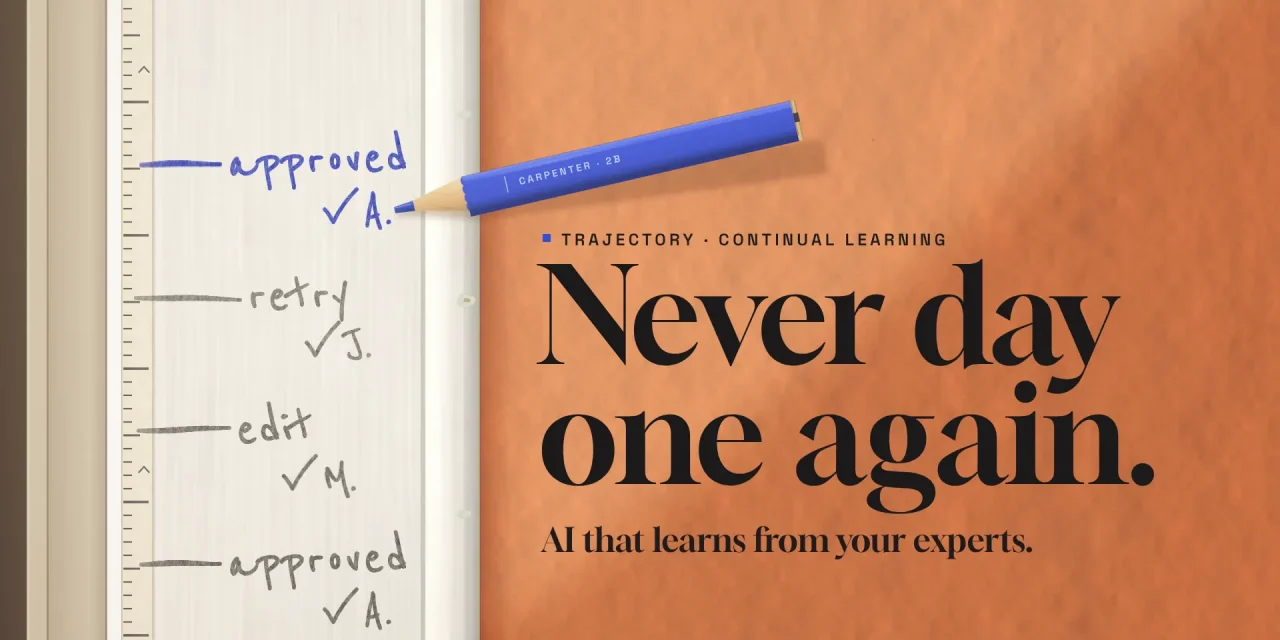
Trajectory wants your AI model to get better every week from the work your experts already do with it. When a lawyer rewrites an AI-drafted memo or an analyst corrects a valuation, that edit becomes a training signal. The open model behind your application is retrained on it, tested and redeployed. The young startup raised $45 million in a Series A led by Sequoia on 2 November 2026, at a $300 million valuation, and opened its platform at the same time.
The idea is called continual learning. Companies could already fine-tune a model on their own data. What is new is who sets the bar, where the signal comes from and how often it can happen. This article explains how the platform works and the three technical ideas behind it, what the first results show, and what European companies should settle before they send production traces to a US platform that promises they will own their value function.
Why AI models don’t learn from their own work
A language model is frozen once training ends. You can give it a better prompt or more documents, but its weights do not change because you use it. A correction a user makes today is forgotten tomorrow. In Trajectory’s manifesto, co-founder Arjun Karanam puts it this way: “The smartest thing we have ever built is the one that does not get smarter from being used.”
CEO Ronak Malde compares a foundation model to a very smart PhD student who is always starting a new job. Smart enough, but what the economy values is someone who has done that job for thirty years. Co-founder Michael Elabd has described today’s agents as episodic: they finish a task, get feedback and then reset.
The missing experience sits in every product. A user who edits an answer, asks again or discards a suggestion is telling you exactly what went wrong. In a Sequoia podcast, Karanam argues that such edits, undos and retries are better signals than a noisy thumbs up or down. Trajectory builds the infrastructure to capture that signal and turn it into training.
Who is behind Trajectory
Three Stanford classmates founded Trajectory about a year ago. Ronak Malde was at Windsurf and among the researchers Google DeepMind hired from there. Michael Elabd was a researcher at DeepMind, and Arjun Karanam worked on generative foundation models at Apple. The team has about 18 people, including researchers and designers from OpenAI, Meta, Stripe and Netflix.
In May the company raised $15 million from investors including Conviction and Bessemer, with Jeff Dean and Fei-Fei Li also backing it. Sequoia leads the new round, joined by Nvidia, Bessemer and Bain Capital Ventures. Trajectory names Harvey for legal work, Rogo for financial analysis and Decagon for customer service as customers, along with Clay, Mercor and Nvidia.
How the Trajectory platform works
Trajectory bundles what used to be four separate products: sandboxes for agents to work in, evaluations, training and deployment. The documentation is built around a handful of concepts.
- Connect your agent. Your application keeps running on your own infrastructure. You route model calls through Trajectory and log a score for each attempt. The company says this takes about five lines of code.
- Define what good looks like. Trajectory calls this a spec: a set of tasks, the harness the agent works in, and a grader that scores every attempt. Without a grader, you collect traces first and define the learning signal later.
- Collect signals. Every attempt yields a trace, with what the model did and which tools it used, and telemetry on how the user responded. The company calls the combination a trajectory, hence the name.
- Train. One click starts a reinforcement learning run on an open base model. You set the token budget, the number of turns, the reasoning effort and the RL algorithm.
- Compare. Each checkpoint is tested on tasks the model did not see during training and set against other models.
- Deploy. The best checkpoint becomes the model your agent serves, after your own evaluations and approval. Then the loop starts again.
Building this loop in-house with a machine learning team takes months. Karanam estimates the hands-on effort for a customer at about fifteen minutes, excluding training time. That is the promise behind the title of the launch post, Own your value function: you decide what good means, the platform does the rest. One customer trained more than eight models for long, complex agent tasks in two weeks.
Three ideas that make Trajectory different
Trajectory’s innovation lies in three problems that have held continual learning back. The company has published research notes on each of them over the past months, with methods and numbers. The two key ones came out at launch.
1. Experts write the reward, without thousands of labels
Reinforcement learning needs a reward function that scores each attempt. For code, a unit test can do that. For a legal memo or a credit analysis, the standard is expert judgement, and it differs from firm to firm. Writing a rubric for every task is slow. Trajectory calculates that 10,000 tasks at half an hour each would cost about 5,000 hours of expert time. And when the task mix shifts, those criteria go stale.
Its answer is Continual Grading. Instead of building a grader per task, the system learns a metagrader: a program of prompts and code around a fixed judge model that writes a grader for any new task. A strong model proposes candidates based on a small set of tasks that experts have already graded. The candidate that most often ranks answers the way the expert did wins. Because the result is a readable program rather than a new neural network, an expert can inspect and correct it.
The results are promising but modest. On τ³-Bench, a benchmark for customer service and business workflows, 60 labelled tasks were enough to rank 80% of answer pairs in the same order as the expert. A model trained with that metagrader rose from 80.0% to 84.9% on the true grader. Training on the benchmark’s original graders reached 87.8%. A generic one-line judge produced essentially no improvement over 40,000 attempts.
2. Learning from a single attempt, as in real life
The most popular RL method for language models, GRPO, has the model attempt the same task several times, say eight. The average of those scores is the baseline: an attempt that beats the average is reinforced. That works in a test environment you can reset. In production it does not. You cannot replay a customer conversation, an API that has since changed or a real client’s file eight times.
Trajectory builds on FlashREINFORCE, a recent method that learns from one attempt per task by comparing it with the average of the whole batch. Every task then gets the same baseline, however easy or hard it is. Group Size 1, or GS1, refines this: as a baseline it uses a weighted average of the scores on other tasks in the same batch. Tasks count more when the current model is expected to score about as well on them, which it infers from what is known in advance, such as the prompt. That removes the need for a separate critic model, as in the older PPO method.
On AutomationBench, GS1 matched GRPO while seeing eight times as many different tasks per training step. FlashREINFORCE, with one batch-wide average, collapsed there at a higher learning rate, from 21.7% to 7.2%, while GS1 stayed stable. On LABBench2, GS1’s held-out score rose from 63% to 68% and stayed there. The company notes that the gain depends on how well task difficulty can be predicted in advance.
3. Cheap enough to do often
Continual learning only makes sense if each training round stays affordable. Trajectory therefore focuses on smaller open models. Its research team also built, with UC Berkeley’s Sky Lab and Anyscale, a system that runs several LoRA training jobs at once on the same GPUs. LoRA trains a small adapter instead of all the weights. In a test with eight experiments, the full sweep finished 2.8 times faster than running them one after another.
The company also optimises for intelligence density: performance per generated token. After a first training round, a small Nemotron model needed about 90,000 tokens per legal task for ten passed tasks. A second round cut that to 37,000 tokens for the same ten, with no loss in score. With models this small and efficient, Trajectory says it becomes feasible to retrain per customer every night rather than once a quarter for everyone.
What it delivers, in numbers
Most results come from Harvey LAB, an open benchmark from legal AI company Harvey that launched in May with more than 1,200 tasks across 24 practice areas. According to Trajectory, it now has 2,010. An agent might have to review a data room of contracts and write a memo on an acquisition. A task only counts as passed if every rubric criterion is met, sometimes more than fifty of them. That is why the percentages are low.
| Model on Harvey LAB | Before training | After training on Trajectory |
|---|---|---|
| Nemotron 3.5 Lightning, open, 30 billion parameters | 0% | 8.3% |
| Nemotron 3 Ultra, open, 550 billion parameters | under 1% | 5.8% |
| Nemotron 3 Super, open, 120 billion parameters | under 1% | 3.3% |
| Claude Opus 4.6, closed, for comparison | 6.6% | not trainable |
| Claude Sonnet 4.6, closed, for comparison | 4.2% | not trainable |
For Ultra’s base score, Trajectory reported 0% in June and 0.8% in August. The smallest model, Nemotron 3.5 Lightning, went from 0% to 8.3%, ahead of Claude Opus 4.6 on the same tasks. Nine of the 24 practice areas improved and none regressed. For Nemotron 3 Ultra, the share of rubric criteria met rose from 52% to 83%, just below Sonnet 4.6 and Opus 4.6 at 85% each. Trajectory post-trained that model within 24 hours of Nvidia’s release, reusing the recipe it had built for Super.
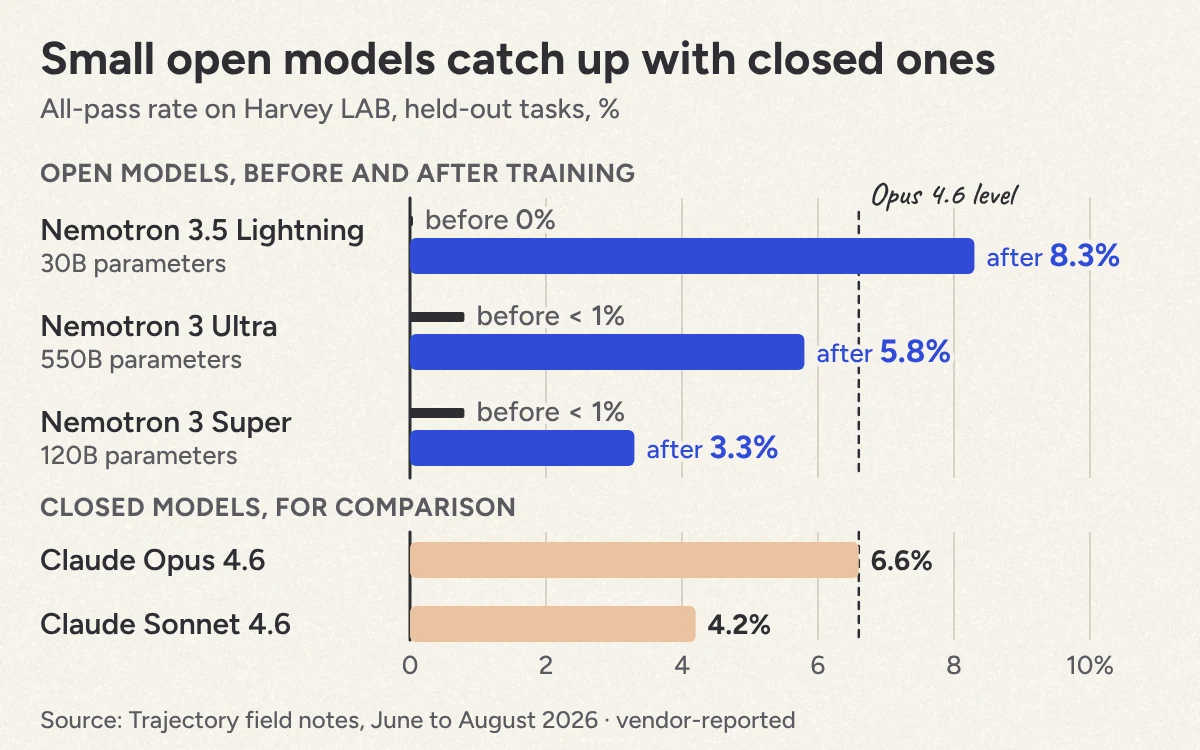
The launch post goes further, claiming that Lightning’s 8.3% matches Claude Opus 5.5’s score at a hundredth of the cost and 3.8 times the speed. That comparison does not appear in the underlying research note, and we found no independent confirmation. All figures come from Trajectory itself, on one benchmark, with only a handful of tasks per practice area. They show the method works, not that every company will see the same jump.
Pricing and trainable models
Trajectory only trains open models. Its pricing page lists eleven trainable models in early November, from Nemotron 3.5 Lightning to GLM 5.3. You pay per million tokens, with separate rates for input (prefill), sampling and training; deployed models are billed at the input and sampling rates. Training costs $0.88 per million tokens on Nemotron 3.5 Lightning, $2.55 on Nemotron 3 Super, $10.96 on Nemotron 3 Ultra and $14.00 on GLM 5.3. Closed models such as GPT-6 Astra and Claude Opus 5.5 can be used for comparison or as graders, but not trained. Sandbox compute and trace storage are billed on top.
Competitors exist. Tinker from Mira Murati’s Thinking Machines Lab is an API for training open models with LoRA and RL, but you write the training loop and the reward yourself, so it is aimed at researchers and ML teams. Tinker is also a building block: Trajectory’s documentation says deployments are backed by Tinker training state, and Thinking Machines lists Trajectory as a user. Applied Compute, which builds training and inference infrastructure for enterprises, was recently valued at $3.25 billion according to TechCrunch. Trajectory’s bet is that the lawyer, the analyst or the support lead who knows what a good answer looks like should be the one in the driving seat.
Own your value function, but what does a European firm actually own?
Trajectory’s pitch speaks to a European worry. Its own research note on the sovereign path argues that post-training an open base turns an agent into “something a firm can inspect, govern, and stand behind”. That is true for the weights. The rest of the stack needs a closer look before you sign.
- Where the trained model runs. The sovereign-path note says the model can be hosted inside a firm’s own secure cloud, but the documentation only describes a managed endpoint operated by Trajectory. It does not mention EU hosting, self-hosting or data residency. If sovereignty is the reason you chose an open model, ask whether you can export the checkpoint and serve it yourself, for example next to a European open model such as Mistral Large 4.
- Production traces are personal data. Prompts, answers and the edits your staff make will often contain client names, case details and information about the employees themselves. Trajectory then processes personal data on your behalf, which calls for a data processing agreement under Article 28 of the GDPR. The website privacy policy, last updated in May 2026, mentions transfers to the United States and other countries but not the GDPR or any transfer mechanism, and it explicitly leaves data processed for customers to the customer agreement. So the DPA is where the answers must come from. Ask whether Trajectory relies on standard contractual clauses or the EU-US Data Privacy Framework, and which subprocessors see your data, including Thinking Machines, whose Tinker the deployments run on. If you want the approach Karanam described for customers with strict data terms, training on synthetic data that mirrors your distribution instead of on your raw data, get that commitment in writing.
- Your employees become training data. Recording how individual experts correct AI output is a form of tracking their work. Tell staff what is captured and why, and check whether local rules require you to consult employee representatives first.
- The AI Act cares about feedback loops. Fine-tuning an open model with a fraction of its original compute will usually not make you a provider of a general-purpose AI model, as we explained in our piece on weight-space programming. But if your agent falls into a high-risk use case, Article 15(4) of the AI Act requires systems that keep learning after deployment to limit biased outputs feeding back into future input. Under recital 128 and Article 43(4), changes from such learning do not count as a substantial modification, and so do not trigger a new conformity assessment, provided the provider predetermined them and described them in the technical documentation at the initial assessment. Those high-risk rules apply from 2 December 2027 for Annex III systems, so now is the time to design the loop with them in mind.
- Your exit. Retrained weights are only part of what you build. Your specs, graders and traces are what let you keep improving. Make sure the contract lets you take all of them with you.
Frequently asked questions about Trajectory
What is continual learning in AI?
An AI model that keeps learning from real use after launch instead of staying frozen until the next version. With Trajectory, corrections, retries and expert judgement become a reward signal on which the model is regularly retrained.
Is Trajectory the same as fine-tuning?
It is a form of post-training, but it uses reinforcement learning rather than only imitating examples, and it runs as an ongoing loop: collect, grade, train, test and deploy.
Can I use Trajectory to retrain ChatGPT or Claude?
No. You train open models such as Nemotron, Qwen and GLM. Closed models from OpenAI and Anthropic can be used on the platform for comparison or as graders.
Can European companies use Trajectory?
The platform is self-serve with a waitlist and lists no regional restrictions, but also no EU hosting. Continual Grading and GS1 are labelled research preview, and learning from live production traffic is still in private beta. Check where your data is processed, what the contract says about training on it and how you would meet GDPR transfer rules before connecting real traffic.
The real product is the standard you set
Trajectory does not sell a smarter model. It sells a way to teach an ordinary open model your own standard. That shifts the question from which model is best to whether your organisation can write down what good work looks like. Firms with clear rubrics, curated examples and experts who are given time to correct the AI will get the most out of continual learning. In Europe, the same firms will also have the documentation the GDPR and the AI Act expect. Both are worth starting on now, whether or not you ever use Trajectory.