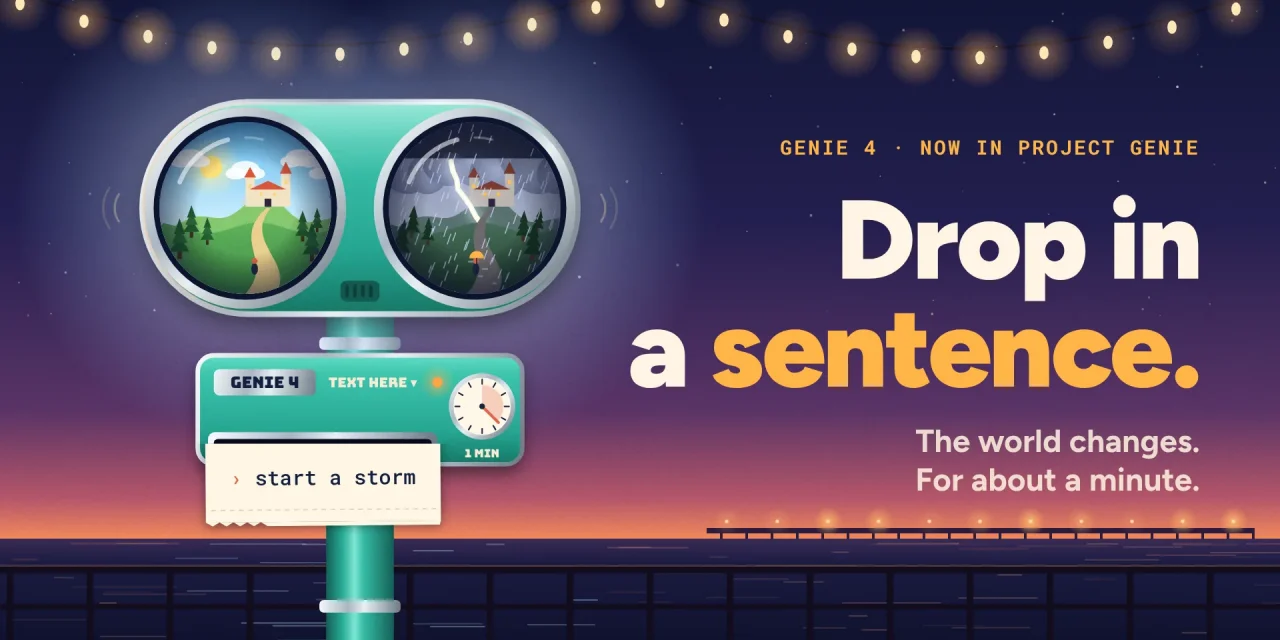
Since 18 November, Genie 4 is available in Project Genie, Google’s browser app for building interactive worlds and walking through them. You describe a place to a new Project Genie agent, it sets the look and the soundtrack, and while you explore you change the world with a sentence, with sound and dialogue generated as you go. Access requires Google AI Ultra, and according to Google’s own help pages that includes the EU. The bigger change for organisations is not the model but the platform around it. A gallery where worlds are published and remixed turns Project Genie into a place where your staff’s prompts, images and names can end up public, on personal accounts, with no business terms and no API yet.
What changed on 18 November
Google launched Project Genie in January as an experimental prototype running Genie 3. The update announced on 18 November by Diego Rivas of Google DeepMind and Pavan Kumar of Google Labs adds five things.
- Genie 4 in the model picker. The world model DeepMind showed to trusted testers in October now runs in the app. You edit the world while it runs, and real-time audio follows the scene, from ambient sound to characters who talk back.
- The Project Genie agent. You build a world in a conversation. The agent orchestrates Google’s multimodal models to create the opening visuals and a custom soundtrack.
- Gemini as co-pilot. Gemini can watch your screen, suggest where to go next or trigger events in the world.
- A community gallery. Curated, creator-made and user-made worlds that others can explore and remix by changing their structure, soundtrack or rules, then publish again. Examples include Villa Giallo, a room-by-room mystery built with creative technologist BLVCKL!GHT, and The Life of Ants with filmmaker Anand Gandhi.
- A richer Genie 3. The older model stays available with sessions of up to three minutes, up from 60 seconds, plus world chaining, 360-degree panorama grounding and in-world events triggered by text.
For how Genie 4 works as a model and how Gemini plans and checks what it renders, see our first analysis of Genie 4. This article is about what it means now that people can use it.
Genie 4 or Genie 3
The choice is realism or time. Genie 4 looks more real, generates its own audio and lets you steer the world as you explore it, but DeepMind’s model page says it “currently supports around a minute of continuous interaction”. Genie 3 has no scene-aware audio, but gives you three times as long and more ways to build a world.
| Feature | Genie 4 | Genie 3 |
|---|---|---|
| Length per world | about a minute | up to three minutes |
| Audio and dialogue that follow the scene | yes, in real time | no |
| Edit the world with text while exploring | yes | yes, new in this update |
| Chain worlds into a longer journey | not mentioned | yes |
| Start from a 360-degree panorama | not mentioned | yes |
Yes, European teams can use it now
Google’s Project Genie help page says the app is available to Ultra subscribers “where Google AI Ultra is available”, and Google’s Ultra country list includes all 27 EU member states. Google announced in May that Project Genie was rolling out globally to eligible subscribers, and heise reports that access works in Germany.
That corrects our article of 28 October, which said Project Genie was not available in the EU. We relied on the country list in the Google Labs FAQ, which still names no EU country but is out of step with Google’s more recent help pages. Two caveats remain. Google is rolling out Genie 4 gradually, so not every subscriber sees it on day one, and we could not test access ourselves.
The conditions matter more for organisations than the geography. Users must be 18 or older and sign in with a personal Google Account. Google says nothing about Workspace accounts, enterprise terms or data processing agreements. Project Genie is not included in Google AI Pro, whose members can join a waitlist. Google AI Ultra costs €99.99 or €219.99 a month in Belgium according to Google’s Belgian price page, and Google’s US plan page ties Project Genie to the 20x tier, so budget €219.99 per person to be safe. There is still no Genie 4 API. Google promised early access for partners in the Gemini API and AI Studio in October without a date or price.
From prototype to publishing platform
The gallery is what changes the risk profile. Until this update, the gallery held curated worlds, and users mostly kept their own creations to themselves or downloaded a video. The help page now describes three levels of exposure.
- A shared link lets anyone who has it view, explore and remix the world.
- When remixing is allowed, others can see the prompts, images and other assets used to create the world, and reuse them in their own version.
- Publishing to the gallery makes the submitted version public together with the account name tied to the creator’s Gmail address. Later edits only appear after republishing.
Deleting your data also deletes your shared and published worlds, and Google says it reviews reports and may remove worlds that break its policies. That is a familiar user-generated content model, now applied to interactive scenes with sound and talking characters. The same tension between free remixing and licensed use is playing out in music, as we described in our analysis of Fadr and licensed AI remixes.
Five things to settle before your team publishes a world
| Question | Why it matters | What to do |
|---|---|---|
| Whose account? | Only personal Google Accounts work, so early use will sit outside company IT and contracts. | Decide who may use Project Genie for work, on which accounts, and who pays. |
| What goes into a prompt? | According to the Labs FAQ, interactions help improve Google’s models and may be reviewed by trained reviewers and kept for up to 18 months. With history off, Google keeps them for up to 72 hours. | Keep unreleased designs, client sites and confidential material out. |
| Who is in the picture? | Living Memory turns personal photos into explorable spaces. Google’s own rule is no personal information or images of other people without permission, and the GDPR applies to photos of identifiable people. | Use your own or licensed images, and get consent for anyone recognisable. |
| How is it labelled? | SynthID marks all video and audio, which covers Google’s duty as provider. Under Article 50 of the AI Act, which applies since 2 August 2026, organisations that use realistic synthetic content of real people, places or events must disclose it, with a lighter duty for evidently artistic or fictional work. | Add a visible AI label to any world or video you publish professionally. Our AI Act timeline lists the other dates. |
| Who owns it? | The Labs FAQ says Google will not claim ownership of what you generate, while commercial use follows Google’s terms. Remixable assets can be reused by anyone. | Switch off remixing for brand work, check the terms before commercial use and check the origin of any world you remix. |
Recognisable likenesses are a real risk, not a theoretical one. Shortly after the January launch, users made playable imitations of Nintendo games such as Mario and Zelda, as reports at the time showed. A gallery makes such worlds easier to spread, and our piece on deepfake detection in identity checks shows how quickly realistic synthetic media turns into a trust problem.
Where it is useful today
With sessions of a minute and no export to Unity or Unreal, Genie 4 is a sketchbook rather than a production tool. That still leaves room for value.
- Previsualisation. Directors and agencies can try a mood, a camera move or a line of dialogue before a shoot.
- Concept prototyping. Game and experience designers can test whether an idea feels right before engine work starts.
- Education and heritage. Teachers and museums can let people walk through a scene, provided they label it clearly as a reconstruction.
- Not yet for training or safety testing. Google lists camera latency, intricate physical interactions, audio precision and long-term scene permanence as unsolved, and Decrypt notes that the claimed gains in motion and physics come from Google’s own demos rather than independent tests.
Frequently asked questions
Is Project Genie available in the EU?
Yes, according to Google’s help page it is available wherever Google AI Ultra is sold, which includes all EU member states. Genie 4 is rolling out gradually.
How long does a Genie 4 world last?
About a minute, according to DeepMind. Genie 3 sessions now last up to three minutes.
Can a company use Project Genie with Workspace accounts?
Google only mentions personal Google Accounts and publishes no business terms for Project Genie.
Is there a Genie 4 API?
Not yet. Google announced early access for partners in the Gemini API and AI Studio in October, without a date or price.
A gallery before an API
Google opened Genie 4 to creators and their audiences before it opened it to developers. For European organisations that order matters. The first Genie worlds made for your brand, your classes or your clients will not come from an IT project but from individual employees on personal accounts, in an app with a public gallery. Writing a one-page rule on accounts, images, labels and remix settings now costs less than taking down a published world later, and it will still be useful when the API arrives.