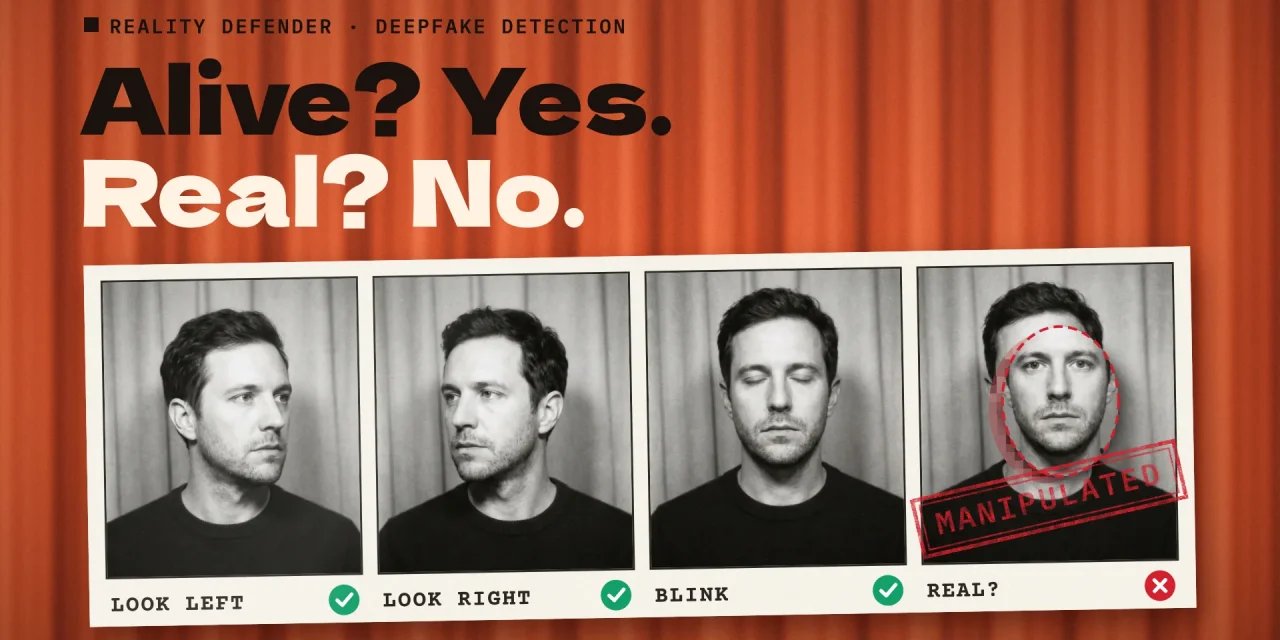
In July, Google let people recover their accounts with a short selfie video in which they turn their head on command. Within a week, the red team of deepfake detection company Reality Defender had enrolled a real-time face swap in that flow, twice out of two attempts. The test proved that a check for a live person is not a check for a real face. That gap is the market Reality Defender sells into, now with backing from BNY, Accenture, IBM Ventures and, since September, a minority stake from KPMG. This article explains what the company does, where its check belongs in an identity and communication stack, what independent tests say, what European rules do and do not solve, and what to ask before you buy.
What the Google test showed, and what it did not
Google introduced selfie video as an account access and recovery option on 23 July 2026. Reality Defender’s red team used a Google account it owned, had an employee follow the head-movement prompts live, and fed the camera stream through commercially available face-swap software on a Windows laptop. Google accepted the synthetic face at enrolment both times, the company writes in its red-team report.
The authors are careful about the limits. They did not take over anyone else’s account, did not test recovery with the enrolled face, and stress that the feature is account recovery rather than formal identity verification. Biometric Update covered the test in August. What remains is a design lesson for every onboarding, recovery or step-up flow that relies on a face. Liveness proves that someone responds in real time. It says nothing about whether the face on the screen belongs to that someone.
Reality Defender in brief
Ben Colman, a former Goldman Sachs vice president, founded Reality Defender in New York in 2021 with Ali Shahriyari and Gaurav Bharaj. It started as a non-profit, joined Y Combinator in 2022 and raised a Series A that grew to $33 million by October 2024, led by Illuminate Financial and DCVC. Strategic money from BNY, Samsung Next and Fusion Fund followed in 2025, and KPMG LLP took a minority stake on 10 September 2026 to build deepfake detection into its cyber and fraud practice. The amount was not disclosed. Gartner named Reality Defender a Market Shaper in its first Emerging Market Quadrant for deepfake detection startups in June 2026, alongside GetReal Security.
The product line is simple. RealScan is a browser tool for analysts, RealAPI sends files from your own software, RealCall checks voices in phone menus and live calls, and RealMeeting analyses audio and video in Zoom and Teams. Behind all four sits an ensemble of detection models whose scores are combined into one result. The API documentation returns AUTHENTIC, SUSPICIOUS or FAKE, plus a score per model. The published prices start with a free plan of 50 scans a month, which the current FAQ limits to images, and a Business plan at $399 a month for 1,000 image, audio and video scans. Live calls, meetings and on-premises deployments are sold as Enterprise contracts.
Where a deepfake check sits in the identity chain
Reality Defender’s own recommendations after the Google test read like an architecture brief. Treat liveness as necessary but insufficient. Add media manipulation detection, checks on the capture source for virtual cameras and injected video, device integrity and session risk, and require step-up verification for high-risk enrolments and recoveries. The animation below shows how those layers relate.
The deals of the past year show where vendors expect that layer to live.
- Onboarding. AU10TIX adds Reality Defender’s verdict on the selfie to its document and biometric signals, so a bank can route a suspicious onboarding to manual review.
- Contact centres and telephony. Orange Business is building the detection into its video conferencing, contact centre and voice services, which matters for European buyers who prefer to buy security from their telecom provider. Reality Defender describes an unnamed global bank that screened more than 2.4 million customer calls in 2025 and found about 1,010 with a synthetic voice, roughly one in 2,400.
- Meetings and hiring. RealMeeting targets impersonation in video calls, including job interviews, where face swaps have already been caught in remote hiring.
- Devices. Samsung Electronics Singapore signed a memorandum in October to run the detection on Galaxy devices alongside Knox, so sensitive media need not leave the phone.
Voice cloning is the common thread. One-shot cloning is now a standard feature, as our article on Miso Labs shows, and Italy’s Intesa Sanpaolo lost about €95 million in February 2026 after its private bank Fideuram approved transfers following WhatsApp messages and a call with a cloned voice of its chief executive, VRT NWS reported. About €59 million was recovered.
What independent tests say
There is no neutral, apples-to-apples benchmark for this market yet. Two independent tests name Reality Defender, and they point in different directions.
On images, a Purdue University team tested nine commercial detectors in September 2025 on real political deepfakes that circulated on social media since 2018. Reality Defender had the highest accuracy of the nine, 93.5%, according to Fit for Purpose? Deepfake Detection in the Real World. Its video detector was not in that test, and none of the video tools beat a baseline that labels everything fake.
On audio, the Podonos benchmark ran 4,524 English clips, half real and half made with about 25 speech generators, through each vendor at its shipping threshold. Reality Defender reached 71.3% accuracy, flagged 53.7% of genuine recordings as fake, left clips under 1.5 seconds unscored and took longer to analyse a clip than the clip lasted. Resemble AI scored 98%. Two caveats apply. The test is English only, and Podonos has published a case study with Resemble AI, the winner.
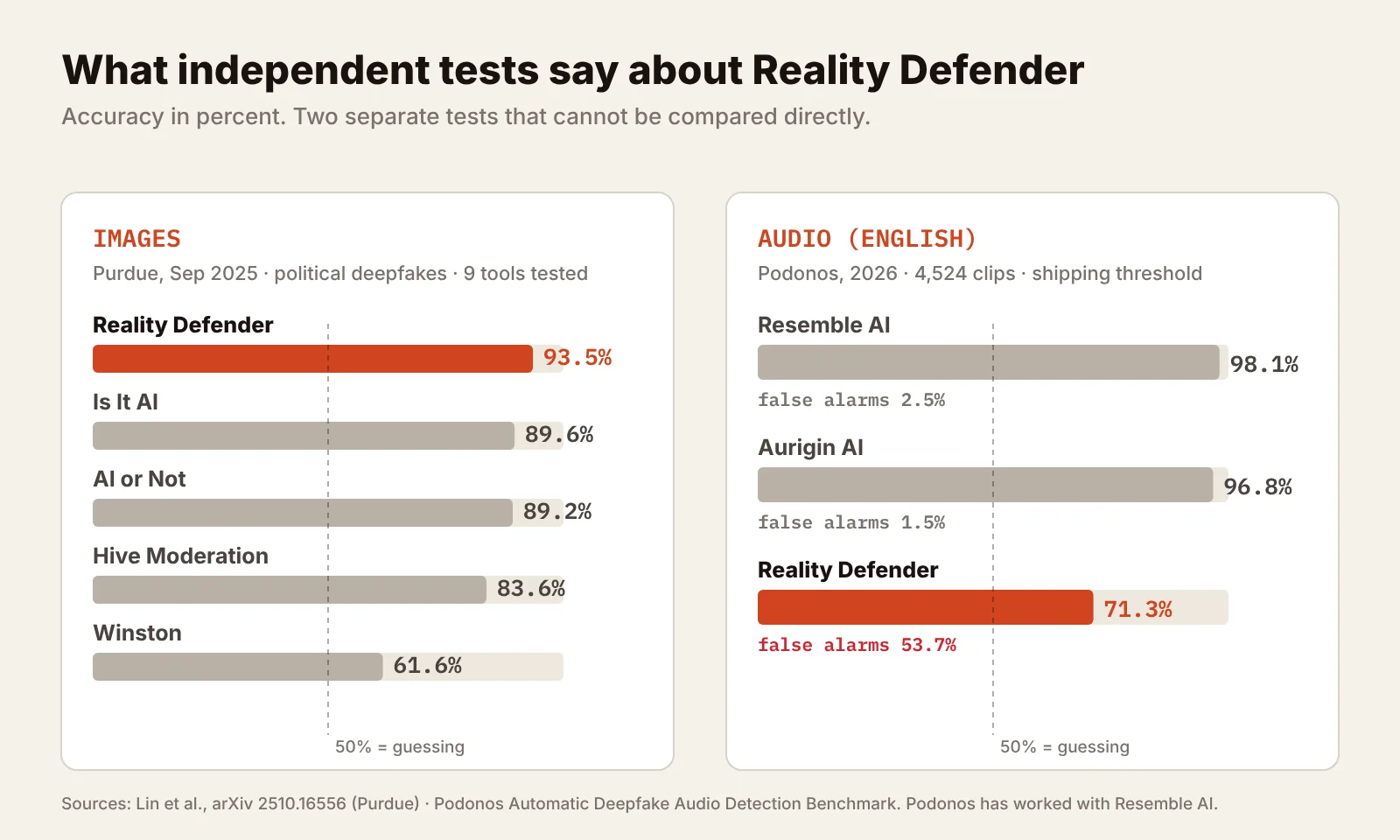
Reality Defender argues that lab sets do not predict production results, where customers tune thresholds to their own risk. The academic Deepfake-Eval-2024 study supports part of that: open-source detectors lose up to half of their performance on deepfakes found in the wild, and commercial tools do better but still trail human forensic analysts. The same argument also means vendor claims cannot be taken at face value. People are no alternative either. In a challenge at DEF CON in August, run by Reality Defender itself, security professionals scored below chance on a 30-item deck they knew was half fake.
What European rules do and do not solve
Since 2 August 2026, Article 50 of the AI Act requires anyone who uses AI to create or manipulate a deepfake to disclose it, and the Digital Omnibus left that date untouched. Our guide to the AI Act after the Digital Omnibus covers the timeline. Labelling binds honest deployers. A fraudster who calls your finance team with a cloned voice will not label anything, which is why detection exists as a separate control.
Detection brings its own obligations. Analysing the voices and faces of customers, staff or job candidates is processing of personal data under the GDPR, so you need a legal basis, a data protection impact assessment where the risk is high, and clarity on where media are processed and how long they are kept. Ask your data protection officer before you switch it on. Reality Defender offers SaaS by default and private cloud, on-premises or air-gapped deployments for Enterprise customers. The Samsung project shows a third route, analysis on the device itself. If you are mapping AI risk for security teams more broadly, our piece on AI and Europe’s security reporting clocks gives the wider context.
Six questions to ask any deepfake detection vendor
- What is the false positive rate at the threshold we would use, on traffic like ours? A 53.7% false alarm rate on genuine audio would swamp any contact centre.
- Which languages have you tested independently? Public audio figures are English only. Ask for Dutch, French, German or whatever your customers speak.
- How fast is the verdict on a live call? In the Podonos test, Reality Defender’s file analysis took about 1.5 times the length of the clip.
- How quickly do you cover a new generator? The founders declined to give a lead time when asked on Hacker News.
- Where is media processed and stored, and for how long? This decides your GDPR assessment.
- How do we explain a decision to a customer or a court? The founders themselves call the score one signal among many, not proof.
Frequently asked questions
Does liveness detection stop deepfakes?
Not on its own. Liveness checks that a person responds in real time. Reality Defender’s test on Google showed that a real-time face swap can pass such prompts, so a separate check on the media itself is needed.
Can European companies use Reality Defender?
Yes. The API is available online, Orange Business is integrating the detection into its communication services, and Enterprise customers can deploy it in their own cloud or on premises.
How much does Reality Defender cost?
There is a free plan with 50 image scans a month and a Business plan at $399 a month for 1,000 scans across image, audio and video. Live calls and meetings require an Enterprise contract.
A score buys you a second look
The best use of a deepfake detector is not to deliver a verdict but to interrupt a process at the right moment, so a human calls back, asks for a second approval or escalates an onboarding. KPMG’s stake suggests that detection is becoming part of audit and assurance work, which raises the bar for evidence. Buyers who ask for error rates on their own traffic, in their own languages, will get better tools and fewer false alarms than buyers who accept a demo.