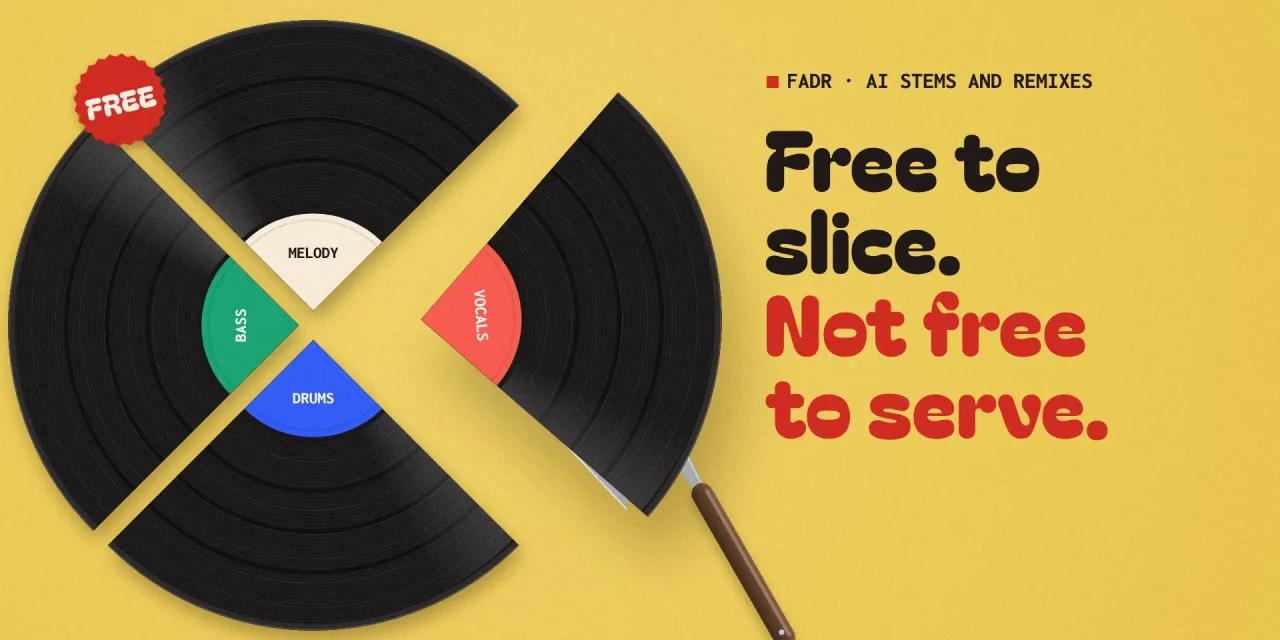
Fadr lets anyone split a song into vocals, drums, bass and melody, match it to another track and turn it into a remix or DJ set, for free and without a cap on the number of songs. Spotify is preparing the opposite model, an AI remix and cover add-on for Premium subscribers that is reportedly due in early 2027 at $4 to $5 a month and built on licences from Universal Music, Merlin, Kobalt and Believe. The technology to take music apart has become a commodity. What separates a hobby project from a publishable remix is the licence, and in 2026 European courts redrew where that line sits. This article sets out what Fadr does, what it leaves to you, and what brands, agencies, creators, music schools and media companies should check before a remix is published.
What Fadr does
Fadr is a browser tool from Pebble LLC, a small company in Virginia co-founded by musician Gabe Earle. You upload a file and it returns stems, the key, tempo and chords, and MIDI for the parts. Its Remix Maker and online DJ controller match key, tempo and beat between tracks automatically, so a mashup needs no music theory. The free Basic plan offers unlimited stems, remixes and DJ sets with MP3 downloads and songs of up to ten minutes. Fadr Plus costs $10 a month or $100 a year and adds sixteen stem types, 32-bit WAV, one-hour uploads, an API and three plugins: Stems, the text-to-synth Siren and the drum kit generator DrumGPT.
Quality is the trade-off. In an April 2026 comparison of twelve stem splitters by producer and educator Mattie, Fadr scored 4.9 out of 10 on quality, against 8.05 for the open-source Ultimate Vocal Remover, 7.85 for Moises and 7.2 for the built-in separation in Ableton Live. Fadr was fast, but its vocals were not competitive. That matters little for a party mashup and a lot for a campaign asset.
The free model leaves the rights with you
Fadr’s terms of service were last updated on 5 September 2023 and are governed by the law of Virginia. Users warrant that what they upload does not infringe anyone’s rights. Contributions remain yours, but you grant Pebble an unrestricted, perpetual, irrevocable and transferable licence over them, including the right to create derivative works. The terms do not make clear whether songs you separate count as contributions. Fadr’s blog calls DrumGPT sounds 100 percent royalty-free, yet the terms do not mention generated sounds at all and contain a general ban on using the site or its content for any revenue-generating endeavour without written permission.
The privacy policy dates from 4 September 2023. It does not mention the GDPR, does not say how long uploaded audio is kept and says nothing about training AI on uploads. Moises, by contrast, publicly states that it never trains on user uploads, as we described in our analysis of Moises. None of this is unusual for a free consumer tool. It does mean an agency should not upload a client’s unreleased master to it.
The licensed model, Spotify’s AI remix add-on
On 21 May 2026 Spotify and Universal Music Group announced licensing agreements for a paid Premium add-on that lets fans create AI covers and remixes of songs by participating UMG artists and songwriters, covering both recordings and publishing. Spotify’s co-CEO Alex Norström framed it around consent, credit and compensation. Merlin, Kobalt and Believe followed, with Believe and TuneCore artists going through a two-step opt-in. The Financial Times reported on 30 October that Spotify targets the first quarter of 2027 and is considering $4 to $5 a month on top of Premium. Sony Music and Warner Music were still negotiating, and royalty rates and splits have not been published.
The design choices are the opposite of Fadr’s. Only opted-in catalogues can be remixed, the output stays inside a licensed environment, and plays generate royalties for the original rights holders. Fans get less freedom and the artist gets paid.
What EU law now says about remixes
On 14 April 2026 the Grand Chamber of the Court of Justice ruled in Pelham II, case C-590/23, the long dispute over a two-second Kraftwerk loop. The court defined pastiche as a creation that evokes existing works while remaining recognisably different, and that shows an objectively recognisable artistic or creative dialogue with the source. Simply repeating an element without evident creative interaction does not qualify. In September Germany’s Federal Court of Justice applied that test and found the sample lawful as pastiche from June 2021, when Germany wrote the exception into its law.
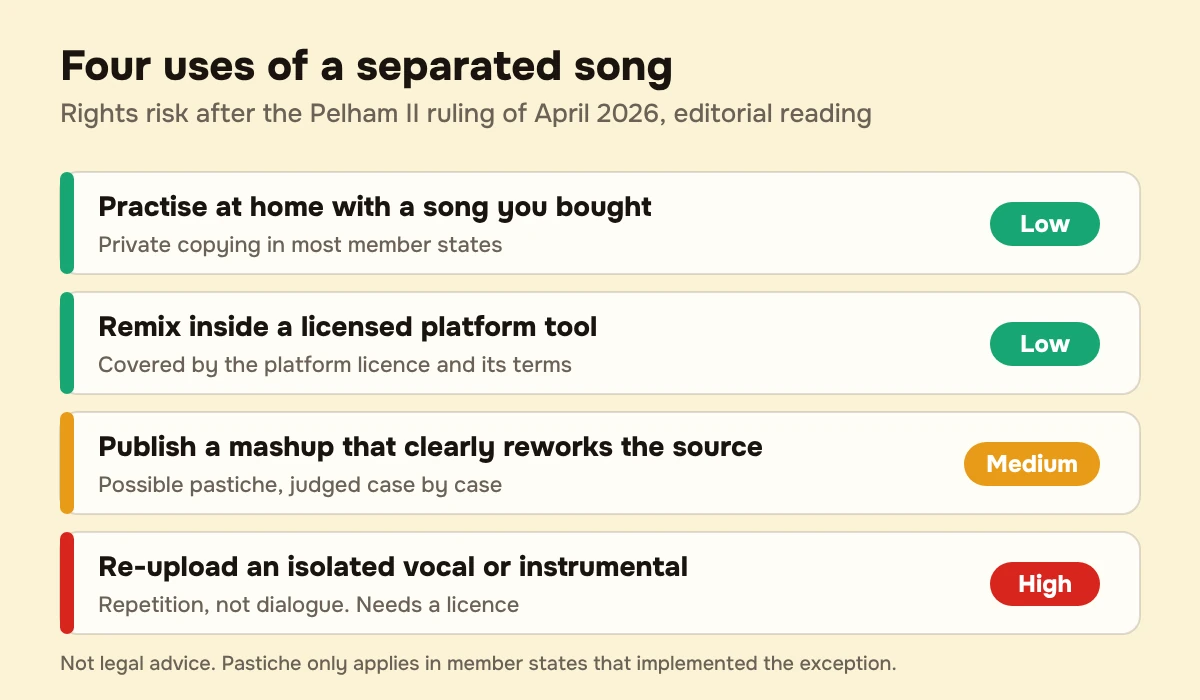
For remixers that is a narrow opening. A mashup that clearly reworks two songs into something new may be defended as pastiche, case by case, in member states that implemented the exception. Re-uploading an isolated vocal or an instrumental of a commercial track is mostly repetition and hardly a dialogue. Lawyers still advise clearance as the lower-risk route. Platforms also run their own content matching, so an unlicensed remix can be claimed or blocked long before any court looks at it.
Generated sounds bring the AI Act into play
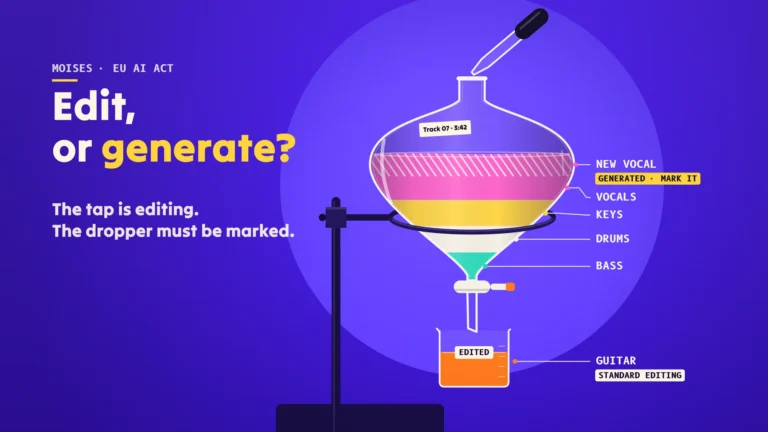
Stem separation itself probably sits on the editing side of Article 50(2) of the AI Act, which exempts systems that perform standard editing or do not substantially alter the input. Siren and DrumGPT are different. They generate new audio from a text prompt, which makes them candidates for the machine-readable marking duty for synthetic audio that applies to systems already on the market from 2 December 2026. Fadr has not said how it handles that, and it has not disclosed its training data. Teams that put generated synth or drum sounds into released work should record which tool produced them. Our earlier pieces on Suno v6 and Lyria 3 show how the full-song generators approach the same question.
What European organisations should check
- Decide what the remix is for. Practice, teaching and internal demos sit in a different place from a published campaign, a branded social clip or a commercial release.
- Clear the source before you choose the tool. A free tool does not include rights. For published work, license the song from its publisher and label, or use a licensed route such as Spotify’s tool once it launches, within its terms.
- Keep confidential audio off consumer tools. Unreleased masters, client jingles and recordings of staff belong in tools covered by a data processing agreement or that run locally, such as Ultimate Vocal Remover or the separation in Logic Pro and Ableton Live Suite.
- Get generator licences in writing. A blog post that says royalty-free is not a licence. Ask for written confirmation before generated sounds go into paid work.
- Treat pastiche as a defence, not a plan. Pelham II helps when a dispute arises. It does not replace clearance.
- Log what was generated. Keep a record of which sounds and parts came from AI, so you can label or disclose them when a platform, distributor or client asks.
Frequently asked questions
What is Fadr?
Fadr is a web-based AI music tool from the US company Pebble LLC. It separates songs into stems, detects key, tempo and chords, extracts MIDI and lets you build remixes, mashups and DJ sets. The Basic plan is free and unlimited, and Fadr Plus costs $10 a month or $100 a year.
Is it legal to remix songs with Fadr in the EU?
Separating a song you bought for private practice is covered by private copying rules in most member states. Publishing a remix of someone else’s song needs permission from the rights holders, unless an exception such as pastiche applies, which courts judge case by case. This is not legal advice.
Does Fadr train AI on uploaded songs?
Its terms and privacy policy, both from September 2023, do not address AI training, and the company has made no public commitment either way.
When will Spotify’s AI remix tool launch?
According to the Financial Times, Spotify targets the first quarter of 2027, possibly at $4 to $5 a month on top of Premium. Spotify has not confirmed a date or price.
The licence is becoming the product
Fadr shows how cheap the technical side of remixing has become: free, unlimited and good enough for most casual use. Spotify is betting that fans will pay a few dollars a month for what a free tool cannot give, a remix that rights holders agreed to and that pays the original artist. European law reaches a similar point from another direction, by allowing creative dialogue with a source but not simple reuse. For organisations the rule is short. Use free tools to explore and learn, and secure the licence before anything is published.