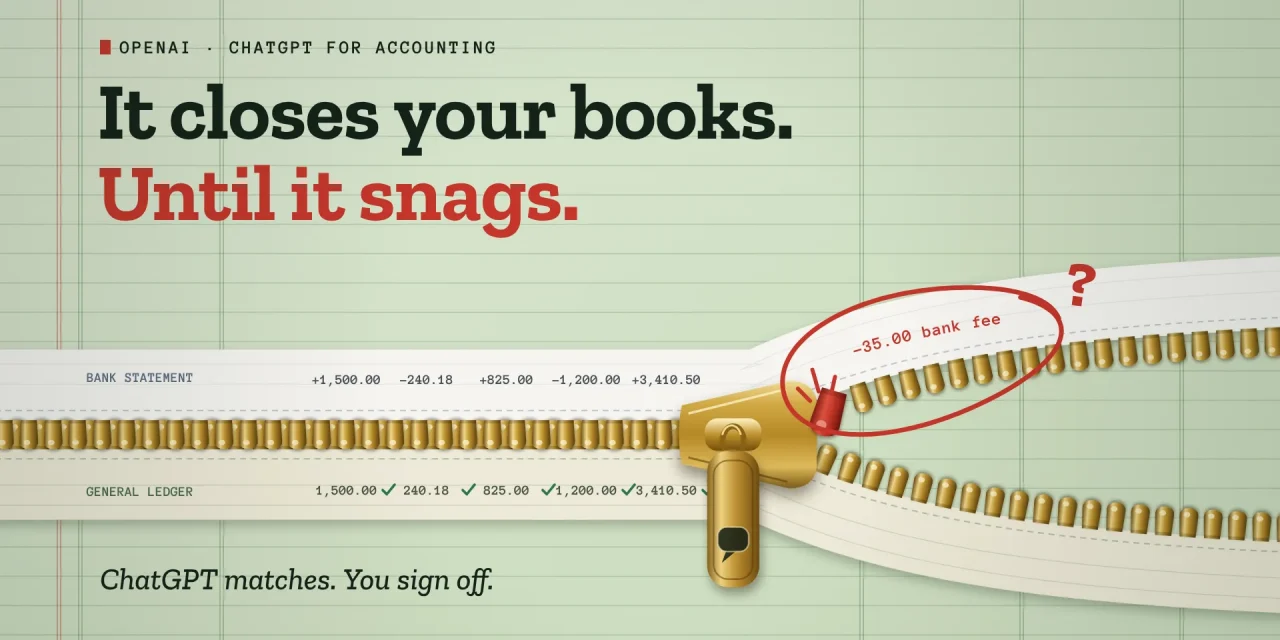
OpenAI launched ChatGPT for Accounting on 18 November 2026. It combines a free Accounting plugin, built by OpenAI, with partner plugins for Intuit QuickBooks, Xero, Oracle NetSuite, BILL, FreshBooks, Rillet and Campfire. ChatGPT reconciles bank transactions, drafts entries from invoices and receipts, prepares month-end reports and helps with audit prep. A person approves every change.
For European organisations this is mostly a preview. The partner list is North American, Xero says ChatGPT for Accounting is “currently available in the US”, and in Europe GDPR, data residency, professional secrecy and the AI Act decide how you may use it. The sensible move is to use the wait to build the controls that any AI close assistant will need. This article covers what the product does, how reliable AI is at accounting work today and what a European finance team should prepare.
What OpenAI shipped
The launch came through the ChatGPT account on X at 20:59 UTC on 18 November, one day after ChatGPT for Sales. OpenAI lists four jobs: month-end reports, bank reconciliation, data entry and audit prep.
- The Accounting plugin is version 1.0.0 and free to install. It carries a built-in accounting skill and bundles Gmail, Outlook, Google Drive and SharePoint, so ChatGPT can pull invoices and statements from mail and shared folders.
- Partner plugins from seven vendors give access to the records in their systems. ChatGPT for Sales launched with more than thirty.
- It runs in the ChatGPT desktop app on macOS or Windows with computer use switched on, according to the 18 November release notes. Business members can install it themselves. In Enterprise workspaces an admin has to approve it first.
How the Accounting plugin works
You start by choosing sources: upload an Excel template with the month’s files, or connect an accounting app with an account that can see the company’s records. Then you ask for, say, the month-end report in your usual format with the records behind each figure. That is the flow OpenAI describes in its guide to accounting work.
The built-in skill shapes how ChatGPT approaches the work. Before it decides that a bank line matches the ledger, it checks for partial payments, fees, reversals and settlement timing, since one payment can map to several entries. When it reviews a workbook, it points to the cell or transaction, explains the financial effect and suggests a specific correction, and it keeps existing formulas intact. Kingy’s first test found it matched a $1,465 deposit to $1,500 of receipts less a $35 fee and left an unexplained $120 debit open for review.
Templates, instructions and review procedures can be saved as reusable skills, so next month’s close runs the same way on fresh records. The output is a draft. “You make the final call,” OpenAI says. In Xero’s case the action happens back in Xero, which Xero describes as the place where the ledger lives and every change stays traceable.
Usually right is not the same as reliably right
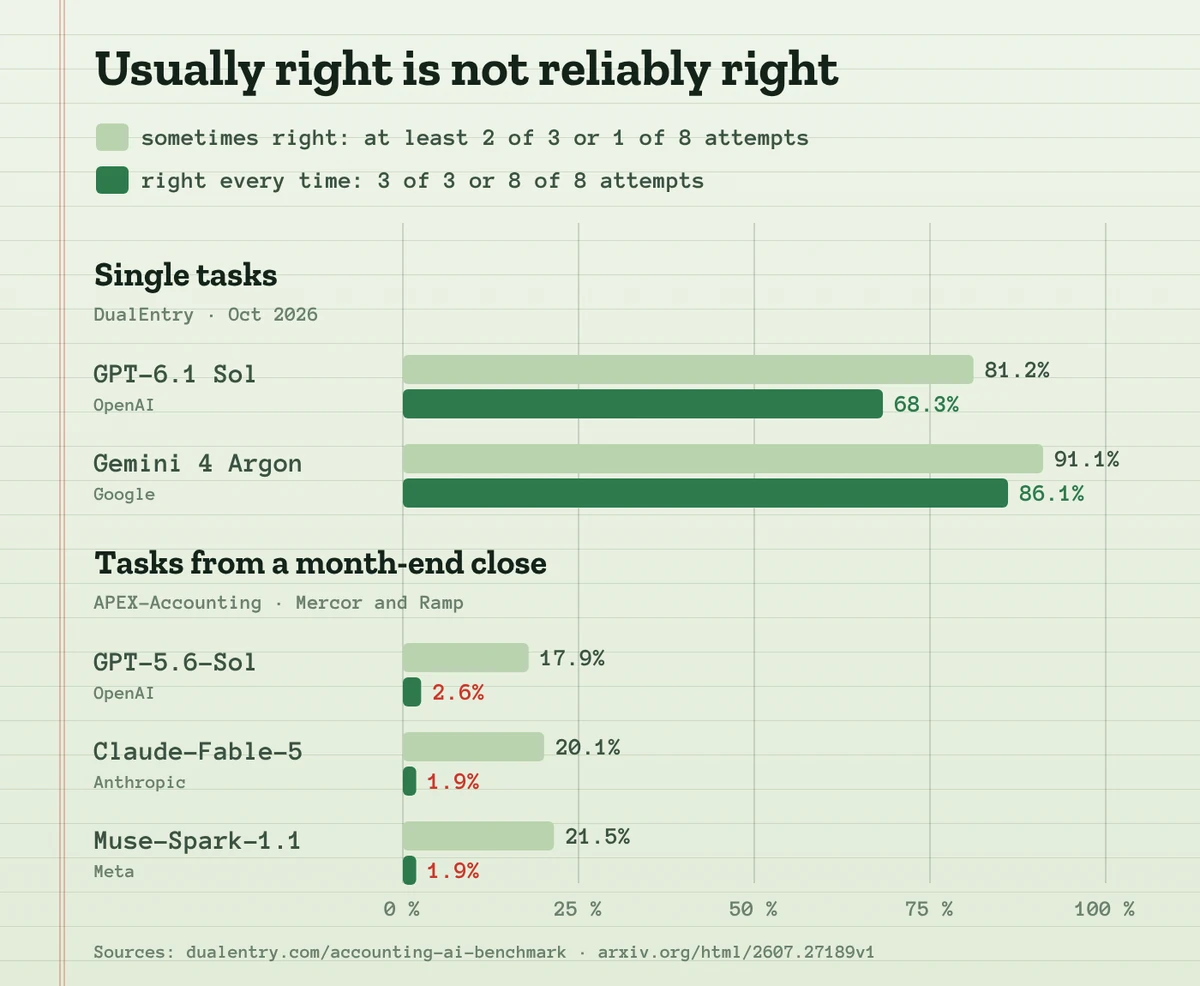
A close is unforgiving. A misclassified expense in January carries into every report after it. Three recent benchmarks show where models stand.
- Single tasks often work. On DualEntry’s benchmark of October 2026, 101 tasks from classification to month-end close, OpenAI’s GPT-6.1 Sol scores 81.2%. It is right in all three runs on 68.3%. The leader, Gemini 4 Argon, reaches 91.1%.
- Close work rarely works every time. APEX-Accounting, built by Mercor with Ramp, gives nine models 160 tasks inside simulated companies frozen at month-end. The best model solves 21.5% of tasks at least once in eight attempts. The best score for solving a task every time is 2.6%, from OpenAI’s GPT-5.6-Sol, and 58% of tasks were never fully solved by any model.
- Errors compound. In Penrose’s AccountingBench, the strongest models stayed within 1% of a human CPA after the first month, then drifted over the year as small mistakes carried forward.
The APEX authors put it plainly: “An agent that is usually correct but not reliably so cannot yet close the books unsupervised.” That is why OpenAI positions the product as a preparer and keeps approval with people. For a finance leader the design question is how review is organised so that errors surface.
Why Europe is not the launch market
The European ledger stack is missing
Europe runs on different systems. In Belgium that means Exact Online, Yuki, Octopus, Billit and, for accounting firms, Silverfin, as a Belgian overview of firm software shows. None of them is a launch partner. Exact has no MCP server of its own, so firms that want ChatGPT on their Exact data use third-party connectors such as Peliqan or Exact AI Connect, according to a comparison from October 2026. Each connector adds another processor with its own contract and security posture to assess.
Availability is not stated for the EEA
OpenAI does not say whether the Accounting plugin can be installed in the European Economic Area. Its plugin documentation says installation depends on plan, workspace, role and region. Xero says the product is available in the US for now. Computer use, which the plugin relies on, reached the EEA, the UK and Switzerland in June 2026. Check your own workspace before you plan a pilot.
E-invoicing changes where AI adds value
Belgium has required structured B2B e-invoices, mostly over Peppol, since 1 January 2026. Under the EU’s VAT in the Digital Age package, structured e-invoicing and near real-time digital reporting become mandatory for intra-EU B2B transactions from 1 July 2030. Where invoices already arrive as data, OpenAI’s data entry pitch matters less than it does in markets that still key in PDFs. The value moves to reconciliation, explaining exceptions and reporting. Some US tools are behind here: QuickBooks users in Europe are still asking how to handle Peppol.
Data, professional secrecy and the AI Act
OpenAI does not train on ChatGPT Business or Enterprise data by default. European data residency, however, is only offered for new Enterprise and Edu workspaces, along with in-region inference for eligible Enterprise customers since January 2026. Business is not included. For an accounting firm holding client data, that difference belongs in the GDPR assessment, not in the footnotes.
Many accountants in Europe also work under statutory professional secrecy. In Belgium the professional body ITAA warns that a regular ChatGPT account gives you no agreement with OpenAI, not even on the cheapest paid plan, and that secrecy follows the data into the tool.
Under the AI Act, a firm or finance team using these tools is a deployer. Routine bookkeeping automation is not high-risk, but AI literacy under Article 4 already applies to staff using it, and credit scoring remains a high-risk use with deployer duties from 2 December 2027, as Legal News sets out. The full schedule is in our AI Act timeline after the Digital Omnibus.
A control set for a European pilot
| Control | What it means in practice |
|---|---|
| Plan and contract | Business or Enterprise, never a personal account. Business costs $25 per user per month, or $20 billed annually, with a two-seat minimum. |
| Data location | Decide whether you need EU residency. If you do, only Enterprise or Edu offers it. |
| Who can install | On Business any member can install the plugin. If that is too open, restrict apps in the admin settings or use Enterprise approval. |
| Connectors as processors | Every third-party connector to your ledger gets a data processing agreement and a security review. |
| Evidence trail | Every conclusion must trace back to a statement line, invoice or journal entry. No trace, no approval. |
| Preparer and approver | Keep segregation of duties. The person who prompts the draft is not the person who signs it off. |
| Thresholds | Write down which differences and which accounts always go to a human reviewer, and save it as a skill. |
| Record keeping | Log which tool was used, who reviewed the output and when. |
| Clients and insurers | Mention AI use under human supervision in engagement letters and confirm cover with your professional indemnity insurer. |
Run the pilot on a month you have already closed. Compare every difference with your own result before you let the assistant near an open period. That approach mirrors what we wrote about collaborating with AI without losing control of your work.
Frequently asked questions
Is ChatGPT for Accounting free?
The Accounting plugin is free to install. OpenAI describes installation for Business and Enterprise workspaces, and what you can do with it depends on the usage included in your plan.
Is ChatGPT for Accounting available in Europe?
OpenAI has not said so. Plugin availability depends on region, and Xero describes the launch as US-only for now. Check your workspace’s plugin directory.
Does ChatGPT post entries to the ledger on its own?
It prepares drafts. Some partner plugins can write, the QuickBooks plugin can create invoices for example, but changes need a person to confirm them.
Does it work with European accounting software?
Not through official partners yet. For Exact Online there are third-party MCP connectors, which you add as custom connectors and assess as an extra processor.
The review procedure is the asset
ChatGPT for Accounting follows Anthropic’s finance agents and agentic planning tools such as Pigment. Models and plugins change every quarter. What lasts is your own description of how your organisation closes: which accounts are always reviewed, which thresholds apply, which entity has which exception. Written down as a skill, in the format Claude and ChatGPT now share, that procedure moves with you to whichever tool reaches your ledger first. Models are rented, context is owned.