Snap launched Easy Lens CLI on 18 November 2026, a free command-line tool that lets Claude Code, Codex and Cursor build, test and publish Snapchat Lenses from a plain-language brief. For agencies and brands, it turns augmented reality into one more thing a coding agent can produce. Adopting the tool takes minutes. The real questions sit around it: whose Snapchat account the agent signs in with, who approves publication, which terms cover generated assets and, if you want to earn from Lenses, whether your country is on Snap’s payout list.
What Snap launched
Easy Lens already existed as a mobile and web app that builds a Lens from a single prompt. The CLI moves that engine into developer tools. According to Snap, the assistant draws on more than 100 AR building blocks and more than 50 AI asset generators, fixes its own errors, renders preview videos, sends new builds to a phone within minutes, publishes to Snapchat and tracks performance in the same session. Snap names three types of Lens: Web Lens games with leaderboards, camera Lenses and beauty effects. It also claims that a full game can go from idea to published Lens in one day without anyone writing code. Nobody has tested that independently yet.
The tool runs on Mac, Windows and Linux and only needs a free Snapchat account. Setup has four steps: visit easylens.snapchat.com/cli, install, sign in with Snapchat and connect your coding assistant. We checked the package in the npm registry. Version 0.2.99 is from 17 November and needs Node.js 18 or later. Binaries exist for Apple silicon Macs and for x64 Linux and Windows. There is no build for Intel Macs, Linux on ARM or Windows on ARM, which matters for IT teams with mixed fleets.
Snap now writes documentation for agents
The most telling detail is not in the press release. A developer who installed the CLI a day after launch found 15 subcommands and an instruction sheet of 467 lines, printed with easylens agent print. That sheet tells the coding agent how to work with Snap’s backend: build a Web Lens for experiences without a camera, use a recipe of building blocks for face or body tracking, upload a draft and push it to a phone without publishing. On the final step it is explicit. “Publication requires explicit authorization”, and building or testing a Lens does not count as that authorisation.
This is a pattern, not a one-off. In June 2026 Snap shipped agents and skills for Lens Studio that run in Claude Code, Codex and Cursor, aimed at its Specs glasses, and Lens Studio itself exposes an MCP server. Platforms are learning that the next developer may be software. That changes where control sits. Research on AGENTS.md files shows how strongly such instructions shape what an agent does. When a vendor ships its own 467-line brief, your organisation’s rules have to sit next to it in the agent’s context, for example as skills your organisation maintains.
What it means for agencies and brands in Europe
Snap pitches the CLI at three groups: game developers who want to bring browser games to Snapchat, AI creators who bring assets from other tools, and agencies that turn campaign videos, images and brand assets into AR Lenses. For the last group the gain is production time. A campaign visual can become a testable Lens in the same afternoon, built by the agent the team already uses for code.
The audience is large but not growing in Europe. Snapchat had 98 million daily active users in Europe in the third quarter of 2026, down 1% on a year earlier, according to Finsee’s analysis of Snap’s results. In Belgium, Snapchat ads reached 4.29 million people at the end of 2025, or 42% of everyone aged 13 and over, reports DataReportal. Snap’s growth now comes from subscriptions, with more than 30 million paying users across Snapchat+, Lens+ and Memories Storage. Exclusive Lenses are what Lens+ sells, so a pipeline that produces more of them serves Snap first.
Two limits are worth knowing before a pitch. Web Lenses are still in beta and, per Snap’s documentation, cannot reach the network, the camera, the microphone or motion sensors. And Lenses built with the CLI go through the same content checks and review as any other Lens, so speed of building does not mean speed of going live.
The money, seen from Europe
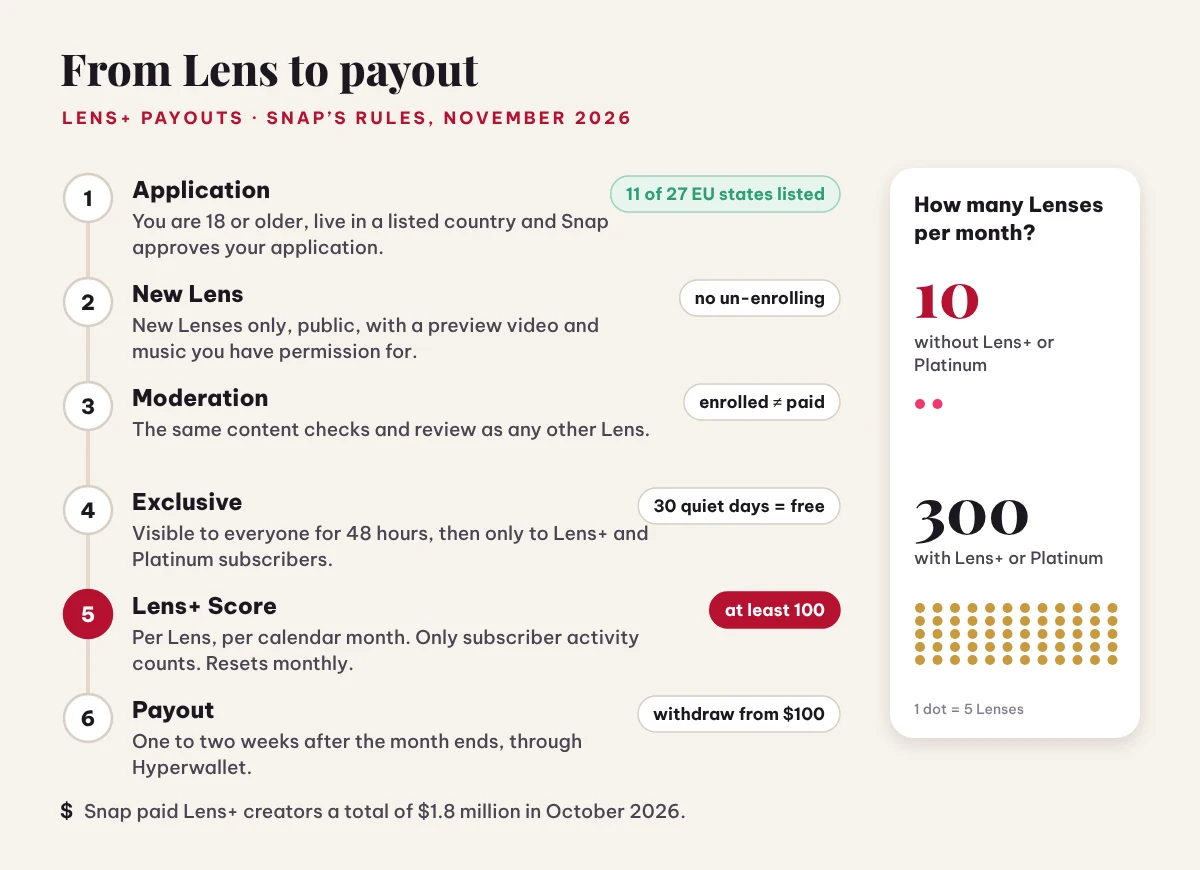
Developers in Lens+ Payouts can earn from CLI-built Lenses, and Snap says it paid Lens+ creators $1.8 million in October. The programme rules are stricter than the headline. Creators must be 18 or older, apply and be approved, and live in a listed country. Only 11 of the 27 EU member states are on that list: Austria, Belgium, Denmark, Finland, France, Germany, Ireland, Italy, the Netherlands, Spain and Sweden. Creators in Poland, Portugal or Luxembourg, for example, cannot take part.
Each Lens must reach a Lens+ Score of at least 100 in a calendar month on its own, based only on subscriber activity, and the score resets every month. Without a Lens+ or Platinum subscription a creator can enrol 10 Lenses a month, with one 300. Payouts arrive one to two weeks after the month ends through Hyperwallet, with a $100 minimum withdrawal. A tool that makes Lenses cheap to build therefore runs into a cap and a monthly performance test, not into a revenue stream.
A checklist before an agent publishes for your brand
| Question | Why it matters | What to do |
|---|---|---|
| Whose Snapchat account signs in? | The agent acts with that account and can publish once someone says yes. | Use an account owned by the brand or agency, not an employee’s personal one. |
| Who gives the explicit go? | Snap’s agent instructions require explicit authorisation to publish. | Name an approver per campaign and keep a record of each approval. |
| Which assets may the agent use? | Imported videos, images and music need rights, and payouts require written permission for music. | Give the agent a folder of cleared assets only. |
| Which terms apply? | The Lens Studio License Agreement and the Generative Lens Tools Terms govern use and outputs. | Have legal read both before the first client project. |
| Is the content fit for 13+? | Prompts and generated assets must be appropriate for people aged 13 and over. | Add that rule to the brief and the review. |
| Which machines can run it? | Version 0.2.99 has no build for Intel Macs or ARM Linux and Windows. | Check the fleet before you plan a pilot. |
| Can the creator be paid? | Payouts need age 18+, approval and a listed country. | Check eligibility per creator, not per agency. |
The same thinking applies to agents elsewhere in the business. If your organisation already has an agent policy for what agents may do on the web, extend it to what they may publish under your name.
Frequently asked questions
Is Easy Lens CLI free?
Yes, with a free Snapchat account. You still pay for the coding assistant, through a subscription or the tokens it uses.
Which coding assistants does it support?
Snap names Claude Code, Codex and Cursor. It does not document support for other agents.
Can creators in the EU earn from their Lenses?
Only in 11 member states on Snap’s list, and only if they are 18 or older, approved and reach a Lens+ Score of 100 per Lens per month.
Does the agent publish on its own?
No. According to the agent instructions, publication needs explicit authorisation, and every Lens then goes through Snap’s standard review.
The next developer audience is software
Snap’s 467-line brief is developer relations written for machines. Platforms that are easy for agents to build on will collect a long tail of content that nobody would have built by hand. For European organisations the governance question shifts with it. It is no longer only whether a team can build a Lens, but what the team’s agent knows about the organisation’s rules when the vendor’s instructions are already in its context.