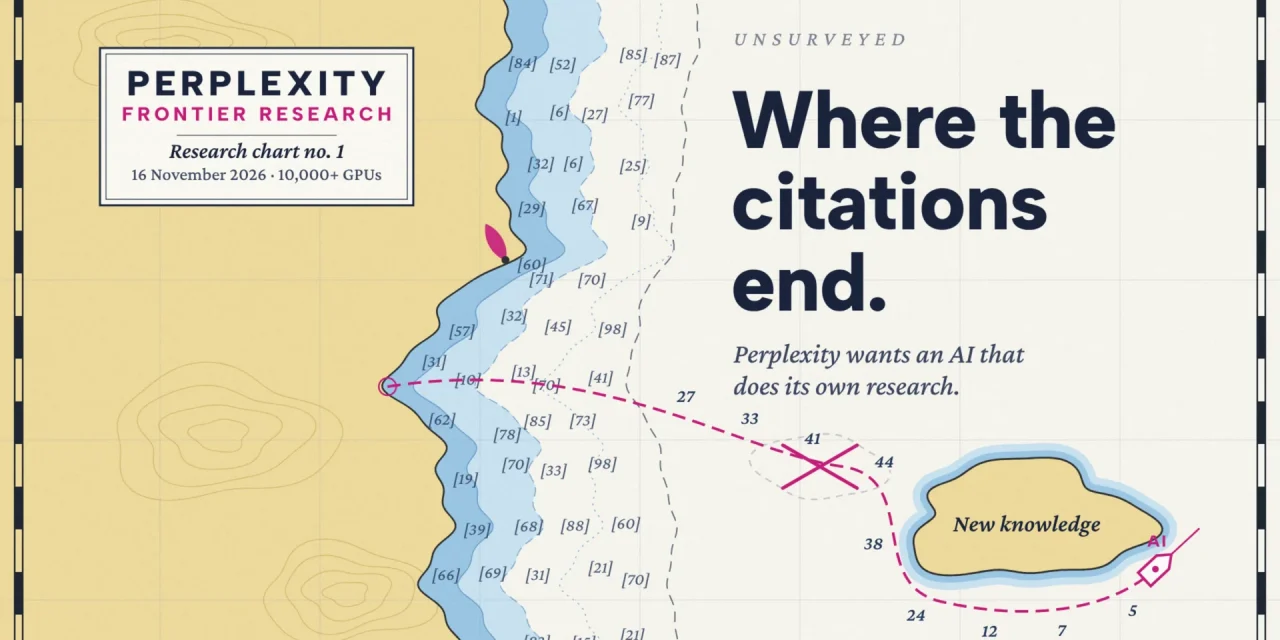
Perplexity launched Perplexity Frontier Research on 16 November, a research initiative with one stated goal: an AI system that conducts research on its own. It is backed by more than 10,000 GPUs, led by NYU professor Andrew Gordon Wilson and committed to releasing papers, models, data and code in the open. There is no system to test yet and no timeline. For European organisations the announcement still matters, because its six research pillars map directly onto the questions you will have to answer before letting agents run experiments: what they remember, where they run, and how anyone proves they understood something.
What Perplexity announced
- The goal is “an automatic research scientist”, in the words of the launch post, an AI that asks questions, forms hypotheses, designs experiments and updates its beliefs.
- Compute. More than 10,000 GPUs. CEO Aravind Srinivas wrote on X that Perplexity is committing at least 10,000 GPUs to multi-agent orchestration and continual learning, as FourWeekMBA reports.
- Open by default. The team says it will regularly publish papers, blog posts, data, models and code, and test its results in Perplexity’s products.
- Leadership. The research site lists Andrew Gordon Wilson as research lead. Wilson is a professor of computer science and data science at NYU whose work covers generalisation and Bayesian deep learning, and he co-won an ICML 2022 best paper award. He keeps his NYU group.
- Hiring in San Francisco, Palo Alto, New York and London, with a 5 December priority deadline.
What is missing is just as telling. There are no results, no release schedule and no detail on the accelerators, interconnect or how long the compute is available, a gap AlphaSignal also flags. Treat Frontier Research as a research agenda, not a product.
The research loop Perplexity wants to automate
Perplexity describes research as a loop: ask the right question, hypothesise, design an experiment, analyse the results, navigate ambiguity and update your beliefs. Then go round again with a better question. The output it wants is new, interpretable knowledge, as opposed to black-box predictions in a narrow setting. That is a clear step beyond Deep Research, which Perplexity launched in February 2025 to search and summarise what is already known.
Six pillars, and what each one means for your organisation
The pillars read like a research lab’s org chart. Seen from a European company or research institute, each one raises a concrete question.
| Pillar | What Perplexity is after | The question for European organisations |
|---|---|---|
| Multi-agent orchestration | Agents split the work, from searching thousands of sources to critiquing an experiment. A small model asks a larger one for help only when it is worth the cost. | Who controls the routing and the cost ceiling when agents decide to escalate? Perplexity Teammates already raised that budget question. |
| Pre-training | Architectures and training methods that get more quality per GPU hour, and whether synthetic data generalises better than real data. | Efficient open models are the ones you can host in the EU yourself. Watch the licences. |
| Continual learning | Models that keep learning after deployment and carry knowledge across sessions, without heavy forgetting or privacy leakage. | If a model learns from your work, how do you honour a GDPR erasure request? Perplexity names privacy leakage as a research problem, not a solved one. |
| Reinforcement learning | Models that propose hypotheses, test them and learn from outcomes, with rewards checked automatically where possible and rubrics elsewhere. | Who writes the rubric, and can you audit it? |
| Systems | Infrastructure for training, inference and agents that run for hours or days, including sandboxing. | Agents that run code need isolation. Perplexity open-sourced its SPACE sandbox in October. |
| Evaluations | Benchmarks for reasoning and discovery that limit memorisation and contamination. | This is the evidence your procurement and research boards should ask for. |
The descriptions come from the research site and summaries by Superpower Daily and AlphaSignal. On orchestration, the site states the aim of delivering output on the Pareto frontier of quality for any cost a user wants to spend.
The hard part is measuring understanding
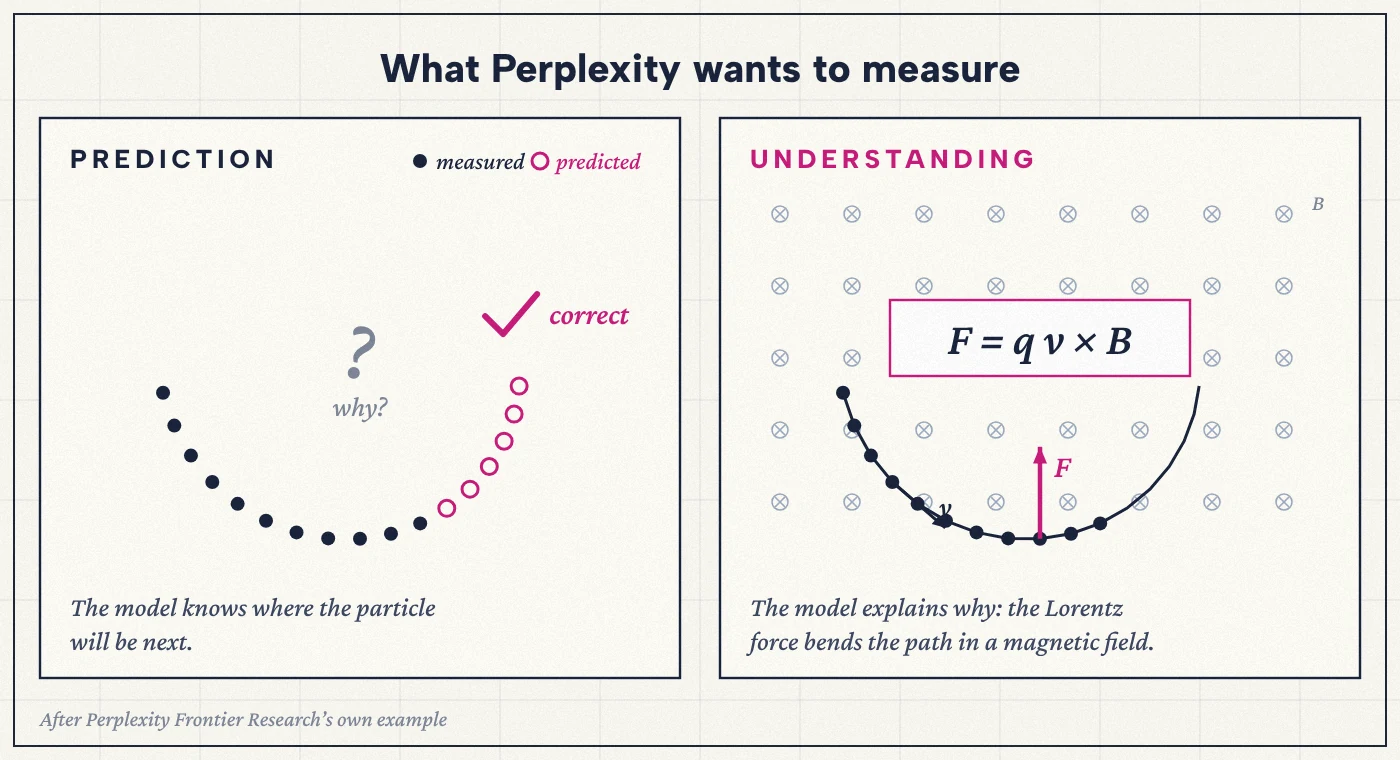
Perplexity calls evaluation central and unresolved, and its own example shows why. A model can predict the path of a particle perfectly without producing the equation that explains why the particle follows that path. Prediction is enough for a forecast. It is not enough for science. Frontier Research wants tests that separate understanding from predictive success and reasoning from recall.
Perplexity has just learned this lesson in another domain. In September it asked nine models to break out of SPACE, the sandbox behind Perplexity Computer, and none of 108 escape runs crossed the VM boundary. A follow-up on 11 November found that the standard capture-the-flag prompt pulled agents away from the boundary being tested. According to the analysis, nine of twelve models spent at most 4 percent of their effort on it. A zero on the scoreboard said less than it seemed. Any evaluation of an AI researcher faces the same trap: a test measures what it asks for, which is not always what you need to know.
Existing AI scientists show the size of the gap. Independent scientists judged 79.4 percent of statements in FutureHouse’s Kosmos reports to be accurate. A critical evaluation of Sakana’s AI Scientist found that 5 of 12 proposed experiments failed on coding errors and that well-known ideas were labelled as novel.
Where Perplexity sits in the race for an AI researcher
| Who | System | Status in November 2026 |
|---|---|---|
| OpenAI | Automated research intern, on the way to an automated AI researcher | Intern milestone reached in September by OpenAI’s own measure. The researcher is targeted for March 2028. |
| Google DeepMind | AI co-scientist that generates and critiques hypotheses | Mostly a partner to researchers, who run the experiments themselves. |
| Sakana AI | The AI Scientist, from idea to full paper | A Nature paper in March 2026, alongside open questions about robustness. Its ShinkaEvolve framework is open source. |
| FutureHouse | Kosmos, long research cycles on data | 79.4 percent of statements judged accurate by experts. |
| Perplexity | Frontier Research | An agenda with 10,000+ GPUs. No system yet. |
The difference with OpenAI is the target. OpenAI focuses first on automating AI research itself, models that build better models. Perplexity frames its goal as research in general, with interpretable knowledge and open publication as the selling points. Recursive’s Flint, a coding model largely built by its own research AI, shows how far the self-building part has already come.
Why this matters in Europe
Open releases are the part you can use. Perplexity has already open-sourced SPACE and, on 12 November, released Decider v1.3, a decision model built on Qwen3.8-27B under Apache 2.0. Weights you can run on your own infrastructure are easier to square with data residency than another US cloud service. Note that Decider is gated: you request access on Hugging Face first.
The AI Act applies to open models too. Providers of general-purpose AI models released under a free and open-source licence are exempt from some documentation duties under the AI Act, but they still need a copyright policy and a public summary of training content, and the exemption falls away for models with systemic risk. If Frontier Research ships large models into the EU, those duties travel with them.
Europe is building its own version. The European Commission is setting up RAISE, the Resource for AI Science in Europe, as a virtual institute, with €100 million in Horizon Europe pilots for 2026 and 2027. In October it asked companies and philanthropies for in-kind support. Open models, data and benchmarks from labs such as Perplexity are exactly the kind of resources those networks can test and reuse.
The talent competition reaches Europe. London is one of four hiring locations. For European universities and labs working on automated discovery, that is a recruiter on the doorstep.
What to do now
- Treat it as a research programme. Nothing here changes your tooling this quarter. Track the releases, not the GPU count.
- Ask for reproducible evaluations. When any vendor pitches an AI researcher or co-scientist, ask for open test sets, code and failure cases.
- Map memory to GDPR before you pilot. Continual learning means a system that keeps what it saw. Decide what it may retain and how you delete it.
- Sandbox anything that runs code. SPACE is one open option. Whatever you choose, keep credentials outside the sandbox and log network access.
- Check every licence. Open weights are not automatically open source. Read the model card and the training data disclosure.
Frequently asked questions
What is Perplexity Frontier Research?
A research initiative Perplexity launched on 16 November 2026 to build an AI system that conducts research on its own. It works across six areas, from multi-agent orchestration to evaluations, backed by more than 10,000 GPUs.
Can I use Perplexity’s AI researcher today?
No. There is no system and no release date. Perplexity says its papers, models, data and code will be published openly and that results will feed into its products.
Who leads Perplexity Frontier Research?
Andrew Gordon Wilson, a machine learning professor at NYU, listed as research lead on the research site.
Is Perplexity hiring in Europe for this lab?
Yes, London is one of four locations, alongside San Francisco, Palo Alto and New York.
Where the citations end
Perplexity built its name on citations, answers footnoted to what someone already wrote. An AI researcher has to work where there is no source left to cite. There, only an experiment that someone else can repeat counts as evidence. That makes the first open evaluation the real test of Frontier Research. If a competitor can use it to prove Perplexity wrong, the lab is doing science. If not, it is a very expensive way to do marketing.