For the last few years, we have all been trained to treat Artificial Intelligence like a very smart, but somewhat passive, consultant. You type a question into a box, the AI generates text, and then the real work begins: you copy that text, paste it into a document, format it, fact-check it, and perhaps open a new tab to generate an image or write some code to go with it.
The friction is obvious. You are the bridge between the AI’s intelligence and the actual execution of the task. You are the copy-paster, the formatter, and the project manager.
Perplexity Computer aims to remove you from that middleman position entirely. It is not just another chatbot update. It is a fundamental shift toward Agentic AI. Systems that don’t just talk, but actually do. By giving an AI agent access to a virtual computer, a browser, and a file system, Perplexity is betting that the future isn’t about who has the best chat model, but who can best orchestrate a team of them to finish a job from start to finish.
What is Perplexity Computer?
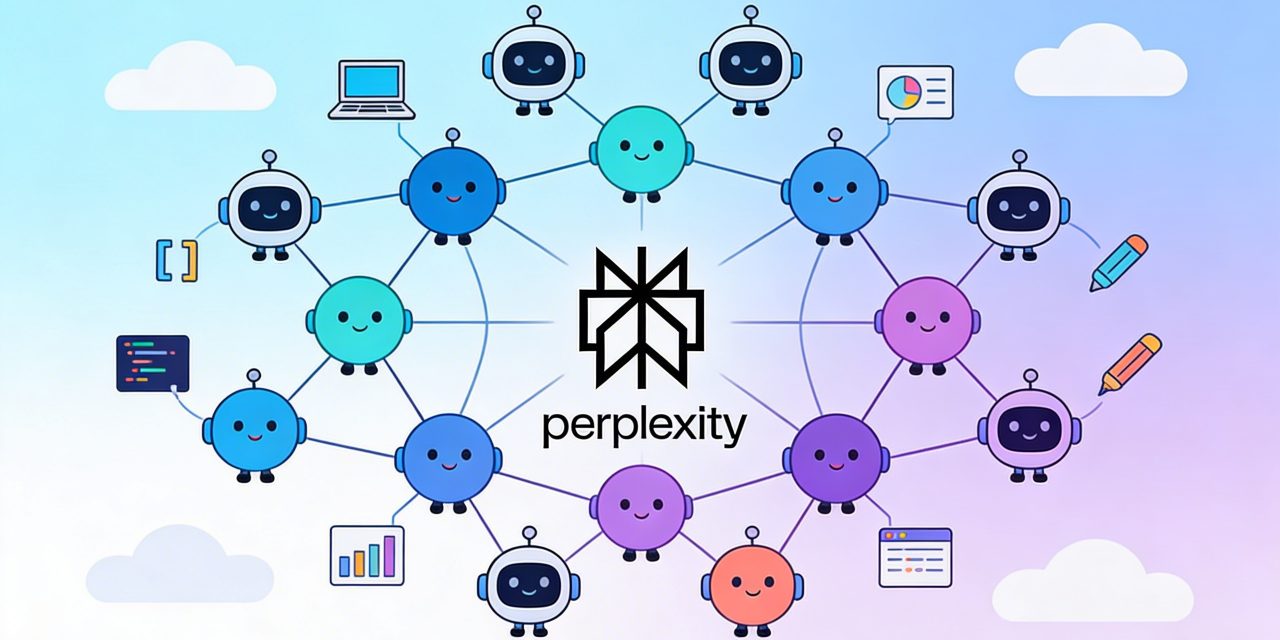
At its core, Perplexity Computer is a cloud-based system that orchestrates 19 different specialized AI models to handle entire projects. It is not a physical device you buy; it is a virtual environment that lives in the cloud.
Think of the current AI landscape. You might use Claude for reasoning and coding, Gemini for deep research, and perhaps a specialized model for image generation. Managing these disparate tools is a workflow bottleneck. Perplexity Computer acts as a wrapper around all these capabilities.
Perplexity CEO Aravind Srinivas framed this vision perfectly with a metaphor: “Musicians play their instruments. I play the orchestra.”
In this scenario, the individual AI models are the musicians. Perplexity Computer is the conductor. When you give it a prompt, it doesn’t just try to answer you with one brain. It assesses the request and assigns specific sub-tasks to the models best suited for them. It might deploy a reasoning model to plan the project, a coding model to write the script, and a research model to browse the web for live data, all running simultaneously.
The Shift from Chat to Action
The distinction between a chatbot and a Computer agent is the environment they operate in. A chatbot lives in a text box. Perplexity Computer lives in a sandboxed environment with a real file system and a browser.
This allows it to:
- Execute Commands: It doesn’t just write code; it runs it to see if it works.
- Browse the Web: It can navigate websites, click buttons, and scrape data just like a human user would.
- Manage Files: It can read, write, and edit files, organizing them into a coherent output.
- Use Tools: It integrates with external applications like Slack, Google Drive, and Notion.
How It Works: The Mechanics of Orchestration
When you interact with Perplexity Computer, you are engaging in “Outcome Engineering” rather than “Prompt Engineering.” You describe the final result you want, and the system figures out the steps to get there.
Decomposition and Planning
Upon receiving a request—for example, “Build a competitor analysis dashboard tracking traffic and pricing changes”—the system first enters a reasoning phase. It breaks the high-level goal into smaller, manageable sub-tasks. It determines that it needs to scrape data from specific websites, store that data in a structured format (like a CSV), visualize it using a Python library, and finally compile it into a report.
Dynamic Model Routing
This is where the “19 models” claim becomes relevant. Perplexity Computer utilizes a dynamic routing system. It doesn’t force one model to do everything. If a sub-task requires high-level reasoning, it might route it to a heavy-duty model like Claude 3.5 Sonnet or Opus. If it needs quick, up-to-date information, it might tap into Perplexity’s own search index or Grok. For visuals, it routes to image generation models like Nano Banana or video models like Veo 3.1.
This model-agnostic approach is a strategic advantage. If a new, superior reasoning model is released tomorrow by OpenAI or Anthropic, Perplexity can swap it into the orchestration layer without redesigning the whole system. They are not locked into a single provider’s roadmap.
Asynchronous Execution and Persistence
Unlike a chat session that times out or forgets context when you close the tab, Perplexity Computer has persistent memory. It remembers your files, preferences, and past projects. More importantly, it can work asynchronously. You can launch a task that takes hours to complete, close your laptop, and come back later to find the work done. It operates in the background, iterating on errors and refining the output until the objective is met.
Real-World Use Cases: What Can It Actually Do?
The theoretical capabilities are impressive, but the value lies in practical application. Early users and demos have highlighted several powerful use cases that go beyond simple Q&A.
The Bloomberg Terminal at Home
One of the most cited examples from early testing involves financial analysis. A user was able to create a real-time financial analysis terminal, similar to a Bloomberg terminal, from a single prompt. The system used Perplexity Finance data to pull live stock information, wrote the code to visualize it, and deployed a functional web interface. This required coding, data fetching, and design, all orchestrated without the user writing a single line of Python.
Deep Research and Briefs
Imagine you need a weekly briefing on your top five competitors. You can instruct Computer to visit their pricing pages, check their blog for new feature announcements, and look for hiring signals on their careers pages. The agent navigates these sites, extracts the relevant data, and compiles it into a polished board-ready deck or a formatted memo. It absorbs the layer of “coordination and data gathering” that usually eats up a knowledge worker’s morning.
Coding for Non-Coders
While tools like GitHub Copilot assist developers, Perplexity Computer aims to replace the developer for certain tasks. You can ask it to “build a satellite tracking web app.” The system will write the backend logic, create the frontend interface, and run the code to ensure it works. If it encounters an error, it reads the error message, debugs its own code, and tries again. This iterative loop is what separates an agent from a code generator.
Perplexity Computer versus The Competition
Perplexity is not alone in this race. The concept of “Computer Use” is spreading rapidly, most notably with Anthropic’s Claude and open-source projects like OpenClaw.
Claude Code and OpenClaw
Claude Code (and the open-source OpenClaw) operates similarly but often runs locally on your machine or requires you to be comfortable with a terminal interface. It is a tool for developers who want to supervise the process. As noted by tech reviewers, Claude Code is powerful but requires you to be a “control freak”—you watch the steps and intervene.
Perplexity Computer is the “managed service” version of this. It is designed for users who don’t want to see the terminal. It handles the environment setup, the API keys for different models, and the error handling in the cloud. If Claude Code is for the engineer who wants to build the engine, Perplexity Computer is for the executive who just wants to drive the car.
Traditional Search (Google)
Perplexity started as an “answering machine” to challenge Google. With Computer, it is pivoting to become an “action engine.” Google is excellent at navigation—sending you to a website. Perplexity wants to be the browser that does the reading for you. By integrating this into their “Comet” browser concept, they are trying to turn the browser from a window into the web into an operating system that manages the web for you.
The Cost of Autonomy
Innovation comes with a price tag. Perplexity Computer is currently available for Max subscribers, but the pricing structure is steep compared to standard AI subscriptions. We are looking at a price point around $200 per month for full access to these agentic capabilities.
Why so expensive? Inference is costly. When you ask a standard chatbot a question, it runs one inference chain. When you ask Perplexity Computer to “build a dashboard,” it might trigger hundreds of inference calls across 19 different models, run virtual machines for code execution, and store large amounts of data. It is effectively hiring a digital intern, and while $200 is expensive for a Spotify subscription, it is incredibly cheap for an employee.
However, this pricing creates a barrier. It positions the tool squarely at enterprise users, power professionals, and businesses rather than the casual consumer who just wants to generate a funny poem.
The Challenges and Risks
Despite the hype, Agentic AI is still in its infancy. There are real challenges that users need to be aware of.
Complexity and Drift
The more complex a task, the higher the chance of “model drift.” This happens when an agent gets stuck in a loop or slowly diverges from the original goal over a long session. While Perplexity’s orchestration layer tries to keep the sub-agents on track, no AI is immune to getting confused during multi-step workflows.
The Commoditization Trap
There is a strategic risk for Perplexity. They are building a layer on top of other people’s models. If OpenAI or Google releases a model that is so smart it doesn’t need orchestration. A single model that can do research, code, and design flawlessly the value of Perplexity’s orchestra diminishes. They are betting that specialization (19 weak models > 1 strong model) will always beat generalization, but in AI, the gap closes quickly.
Copyright and Legal Battles
Perplexity has already faced scrutiny regarding how it indexes and uses content from publishers. By launching a browser and an agent that reads websites for you, they are walking a fine line. If the AI visits a website, extracts the value, and presents it to the user so the user never has to visit the site, the economic model of the open web is challenged. This is a legal battleground that will likely intensify as these agents become more popular.
The Verdict: A Glimpse into 2026
Perplexity Computer feels like a product from the future—specifically, it aligns with what many predicted for 2026. It moves us away from the “chat” paradigm that has dominated since late 2022.
For professionals who spend their days gathering data, synthesizing reports, or managing complex workflows across multiple apps, this is a glimpse of salvation. It promises to absorb the drudgery of digital work.
Is it perfect? No. It is expensive, and like all current AI, it can be confident but wrong. But the direction is undeniable. We are moving toward a world where we don’t just talk to our computers; we assign them work. And for now, Perplexity is handing out the most capable computers on the block.
If you are ready to stop playing every instrument yourself and start conducting, it might be time to give your AI a computer of its own.