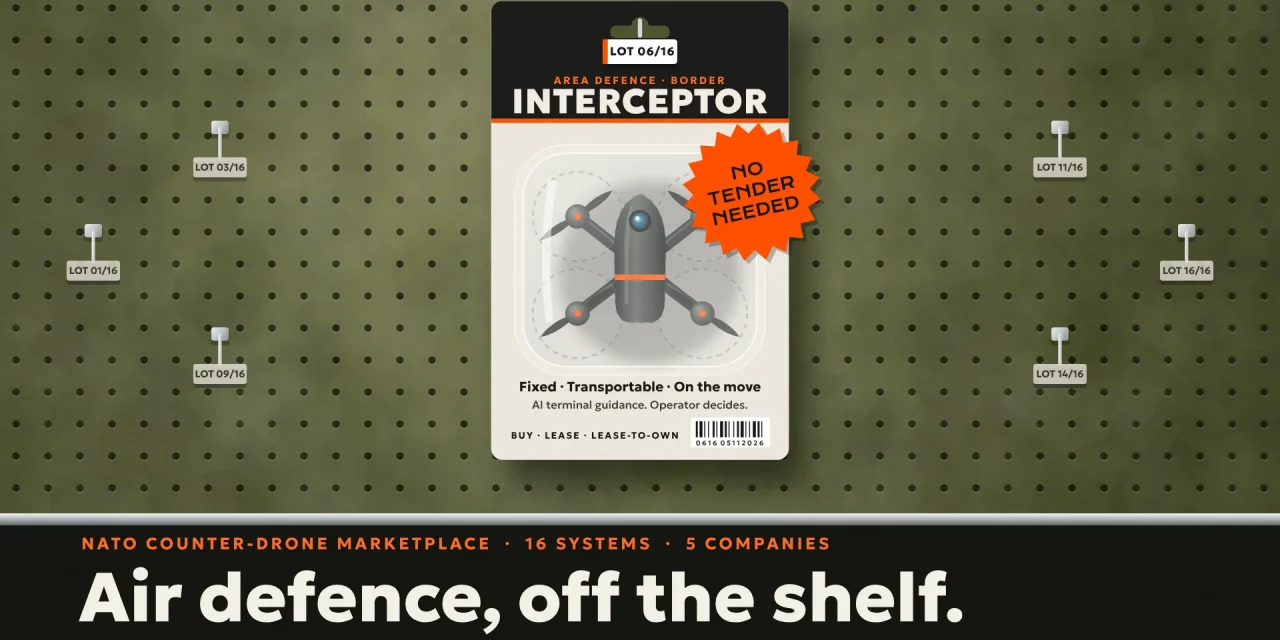
On 5 November NATO opened a catalogue of 16 counter-drone systems that allies can order without running a tender of their own. French start-up Alta Ares, founded in 2024, says it won six of those 16 lots, more than Northrop Grumman, Axon, OSL UK or Quantum Systems. The framework contract carries no money yet. What it changes is the way NATO buys, and for Europe’s defence-tech companies that matters more than any single award.
Air Street Capital, which led Alta Ares’s €50 million Series A in June, calls the award one of the most consequential milestones a defence company can reach. That is true, but not for the reason most headlines suggest. The award is an entry ticket. The bigger shift is a buying model in which only fielded systems get in, allies can lease before they buy and every contract on the shelf expires after 18 months.
What NATO actually bought, and what it didn’t
The NATO Communications and Information Agency, NCIA, competed and selected 16 solutions from five companies: Alta Ares, Axon Enterprise, Northrop Grumman, OSL UK and Quantum Systems. They cover static, transportable and on-the-move systems, and all of them have already been deployed in allied countries and in Ukraine. The framework contracts run for one and a half years. NATO plans regular new competitions so that newer technology keeps entering the catalogue.
What NATO did not do is place an order. A framework is a contractual shelf, not a purchase. As DroneXL points out, funds are only committed when a nation or a NATO command orders. That works through task orders: a buyer states a requirement, NCIA asks the selected suppliers in that category for a quote and they get roughly two weeks to answer. Allies can buy, lease or lease-to-own. The only common money so far is 3.1 million euros to fund further testing of the selected systems.
The larger figure you see next to this story belongs to something else. Under Drone Edge, launched at the NATO summit in Ankara in July, allies pledged more than 40 billion dollars for counter-drone capabilities over five years. That money sits in national budgets. The catalogue is one way to spend it.
Speed is the selling point. Claudio Palestini, who leads innovation and technology adoption in NATO’s armaments division, told reporters in Riga that a nation can still run its own competition, but that through the marketplace ordering takes a day and the systems “will be there in 90 days”. Nations that are not ready to buy can lease a system and test it for six months. Programmes funded nationally and those financed through the EU’s SAFE defence loans can both use it. All selected systems also had to be free of US ITAR export restrictions.
NCIA scored the bids against four reference scenarios. Alta Ares says its six lots cover area protection and border protection, and that it is the only supplier selected for area protection in all three mobility classes.
Why a 2024 start-up sits next to Northrop Grumman
The rule that made this possible is simple. The tender notice of December 2025 admitted only systems already deployed with NATO nations or allied forces, and it barred prototypes. It listed 85 prospective bidders. Palestini spoke of more than 80 offers, and Alta Ares says five companies were picked from close to 100 applicants. Larger names on the bidder list, among them Anduril, Thales and Saab, are not in the catalogue. Whether they actually bid is not public.
Under a fielded-only rule, operational history counts more than company size. Alta Ares has plenty of it for its age:
- its counter-drone systems have been deployed in Ukraine since 2024;
- in March 2025 NATO’s Allied Command Transformation named it the winner of its 15th Innovation Challenge, for embedded AI that detects and identifies glide bombs;
- on 20 October 2025 its interception system passed NATO validation at a test range of the French procurement agency DGA;
- interceptors running its Pixel Lock software started shooting down Shahed-type drones in November 2025;
- it tested its turbojet interceptor Black Bird in arctic conditions with the Estonian armed forces, and its software also learns from operations in the Gulf.
One caveat. The lot-by-lot split rests on the company’s own count. NATO has confirmed the five suppliers and the 16 solutions, but not who won what.
The kill chain as a product
Alta Ares does not sell a drone with some AI bolted on. It sells the chain from first detection to interception. In its Series A note, Air Street argued that in air defence a useful AI system has to be part of the kill chain itself, not an analyst sitting next to it. Targets are small, fast and cheap, and operators decide in seconds while they are jammed, cold and tired.
The stack has three software layers and two interceptors:
- Pixel Lock is onboard computer vision. It detects, classifies and tracks targets in real time and guides the interceptor in the final phase, while the operator keeps control over the engagement.
- Cyclop C2, also written Cyclops, handles mid-course guidance with data from connected sensors and command systems.
- Gamma supports autonomous guidance and ISR workflows.
- X-Lock is the short-range interceptor against Shahed-type drones, with a stated range of 15 km and a top speed of 310 km/h.
- Black Bird is the turbojet interceptor for faster threats such as cruise missiles and glide bombs, with a stated range of 30 km and 700 km/h.
The company has not said which interceptors sit in which NATO lot.
Why automate that last phase? CEO Hadrien Canter told Le Point in 2025 that interceptor drones hit between 35 and 45% of targets without AI and up to 65% with it, and that more radar coverage was needed to close the gaps. Those are the company’s own numbers, but they explain the bet. A better hit rate means fewer interceptors per kill, and that changes the cost of a whole night of defence.
The integration work is happening around it. In June Alta Ares signed an agreement with Airbus Defence and Space to plug Pixel Lock and its interceptors into Airbus’s Fortion battle management software, and MBDA works with the company on interception of Shahed-type threats. Air Street sees the real moat elsewhere: the loop in which operators use the system, the system fails somewhere, engineers recover the evidence and the product changes.
The arithmetic behind cheap interceptors
The reason NATO wants a catalogue for this category is money. A Patriot interceptor costs more than 3 million dollars and a NASAMS round slightly more than 1 million. A Shahed can cost Russia as little as 35,000 dollars to build, according to CSIS. Each time a Patriot shoots down a drone, the defender is on the wrong side of an exchange of roughly 85 to 1.
Interceptor drones turn that around. Ukrainian models cost 3,000 to 5,000 dollars apiece, and by early 2026 they brought down one in three Russian aerial targets destroyed over Ukraine, according to its air force. The American Merops interceptor, bought by Lithuania in April, sells at about 15,000 dollars per shot.
Alta Ares has not disclosed what an X-Lock or a Black Bird costs. It does say it wants to produce more than 1,000 interceptors a month by 2027 with industrial partners, and that it will set up production in customer countries for large orders. The threat keeps moving too. Russia now fields jet-powered Shaheds, which is why Black Bird was designed for targets flying faster than 500 km/h.
What it means for European buyers and builders
For defence ministries, the catalogue adds a route that is both pre-competed and fast. You can lease, test for six months and then decide, which is useful in a category where a system bought today can be outdated in a year. It does not replace national programmes, and it competes with other channels. Bulgaria bought counter-drone systems directly from Axon, and the US Army is opening its own drone marketplace to European allies. No task order against the NATO contracts has been announced yet.
For defence-tech start-ups, the message is that fielded beats impressive. The entry ticket was operational use, not a demo, and contracts of 18 months with regular re-competition favour companies that improve their product every quarter. Air Street adds the industrial side: interceptors are consumed and must be replaced, so factories need predictable orders. That is the same scale-up problem economist Rudy Aernoudt describes for European tech in general. The ITAR-free requirement also rewards companies that control their own supply chain, a theme that runs through the debate about sovereign AI in Europe.
For anyone working on AI governance, note where the rules stop. The EU AI Act does not apply to AI systems used exclusively for military, defence or national security purposes, so the obligations described in our AI Act timeline do not cover Pixel Lock. Human control is set by military doctrine, rules of engagement and national law, and by design choices such as keeping the operator in the decision step. Dual-use parts are a different story: the same computer vision running efficient AI at the edge can end up in civilian security products, where the AI Act does apply.
Frequently asked questions
How much is Alta Ares’s NATO contract worth?
No value has been disclosed. The framework contracts carry no money in themselves. Revenue only follows when a nation or NATO command places a task order.
Who can buy from the NATO counter-drone marketplace?
NATO allies and NATO commands. They can buy, lease or lease-to-own, with national budgets or with EU SAFE loans, and without running their own tender.
What is Pixel Lock?
Pixel Lock is Alta Ares’s onboard computer vision. It detects, classifies and tracks a target and guides the interceptor in the final phase, while the operator keeps control over the engagement.
Which other companies are in the catalogue?
Axon, through its counter-drone business Dedrone, Northrop Grumman with its FAAD C2 command system, OSL UK, owned by Denmark’s Terma since late 2025, and Germany’s Quantum Systems.
The first order is the real test
Six lots make a strong headline, but a framework is a promise of access, not of revenue. The number to watch is the first task order, and how fast it turns into delivered interceptors. If NATO can really go from requirement to fielded system in 90 days, the catalogue will matter more than any single contract, because it rewards the companies that learn fastest from the field. The open question for Europe is whether catalogue access turns into factories that can deliver interceptors by the thousand, month after month.