Moises started as an app that splits a song into separate tracks so musicians can practise along. In 2026 it became infrastructure: its separation runs inside Ableton Live and Fender Studio Pro, SoundCloud artists can open their tracks in it, and its new Moises Studio also generates instrument parts and singing voices. The company’s pitch is AI that assists musicians rather than replacing them, trained only on licensed music. In Europe that distinction is turning into a legal one. The AI Act exempts standard editing from its new marking duty for AI-generated audio, and German courts have ruled that training on unlicensed music infringes copyright. For labels, publishers, music schools, agencies and platforms, the useful question is which Moises features count as editing and which as generating.
From practice app to music infrastructure
Moises is built by Music AI, a company founded in 2019 and headquartered in Salt Lake City, with teams in the US, Brazil and Europe. It says 80 million musicians use its consumer suite, which Apple named iPad App of the Year in 2024. Its core is stem separation: you upload a mixed recording and AI splits it into vocals, drums, bass, guitar and other parts. Around that sit practice tools for tempo, key, chords, lyrics and a smart metronome.
The same models increasingly sit inside other companies’ products. Moises says it runs more than 50 proprietary models and processes nearly six years of audio every day. The separation in Ableton Live 12.3 is powered by Music AI algorithms and runs locally. Fender Studio Pro 8.1 added a Moises panel in June. Blackstar’s Beam amps separate streamed music in real time through the Moises app. Since 21 October, SoundCloud artists can import their own tracks into Moises and publish the reworked versions straight back.
Music AI raised a $40 million Series A in January 2025, bringing its total to $50.2 million. In 2026 it added Charlie Puth as Chief Music Officer and Dutch DJs Armin van Buuren and Laidback Luke as the first members of an artist partnerships programme for DJ and producer features.
What Moises Studio adds, and where it starts generating
Launched on 2 September 2026, Moises Studio is a browser workspace where several people edit one session at the same time. It combines multitrack recording, MIDI transcription, auto-mixing in more than 20 genres and export to stems, MIDI, MusicXML and DAWproject. Its separation models were retrained on larger licensed datasets and now recognise more than 30 instrument and vocal categories.
Three Studio features go beyond processing what you recorded. AI instrument generation adds drums, bass, guitar, keys or strings that follow the key, tempo and genre of a project. Custom voice models are trained on a user’s own recordings, alongside more than 50 licensed voices. Agentic Mode takes plain-language instructions to comp takes, clean up recordings or build effect chains, showing each step and letting you undo it. In the SoundCloud announcement the company calls its assistant Moi.
Two futures, and the data behind Moises’ bet
CEO Geraldo Ramos frames the market as two futures. In one, you type a prompt and a machine hands you a song. In the other, AI helps musicians make music together. Studio is designed for the second: it generates parts that respond to what an artist already played, not complete tracks. That is the contrast with generators such as Suno v6 and Lyria 3.
A survey of 1,525 musicians by Water & Music for Moises supports the assistive story. Stem separation was the most used AI task, 78 percent of professionals had used AI for music work in the past year against 60 percent of hobbyists, and 26 percent of musicians who earn from music said AI raised their income while fewer than 4 percent saw a drop. About 80 percent of respondents were recruited through Moises itself, so read the numbers as a picture of its users rather than of all musicians.
The generative side is growing faster in volume. Deezer reported that fully AI-generated tracks passed 50 percent of new daily uploads at their June 2026 peak, around 90,000 tracks a day. In April it said such tracks drew only 1 to 3 percent of streams.
Where European law draws the same line
Training data is becoming a licensing question
On 31 July 2026 the Munich Regional Court ruled that Suno infringed copyrights managed by GEMA by training on protected songs without a licence. Suno has to disclose related revenue and pay damages, and it can still appeal. It was GEMA’s second win after its November 2025 case against OpenAI over song lyrics. At EU level, Advocate General Szpunar advised on 3 November in Like Company v Google that training can fall under the text and data mining exception, but only with lawful access, respect for machine-readable opt-outs and measures against memorisation. The opinion is not binding.
Moises says it trains only on licensed and authorised music and never on user uploads. Music AI signed a deal with SourceAudio in 2025 for millions of pre-cleared songs. These are company statements, not an independent audit, but after the Suno ruling they are a commercial argument as much as an ethical one.
The AI Act exempts standard editing
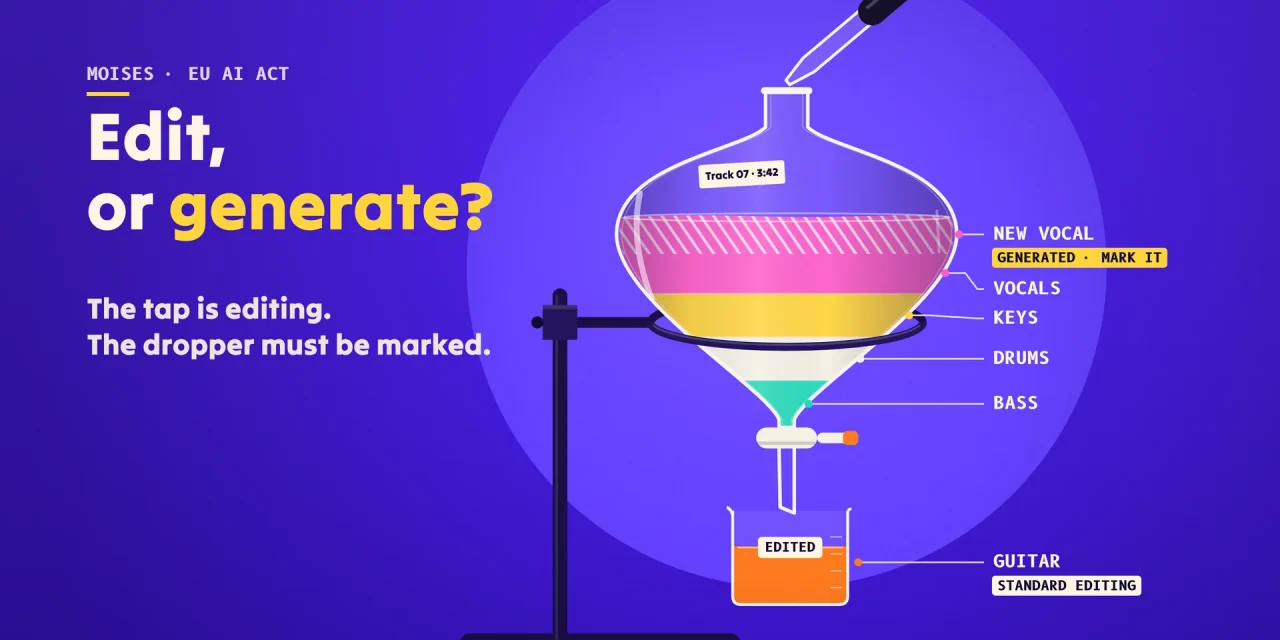
Article 50(2) of the AI Act requires providers of AI systems that generate synthetic audio to mark the output in a machine-readable way. It applies from 2 August 2026 for new systems and, after the Digital Omnibus, from 2 December 2026 for systems that were already on the market. The duty does not apply where a system performs an assistive function for standard editing or does not substantially alter the input. The Commission’s draft guidelines listed noise reduction among the exempt examples.
That maps closely onto Moises’ own split. Separating, cleaning, mixing and mastering a recording you supplied plausibly sit on the editing side. Generated instrument parts and voice models that sing new lines produce synthetic audio and fall under the marking duty. Moises has not published how it classifies its own features. Separately, Article 50(4) requires deployers who publish deepfake audio, such as a voice that convincingly imitates a real person, to disclose that it is artificial. That matters for voice models. We covered how emotion and voice AI meet the same Act in our piece on Block’s Dessa.
What European music businesses should check
- Map features to editing or generating. Write down which Moises features your teams use. Practice, separation and mastering are low-risk. Generated parts and voices need disclosure and marking planned in.
- Get the training promise in writing. If you license Music AI technology or use Moises at scale, ask for licence provenance and a contractual commitment that your uploads are not used for training.
- Clear the source, not just the tool. Separated stems of a commercial recording still belong to its publishers and label. Moises puts responsibility for uploads on the user, and the SoundCloud integration only covers your own tracks.
- Choose where the audio goes. Moises Studio processes in the cloud, while the Ableton integration and Moises Live run on the device. For unreleased masters, decide which route you allow. Our piece on Scribe v3 shows the same question for speech.
- Treat voices as personal data. A custom voice model is trained on a real singer’s recordings. Get explicit consent and agree who may use the model, for what and for how long.
- Plan disclosure before release. Deezer already tags AI-generated music for listeners. Decide how you will describe tracks with generated parts before a distributor or platform asks.
Frequently asked questions
What is Moises AI?
Moises is an AI music app and creative suite from Music AI. It separates songs into stems and offers practice tools, and since September 2026 its browser-based Moises Studio adds collaborative recording, AI-generated instrument parts and custom voice models.
Does Moises train its AI on what users upload?
Moises says it does not and that it trains only on licensed and authorised music. This is the company’s own statement and has not been independently audited.
Do stems separated with Moises need an AI label under the AI Act?
Probably not when the tool only separates or cleans audio you supplied, because Article 50(2) exempts standard editing. Generated parts and synthetic voices are a different matter. This is not legal advice.
How much does Moises cost in Europe?
In the Belgian App Store on 17 November 2026, Premium costs €6.99 a month or €49.99 a year and Pro €34.99 a month. A free plan allows five songs a month of up to five minutes each.
The assistive line will be tested from both sides
Moises has built a strong position on the side of the line that European regulators and courts treat most kindly: help musicians work with music they have the rights to. Every generative feature it adds moves part of the product to the other side, where marking duties and licensing questions apply. Organisations that adopt it should hold the company to its training promise and keep their own map of which features they use, because that map will decide what they owe listeners from December onwards.