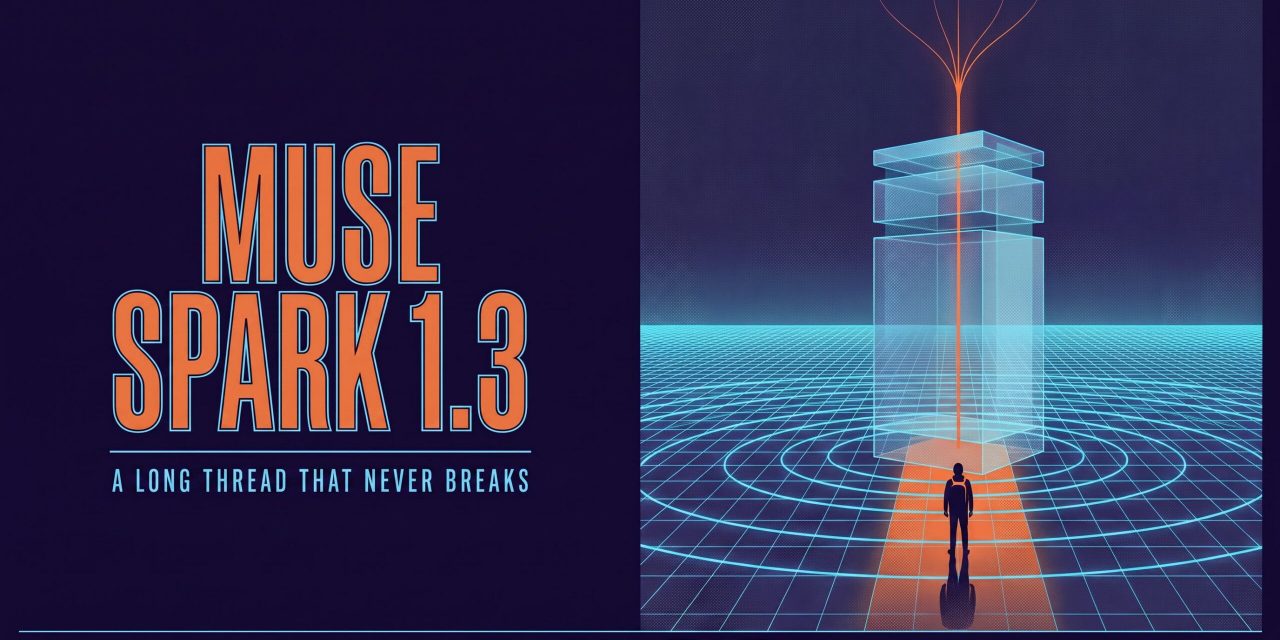
Meta has released Muse Spark 1.3, an update to its flagship model family aimed squarely at agentic workflows and coding. The launch arrived only hours after Google unveiled Gemini 3.8 Flash and lands in a field where GPT-5.6 Sol, Claude Opus 5 and Grok 4.6 are all competing for the same developers. Muse Spark 1.3 is rolling out now in Muse Code and the Meta Model API, and Meta frames the release as another step “toward personal superintelligence”. Beneath that framing sits something more concrete. A model that holds long messy tasks together, asks before it acts and finishes coding jobs with roughly 20% fewer tool calls and 25% fewer tokens than its predecessor.
What is Muse Spark 1.3
Muse Spark 1.3 is an incremental update over Muse Spark 1.2, built from what Meta learned during months of broad adoption of Muse Code and the Meta Model API. Two reasoning variants exist. The xhigh variant is available today and the max variant follows shortly, once Meta finishes additional safety testing. That split matters when you read the launch benchmarks, so keep it in mind.
The context window stays at 1M tokens, roughly 1500 pages of text, and the model accepts text, image and video as input. Audio understanding is currently flagged as not fully supported, so expect degraded quality if you send audio in. Muse Spark remains closed weights, unlike Meta’s open Llama line, although Meta says a Muse Spark open weights release sits on the roadmap alongside bigger models.
Built for long horizon work in a single thread
The central design goal of Muse Spark 1.3 is sustaining longer work inside one conversation. Give it an open ended objective and it uses tools to build its own context from messy and conflicting sources, corrects gaps in its plan as it goes and keeps track of what it has learned before delivering a final result. Meta trained the model across a diverse set of harnesses so it generalizes to different agentic environments.
Multitasking inside a single thread also improved. The model maps each incoming message to the correct task even when you are steering an earlier request or interrupting it while it works. Anyone who has watched an agent confuse two tasks in one conversation knows how fast that failure makes a session useless.
Meta’s own examples show the intended workload clearly. Each demo asks for a complete professional deliverable under heavy constraints:
- A mechanical engineering flow simulation report built from raw CFD results and a STEP CAD file, with tables of goal values and field variables, exported as a PDF
- A cleaned bass track for a 70s style demo, with wrong notes replaced at exact timecodes and clicks edited out, delivered as a full stereo mix in 48k and 24 bit WAV
- A persuasive 8 to 10 slide PowerPoint convincing a skeptical recreation advisory board to approve a Chamber of Commerce partnership
- A one page summary of constituent feedback per district plus talking points for a county board meeting, both saved as PDF files
These are exactly the long, constraint heavy jobs where earlier models tended to drop requirements.
A collaborator that asks before it acts
Behavioral training is the other half of the release. Muse Spark 1.3 asks clarifying questions when a prompt is ambiguous, pulls you in when it gets stuck and confirms before taking consequential actions. On long tasks it adapts to your preference and either reports frequently or works quietly in the background until there is a result.
Instruction following tightened as well. Earlier Muse Spark versions could handle the first requirements of a complex request and quietly lose the last few. Meta says 1.3 preserves detailed constraints across long instructions with less drift from the requested workflow. The model also has a sharper sense of its own limits and reports when it hits a hurdle instead of hallucinating a finished outcome. Meta does not quantify how often that holds, so treat it as a claim to verify on your own tasks.
Coding that costs less per task
For engineering work Meta trained Muse Spark 1.3 on more long horizon coding tasks, and the payoff shows up in daily usability. The model takes fewer turns where they are not needed, writes less verbose output and produces a cleaner coding style than 1.2.
The headline efficiency figures come from comparisons run by Meta engineers, where 1.3 finished the same work with about 20% fewer tool calls and 25% fewer tokens. Fewer tool calls mean fewer round trips and lower latency on agentic coding. Fewer tokens mean a lower bill per completed task, which compounds quickly if you run agents at volume.
Two caveats deserve attention. The model does not expose its reasoning traces, which makes debugging its decisions harder than with models that show their thinking. Artificial Analysis also measured 1.3 emitting around 120M output tokens to complete its full Intelligence Index, well above the field median of 72M. Simulate costs on your own workload before assuming the sticker price tells the whole story.
How Muse Spark 1.3 benchmarks against rivals
Meta’s published scorecard compares Muse Spark 1.3 against Muse Spark 1.2, GPT-5.6 Sol and Claude Opus 5 across agent, coding and long context tasks. The pattern is consistent.
Coding is the strongest category. Muse Spark 1.3 leads DeepSWE v1.1 at 75.4, ahead of both frontier rivals, and tops SWEAtlas CodeBase QnA at 59.4 for reasoning over large codebases. It ties GPT-5.6 Sol at the top of Terminal-Bench 2.1. Long context retrieval shows an even bigger gap. On MRCR the model holds 98.5 in the 256K to 512K band and 98.1 in the 512K to 1M band, where GPT-5.6 Sol drops to 91.5 and 73.8. If your work means feeding entire codebases or long agent traces into one context, this is the number that matters most.
Agent benchmarks tell a more balanced story. Claude Opus 5 edges ahead on four of six agent evaluations, including computer use and knowledge work, while GPT-5.6 Sol takes DeepSearchQA and the instruction following index. Muse Spark 1.3 lands as a strong second here, though its JobBench margin over GPT-5.6 Sol, 64.9 against 45.4, is the largest gap in the agent category.
Read the scorecard with one asterisk. Meta’s table places the 1.3 max variant next to the 1.2 xhigh variant, and those are different reasoning tiers. Part of the eye catching jumps reflects that tier difference rather than a pure version gain. The variant you can call today is xhigh, which Artificial Analysis scores at 61 on its Intelligence Index, with the max variant at 62 in limited preview.
Pricing and availability
Pricing splits along a single axis. Your data. The contributor tier, where your inputs may be used to improve Meta’s products, costs $0.10 per 1M input tokens and $0.20 per 1M output tokens. The standard xhigh tier, which keeps your data private, runs $1.25 input and $4.25 output per 1M tokens, with cached input at $0.15 and a reported 88% cache discount. Pricing for the max variant was not public at launch. Artificial Analysis puts the cost of the xhigh tier at $0.55 per Intelligence Index task, with output around 182 tokens per second.
Existing Meta Model API users can switch by changing the model ID while keeping the same endpoints, SDKs and pricing structure. Two availability notes are worth flagging. Community reports describe an uneven regional rollout, with some European users still served Muse Spark 1.1 at launch, and the max reasoning mode remains gated behind safety testing instead of shipping day one.
Safety tuned for agents that act
The safety work targets the risks that matter when a model can execute actions. Muse Spark 1.3 shows stronger resistance to adversarial inputs and prompt injections, and Meta trained better calibration around irreversible actions so the model proceeds more cautiously when a step cannot be undone. For agents that touch files, send messages or run shell commands, a model that pauses to confirm beats a confident model that quietly does the wrong thing.
The signal
Muse Spark 1.3 is an efficiency and reliability update. The figures that count are the 20% fewer tool calls and 25% fewer tokens, because they convert directly into lower cost and latency on work you already run. The detail most launch coverage skips is that Meta trained the model together with its own Muse Code harness, so it tends to use fewer tokens and turns inside Muse Code than inside external agents. Where you run this model may shape your bill as much as which model you pick.