OpenAI shipped the GPT-5.6 family into general availability, and the release changes how teams should think about frontier model choice. Instead of one model at one price, you now pick between three tiers, each tuned for a different type of workload. That structural shift matters more than any single benchmark number, because it forces a question most teams have been avoiding: which of your requests actually need a flagship model, and which just need something fast and cheap that gets the job done?
Here is what GPT-5.6 delivers, how the three tiers compare, and how to think about routing your workloads without lighting your budget on fire.
Three models, one release
GPT-5.6 launched as three simultaneous models rather than a single flagship followed by trimmed-down variants. The lineup:
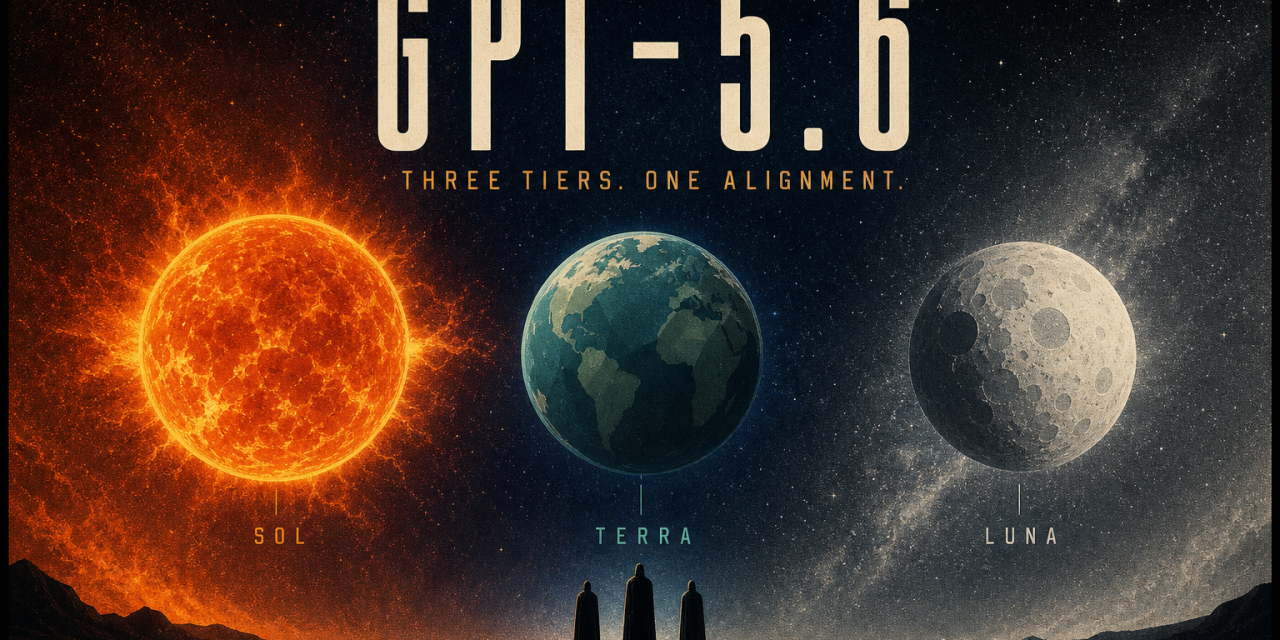
- Sol is the flagship, aimed squarely at Anthropic’s Fable 5 and built for complex reasoning, agentic workflows and hard coding problems.
- Terra is the mainstream mid-tier, positioned as GPT-5.5-class performance at roughly half the cost of Sol.
- Luna is the fast, affordable option for high-volume tasks where deep reasoning is not required.
The naming carries intent. The number identifies the generation, while Sol, Terra and Luna are durable capability tiers that can each evolve on their own cadence. That means Sol in a future generation will still be the top tier, and Luna will still be the throughput tier. Teams building routing logic can plan around this without rewriting their infrastructure every six months.
Pricing that rewards workload segmentation
The per-token rates across the three tiers make the pricing philosophy explicit:
- Sol costs $5 per million input tokens and $30 per million output tokens.
- Terra costs $2.50 per million input tokens and $15 per million output tokens.
- Luna costs $1 per million input tokens and $6 per million output tokens.
Alongside base pricing, GPT-5.6 introduces more predictable prompt caching. Cache reads receive a 90% discount, while cache writes are billed at 1.25x the standard uncached input rate, with a 30-minute minimum cache life. For applications that reuse system prompts or long context across many calls, that caching mechanism can cut effective input costs substantially.
The spread between Luna at $1 input and Sol at $5 input is where routing pays off. If you send classification, intent detection or simple summarization to Sol out of habit, you are paying five times more than you need to. Multiply that by the volume of a production API and the difference becomes hard to ignore.
What Sol actually does well
OpenAI trained GPT-5.6 to get more useful work from every token, and the benchmark story reflects that framing. On the Artificial Analysis Intelligence Index, Sol at max reasoning comes within a single point of Fable 5 while completing tasks in 61% less time at roughly half the estimated cost. On Agents’ Last Exam, which tests long-horizon professional workflows across 55 fields, Sol scores 53.6, beating Fable 5 by 13.1 points. Even at medium reasoning, Sol still beats Fable 5 by 11.4 points at roughly a quarter of the estimated cost.
On coding, the numbers are close at the top. Sol posts 88.8% on TerminalBench 2.1, edging Claude Mythos 5 at 88.0%. A separate ultra mode dispatches multiple agents across parallel workstreams and pushes that number to 91.9%, at the cost of burning more compute per task. For knowledge work, Sol scores 92.3% on the BrowseComp agentic browsing benchmark and 62.6% on OSWorld 2.0 for long-horizon computer-use tasks.
One capability improvement stands out for everyday users. Sol has become noticeably better at building presentations and documents that follow templates. It can infer a deck’s design system, layouts, typography, spacing, colors and recurring content patterns, and apply those conventions consistently to new slides. If your team has spent hours cleaning up AI-generated decks that ignored the corporate template, this alone justifies attention.
Programmatic tool calling and multi-agent work
Sol includes new built-in capabilities that change how agentic workflows execute. It can write and run lightweight programs in memory that coordinate tools, process intermediate results, monitor progress and choose the next action as work unfolds. In practice this means tool-heavy tasks advance with fewer tokens, fewer model round-trips and less prompt engineering to keep the agent on track.
In the Responses API, programmatic tool calling is Zero Data Retention compatible. A multi-agent capability, initially in beta, lets Sol run concurrent subagents and synthesize their output in a single request. Combined with ultra mode, this is where the pricing math tips toward Sol for the hardest agentic workloads, since fewer round-trips can offset the higher per-token rate.
Where Terra and Luna fit
Terra is the tier most production teams will settle into. It handles retrieval-augmented generation pipelines, customer-facing chatbots and standard production APIs with quality close to what GPT-5.5 delivered, at half of Sol’s cost. On TerminalBench 2.1, Terra scores 84.3%, matching Claude Fable 5 at a fraction of the price.
Luna handles the volume floor of your stack. Intent classification, content moderation, routing decisions, preprocessing pipelines and lightweight summarization all fit its profile. At $1 input and $6 output per million tokens, Luna makes it economically viable to run AI on requests that previously did not justify the spend. For a routing layer that decides which downstream model to invoke, Luna is often the correct default.
Availability across ChatGPT, Codex and the API
Access differs by product and plan. In ChatGPT, Plus, Pro, Business and Enterprise users reach Sol through medium and higher effort settings, and Pro and Enterprise users can select Sol Pro for the highest-quality results on complex tasks. In ChatGPT Work and Codex, Free and Go users get Terra, while paid tiers can choose between Sol, Terra and Luna and set an effort level for each. Ultra mode is available to Pro and Enterprise in ChatGPT Work, and to Plus and higher in Codex.
All three models are in the OpenAI API from launch, with a rollout that started globally and continued toward full availability over the first 24 hours.
Safety, cybersecurity and the dual-use problem
OpenAI paired this release with its most robust safety stack to date. The GPT-5.6 models are more capable than earlier versions in biology and cybersecurity, but do not cross the critical threshold in either category. In cybersecurity, testing suggests Sol is better at finding and fixing vulnerabilities than at reliably executing autonomous end-to-end attacks against hardened targets, which gives defenders a window to strengthen systems.
The safeguards themselves are layered. A reasoning monitor now reviews conversations for potential harm rather than relying solely on classifier flags, and the most sensitive capabilities are gated behind Trusted Access verification. Compared with earlier models, Sol cyber safeguards block roughly ten times more potentially harmful activity. Before general availability, OpenAI ran approximately 700,000 A100e GPU hours of black-box automated red teaming to surface weak points.
OpenAI is candid that no security is perfect. New jailbreaks will emerge, and each generation opens new attack surfaces. To handle that, the company paired existing bug bounty programs with a new rapid-remediation process, so fixes ship without needing to retrain classifiers from scratch.
The routing question worth asking today
The most useful thing to take from GPT-5.6 is not that Sol scored a point higher than Fable 5 on a specific benchmark. It is that OpenAI has made model choice a first-class operational concern by giving you three distinct price points inside one family. The winners under this structure are teams that can segment workloads by complexity and route to the appropriate tier. The losers are teams that default everything to Sol and treat AI spend as a fixed cost.
The nuance worth adding: routing logic is not a one-time project. As Sol and Luna both improve on their own cadence, the boundary between “needs the flagship” and “Luna handles it fine” will keep moving. Building a routing layer that you can re-tune quarterly, backed by cost telemetry per feature and per team, is what turns tiered pricing from a billing quirk into a durable advantage.