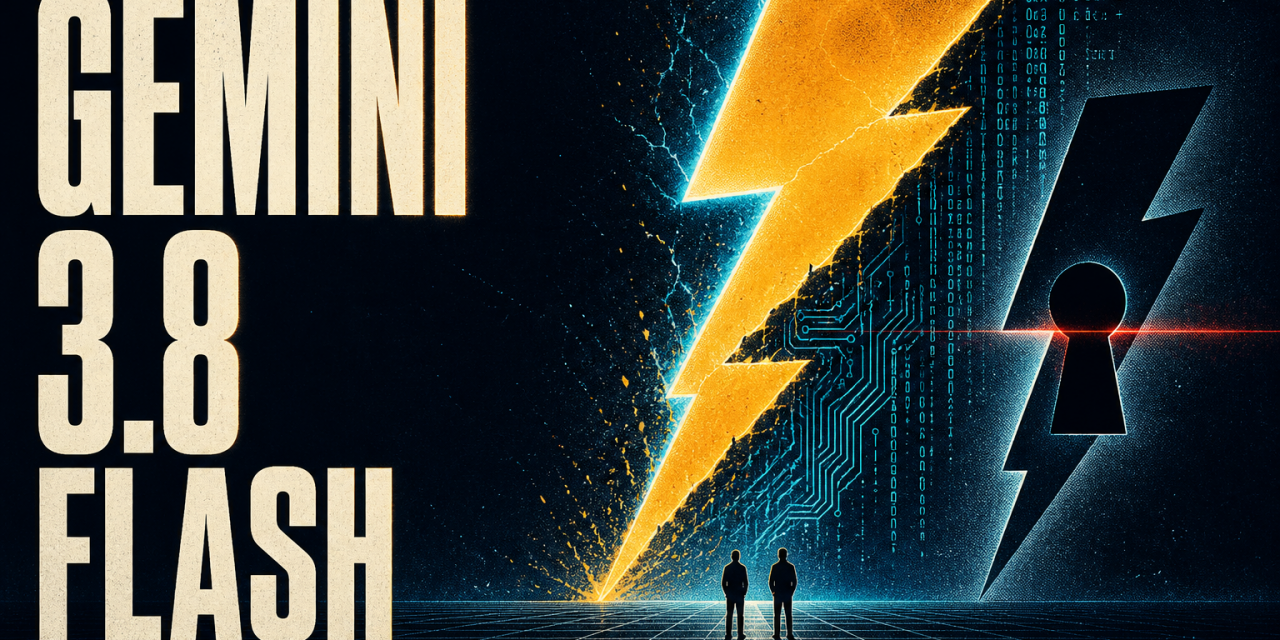
Google has released Gemini 3.8 Flash, its third Flash model in six weeks. Gemini 3.8 Flash is positioned as the company’s most intelligent workhorse model, built for long-horizon software engineering, autonomous agents and demanding knowledge workflows. Gemini 3.8 Flash Cyber applies the same foundational intelligence to vulnerability discovery and automated patching. Both models share a core that was sharpened through rigorous cybersecurity training and through long-running agentic loops that recursively evaluate and refine the underlying models.
Same price, more intelligence
Pricing stays at $0.75 per million input tokens and $3.75 per million output tokens, identical to the introductory price of Gemini 3.7 Flash. The performance gains come from a deliberate design choice: 3.8 Flash works harder. On complex tasks it shows greater diligence, executing extra reasoning steps and calling tools iteratively until the job is done. The trade-off is that the model may consume more tokens to maximize performance, especially at higher effort levels.
You control that behavior through customizable thinking levels. Low, medium and high are supported. If compute efficiency is your primary constraint, you can dial the effort down to reduce token overhead or simply keep running Gemini 3.7 Flash, which Google continues to fully support for efficiency-first workloads.
The technical specifications remain generous. You get a 1 million token input window and a 64K token output limit. The model accepts text, images, audio, video and PDF files as input and produces text. Code execution, function calling, file search, structured outputs, caching, search grounding, grounding with Google Maps and computer use in preview are all supported through the Gemini API.
Benchmark results
On DeepSWE v1.1, a benchmark for long-horizon software engineering, Gemini 3.8 Flash outperforms most larger frontier models at autonomously solving complex engineering problems end to end, at a fraction of their cost. In specialized knowledge domains, the model beats both its predecessor and other frontier models on Vals Finance Agent V2 and Harvey’s Legal Agent Benchmark, two evaluations that test advanced analysis and reporting in finance and law. It also scores 54.9% on HLE-Verified, which measures multi-step reasoning across STEM, humanities and professional fields.
Independent trackers paint a similar picture. According to Arena.ai, 3.8 Flash entered the Agent Arena at number 14, placing it above DeepSeek-V4-Pro and far ahead of Gemini 3.7 Flash, which sits at number 32. It debuted at number 7 in the Text Arena, ahead of Claude Opus 5, with notable improvements in multi-turn requests, longer queries, hard prompts, coding and instruction following. Artificial Analysis measured an Intelligence Index of 59 for the high effort configuration, up from 56 for 3.7 Flash, with output speeds around 327 tokens per second and a time to first token of 0.70 seconds on the low effort setting.
What developers are building with it
Google showcased several demos that highlight the model’s agentic coding ability. In Google Antigravity, a simple looping prompt produced an immersive 3D game in which you play a wizard navigating a castle, complete with puzzles, environmental storytelling and textures generated with Nano Banana. Another single prompt yielded a fully functional DOS version of Google Maps with locations, directions and Street View.
The model also built a topographic explorer of famous geographical sites using real datasets from the U.S. Geological Survey, featuring realtime cross-sections, 2D projections and scientific explanations. In Google AI Studio, it created Hardware Anatomy, an interactive 3D visualizer that generates realistic Three.js renderings of hardware teardowns and lets you explode devices into inspectable layers with a deconstruction slider.
Gemini 3.8 Flash Cyber hunts vulnerabilities
The second variant, Gemini 3.8 Flash Cyber, is Google’s most capable cybersecurity model. On CyberGym, the standard industry benchmark for autonomous vulnerability discovery, it demonstrates frontier-level performance and surpasses both 3.5 Flash Cyber and significantly larger frontier models. Google CEO Sundar Pichai cited a score of 86.2% on that benchmark.
Because real-world defense extends well beyond the C and C++ codebases that CyberGym covers, Google also evaluated the model on a comprehensive internal benchmark spanning 20 programming languages. There it reached a success rate exceeding 70%, a substantial leap over previous models. Patching is equally strong. On CWE-Bench, an external benchmark for patching capabilities run by Collinear, 3.8 Flash Cyber sits on the Pareto frontier with a pass@1 of 47.2%, essentially matching a leading frontier model at 47.8% while costing significantly less.
The philosophy behind the model is deliberately defensive. Google invested in vulnerability fixing from the start and prioritized it over offensive capabilities like exploitation. The goal is to give defenders expert-level tooling that tilts the balance against attackers, whether those attackers are humans or other AI agents.
Real-world results inside Google and beyond
The model is already securing production code. The Chrome Security team found that 3.8 Flash Cyber produced 2.6 times more correct patches for Chrome vulnerabilities than the best commercial models that are much larger. One striking example is a subtle bug that had survived in Chromium and Chrome for 13 years, reviewed by dozens if not hundreds of engineers without ever being flagged. The model found it.
Security firm Wiz reported that 3.8 Flash Cyber achieved 7.5 to 9.7% higher recall on its internal penetration testing benchmark at 2.3 to 5.2 times lower cost than other leading frontier models. Google’s Cloud Vulnerability Research team used the model to uncover a critical foundational vulnerability in under two hours, a discovery process that typically takes months.
The timing matters. Chrome engineering director Doug Turner described a “vulnerability apocalypse” in recent months, with a hockey stick increase in reported software vulnerabilities driven by generative AI. As Gemini security lead Raluca Ada Popa put it, attackers only need to find one significant flaw in millions of lines of code, while defenders must remove every single one. Fast and affordable scanning at scale is exactly what defenders have been missing.
Safety, limits and the Fairwind Program
Both models ship with safeguards against misuse in the chemical, biological, radiological and nuclear domains and against cyber offense, in line with Google’s Frontier Safety Framework. Because 3.8 Flash Cyber carries a more permissive set of cybersecurity mitigations, access is restricted to trusted defenders through the new Fairwind Program. Government authorities, critical infrastructure operators and software maintainers receive prioritized access via an application process.
The 3.8 generation also makes a significant leap in prompt injection robustness, as measured by Gray Swan, which protects users from injection-based malicious attacks. The official model card adds useful nuance. Overall safety performance is similar to 3.7 Flash with low unjustified refusal rates, although safety performance across non-English languages regressed slightly. The knowledge cutoff is March 2026, and in some domains the model’s knowledge remains limited to January 2025.
Where you can use Gemini 3.8 Flash
Developers can build with 3.8 Flash through the Gemini API in Google AI Studio, explore agent-first workflows in Google Antigravity, work in Android Studio or generate interfaces in Stitch. Enterprises get access through Gemini Enterprise. Consumers with a Google AI Pro or Ultra subscription will find the model in the Gemini app, AI Mode in Google Search and Gemini in Google Sheets.
Why defense work made the general model smarter
The most revealing detail in this release is not any single benchmark. It is that training for cybersecurity measurably improved the general model’s coding and reasoning. Hunting subtle bugs across 20 languages demands exactly the persistence and multi-step rigor that agentic workflows require, and that capability transferred. Combined with a release cadence of three Flash models in six weeks, the signal is clear: Google is using self-refining agentic loops and high-stakes defensive domains as the engine for general progress. If that flywheel holds, the gap between workhorse models and frontier flagships will keep shrinking, and your choice of model will increasingly be a question of budget and latency rather than raw capability.