Pigment, the Paris-based business planning platform, has raised $250 million at a $2.3 billion valuation to let AI agents build and eventually run enterprise plans. The company says agents already create 85% of all new metrics on its platform. That shifts the finance team’s job from building models to checking them, and it raises questions most CFOs have not yet answered: who approves what an agent built, where the planning data is processed, and what the AI consumption will cost. This article covers the round, what Pigment’s agents do and the controls to put in place before they touch your plan.
What Pigment announced
The round was announced on 21 October 2026. Bloomberg described Pigment as “a French AI company that competes with Microsoft’s Excel and PowerPoint”, which matches Pigment’s pitch: replacing spreadsheet-based planning and older planning software. The company says 56% of its new customers in 2025 came from a legacy planning vendor.
| Item | Detail |
|---|---|
| Round | Series E, $250 million |
| Valuation | $2.3 billion |
| Lead investor | Scaleup Europe Fund, managed by EQT |
| Other investors | World Innovation Lab (new); Greenoaks, ICONIQ, IVP and Meritech (existing); Nvidia has a planned investment |
| Revenue | More than $100 million in annual recurring revenue in 2026, doubling year on year again (company figure) |
| Previous round | $145 million Series D, April 2024, led by ICONIQ Growth |
| Use of funds | The Graphite compute engine, agents that run planning workflows end to end, engineering hiring and new regions |
Named customers include Unilever, Siemens, Danone, Snowflake, ServiceNow, Uber, ElevenLabs and Anthropic. L’Oréal is replacing its salary planning tool with Pigment for a workforce of more than 95,000 people. Nvidia’s stake was first announced by Jensen Huang in Paris on 13 October, alongside stakes in Doctolib, Genesis AI and Entalpic.
Why an EU-backed fund led the round
The lead investor is the most European part of this story. The Scaleup Europe Fund was set up under the EU Startup and Scaleup Strategy to close Europe’s late-stage funding gap. It targets €5 billion, counts the European Commission, Novo Holdings, Allianz and APG among its founding investors, and EQT was picked to manage it in May 2026. According to Tech Funding News, it co-led a €1 billion round for Finnish satellite company ICEYE in August and Mistral’s €3 billion Series D in September. In Pigment’s round it is the only lead investor named.
That fits the argument economist Rudy Aernoudt made on i-scoop: Europe does not have a startup problem, it has a scale-up problem. Here a European public-private fund backs a European software company competing for the finance stack of global enterprises. The price is high. Tech Funding News puts the valuation at about 23 times recurring revenue, and French Tech Journal notes that Pigment’s rivals have stronger distribution and that the public financial picture is incomplete.
What agentic planning looks like in practice
Pigment describes its approach in three steps in a recent post: unify finance, sales, HR and supply chain data in one live model, build models by describing intent, and automate monitoring and reporting. The agents behind it arrived over 2025 and 2026:
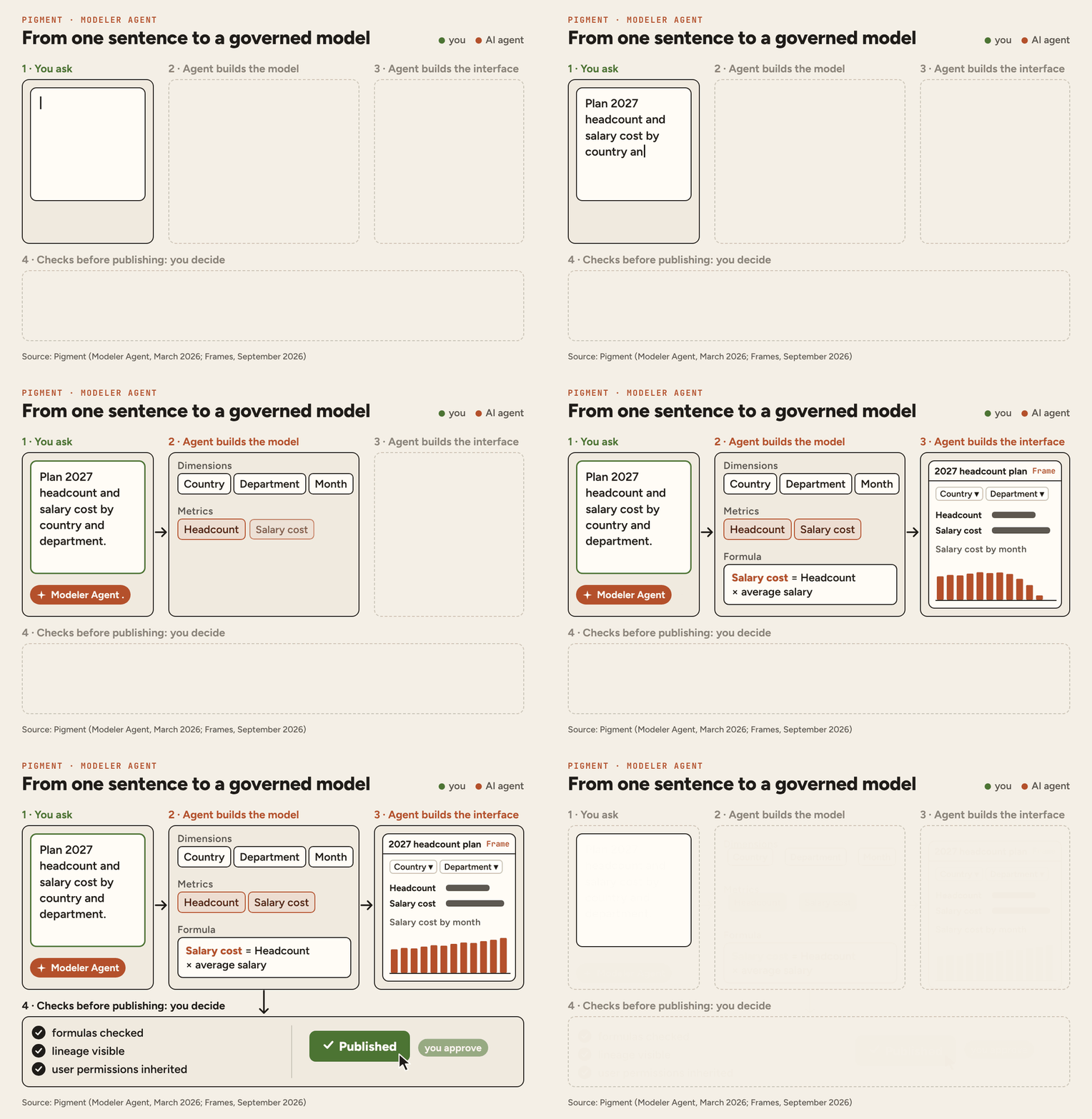
- Modeler Agent (March 2026) builds dimensions, metrics, formulas and dashboards from a plain-language description, a requirements list, an Excel file or a slide deck.
- Analyst Agent answers questions, runs code for analysis and turns a validated analysis into a scheduled “Mission”.
- Custom Agents are configured with a company’s own processes, terms and knowledge.
- Frames (September 2026) has an agent build the interface on the live model, from data-entry forms to executive views.
- Agent Connectors let the agents read context from Notion, with Google Drive and Slack to follow.
Pigment’s examples are concrete. Unilever’s North America overhead planning app went live in 25 days against an estimated four to six months. At an Uber workshop, a photographed whiteboard sketch became a working Frame in about an hour, according to SiliconANGLE. These are vendor case studies rather than independent measurements, but they show where the time goes: model and interface building, which used to take weeks of specialist work.
The control problem finance teams now own
A planning model is a chain of formulas. One wrong driver flows into every forecast, budget and board deck built on top of it. Pigment is open about the limit. “We ask the user to verify because there is no 100% guarantee that something built by AI will work,” Ben Previeux, its head of product and AI strategy, said at the Frames launch. The Graphite engine’s “deterministic, fully traceable” results describe the calculation: the same formula always gives the same answer. Whether the agent wrote the right formula is a separate question.
The safeguards Pigment describes are sensible: agents inherit the permissions of the user who runs them, every agent action is logged, Frames pass a publishing workflow in which the agent checks formulas, relationships and generated data, and users can inspect the agent’s reasoning and the lineage of each metric. In finance, though, a safeguard only counts if it maps onto your own control framework. These are the questions to settle before agents touch the plan:
| Question | What Pigment provides | What you still decide |
|---|---|---|
| Who approves an agent-built model or Frame? | A publishing workflow and visible lineage | Who may publish, and whether the builder and the approver must be different people |
| What can the agent see? | Agents inherit the running user’s access rights | Whether those rights are clean enough, especially for salary data, before you switch agents on |
| Can you reconstruct what happened? | Every agent action is logged | How long logs are kept and who reviews them |
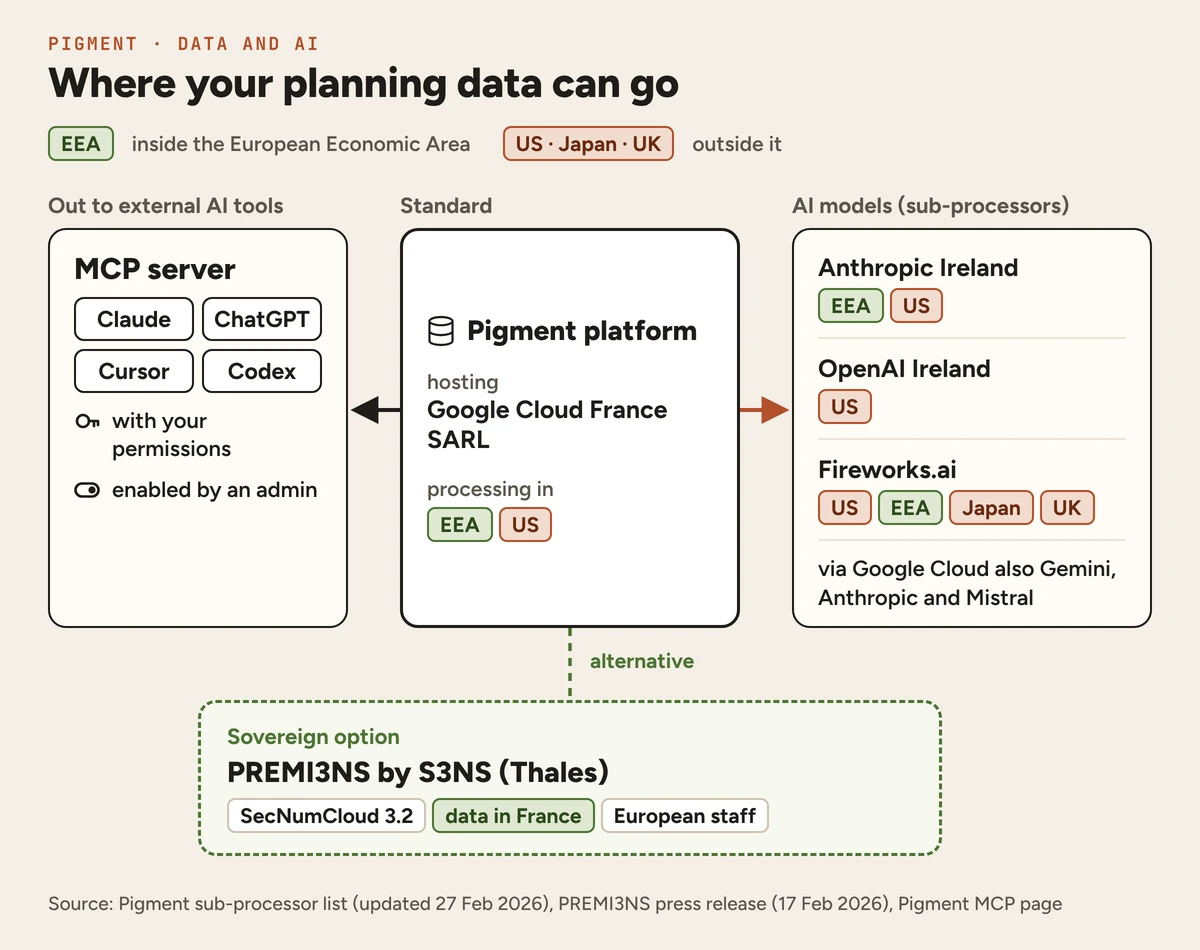
| Which external AI tools may connect? | An MCP server that an admin must enable, with a “Use AI Agents” permission per user and application | Whether Claude, ChatGPT, Cursor or Codex may read and change models |
| What will it cost? | Annual AI credits, usage visible to admins | A budget per use case and a monthly review |
The MCP server deserves its own decision. Pigment says Claude, ChatGPT, Cursor and Codex can not only query live metrics but also build and edit models through it. In its own walkthrough of building with Claude Code, a human reviews every change before it ships. Treat that as policy, not as a default. It belongs in the agent policy every organisation now needs, alongside rules for tools such as Claude Cowork that can act on a user’s behalf.
Where planning data is processed
Pigment’s sub-processor list, last updated in February 2026, shows standard hosting on Google Cloud with processing in the European Economic Area and the US. For AI features it uses Anthropic (EEA and US), OpenAI (US) and Fireworks.ai (US, EEA, Japan and UK), and models such as Gemini, Anthropic and Mistral through Google Cloud. Organisations that need data to stay under European jurisdiction can use Pigment on PREMI3NS, the SecNumCloud 3.2-qualified cloud of Thales-controlled S3NS, available since February. Pigment says it was the first EPM platform on a SecNumCloud 3.2-qualified sovereign cloud. Its documentation does not say whether the AI sub-processors change on that version, so ask.
Workforce planning and the AI Act
Most planning sits outside the EU AI Act’s high-risk categories. Budgets, revenue forecasts and supply plans are not decisions about people. Workforce planning can come closer. Annex III lists AI used to make decisions that affect the terms of employment, promotion or termination, to allocate tasks based on personal traits, or to monitor and evaluate performance. A headcount budget at department level is not that. An agent that proposes individual salary changes, which a manager then rubber-stamps, may be. After the AI omnibus, the Annex III obligations apply from 2 December 2027. If you plan pay or headcount at the level of individuals with agents, ask legal how your use is classified now, while the process is still being designed.
The cost line nobody planned for
Pigment does not publish prices. AI use runs on annual credits that expire at the contract anniversary. Agent tasks cost more or less depending on complexity, a machine-learning prediction costs 0.1 credit per time series, and AI features can be limited or paused when credits run out. A 14-day free trial with capped credits lets you test the agents on your own files first.
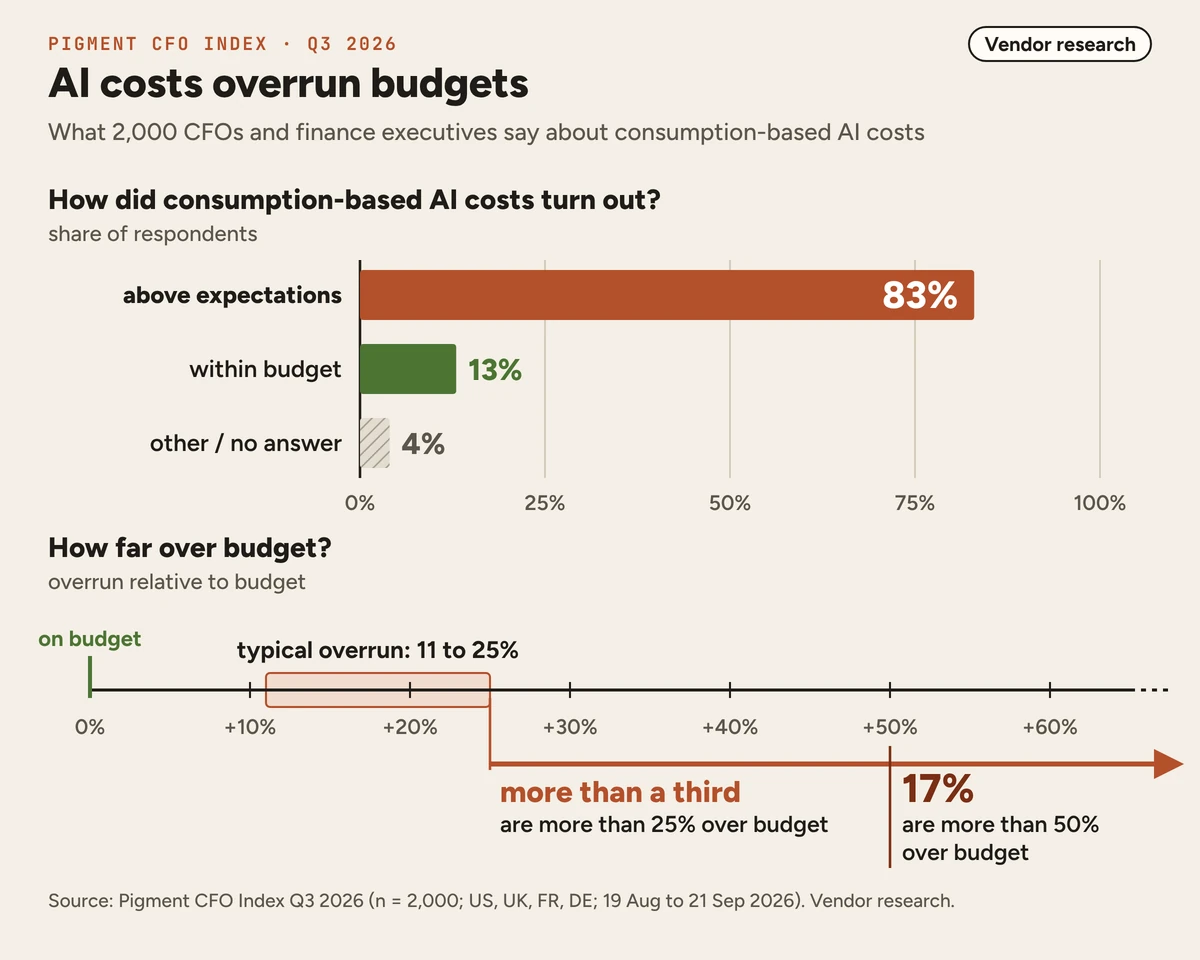
Pigment’s own survey shows why this deserves a line in the budget. In its Q3 2026 CFO Index of 2,000 finance leaders in the US, UK, France and Germany, 83% said consumption-based AI costs pushed spending above expectations. The typical overrun was 11 to 25%.
How the rest of the market is moving
Pigment is not alone. Anaplan launched CoModeler, Custom Analyst and Agent Studio in March, and Workday announced Adaptive Decision Intelligence for Adaptive Planning in May, for early adopters first. Pigment says 56% of its new customers in 2025 moved from a legacy planning vendor. Users on G2 rate it 4.6 out of 5 across 123 reviews, praising flexibility and support, while newer users mention a learning curve, which is exactly where the agents aim. If you are choosing a platform now, compare how each vendor lets you review, export and govern what its agents build, not only what the agents can do. Your models and planning logic are the part you should be able to take with you, as we argued in Models are rented, context is owned.
Frequently asked questions
What does Pigment do?
Pigment is an enterprise performance management platform for budgeting, forecasting, workforce and scenario planning across finance, HR, sales and supply chain, with AI agents that build models, analyse data and generate interfaces.
Who led Pigment’s Series E?
The EQT-managed Scaleup Europe Fund led the $250 million round, with World Innovation Lab, Greenoaks, ICONIQ, IVP and Meritech participating and a planned investment from Nvidia.
Can Pigment keep data in Europe?
Standard hosting processes data in the EEA and the US, and some AI sub-processors work in the US. A version on the French sovereign cloud PREMI3NS keeps platform data under European jurisdiction.
Does Pigment work with Claude or ChatGPT?
Yes. An admin can enable Pigment’s MCP server, after which Claude, ChatGPT, Cursor or Codex can query live planning data, and build models, with the user’s existing permissions.
Planning becomes a review job
If Pigment’s bet pays off, the scarce skill in finance moves from building models to reading them. Agents will produce plans faster than any team can check them, so the controls have to scale too: clear approval rights, clean permissions, logs someone actually reads and a credit budget that is watched. The organisations that set this up now can let the agents do more. The others will either slow them down or trust a plan nobody fully understands.