Anthropic has put concrete numbers on the impact of AI on economic growth in 2030. In every scenario its Economics team modeled, the US economy grows. The difference lies in how fast it grows and who ends up with the money. The interactive scenario explorer, published alongside the technical report Economic Scenarios for Transformative AI, lets you enter your own expectations about AI capabilities and adoption, then shows what the economy of 2030 would look like if your predictions came true.
Three scenarios for AI and economic growth in 2030
The future depends on how capable AI becomes and how quickly companies and workers adopt it. Anthropic highlights three scenarios that capture distinct kinds of impact.
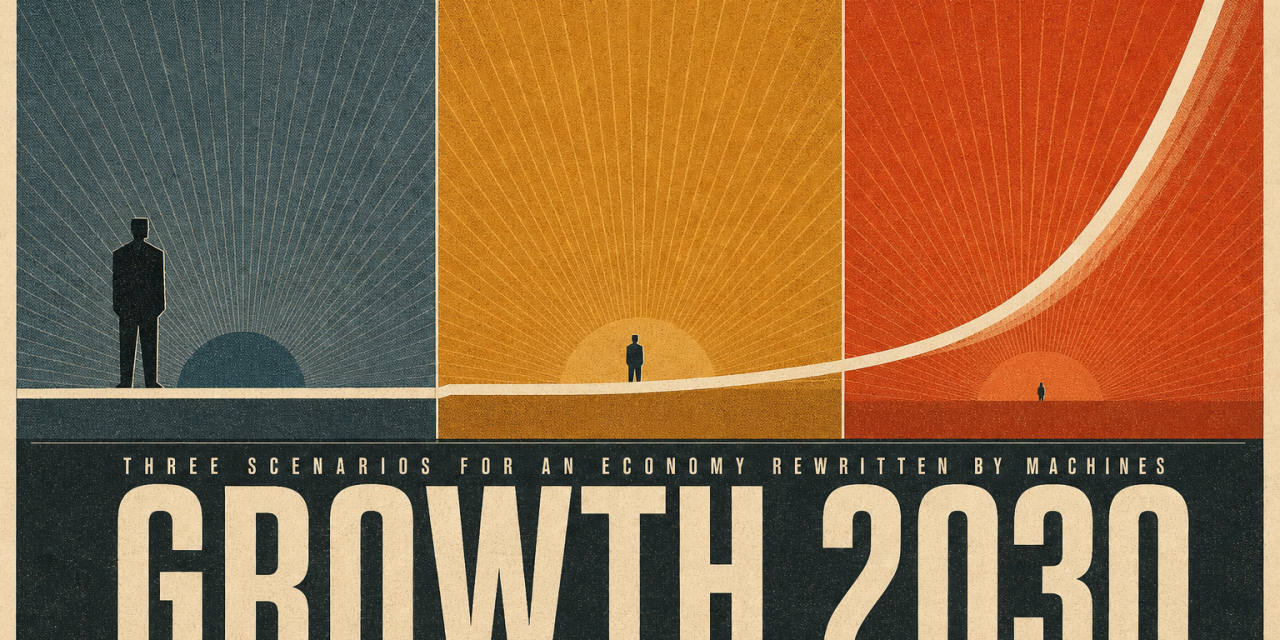
- Modest. AI has roughly the impact the internet did. It delivers real economic gains, but they stay within the historical norm for new technologies and arrive gradually. GDP ends up about 1.6% higher, at roughly $34.1 trillion.
- Substantial. By 2030, AI is capable of doing half of all knowledge work, most of it autonomously. Adoption lags behind capability, so people still perform the majority of knowledge work tasks. Even so, the economy grows at twice its normal rate and GDP reaches $36.3 trillion, 8.3% higher than without AI.
- Extreme. AI outperforms humans at the vast majority of knowledge work tasks, does nearly all of them autonomously, and creates essentially no new knowledge tasks for people. This scenario likely requires recursively self-improving AI adopted at extraordinary speed. Annual GDP growth hits 15%, the economy doubles every 4.5 years, and output reaches $44.4 trillion, 32.4% larger than it would have been without AI.
Anthropic is explicit that these are scenarios, not predictions. They show how assumptions about capability, adoption and adjustment shape who benefits from the productivity boom.
How Anthropic models the economy, task by task
The model treats every job as a bundle of tasks, based on the US Department of Labor’s O*NET taxonomy. For each task, AI can do one of four things: leave it untouched, augment it so a person works better or faster, automate it entirely, or create new tasks.
Anthropic illustrates this with a nurse. AI can help draft discharge instructions, monitor patients remotely and plan the shift’s care schedule. Charting vitals and ordering supplies could be fully automated. New tasks appear too, like checking how well an AI triages patients. Bathing a patient stays firmly human. As the nurse incorporates AI, she oversees more, spends more time with patients, and productivity rises.
Scale that across millions of daily task instances and you get the macro picture. Today those instances add up to an economy worth over $30 trillion a year. How AI affects each task determines GDP, the labor market and the share of income workers take home.
A bigger pie with a smaller slice for workers
Average wages rise in all three scenarios, but the gains concentrate outside knowledge work. In the substantial scenario, knowledge worker wages stay essentially flat. In the extreme scenario, they fall by more than 10%. Electricians, nurses and construction crews see pay rise, because AI-accelerated design and permitting make more projects viable, and those projects still need people to build them.
The distribution between labor and capital shifts just as sharply. Today about 60 cents of every dollar the economy produces goes to workers and 40 cents to capital. In the modest scenario labor’s share slips to 59.4%. In the substantial scenario it falls to 56.1%. In the extreme scenario it drops to 45.2%, handing capital an extra 14.8 percentage points. This happens because capital becomes useful for more things, which raises its price, even when wages for many workers rise.
The result is a striking divergence. In the extreme scenario the economy grows by a third, yet total labor income barely changes by 2030. Society becomes far wealthier than it has ever been, and in Anthropic’s words “the challenge is making sure that the gains are broadly shared.”
Job switching is the bottleneck
Some churn in the job market is normal, and most job seekers find new work fairly quickly. The substantial and extreme scenarios change that equation for knowledge workers. Coders and call center agents may need to move toward occupations less exposed to AI, such as nursing or electrical work.
Switching occupations entirely is hard. Workers may not want to change fields, they often need new skills, and landing a different kind of job takes time. The more switching a scenario requires, the more people sit between jobs. In the extreme scenario, unemployment rises beyond levels typically seen in recessions, with unemployment climbing in knowledge work while it falls in other occupations.
What 10,000 Americans expect from AI
In August, Anthropic surveyed more than 10,000 Americans about future AI capabilities, adoption and the ease of finding new work. The typical respondent’s answers imply outcomes close to the substantial scenario. GDP ends up 10% higher by 2030 than it would be without AI, and unemployment rises to around 5%. Roughly 10% of respondents hold views consistent with the extreme scenario. Even that middle ground would transform which careers companies hire for and which skills command higher pay.
The limits
The explorer is version 1.0 and a simplification. It omits policy responses, business cycles, aggregate demand and financial market disruptions, catastrophic risks, and hyper-capable robots that could take over physical work. It also ignores the demand effects of the current data center buildout and cannot track individual workers through displacement.
The framework was reviewed by economists including Daron Acemoglu, David Autor and Emi Nakamura. Their feedback visibly shaped the model, adding the rising returns to capital and the wage divergence between exposed and sheltered occupations. Open criticisms remain, from whether exposed occupations will shrink at all to the possibility that the model underestimates how much AI could accelerate technological progress itself.
The number that matters most in 2030
The decisive variable in Anthropic’s model is the gap between capability and adoption. Task-level augmentation dominates the milder scenarios, autonomous execution defines the extreme one, and the swing factor is how quickly agentic systems become reliable enough to run without a human in the loop. Anthropic says the model will guide the research it funds and the policy ideas it proposes. The clearest takeaway for anyone watching the economy: by 2030 GDP will almost certainly be bigger. The real contest will happen in paychecks.