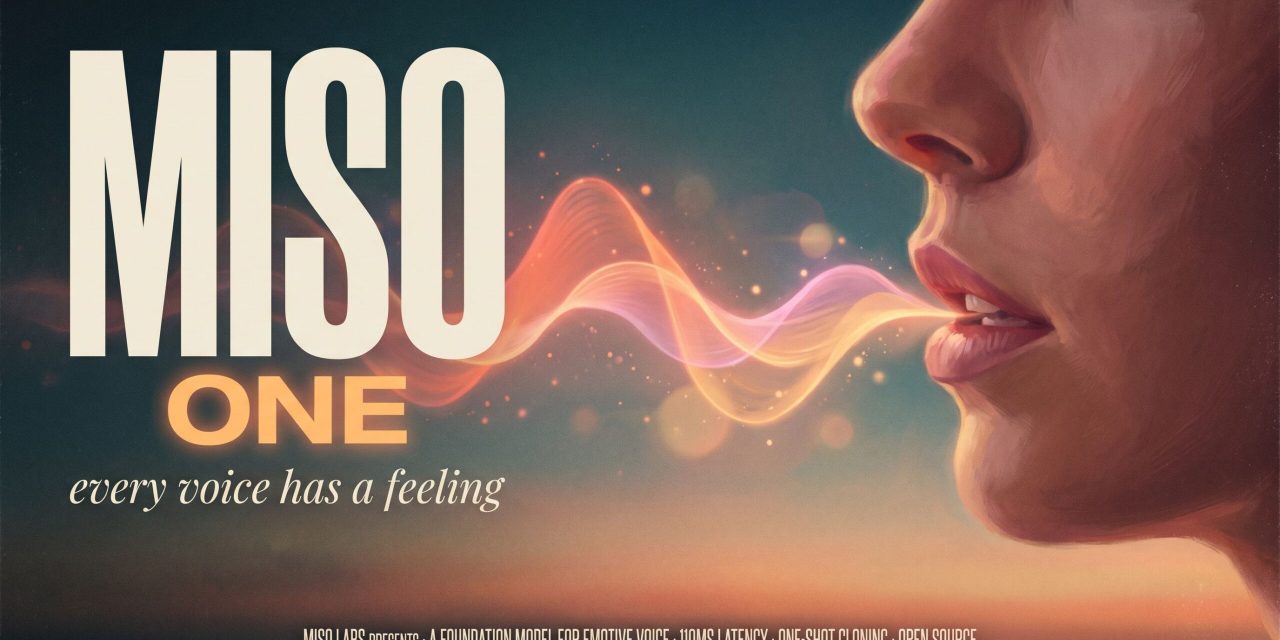
Voice agents have a reputation problem. They sound robotic, they pause awkwardly, and they rarely capture the warmth of a real conversation. Miso Labs wants to change that with a foundation model built specifically for emotive, low-latency speech. The company has released Miso One, an eight-billion-parameter text-to-speech model that responds in 110 milliseconds and speaks with the kind of expressive range you would expect from a human, not a machine.
This shift matters because voice is becoming the dominant interface for AI. From customer support to in-car assistants, the difference between a tolerable agent and one users actually enjoy comes down to two things: how fast it reacts and how natural it sounds. Miso Labs is targeting both at once.
Why latency defines a good voice agent
Most AI voice agents respond at around 700 milliseconds or slower. That delay sounds small on paper, but in a live conversation it creates a noticeable lag. Users start repeating themselves. They interrupt. The flow breaks and the illusion of talking to something intelligent collapses.
Miso One operates at 110 milliseconds, which is faster than the natural latency of human conversation. When response time drops below human reaction speed, conversations feel continuous instead of turn-based. The agent stops feeling like a tool you query and starts feeling like a participant.
For developers building voice agents, latency is often the hardest engineering challenge. It involves the speech recognition layer, the language model, and the text-to-speech output. Miso Labs focuses on the final layer, where most of the perceived delay accumulates. By compressing that step to 110 milliseconds, they remove the bottleneck that has held back conversational AI for years.
Emotive speech as a foundation, not a feature
Synthetic voices have improved dramatically in clarity and pronunciation, but emotion has been the hard part. Most models can read a sentence accurately while still missing the intent behind it. A question sounds like a statement. Excitement sounds like fatigue. Sarcasm disappears entirely.
Miso One was built from the ground up to handle emotional expression as a core capability rather than a bolt-on effect. The model captures shifts in tone, pacing, and intensity that match the meaning of the text. That difference becomes obvious in extended dialogue, where flat delivery quickly becomes exhausting to listen to.
This matters in practical applications. A voice agent handling a frustrated customer needs to respond with calm patience. A narrator reading an audiobook needs to differentiate characters. A virtual assistant explaining bad news needs to soften its tone. These are the moments where voice AI either earns trust or loses it.
One-shot voice cloning from a ten-second sample
Miso Labs also offers one-shot voice cloning. Feed the model a ten-second audio clip and it generates speech that matches the original speaker. The cloned voice stays consistent across long conversations, holding its character from the first second of a call to the last.
Voice consistency is harder than it sounds. Many cloning systems drift over time, gradually losing the qualities that made the source voice recognizable. By the end of a long interaction, the agent sounds like a generic synthetic voice with a faint resemblance to the original. Miso One avoids that drift, which makes it usable for production scenarios where brand voice or personal identity matters.
The applications stretch across industries. Media companies can preserve the voices of specific narrators across thousands of hours of content. Enterprises can build agents that speak in a consistent brand voice. Accessibility tools can recreate the voices of users who have lost the ability to speak. The ten-second requirement lowers the barrier dramatically compared to older systems that needed hours of training data.
Open source and on-premises deployment
Miso Labs has open-sourced the model weights for Miso One. The repository is available on GitHub under MisoLabsAI, and the model can be tested directly through their site. API access is coming soon for teams that prefer a hosted solution.
The open-source decision is strategic. Voice data is among the most sensitive categories of information a company handles. Recordings of customer calls, medical consultations, or internal meetings cannot always be sent to third-party APIs without legal and compliance risks. By releasing the model for local deployment, Miso Labs lets enterprises keep voice data inside their own infrastructure.
For organizations with strict data residency requirements, this approach removes a major obstacle to adopting voice AI. The company also offers on-premises hosting and support contracts for enterprise teams that want the open-source flexibility with commercial backing. That combination is rare in the foundation model space, where most leading systems remain closed and cloud-only.
What this means for builders
If you are building a voice agent, the technical stack you choose shapes the product more than any other decision. A model that lags by 700 milliseconds will limit what your agent can do, no matter how clever the underlying logic. A flat, robotic voice will turn off users before they get to the value your application provides.
Miso One changes the constraints. With sub-human latency and expressive output, developers can design agents that handle nuanced conversations, not just scripted exchanges. Voice cloning opens the door to personalized agents at scale. Local deployment makes regulated industries viable customers instead of impossible ones.
There are still trade-offs. An eight-billion-parameter model requires real compute resources to run locally, and tuning it for specific accents, languages, or domains takes engineering effort. But the baseline capabilities now sit at a level where building a voice agent that users actually want to talk to is a realistic goal rather than an aspirational one.
Where voice AI goes next
The conversation around large language models has dominated AI coverage for the past two years, but the voice layer is where most users will first encounter these systems in daily life. Phones, cars, smart home devices, customer service lines, and accessibility tools all rely on speech as the primary interface.
Miso Labs is betting that emotion and speed are the two qualities that separate voice AI you tolerate from voice AI you choose. Their work on Miso One suggests that the gap between synthetic and human speech is narrowing not just in fidelity, but in the harder qualities that make voices feel alive.