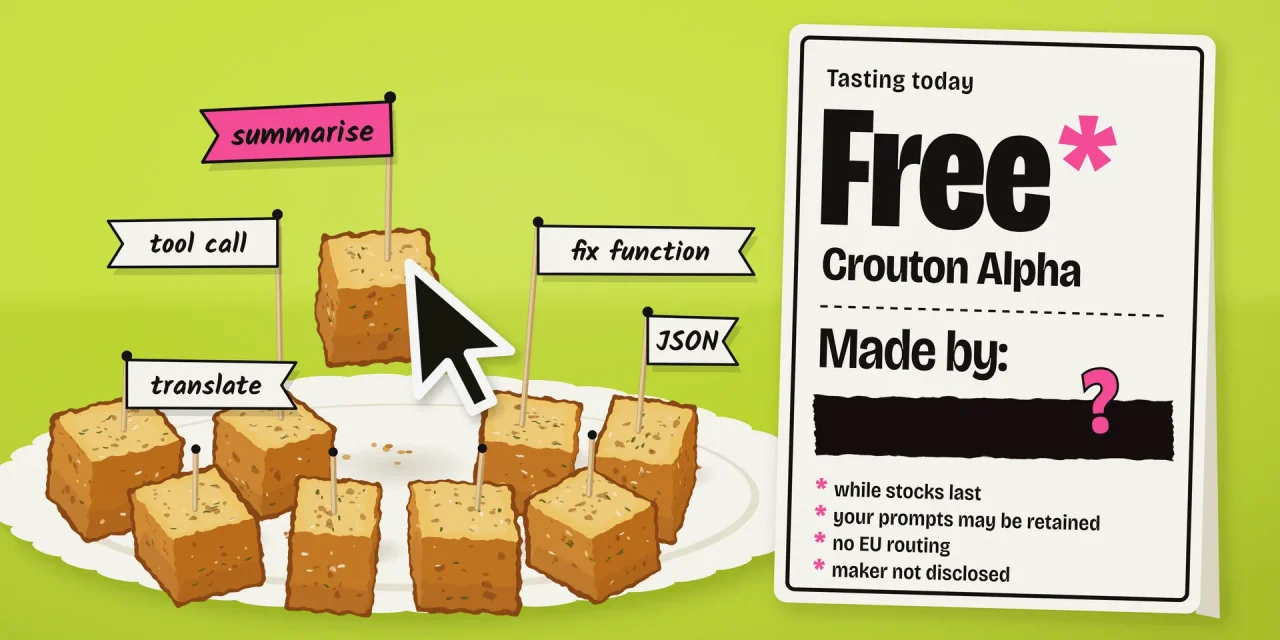
Crouton Alpha is a free AI model that appeared on OpenRouter on 3 November 2026 without a maker’s name attached. It reads text, images, audio, video and files, has a context window of just over one million tokens, and is pitched at the small, repeated steps inside AI agents. For European teams the interesting part is not only what it can do. It is that you cannot keep it inside Europe through OpenRouter’s EU in-region routing, you do not know who keeps your prompts, and if precedent holds, the free price ends once the lab behind it steps forward.
This article covers what Crouton Alpha is, the job it is designed for, the clues about its maker, and a test plan that keeps your company data out of an anonymous model.
What Crouton Alpha is
Crouton Alpha is a stealth model. An AI lab puts an unreleased model on OpenRouter under a code name, collects real-world feedback, and often reveals itself later. OpenRouter routes the requests and states that it is not the model’s developer, owner or provider. The listing went live at 01:38 UTC on 3 November and OpenRouter announced it on X that evening, according to CellCog, describing it as “a highly efficient reasoning model built to scale out the work your agents repeat all day”.
The specifications in OpenRouter’s API and model page on 4 November:
| Feature | Crouton Alpha |
|---|---|
| Model ID | stealth/crouton-alpha |
| Context window | 1,048,576 tokens |
| Maximum output | 943,718 tokens |
| Input | text, image, file, audio and video |
| Output | text only |
| Price | $0 for input and output during the preview |
| Reasoning | always on, adjustable from minimal to max |
| Tools | tool calling and structured outputs, with tool_choice limited to auto |
| Speed | about 2 seconds to first token and 72 tokens per second (median) |
| EU in-region routing | not available |
There are no official benchmark scores yet. One tester reported on X that it passed 140 of 157 tasks on his own test set, with a perfect coding score and a weaker result in maths. That is a single person’s benchmark and a first impression, not a ranking. Usage is climbing fast, though: on 4 November Crouton Alpha ranked second in OpenRouter’s new and trending models, with 25.1 billion tokens processed.
The job it is built for
OpenRouter’s description is unusually specific: pair Crouton Alpha with a frontier reasoning model and let it execute the bounded steps. That is the pattern many agent systems now follow. An expensive model plans and checks. A fast, cheap model does the dozens of sub-tasks in between, such as extracting fields from a PDF, reading a screenshot, editing a function or calling a tool and returning the result in a fixed schema.
For that worker role, cost per task and reliable tool calls matter more than a leaderboard position. The long context helps with document work, because a full contract set or a large codebase fits in one request. Two limits matter if you build with it. You cannot force a specific tool, because tool_choice only accepts auto. And reasoning is always on, at the highest effort by default, so lower it yourself for quick sub-tasks or you pay in latency.
If you are designing that kind of system, the code around the model can matter a great deal: in Stanford’s Meta-Harness research, changing only the harness around the same model produced a sixfold performance gap.
Who is behind Crouton Alpha
Officially, nobody. Most speculation points to Meta and its Muse family. CellCog collected and graded the clues posted by a tracking account:
- Effort settings. Only Meta’s Muse listings on OpenRouter show the same set of reasoning levels.
- A rare Japanese word. Crouton Alpha fails a word that every Muse model fails and 93 other models get right. If it holds, this is the strongest clue.
- Context and output limits. 1,048,576 tokens in and 943,718 out, identical to Muse Spark 1.3, but more than twenty OpenRouter models share these limits, including DeepSeek, GLM and Kimi models, so this clue carries little weight.
- Blocked in 21 countries, the same list as Meta’s model API, according to the tracker. CellCog did not check this.
The counter-evidence is real. According to the tracking account itself, the token counts do not match Meta’s. A developer of the pokebench benchmark probed the tokenizer against twelve known models: Google, Qwen, Mistral and GLM were ruled out, and no known tokenizer matched. Whether Meta was among the twelve is not stated, and another tester on X concluded from the tokenizer that it is almost certainly a Muse model. Another tester judged its output on the familiar pelican drawing test weak enough to guess at a cheap Chinese model instead.
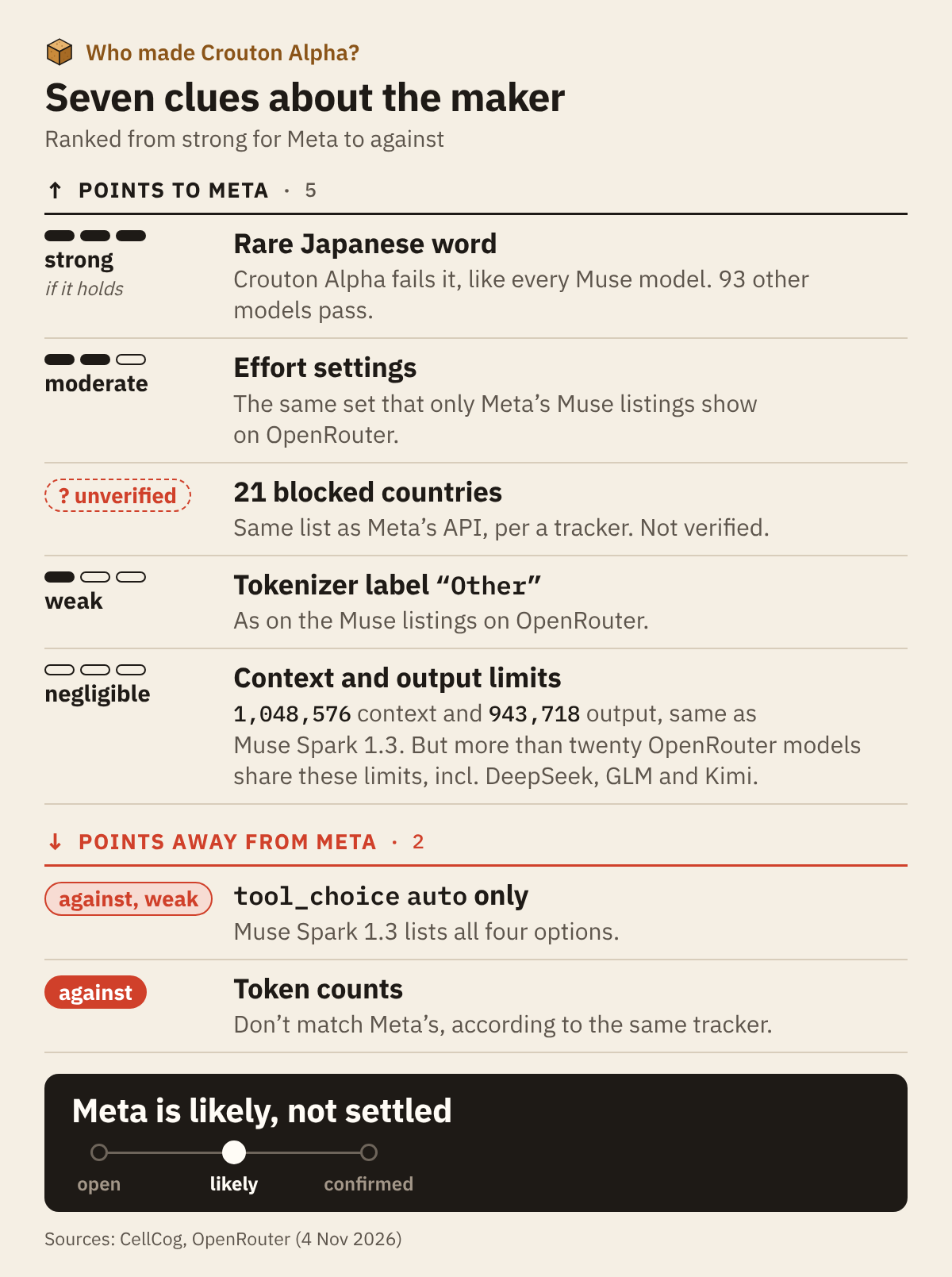
Meta is the likeliest candidate, not a settled answer. A light worker model would fit next to Muse Spark Open, which already gives Europe a US open-weight option with strings attached. Early fingerprinting has been wrong before, as with Union Alpha.
What earlier stealth models turned out to be
Stealth models that do get named are usually named within two weeks, sometimes within days, according to counts from CellCog and a census by Digital Applied. The labs behind them ranged from OpenAI and Xiaomi to Meituan, Z.ai, MiniMax and Unbiased. Digital Applied also counts six of fourteen earlier listings that were never officially revealed. Owl Alpha, which became Meituan’s LongCat-2.0-Preview, was the exception at 63 days. Meituan has since pushed LongCat 2.0 onto Chinese chips. Ox Alpha was revealed by Z.ai on 26 August as GLM-5.3-Flash, the family behind GLM-5.3-FlashX-Legal.
Two patterns follow. The free price ended each time the maker was named. And what an anonymous model shows in its first days is often a pre-release snapshot: Quasar Alpha turned out to be an early GPT-4.1. Do not build a product on a stealth model. Use it to see what is coming.
The European questions: data, region and routing
Data. The model page says the anonymous provider may retain prompts and completions, but does not use them for training. Everything else falls under OpenRouter’s Stealth Model Terms. That is better than the norm: according to Digital Applied, 13 of 14 earlier stealth listings allowed training by default. Only Ox Alpha had the same exception.
Your contract, at most, is with OpenRouter. The party that actually processes and retains your prompts is an unnamed provider in an unknown location. Article 28 of the GDPR requires processors with sufficient guarantees, a written contract and prior authorisation of sub-processors, and you cannot meet that, or check the international transfer rules in Chapter V, for a provider you cannot identify. OpenRouter’s own stealth terms also prohibit uploading regulated or sensitive data. In practice: no personal data goes in.
Routing. OpenRouter offers EU in-region routing through eu.openrouter.ai on its Business and Enterprise plans. It keeps prompt processing and inference on European endpoints and never silently falls back to another region, though account and billing data may still be handled in the US. Crouton Alpha is not on that list, and neither is Muse Spark 1.3.
Region. OpenCode, which offers the model free for a week, says access is limited to certain regions without naming them. A Chinese-speaking developer reported on X that it worked through a US server. Whether EU countries are blocked is unconfirmed, so test it. Working around a regional block with a VPN is a bad idea for a company: you step outside the terms and send data to a party whose identity and location you do not know.
A test plan that keeps company data out
| Test | What to use | What to measure |
|---|---|---|
| Document extraction | public reports or synthetic invoices | field accuracy over 20 identical runs |
| Tool calls | a mock API with a fixed JSON schema | schema errors and wrong tool picks |
| Vision | screenshots of your own public website | correct reading of labels and tables |
| Long context | open-source code or public regulations | whether answers cite the right section |
| Cost and speed | the same tasks on your current worker model | latency at low and medium effort |
Access is straightforward. On OpenRouter you call stealth/crouton-alpha through the OpenAI-compatible API. Free models are capped at 20 requests per minute and 50 per day, or 1,000 per day once you have bought at least $10 in credits, according to the documentation. OpenCode Zen offers it as Crouton Alpha Free for a week from 3 November, so until around 10 November, with output capped at about 270,000 tokens per request. Command Code charges nothing for it, although its plans start at $1 a month, and Kilo Code passes requests to the free OpenRouter listing. Expect some failed requests, because availability swung widely in the first day.
Write down your results. When the maker is named and a price appears, you will have your own numbers to compare it with, such as DeepSeek V4.1 Flash, the model that processes the most tokens on OpenRouter, or whatever worker model you use today. Keep a frontier model such as Kimi K3.1 Pro in the planner seat for the comparison.
Frequently asked questions about Crouton Alpha
Is Crouton Alpha free?
Yes, $0 per million tokens during the preview. OpenRouter has announced no end date; OpenCode Zen’s free week runs to around 10 November. Earlier stealth models stopped being free once their maker was revealed.
Does Crouton Alpha train on my data?
OpenRouter says it does not, but the provider may retain prompts and completions. Keep confidential and personal data out.
Is Crouton Alpha made by Meta?
Not confirmed. Several technical clues point to Meta’s Muse family, but according to the same tracker the token counts do not match.
Can I use Crouton Alpha with EU data residency?
No. It is not available through OpenRouter’s EU in-region routing.
Can Crouton Alpha generate images or audio?
No. It accepts text, images, audio, video and files, and returns text only.
Taste first, procure later
The name gives the game away: a crouton is not the meal, it is the small piece you use by the handful. If a major lab is about to ship a fast worker model with a million tokens of context, the procurement question for European companies shifts from which model is smartest to which model does the repeated work at the lowest cost per task, in a region you can defend to your data protection officer.
Crouton Alpha cannot answer the second half of that question yet. Test it now with data that is worthless to anyone else, keep your notes, and wait for the name and the price list.