Dessa is a voice model from Block, Jack Dorsey’s company behind Square and Cash App, that learned to talk by listening to recorded conversations and nothing else. Because no text sits between your voice and the model, it picks up what transcripts throw away: sarcasm, a sigh, a laugh, a voice that cracks. That is the point of the research, and for European organisations it is also where the questions start. The EU AI Act already bans AI that infers emotions at work or in education, and it requires people to be told when they are talking to a machine. Dessa itself is not available yet, but the kind of voice AI it represents is heading for contact centres, HR tools and classrooms.
What Block announced
Block unveiled Dessa on 23 October 2026 as a research preview, not a product. On its project page the team calls it “the most authentic full-duplex speech model ever built”. The lab is small: six researchers and a few interns led by Ragavan Thurairatnam, reporting directly to Dorsey. Thurairatnam described it on X as “a GPT3 moment for speech”.
Block’s main claims:
- Speech only. Dessa was trained from scratch on human conversation, with no text and no pretrained model. Audio goes in, audio comes out.
- Full duplex. It listens while it speaks and learned by itself when to interrupt and when to just say “got it”.
- Emotion. It hears and produces sarcasm, laughter, sighs and a voice cracking with sadness.
- Efficient. It learned language from hundreds of times fewer words than a large language model, trained on a single NVIDIA GB200 NVL72 rack.
- Local. Inference runs faster than real time, and the model runs locally on a MacBook Pro with an M4 Max chip or better.
Access is limited to “a small group of AI safety researchers”, who are asked to find the risks the team has not anticipated. Everyone else can join a waitlist.
Why a speech-only model hears more
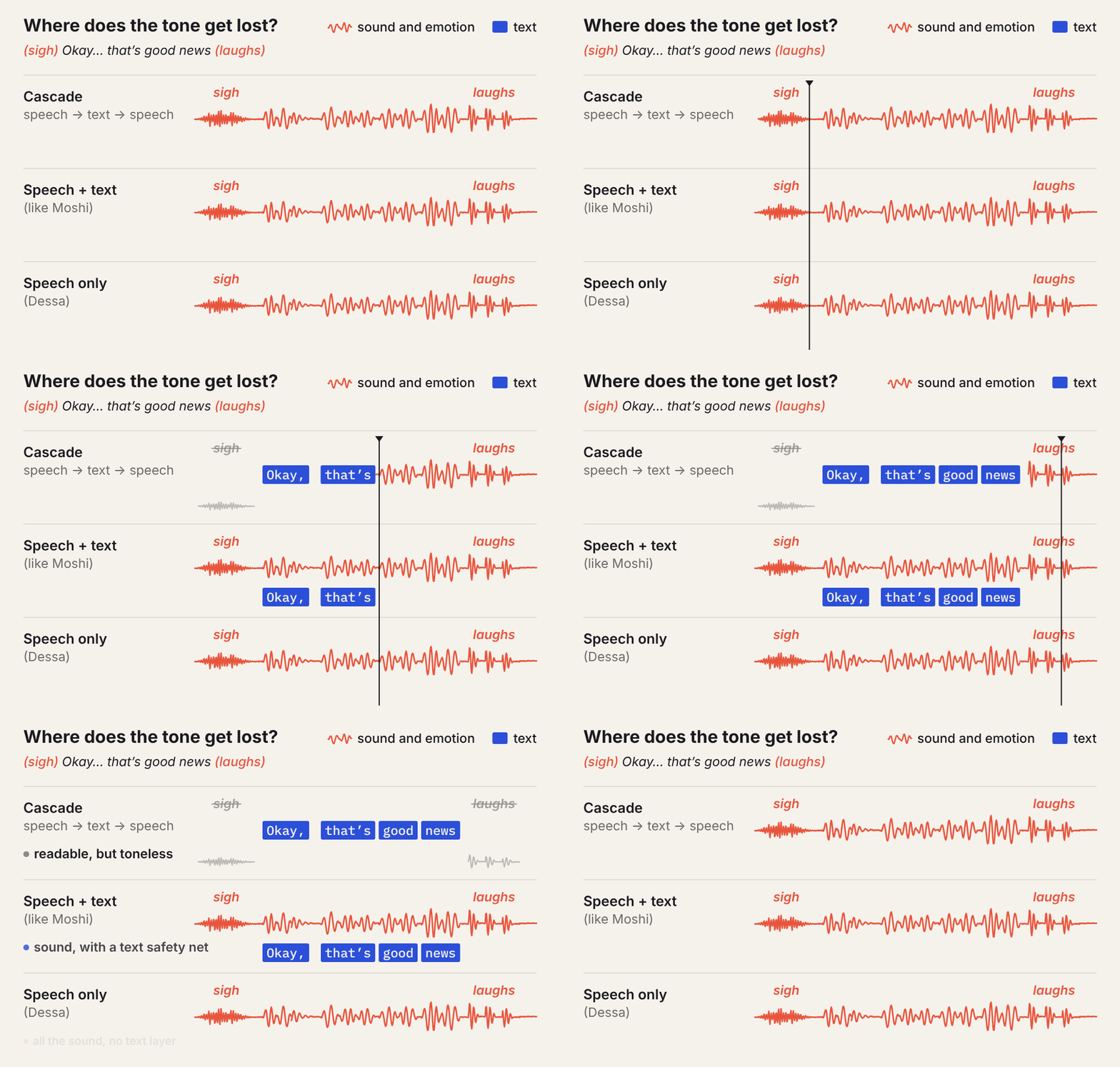
Most voice assistants are a chain of models. Speech recognition turns your voice into text, a language model writes a reply and a voice model reads it out. Vendors like this design because the text in the middle can be read, logged and checked against guardrails. The cost is everything that does not fit into letters. ElevenLabs, which sells such cascades, acknowledged in March 2026 that models processing speech directly preserve intonation and emotion better.
Europe already has a middle way. Moshi, built by the Paris lab Kyutai, handles audio directly but also predicts text as an inner monologue and starts from a 7-billion-parameter text model. NVIDIA’s open PersonaPlex builds on Moshi. Dessa drops the text entirely. Block compares it to a baby: “Babies learn to talk without ever seeing a word written down. We wanted to see if a model could too.”
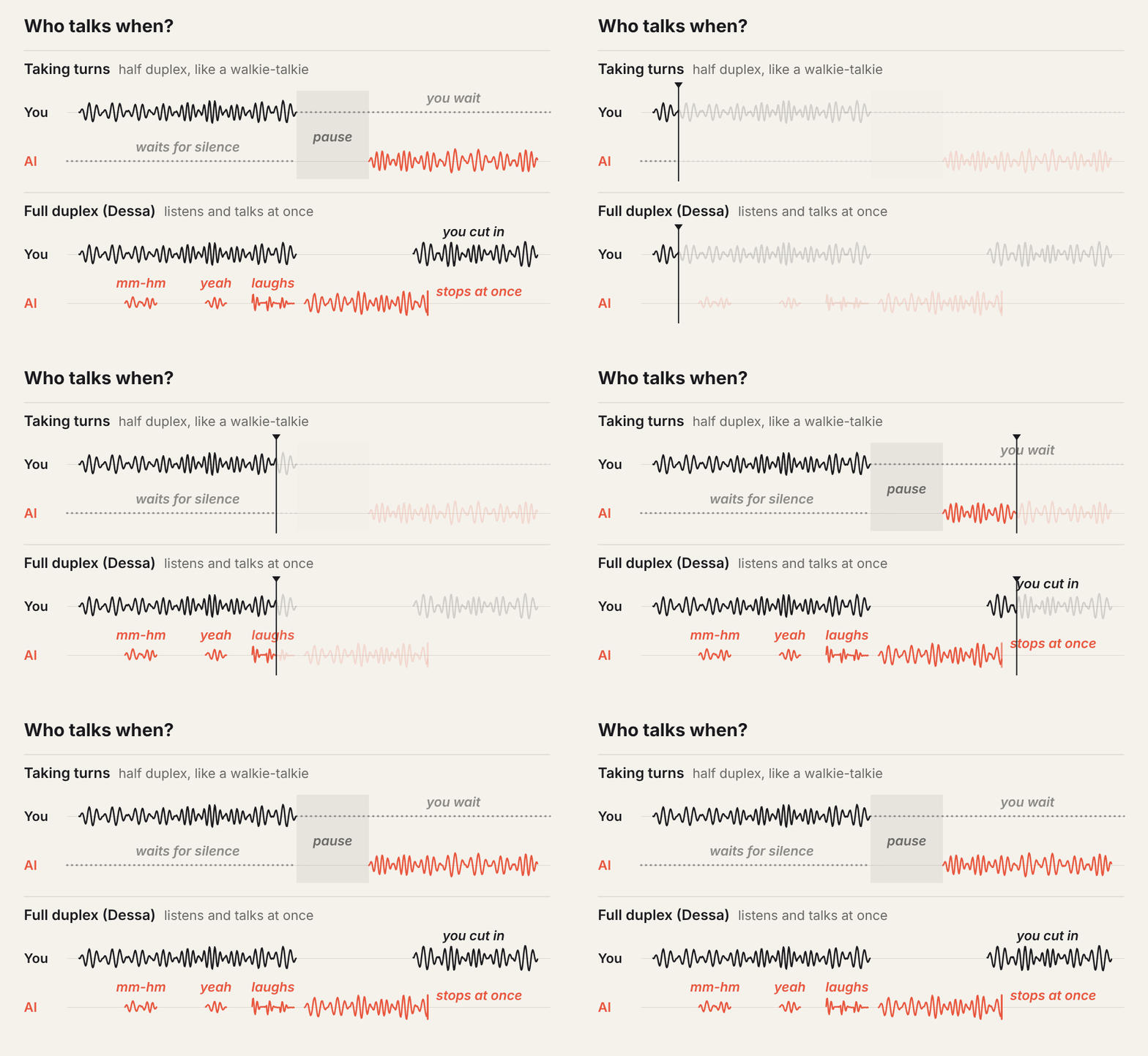
Full duplex adds the second human trait. A classic assistant behaves like a walkie-talkie and waits for silence before it answers. A full-duplex model talks while you talk, backchannels with “mm-hm”, laughs along and stops when you cut in. OpenAI brought this to ChatGPT in July 2026 with GPT-Live, which hands hard questions to a background model, GPT-5.5 at launch, while the conversation continues. Dessa is the first full-duplex model that, according to Block, learned everything from sound.
What is still unproven
Block highlights six live, unsteered recordings and posted about fifteen more samples. Dessa laughs at a joke, speaks up on request, supplies a film title the speaker forgot and responds with what sounds like teary gratitude to an anniversary surprise. One recording pairs it with OpenAI’s GPT-Live-1. The Verge found the conversations mostly natural but at times awkward and uncanny, noting that Dessa called its partner “Ronaldo”.
Everything a buyer would need is missing: no paper, no model size, no hours of training audio, no latency figures, no licence, no price and no benchmarks. OrcaRouter called it a “research result with an unusually good demo page”. Rival models can be compared on the independent Artificial Analysis leaderboard, which tracks response time, spoken reasoning, task completion and turn-taking for Grok Voice 3.0, GPT-Live-1 and Eleven Realtime. Dessa is not on it, and no widely used leaderboard measures how well a model reads emotion.
The team’s history explains the caution. It comes from Dessa, a Toronto start-up that in May 2019 cloned the voice of podcaster Joe Rogan so convincingly that it withheld the model and data. The company then worked on deepfake detection and was acquired by Square in February 2020. Block says safety is one of its three motives: AI “keeps gaining power and independence, and it’s still nearly deaf to the emotion in our voices”, and a model that hears distress could respond better to someone in pain. A convincing emotional voice is just as useful to a fraudster, which may be why Block gives researchers access first.
Where emotion-aware voice AI meets the EU AI Act
There is no sign Dessa will reach European customers soon. Its approach will, through vendors who promise voice agents that understand how customers feel. Several rules in the AI Act matter, and none of them waits for Block.
| Rule | What it says | Applies from |
|---|---|---|
| Article 5(1)(f), prohibited practice | No AI systems that infer the emotions of people in the workplace or in education, except for medical or safety reasons | 2 February 2025 |
| Article 50, transparency | People must be told they are interacting with an AI system unless it is obvious; deployers of emotion recognition must inform the people exposed to it | 2 August 2026 |
| Article 50(2), marking synthetic audio | Providers mark AI-generated audio in a machine-readable way; grace period for systems already on the market | 2 August 2026, or 2 December 2026 for older systems |
| Annex III, high-risk | Emotion recognition systems are high-risk and need risk management, logging and human oversight | 2 December 2027, after the Digital Omnibus |
The prohibition is the sharpest line. The Commission’s guidelines count voice among the biometric data relevant to the ban, a reading the FPF notes is not fully aligned with the GDPR definition. So a system that infers from someone’s voice that they are angry or stressed falls under the ban when it is used on employees or students, as the Future of Privacy Forum explains. Merely registering that someone raises their voice is not emotion recognition. Inferring frustration from it is. Wellbeing or burnout monitoring does not count as a medical exception.
For a contact centre the distinction matters. A voice agent that responds warmly when a customer sounds upset is a different case from a dashboard that scores the mood of your own agents. The first may still trigger the disclosure duty and the high-risk rules if it is designed to recognise emotions. The second is banned outright.
Models like Dessa make the line harder to draw. A speech-only model does not output a label such as “angry”. It simply hears tone and reacts to it, the way a person would. Whether such a system counts as an emotion recognition system depends on its intended purpose and how it is deployed, and there is no case law yet. Treat that as an open legal question for your counsel, not a loophole.
The transparency rules are simpler. The more human a voice sounds, the less obvious it is that it is a machine, so the disclosure in the first sentence of the call becomes essential rather than optional. And voice recordings remain personal data under the GDPR. If Block’s claim holds that Dessa runs on a laptop, audio would not have to leave the device, which would make data protection easier than with cloud voice services.
What European organisations can do now
- Map where voice AI touches employees and students. Call analytics, interview tools, coaching software and e-learning platforms often add “sentiment” or “emotion” features. Under Article 5 those may already be illegal in your workplace.
- Ask vendors one direct question. Does the system infer emotions or intentions, and does it store or show those inferences? Get the answer in writing, with the intended purpose.
- Script the disclosure. Let every voice agent say in its first sentence that it is an AI system, whatever the vendor’s default.
- Prefer local processing where you can. On-device models are improving quickly. They reduce transfers of personal data and dependence on non-EU clouds.
- Keep an eye on open alternatives. Moshi from Kyutai and NVIDIA’s PersonaPlex are open full-duplex models you can test today, which Dessa is not.
For the human side of the story, see our earlier pieces on emotive voice AI from Miso Labs and on how emotions shape the behaviour of language models.
Frequently asked questions about Block Dessa
Can I use Block Dessa?
Not yet. Only a small group of AI safety researchers with an institutional email address get early access. Anyone can join the waitlist on block.xyz/dessa. There is no release date, price, API or licence.
Is Dessa an emotion recognition system under the AI Act?
That is unclear. The definition covers systems whose purpose is to identify or infer emotions from biometric data such as voice. A conversational model that reacts to tone without producing emotion labels is a grey area, and the answer will depend on how it is deployed.
Which languages does Dessa speak?
Block has not said. The published recordings are essentially all in English, and Block lists learning new languages as an open research question.
How is Dessa different from GPT-Live?
Both listen and speak at the same time. GPT-Live is available in ChatGPT and can pass hard tasks to a background model, GPT-5.5 at launch. Dessa is a research model that, according to Block, learned only from speech and runs locally, but it cannot be used yet.
A voice that hears everything needs rules about what it concludes
Text-based voice assistants are deaf to tone, and that was convenient. What a system never hears, it cannot misuse. Models like Dessa end that convenience. The useful question for European organisations is no longer whether AI can hear how people feel, but what it is allowed to conclude from it, who sees those conclusions and whether the person on the line knows. Those answers belong in the procurement file now, before the voice on the other end sounds entirely human.