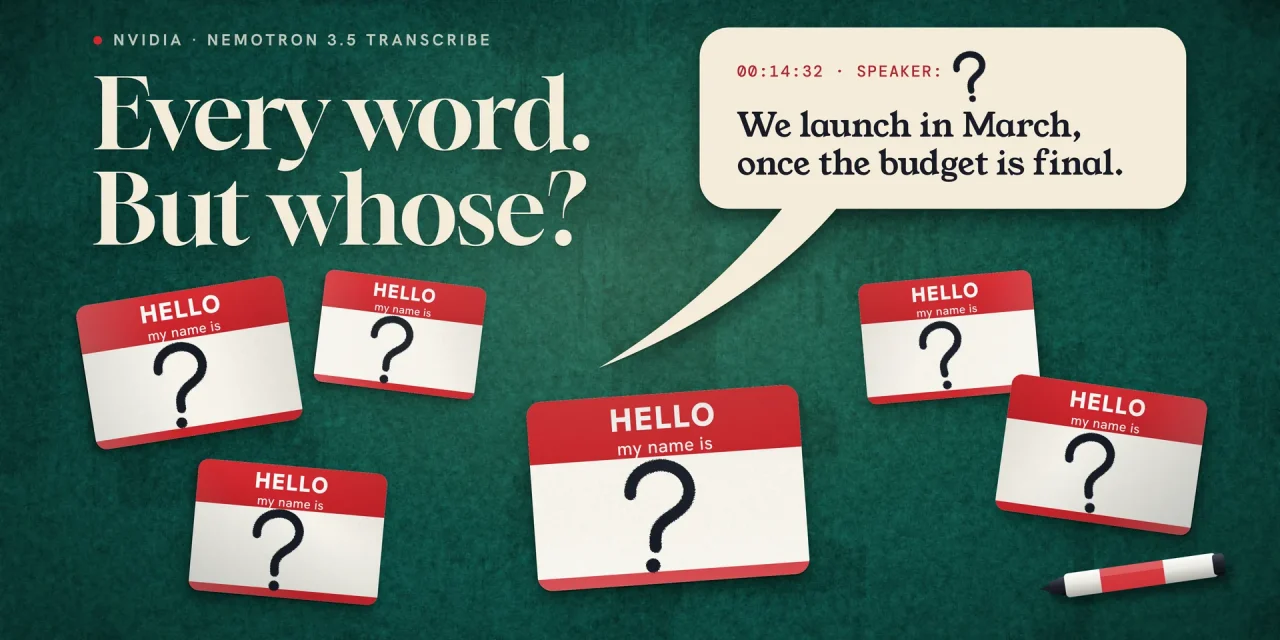
Nvidia released Nemotron 3.5 Transcribe on 28 October, a free open-weight speech model that transcribes recordings in 40 languages, translates them to and from English and can label who said what. For European organisations the language list is the headline: it covers 23 of the EU’s 24 official languages. The catch is in the detail. Speaker attribution, the feature that turns a transcript into usable meeting minutes, works in only six of them, and the model handles recorded audio only, not live streams.
This article looks at what the model does, how each EU language fares, what self-hosting means for your data and what to test before you put it into production.
What Nemotron 3.5 Transcribe does
Nemotron 3.5 Transcribe is a speech-augmented language model. A speech encoder feeds audio into Nemotron 3.5 Lightning, the text model Nvidia released in August, and you steer the result with a plain-text instruction. According to the model card on Hugging Face, the same checkpoint can produce a verbatim or a clean written transcript, follow a list of names and domain terms, attribute speech to up to eight speakers with word-level timestamps, translate between English and 31 other languages, identify the spoken language and answer questions about a recording (the latter trained in English only).
Recordings can be up to an hour long. The model has 34 billion parameters in total, but only about 4.3 billion are active for each step, which makes it fast. All parameters still have to fit in memory, so the full-precision version needs an 80 GB GPU, with smaller FP8 and NVFP4 versions for lighter cards. It replaces what used to be a chain of separate tools: one for transcription, one for diarisation, one for translation and one for clean-up.
How Europe’s languages fare
Nvidia sorts the 40 languages into three tiers. “Leading” languages have the best accuracy, “production-ready” languages are usable out of the box and “supported” languages may need fine-tuning. Mapped onto the EU’s official languages, the picture looks like this:
| Tier | EU languages | Speaker attribution |
|---|---|---|
| Leading | Czech, Dutch, English, French, German, Italian, Polish, Portuguese, Slovak, Spanish | English, French, German, Italian, Portuguese, Spanish |
| Production-ready | Bulgarian, Croatian, Danish, Estonian, Finnish, Hungarian, Latvian, Lithuanian, Romanian, Slovenian, Swedish | None |
| Supported (may need fine-tuning) | Greek, Maltese | None |
| Not covered | Irish | None |
All 23 covered EU languages also support translation to and from English. Nvidia reports word error rates for each of them on FLEURS, a benchmark of read sentences, and the spread is wide. Italian (1.41%), Spanish (2.20%), German (2.73%), Portuguese (3.01%) and French (3.16%) are excellent, Dutch (3.75%) and Polish (3.81%) close behind. Several production-ready languages sit between 6% and 13%, from Romanian at 6.02% to Lithuanian at 12.47%. Maltese (16.41%) and Greek (26.93%) lag far behind, which matches their lower tier.
On the tougher multilingual Open ASR Leaderboard test, which covers only six EU languages, the error rates are higher: German 2.81%, Spanish 2.82%, Italian 3.61%, French 3.92%, Portuguese 4.06% and Dutch 5.96%. The seven-language average, Hindi included, is 4.62%, against 6.49% for Qwen3-ASR-1.7B, the next open model in Nvidia’s comparison. On the English Open ASR Leaderboard it ranks first among open models with an average word error rate of 5.33%, according to Nvidia’s blog on Hugging Face.
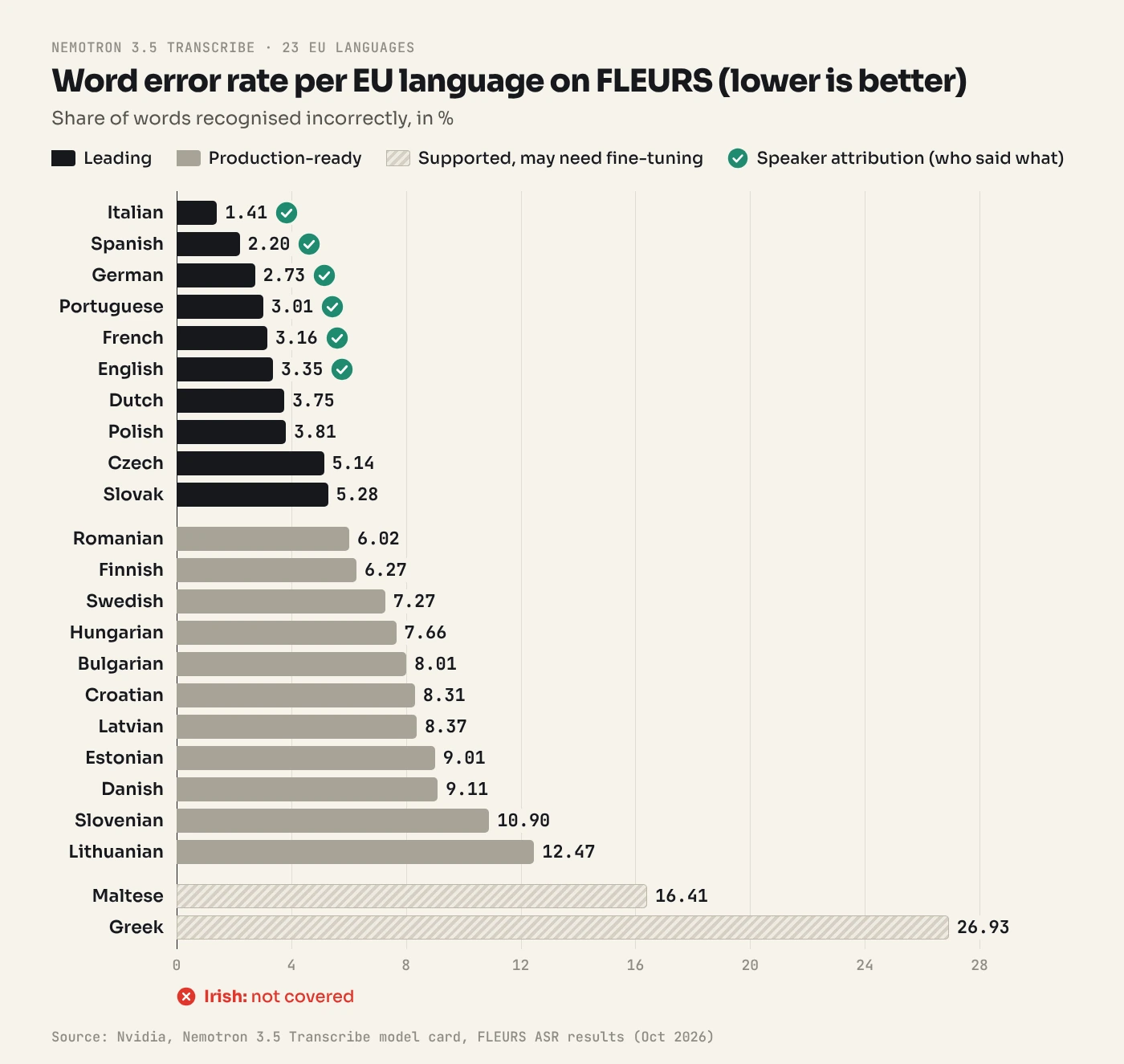
These are Nvidia’s own numbers on largely clean, read speech. Independent figures are scarce so far. On Artificial Analysis the model scores 2.81% in English, just behind Mistral’s open Voxtral Small at 2.77%, reports The Decoder. On that independent measure it is close to, but not ahead of, the best open model, and paid services such as Mistral’s newer Voxtral 3 models score lower still.
Why speaker attribution matters
Speaker attribution is the model’s showpiece. A diarisation module passes speaker activity straight into the language model, so it knows who is talking while it writes. Nvidia says this is the first model of its kind to beat specialised two-step pipelines on overlapping speech, and on its multi-speaker test it scores a concatenated word error rate of 15.80% against 16.83% for the best cascaded system it compared.
For a German, French or Spanish team that means speaker-labelled transcripts straight from a recording, although on Nvidia’s mostly English meeting test about one word in six is still attributed or transcribed wrongly. For a Polish, Dutch, Swedish or Czech team it means a correct transcript without “Speaker 1” and “Speaker 2”. That matters for the use cases where European organisations are most likely to deploy a model like this: board and works council meetings, multilingual project calls, customer service recordings and public hearings. The workarounds are a separate diarisation model aligned on the word timestamps, or fine-tuning. Nvidia showed adaptations to new languages and tasks that took 0.5 to 2.3 GPU hours each, but nobody has yet published results for adding speaker attribution to a new language.
Recorded audio only
Transcribe processes files. It splits audio into 30-second chunks internally, but Nvidia is explicit that this is not a streaming mode. For live captions or voice agents, Nvidia points to a different model, Nemotron 3.5 ASR Streaming, a 600-million-parameter model from June that covers 40 language locales in real time, 19 of them ready out of the box. Managed alternatives include Mistral’s realtime models and Eleven Realtime from ElevenLabs.
Self-hosting, data and the licence
The reference setup is one Nvidia H100 with 80 GB of memory. Supported hardware also includes A100, H200, B200, GB200, L40S (FP8 only), RTX 5090, RTX PRO 6000 and DGX Spark. Weights come in BF16, FP8 and NVFP4, plus a GGUF build for NeMo-Speech.cpp that runs natively on Windows. Developers serve it with vLLM behind an OpenAI-compatible API, and hosted endpoints are available from Baseten, DeepInfra and Simplismart.
Throughput is high. The model card lists roughly 260 to 410 times real time for batched English on one H100, so an hour of audio takes 9 to 14 seconds. Nvidia’s headline figures go further: 100 hours of audio in under three minutes and up to 2,238 times real time on one RTX PRO 6000 Blackwell. Those require Nvidia’s NIM serving stack with optimisations that are not yet open source, and Nvidia expects the open vLLM route to be about half as fast. For comparison on the API side, SpaceXAI charges $0.10 per hour of audio for batch transcription with Grok, and Mistral charges $0.004 per minute for Voxtral Small Transcribe 3, part of its Voxtral 3 family without open weights.
The model is licensed under OpenMDW-1.1, the Linux Foundation’s permissive model licence, which allows commercial use. The bigger point for European organisations is control. Run it on your own infrastructure and recordings never leave it, which removes a processor and a possible transfer outside the EU from your GDPR analysis. It does not remove the analysis itself: voice recordings are personal data, and an AI system intended to monitor or evaluate staff performance or behaviour can fall under the EU AI Act’s high-risk category (Annex III, point 4). We made the same point about AI agents running on your own devices: local processing helps, governance still applies.
Teaching it your vocabulary
For organisations, how easily the model adapts may matter more than its baseline score. Supplying a list of expected names and terms cut the error rate on Nvidia’s context benchmark from 3.33% to 1.71%. On earnings-call recordings, recall of key terms rose from 58% without a list to 96% with a list per segment.
Fine-tuning goes further. In a medical case with recordings from Indian doctors, a better prompt reduced the error rate from 30.8% to 23.8%, and fine-tuning brought it to 11.8%, at a cost of about 14 GPU hours on one GB300. General English barely moved, from 1.54% to 1.69%. Nvidia advises keeping at least 100 real, verified recordings aside to choose the best checkpoint.
Alongside the model, Nvidia released Granary v2, an open speech dataset whose public manifest covers 463,062 hours in 48 languages, up from 25 languages in the first version. Audio has to be downloaded from each original source under that source’s licence, so check the terms before you train on it.
What to test before you commit
| Test | Why |
|---|---|
| Ten of your own recordings per language, including accents and poor audio | Published scores come mostly from clean, read speech, and vary tenfold across EU languages |
| Speaker attribution in your meeting languages | Supported in six EU languages only |
| A term list with names, products and acronyms | Cheapest accuracy gain before any fine-tuning |
| Translation quality on a sample reviewed by a native speaker | Only automatic BLEU scores are published, no human evaluation |
| Throughput and cost on your own GPU or a hosted endpoint | Headline speed figures depend on Nvidia’s NIM stack |
| Data protection impact assessment and retention rules | Self-hosting reduces risk, it does not remove GDPR duties |
Strong on languages, short on names
Nemotron 3.5 Transcribe is one of the strongest free options for transcribing and translating recorded audio across Europe, and the fact that you can run it in-house will appeal to anyone handling sensitive recordings. Its limits are just as specific: no live mode, weak results in Greek and Maltese, no Irish, and speaker labels in only six EU languages. TechCrunch called October a crowded month for voice AI, with releases from Mistral, ElevenLabs and Salesforce. As those models converge on English accuracy, the differences that matter to European buyers are increasingly about which languages get which features. That is worth checking language by language before you sign anything. If you are comparing managed services as well, our earlier look at MAI-Transcribe-1 from Microsoft covers that side of the market.
Frequently asked questions
Is Nemotron 3.5 Transcribe free for commercial use?
Yes. The weights are free under the OpenMDW-1.1 licence, which permits commercial use. You still pay for hardware or a hosted endpoint.
Which EU languages does it support?
23 of the 24 official EU languages. Irish is missing. Greek and Maltese are in the lowest tier, with FLEURS error rates of 26.9% and 16.4%, and may need fine-tuning.
Can it tell speakers apart in every language?
No. Speaker attribution works in 13 languages, of which six are official EU languages: English, French, German, Italian, Portuguese and Spanish.
Can it transcribe live meetings?
No. It handles recorded audio up to an hour. For live use Nvidia offers the smaller Nemotron 3.5 ASR Streaming model.