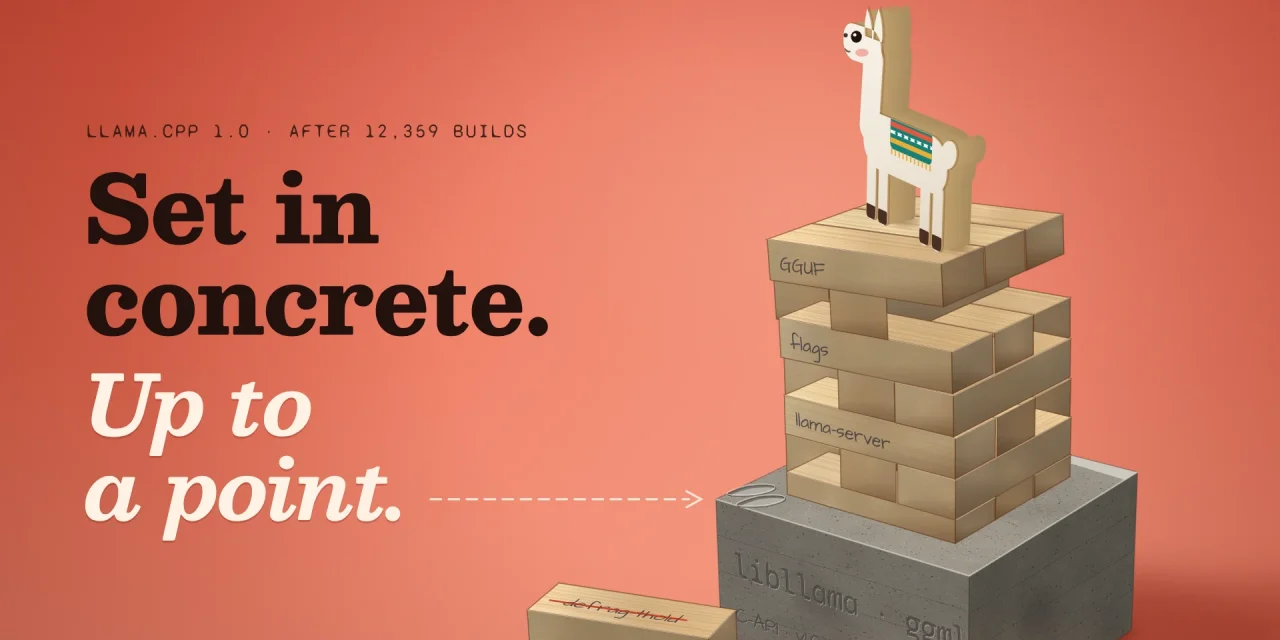
llama.cpp, the open-source engine that runs AI language models on ordinary computers, reached version 1.0.0 on 13 November 2026, together with ggml, the maths library underneath it. The release is mostly a promise: from now on, any change that breaks the public C interface raises the first digit of the version number. For organisations that run models in-house to keep data off third-party clouds, that turns llama.cpp from a fast-moving project into a dependency you can plan around.
Two things deserve a closer look before you write it into your architecture. The promise covers less than the version number suggests, and the team behind the engine is set to become part of Nvidia.
Where llama.cpp already runs in your organisation
Georgi Gerganov started llama.cpp in March 2023, about a week after Meta’s first LLaMA model leaked online. Meta’s own code needed Python, PyTorch, CUDA and an Nvidia graphics card. Gerganov’s version was plain C/C++ with no dependencies, and it ran on a MacBook. That made running a language model a job for a laptop rather than a data centre.
Few people use it directly. It sits inside other tools. Ollama runs GGUF models through llama.cpp again since version 0.30 in June, next to its own MLX engine for Apple silicon. LM Studio runs llama.cpp and MLX. The new Llama app from the llama.cpp team and Hugging Face puts it in the Mac menu bar and the Windows 11 system tray, with no terminal and, on Windows, no admin rights.
If staff in your organisation run a model on a laptop, there is a good chance llama.cpp is doing the work. Whether those laptops have the memory for it is a separate question, covered in our pieces on the M6 MacBook Pro and Nvidia’s RTX Spark laptops.
The engine is built for portability. Models come as GGUF files, a quick-loading format the project introduced, and Hugging Face hosts thousands of them. Quantisation stores a model’s weights at lower precision, for instance 4-bit instead of 16-bit, so models shrink and often run faster at some cost in accuracy. ggml reaches hardware through separate backends, including CUDA for Nvidia, Metal for Apple, the cross-vendor Vulkan standard and plain CPUs. The 1.0 announcement counts more than 150 supported architecture variants.
The bundled llama-server accepts requests shaped like the OpenAI and Anthropic APIs, so many applications written for cloud models can switch to a local one. Its documentation makes no strong compatibility claims, but says it is enough for many apps.
What the 1.0 promise covers, and what it does not
For three and a half years llama.cpp simply counted builds. The 1.0 tag points to nightly build b12359. Version numbers only arrived in August 2026, with v0.1.0, and v0.9.0 shipped nine days before 1.0. The new rules apply to every ggml-org project:
| Type of change | Version bump | What it means for you |
|---|---|---|
| Breaking change to the public C API in the include headers | Major, 1.x to 2.0 | Plan work before upgrading |
| New feature, backend update, new model support or backward-compatible API addition | Minor, 1.0 to 1.1 | Safe to upgrade for code that links the library |
| Bug fix with no API change | Patch, 1.0.0 to 1.0.1 | Apply promptly |
The contract is about libllama and libggml, the libraries developers build into their own software. The announcement says nothing about the HTTP API of llama-server, the command-line flags, the GGUF format or a support window for the 1.x line, a gap OpenTools spelled out in detail. On r/LocalLLaMA, the first question was whether the command-line parameters would finally stop changing every release. Version 1.0 does not answer it. Most in-house deployments talk to llama-server over HTTP, so the layer you depend on most is the one without a written promise.
What changes when you upgrade
The release notes list a few hundred changes since 0.9.0. New models include Kimi-K3.1-Pro, Ricursive’s Ripple-65B-Preview, xing4_0 and the DRAMA-3 text-to-speech model from Fish Audio. The server gains an OpenAI-style /v1/audio/speech endpoint, the web chat interface was redesigned, and the KV cache, the memory a model uses to keep track of context, can now be stored in FP8. A new cache helps mixture-of-experts models when not every expert fits on the graphics card.
Three changes matter most for IT teams:
- Removed functions and flags. llama_set_warmup and 35 other deprecated functions are gone, and the shared library is now libllama.so.1. The –defrag-thold flag was removed, and a hands-on test by computingforgeeks found the server now refuses to start when it is passed, where the previous build only printed a warning.
- Tighter server security. Tools and MCP servers on a non-loopback address without an API key now stop the server from starting. Image URLs that point to private or local addresses are rejected, and the Hugging Face token is only sent to Hugging Face hosts. The opt-outs, –allow-unauthenticated-tools and –media-allow-private-urls, reopen exactly the exposure the defaults close, including tools that can run shell commands.
- No promised speed-up. The release notes do not claim a general performance gain, so do not budget for one.
Treat the security changes as a gift rather than a nuisance. A local model server that agents can reach over the network is as much an attack surface as any other service, a point we made in our look at AI agent sandboxes.
Who stands behind the engine
llama.cpp is no longer a side project. GitHub’s Octoverse 2026 ranks it fifth among independent open-source projects for growth in contributors and third for overall engagement. Development never pauses: The Batch from DeepLearning.AI counted 50 nightly builds on 15 and 16 November alone.
Ownership has moved quickly. Gerganov founded ggml.ai in Sofia in 2023 with pre-seed money from Nat Friedman and Daniel Gross. In February 2026 the team joined Hugging Face, which gives the project long-term resources and the CI capacity to test every change. In September, Nvidia agreed to buy Hugging Face for $12.93 billion. Computing reports the deal is expected to close in the first half of 2027, and Reuters reported in October that the US Justice Department is asking how it would affect competition.
Jensen Huang has promised that Hugging Face stays an open platform and that Nvidia compute will not be required to build on it.
None of this changes the licence. llama.cpp and ggml are MIT-licensed, so anyone can use, modify and fork them, commercially or not. Hardware for the project’s self-hosted test runners also comes from AMD, Qualcomm, Arm, IBM and Intel, not only Nvidia. The practical risk for Europe is not that the code disappears. It is that the pace, priorities and default integrations of the engine most local AI tools rely on will be set inside a single chip company, while European organisations increasingly use local AI precisely to reduce dependence on a few US providers.
What European organisations should put in writing
- Find it. List where llama.cpp runs, including inside Ollama, LM Studio, the Llama app and in-house tools. If you ship a product that embeds it, the Cyber Resilience Act already expects due diligence on open-source components, with reporting obligations in force since 11 September 2026 and full application from 11 December 2027. Our piece on owning your open-source dependencies covers the patching side.
- Pin it. Run a fixed vX.Y.Z release in production, or a specific bNNNN build if you need a brand-new architecture, and test every upgrade on your own hardware first.
- Test the layer you use. If your applications call llama-server over HTTP, the version contract does not cover you. Keep a small regression test of the endpoints and flags you rely on.
- Harden the server. Bind it to 127.0.0.1 or set an –api-key, and do not use the new opt-outs outside an isolated network.
- Separate engine and model. The MIT licence covers the engine only. Each model you run has its own licence, and that is where obligations under the AI Act, data protection and acceptable use usually sit.
- Keep an exit. GGUF files, the OpenAI-style API and the MIT licence make it realistic to switch wrappers or maintain a fork. Write down which one you would use if priorities change after the Nvidia deal closes.
Frequently asked questions
Is llama.cpp related to Meta’s Llama models?
Only by name. The project was built to run Meta’s first LLaMA model, but it is an independent open-source engine that now supports more than 150 architecture variants, from Qwen and Mistral to Kimi. The Llama desktop app from Hugging Face is not a Meta product either.
Can companies use llama.cpp commercially?
Yes. llama.cpp and ggml are released under the MIT licence, which allows commercial use. The licence of the model you run is separate and needs its own check.
Does the 1.0 promise cover llama-server?
Not explicitly. The rule ties major versions to breaking changes in the public C API. The announcement gives no compatibility rule for the server’s HTTP API, the command-line flags or GGUF files.
Will the Nvidia deal change the licence?
Releases already published under MIT stay usable under that licence, and anyone can keep developing a fork of them. Nvidia has said Hugging Face will remain an open platform. The deal still needs regulatory approval and is expected to close in the first half of 2027.
A contract for builders, a checklist for operators
For software vendors that build llama.cpp into their products, 1.0 is a real step: a 2 at the front means work, a 1.x means a safe upgrade. For organisations that run llama-server as a service, the contract stops one layer short of where they live. Pin a version, test what you call, and keep the exit route documented, because the most important engine in local AI is about to have a new parent company.