Aleph Alpha released Kolibri 1.1 on 23 November 2026, seven weeks after Kolibri 1.0. The German open-weight model has 75 billion parameters, 3.44 billion of them active per token, and keeps its Apache 2.0 licence. According to Aleph Alpha it needs 3.4 times less GPU time per task than its predecessor while scoring higher, and it now resists prompt-injection attacks in 99% of AgentDojo cases, up from 30%.
For European organisations that want a capable model on their own infrastructure, those two numbers matter more than the leaderboard. Serving cost decides whether an in-house model is viable at all. Injection resistance decides whether you can let it read untrusted web pages, emails and documents and then act. The caveats are just as concrete. Every score is self-reported, short prompts run slower than on 1.0, long-context English still trails Qwen, the model speaks only German and English, and the Cohere merger that will decide its future is still awaiting approval.
What Aleph Alpha changed in seven weeks
Kolibri 1.1 is not a new model trained from scratch. It continues from a Kolibri 1.0 checkpoint taken during mid-training, after 20 trillion pre-training tokens and 3.42 trillion mid-training tokens, according to the model card on Hugging Face. Aleph Alpha then trained it on another 805 billion tokens with the new attention design and 201 billion long-context tokens, and averaged 40 checkpoints into the final model.
- Size: 75.1 billion parameters in total and 3.44 billion active per token, against 78.1 and 3.46 billion for 1.0. Two dense layers are followed by 48 mixture-of-experts layers, each with 384 routed experts, of which 6 are picked per token, plus one shared expert.
- Attention: one layer in five now uses sparse attention over the whole text, the other four look at a sliding window of 512 tokens. Several layers share their key-value cache, which is stored largely in NVFP4.
- Context: 262,144 tokens natively and up to 1,048,576 with an extension. The card recommends staying at 262,144 tokens or less for complex tasks.
- Hardware: about 77.6 GB of weights in FP8, with a minimum of two H100 or H200 GPUs, or one B200 or B300. The A100 is no longer on the list.
- Licence: Apache 2.0, covering the published weights and configuration files. Training code and methods stay with Aleph Alpha.
That positioning fits the wider push for sovereign AI in Europe: a model built and trained in Germany and Finland under European law, which customers can run on premises rather than through a foreign API.
How sparse attention cuts the cost of long documents
A language model looks back at the preceding text for every new token. In a standard attention layer that means every earlier token, which gets expensive once a document runs to hundreds of thousands of tokens. Kolibri 1.1 is more selective. In its long-range layers, each token attends to the 2,048 tokens that matter most to it, plus the 128 most recent ones.
The selection happens in two stages, Aleph Alpha explains in its release post. The model first scores a short summary of every block of 16 tokens, then looks at individual tokens only inside the best blocks. Think of a library card catalogue: you read the labels on the drawers first and only pull out the drawers that look right.
Aleph Alpha trained 1.1 with that NVFP4 rounding in the loop, so the compact cache format is part of the recipe rather than a squeeze applied afterwards. At a context of one million tokens, one engine on four B300 GPUs handles 64 concurrent requests instead of 20, and the first token arrives after 17.3 seconds instead of 76.
Cheaper per task, but not on every workload
Aleph Alpha models the serving cost at 0.208 GPU-hours per 1,000 tasks for Kolibri 1.1, against 0.718 for 1.0. In its comparison of twelve models, only Kolibri 1.1 and the much larger Qwen3.8 Flash Next sit on the frontier of quality against cost. GPT-OSS 120B needs 0.451 GPU-hours for a lower score, and Qwen3.8 27B scores higher but needs 1.972.
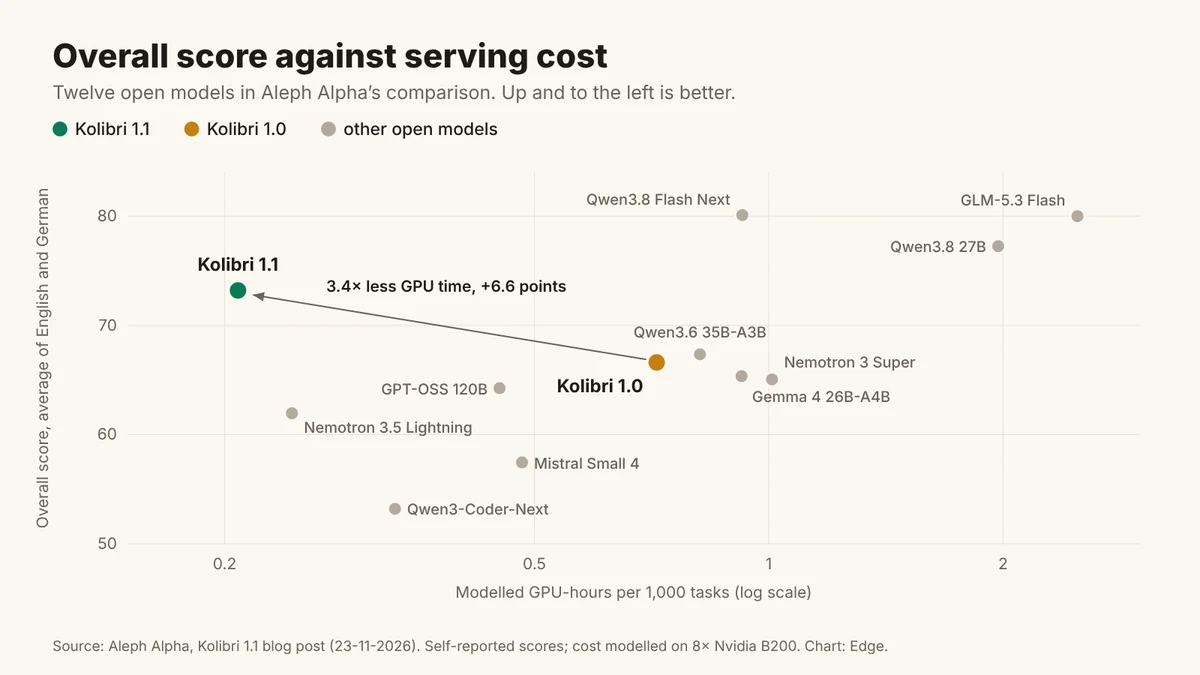
Two things drive that saving. The first is shorter reasoning. Kolibri 1.1 writes 41% fewer output tokens per task on average, 8,678 against 14,723, or 30% fewer if you leave out runs that hit the context limit. At its low reasoning setting it averages 81.1% on a mix of maths, science, code and long-context tests with 4,254 tokens. Kolibri 1.0 needed more than 20,000 tokens at its highest setting for 81.9%.
The second is speed at long context, and that is where the headline 14x comes from. At one million tokens, 1.1 generates 6,777 tokens per second per GPU against 483 for 1.0. The gain shrinks as the context gets shorter, and below 8,000 tokens it turns negative. At 1,000 and 2,000 tokens, decoding runs at 0.76 times the speed of 1.0, and at 4,000 tokens at 0.86 times.
Orcarouter therefore expects little gain for teams whose prompts average under 8,000 tokens, and a large one for teams that process contracts, case files, codebases or long agent transcripts. Note that the cost figures are modelled on eight B200 GPUs and the speed figures measured on four B300s, so they do not combine directly.
The agent-safety numbers regulated teams should read first
On Aleph Alpha’s own test mix, the overall score rises from 64.0 to 72.2 in English and from 69.2 to 74.2 in German. Do not compare that with the Kolibri 1.0 model card, which listed 75.5 for English, because the test suite has changed. More useful for regulated deployments are the rows that describe how the model behaves as an agent and with your documents.
| Benchmark | Kolibri 1.0 | Kolibri 1.1 |
|---|---|---|
| AgentDojo, resists prompt injection | 30.3% | 99.1% |
| CyberSecEval 2, resists prompt injection | 85.3% | 93.2% |
| Correct answers with exact supporting citations | 67.7% | 89.1% |
| AA-Omniscience, answers without hallucination | 42.1% | 61.1% |
| SWE-bench Verified, coding | 64.0 | 70.4 |
| BrowseComp-Plus, search | 33.1 | 43.9 |
| IFBench, instruction following | 78.8 | 82.7 |
| τ³-bench, banking agent | 38.7 | 28.6 |
Prompt injection is the attack in which someone hides instructions in a page, email or file, hoping an AI agent will follow them. A model that withstood it in 30% of AgentDojo cases was hard to justify for any agent reading outside content. At 99% the model itself is no longer the weakest link, although the model card says its mitigations are not complete. The citation row matters for the same audience: when 89% of correct answers come with the exact supporting passage, a reviewer can check them quickly. Both belong in the controls of your agent harness, not in place of them.
The table also shows where 1.1 got worse. On τ³-bench, where an agent serves customers of a bank, the score fell from 38.7 to 28.6, and an internal suite for an automotive supplier dropped from 97.1 to 90.0. For a bank or insurer evaluating customer-facing agents, that is the row to test first. Long context in English remains a weak spot too, with an average of 67.7 against 83.6 for Qwen3.6 35B-A3B. On RULER at one million tokens 1.1 scores 62.5, roughly where 1.0 was. Long documents get cheaper to process, not better understood.
Within the class of models with 3 to 4 billion active parameters, Kolibri 1.1 has the highest overall score, Aleph Alpha says, and it beats larger open models such as GPT-OSS 120B, Mistral Small 4 and Nemotron 3 Super. Qwen3.8 27B, Qwen3.8 Flash Next and GLM-5.3 Flash score higher. None of these numbers has been reproduced independently. As of 24 November, Artificial Analysis had no entry for either Kolibri version.
What the AI Act paperwork tells you
Aleph Alpha published a public summary of the training content on release day, filled in on the European Commission’s template. Providers of general-purpose AI models must publish such a summary under Article 53 of the AI Act, and since 2 August 2026 the AI Office can enforce those obligations. Because Kolibri is released under an open-source licence, Aleph Alpha is exempt from part of the technical documentation duties, but the summary and a copyright policy remain mandatory.
- Data: more than 10 trillion tokens of text, about 62.5% English, 23.9% German and 13.6% source code. Other languages were not deliberately included.
- Sources: public datasets such as Common Crawl, HPLT 3.0, FinePDFs and The Stack v3, after filtering and removal of personal data. No licensed private data, no crawlers of its own and no user data.
- Synthetic data: generated with other models, including two uncensored variants that produced harmful requests so the model could learn to refuse them.
- Copyright: Aleph Alpha signed the General-Purpose AI Code of Practice and says it only uses third-party data collected by crawlers that respect robots.txt.
- Customer data: the release post says customer feedback became new tests and synthetic training environments, without using customer data for training.
None of this transfers the deployer’s obligations. What your organisation has to do depends on the system you build and the risk class it falls into, as our overview of the AI Act timeline after the Digital Omnibus explains. The model card adds its own boundary. Kolibri is meant for systems in which a person reviews the output, not as the component that makes the decision.
What it takes to run in-house
On a server, Kolibri 1.1 runs on vLLM with Aleph Alpha’s plug-in, now from version 2. The model also works with Hugging Face Transformers, which serves as a reference for community implementations.
pip install "aleph-alpha-inference>=2"
vllm serve Aleph-Alpha/Kolibri-1.1 --reasoning-parser kolibri1 --tool-call-parser kolibri1 --enable-auto-tool-choice
Official GGUF builds bring it to llama.cpp on a GPU or an Apple silicon Mac. The IQ4_XS build of 40.2 GB loses 0.4 points on the overall score and fits a Mac with 64 GB of memory, while the Q4_K_M build of 45.5 GB loses 0.7. The release post says the smallest build runs on a 24 GB GPU, but that is a 16.6 GB IQ1_M with no published quality figure. Mainline llama.cpp cannot load the model yet. Support sits in a pull request that has been open since 23 November.
There is no public endpoint to try it quickly. Hugging Face lists no inference provider, and Aleph Alpha points to its sales team for its own Inference API or a specialised version. Teams that need a smaller local model for coding can look at Inkling 2 Mini, which fits a 32 GB laptop.
Language is the other limit. For French, Dutch, Italian or Polish documents there are no scores at all, and even in German the model is not flawless. In an independent test of Kolibri 1.0, Google’s Gemma 4 31B wrote more accurate German practice stories, with grammar errors in 5 of 20 hand-checked stories against 9 of 20 for Kolibri. The tester plans to repeat the test with 1.1.
Before you switch from Kolibri 1.0
- Re-run your own evaluation. The two model cards use different test suites, and several of Aleph Alpha’s customer suites are not public. Compare both versions on a sample of your real tasks.
- Profile your prompt lengths. If most requests are under 8,000 tokens, the gain comes only from shorter reasoning, because decoding itself is slower.
- Set the reasoning effort deliberately. Start at low or medium. High adds 1.2 points over medium on Aleph Alpha’s mix for more than 40% more tokens.
- Test agents in your own domain. The banking-agent regression shows that a better average does not mean every task improves.
- Keep a human in the loop. Validate tool calls in the application layer and require confirmation for actions with side effects, as the model card recommends.
- Plan the upgrade. The inference plug-in moves to version 2, the A100 drops out of the hardware list and llama.cpp support is still pending.
A model factory, not a one-off release
The most telling part of Kolibri 1.1 may be the pace. Aleph Alpha turned customer and community feedback into benchmarks and synthetic training environments, kept separate from its evaluation items. Its automated model factory evaluates every checkpoint during training, so teams can see within days whether a change helps. Seven weeks from 1.0 to 1.1 is what a European open model needs to stay a real option next to the frequent releases from Chinese and American labs.
Whether that pace holds depends on Cohere. The two companies signed a definitive agreement in September to combine under the Cohere name, with Heidelberg kept as a research centre, and the deal still needs regulatory approval, The Next Web reported. Cohere already called Kolibri 1.1 “faster, cheaper, better than ever before” on X. For organisations that pick an open model for sovereignty, the question that counts is not how good it is today but who ships the next version, and when. Our profile of Cohere and its sovereign AI strategy explains what the combined company wants to become.
Frequently asked questions
Is Kolibri 1.1 free for commercial use?
Yes. The weights and configuration files are released under Apache 2.0, which allows commercial use, modification and redistribution. The training code is not included, and you still pay for the hardware or hosting.
Does Kolibri 1.1 support French, Dutch or other EU languages?
No. It is trained on English, German and code, and Aleph Alpha publishes no scores for other languages. Simple tasks in related languages may work, but test them on your own documents first.
Can Kolibri 1.1 run on a laptop?
Only on a high-end one. The IQ4_XS build of 40.2 GB fits a Mac with 64 GB of unified memory once llama.cpp supports the model. On a server, plan for two H100 or H200 GPUs, or one B200 or B300.
Should we move from Kolibri 1.0 to 1.1?
For long documents and agents that read outside content, probably yes, because 1.1 is cheaper there and far more resistant to prompt injection. For short prompts and banking-style agent tasks, test first, because 1.1 is slower or weaker there.