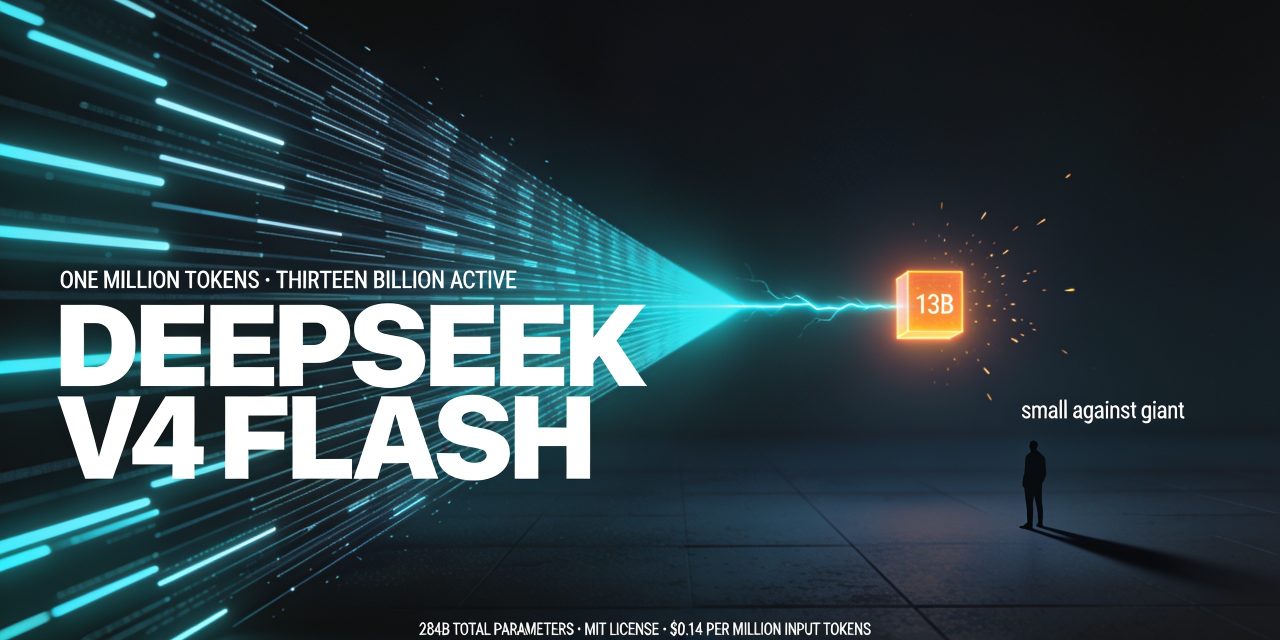
DeepSeek V4 Flash is the small sibling in the V4 family, and on the benchmarks that developers actually care about it is no longer behaving like a small sibling. It ships 284 billion total parameters with only 13 billion active per token, a one million token context window as standard, and API pricing of $0.14 per million input tokens. The July 31, 2026 release, tagged 0731, also posts agentic coding scores that beat the earlier V4 Pro preview outright, which is an odd result for a model roughly a fifth of the size.
If you are choosing between Flash and Pro for a production workload, or weighing whether to self host the open weights at all, the details below are the ones that change the decision.
What DeepSeek V4 Flash actually is
Flash is a Mixture of Experts language model released under the MIT license, which permits commercial use. It takes text in and produces text out. There is no image input and no other modality, so if your pipeline depends on screenshots, diagrams or document images, Flash is not a drop in replacement for a multimodal frontier model.
The headline number is the context window. One million tokens is roughly 1500 pages of A4 at 12 point Arial. More importantly, one million is now the default across DeepSeek’s official services rather than a premium tier you unlock. That reframes retrieval augmented generation work. Instead of aggressively chunking and ranking, you can push far larger candidate sets into the prompt and let the model do the filtering, which shifts engineering effort from retrieval tuning to prompt construction.
The architecture behind affordable long context
Long context is easy to advertise and expensive to serve. The cost sits in attention compute and in the KV cache, both of which normally scale badly as sequences grow. DeepSeek attacks both with a hybrid attention stack that combines Compressed Sparse Attention and Heavily Compressed Attention. At one million tokens, DeepSeek reports that V4 Pro needs only 27 percent of the per token inference FLOPs and 10 percent of the KV cache required by V3.2. Flash inherits the same attention design.
Two other changes support training rather than inference. Manifold Constrained Hyper Connections strengthen conventional residual connections, which improves the stability of signal propagation across layers without flattening the model’s expressivity. The Muon optimizer handles convergence speed and training stability. Both models were pre trained on more than 32 trillion tokens.
Post training is where the family gets interesting. DeepSeek used a two stage pipeline. First, domain specific experts were cultivated independently through supervised fine tuning and reinforcement learning with GRPO. Then those separate proficiencies were consolidated into a single model through on policy distillation. That approach explains a lot about how a 13B active model can hold its own on specialised tasks. It is not one generalist trained to average competence across everything. It is several specialists compressed into one set of weights.
Benchmarks and the agentic jump in the 0731 release
The published evaluation results put Flash at 79 on SWE-bench Verified, 88.1 on GPQA Diamond, 86.4 on MMLU-Pro and 56.9 on Terminal Bench 2.0. On the Artificial Analysis Intelligence Index it scores 50, against a median of 25 for comparable open weight models of similar size.
The bigger story is the gap between the preview weights and the official 0731 release. On Terminal Bench 2.1 the official release reaches 82.7 versus 61.8 for the preview. On DeepSWE it reaches 54.4 versus 7.3. That second jump is not an incremental improvement, it is the difference between a model that cannot reliably complete a software engineering agent loop and one that can. Across every agentic benchmark DeepSeek published, the 0731 Flash release beats the V4 Pro preview despite the far smaller activated parameter count.
The practical consequence is that if you evaluated the Flash preview and dismissed it for agent work, that evaluation is stale. DeepSeek also states that V4 is integrated with agent frameworks including Claude Code, OpenClaw and OpenCode, and that it drives their own in house agentic coding.
Where Flash still trails Pro
DeepSeek is explicit about the limits. Given a larger thinking budget, Flash Max reaches reasoning performance comparable to Pro. Its smaller parameter scale still places it behind on pure knowledge tasks and on the most complex agentic workflows. Parameter count buys stored world knowledge, and no amount of extra thinking time recovers a fact the model never memorised. Reasoning scales with compute at inference. Knowledge does not.
Pricing, and the verbosity caveat that changes the maths
Flash costs $0.14 per million input tokens and $0.28 per million output tokens on DeepSeek’s API. The medians for comparable models are $0.58 and $2.20, so the sticker price is genuinely low. With a blended 7:2:1 cache hit to input to output ratio, the effective rate drops to around $0.06 per million tokens. Running the full Artificial Analysis Intelligence Index cost $72.02.
There is a caveat worth taking seriously. In that same evaluation Flash generated 210 million output tokens, against a median of 100 million for similar open weight models. It is verbose. Cheap tokens multiplied by twice as many tokens is not automatically cheap. Before you build a budget on the rate card, measure tokens per completed task on your own workload rather than price per million tokens in isolation.
Three reasoning effort modes and how to choose
Both V4 models expose three reasoning effort levels, named low, high and max on the 0731 release. Low gives fast intuitive responses and suits routine daily tasks and low risk decisions. High applies conscious logical analysis, slower but more accurate, for complex problem solving and planning. Max pushes reasoning to its fullest extent and is best understood as a way to probe the ceiling of the model’s capability rather than a default for production traffic.
Max has a hard requirement. You need a context window of at least 384K tokens to avoid truncated output, so serving it means passing a maximum model length of 393216. Allow up to 384K output tokens at both high and max. Recommended sampling is temperature 1.0 with top_p 1.0, dropping to top_p 0.95 for agentic scenarios on the 0731 weights.
Self hosting notes worth knowing before you download
The published checkpoint is mixed precision. MoE expert parameters are stored in FP4 while attention, norm and router parameters stay in FP8. NVIDIA also publishes an NVFP4 re quantisation for Blackwell hardware, though its experts do not support the FP8 only mega MoE kernel and fall back to the default MoE backend.
A separate DSpark variant is not new weights. It is the same checkpoint with a fused speculative decoding module attached, which pushes the on disk size to roughly 167 GB versus 160 GB. Serving requires vLLM 0.25.0, and ROCm support for DSpark drafting only arrived in 0.26.0, so AMD deployments need the newer release. One more detail catches people out. There is no Jinja chat template. The repository ships an encoding folder with helper functions instead, although serving through vLLM with the deepseek_v4 tokenizer mode applies the built in encoding and keeps the OpenAI compatible endpoint working.
The migration you cannot postpone
Legacy API aliases stopped resolving on July 24, 2026. Requests to the old chat and reasoner model names now return HTTP errors. The base URL and the OpenAI compatible request shape are unchanged, so migration is a model identifier swap, but it forces every production integration to make an explicit Flash versus Pro decision rather than inheriting a silent default.
A peak hour surcharge tied to Beijing business hours has been announced but is not active. No percentage and no start date are published, and the official rate card still lists a single flat tier per model. The sensible response is not to reschedule batch jobs, it is to log a timestamp, model name and token count on every request so you can attribute spend to peak and off peak windows the day pricing changes.
The number to watch is not the price
Flash makes a specific bet. Rather than growing parameters, it spends its engineering budget on making long context cheap enough to use casually and on distilling specialist competence into a small activated footprint. On agentic coding that bet has paid off well enough to embarrass the larger preview model in the same family.
The quieter implication is about evaluation habits. The gap between the preview and 0731 weights on DeepSWE was seven points versus fifty four, on the same architecture and the same parameter count. Almost all of that came from post training rather than scale. If your model selection process still treats parameter count as a proxy for capability, that single comparison should be enough to retire the shortcut.