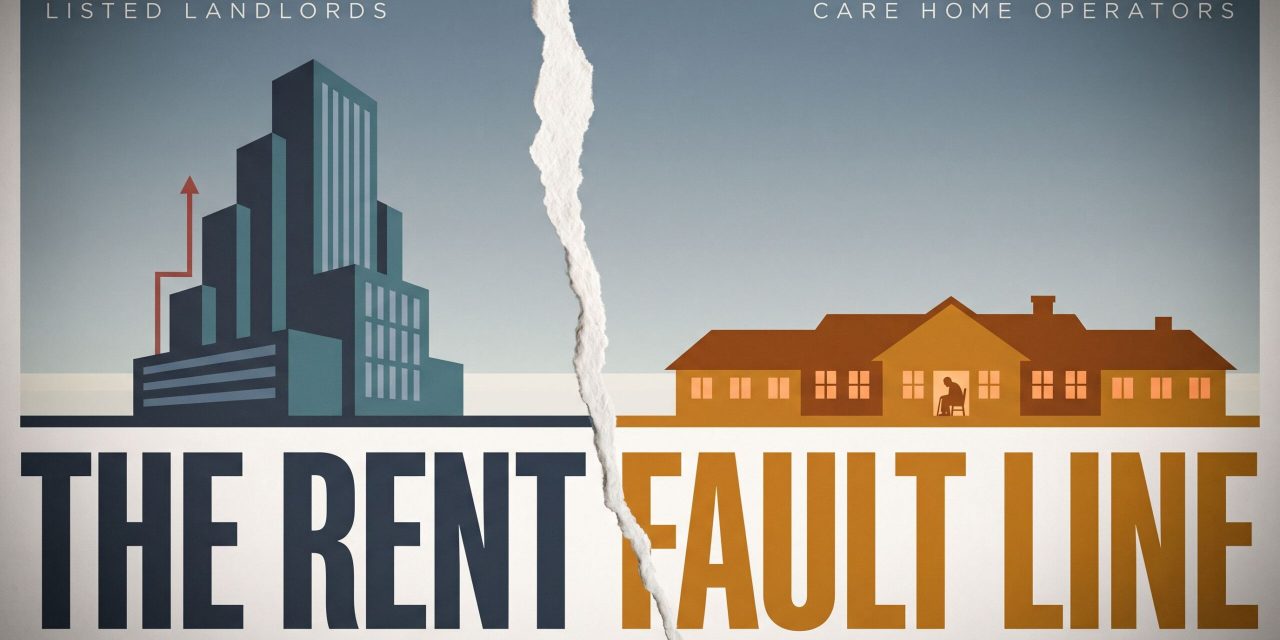
In residential elderly care, the landlord and the care provider look at the same building and see two different businesses. For the listed healthcare real estate company, a care home is a long lease with indexed rent and a predictable yield. For the operator, that same rent is a fixed cost line that has to be covered by occupancy, staffing levels and fees that are often set by a public payer. When those two logics drift apart, the whole model creaks. That drift is exactly what Europe has been living through since 2022, and it explains why healthcare real estate is now consolidating while many care home operators are still repairing their balance sheets.
Why rent became the pressure point in European elderly care
The pre 2022 growth cycle was built on cheap debt and sale and leaseback. Operators sold their bricks, used the proceeds to buy more beds, and signed leases of fifteen to twenty five years. Landlords such as Aedifica, Cofinimmo, Care Property Invest and Healthcare Activos built pan European portfolios on the back of those transactions. Investment across Europe’s core care home markets climbed from an average of around €2.1 billion a year between 2016 and 2019 to roughly €5 billion in 2021.
Then interest rates jumped, construction costs rose and inflation hit payroll. New buildings could only be delivered at higher rents, precisely at the moment operators were least able to pay them. Aedifica chief executive Stefaan Gielens described the squeeze plainly: operating costs at his tenants rose faster than their income. That is the fault line in one sentence. Rent indexation is close to automatic. Fee increases in most European markets are not.
Regulation decides who absorbs inflation
The geography of that squeeze is not random. In Germany, operators must justify fee increases and get regulatory approval, so compensation for wage and energy inflation arrived late. In France, fee regulation is tight and the approval of new beds is restricted, which slows both margin repair and new development. Belgium and the Netherlands combine capped fees with limits on new openings. The United Kingdom is the outlier, with roughly half the market in uncapped private pay, which lets operators pass cost increases through to residents and defend their margins. That single regulatory difference is why UK care homes attracted more than €2.7 billion of capital through 2024 and into 2025, more than any other core European market.
A structural mismatch in scale between landlords and operators
The most underrated part of this tension is size. Landlords are consolidating fast. The combination of Aedifica and Cofinimmo creates a vehicle of roughly €12 billion in assets and the fourth largest healthcare focused REIT in the world, with exposure across the United Kingdom, Germany, Spain, Finland, Ireland and Italy. The stated logic is a lower cost of capital, a better credit rating and a share that larger investors can actually trade. Gielens has been blunt about the alternative for smaller listed property companies. Stay too small, trade too long at a discount to net asset value, and you become the target rather than the buyer.
The operator side looks nothing like that. Across Europe’s core markets, the top five operators hold on average just 11.9 percent of beds. Even in Belgium, where the merger triggered a competition review and a commitment to sell €300 million of local care assets, the two combined landlords touch only around 12 percent of care beds. So you get an asymmetry that shapes every negotiation. A landlord with a €12 billion balance sheet and a diversified tenant base sits across the table from regional operators whose entire equity story depends on a handful of homes and one national funding system.
When the operator breaks, the yield breaks with it
Diversification protects the landlord at portfolio level, but not at asset level. Germany showed what happens when the operating model fails. Convivo, Curata, Dorea and Hansa all filed for insolvency, alongside a long tail of smaller providers. According to sector data, 142 of roughly 11,000 German care homes closed in 2022, and 200 more in the first three months of 2023. A Roland Berger analysis expected 37 percent of homes to be loss making by the end of that year. The margin for error is brutal: below around 98 percent occupancy, many facilities slide into the red.
And occupancy is rarely a demand problem. One small home in the Eifel region had a long waiting list and two enquiries a day, yet only 17 of its 38 places were filled, because staff had left during the insolvency scare and beds cannot legally be filled without the right staffing ratio. Germany is short around 100,000 nursing staff. No lease structure fixes that. A landlord can index rent to inflation, but it cannot index a nurse into existence, which is why workforce risk has quietly become a real estate risk.
Deleveraging pushed the bricks back to the landlords
Reputational shocks accelerated the reversal. The publication of Les Fossoyeurs in early 2022 triggered allegations of neglect and financial misconduct at Orpea, now Emeis, whose market value fell from a peak of about €7 billion to below €150 million. Clariane was dragged down by association. Both then had to sell assets into a weak market. Clariane worked towards a €1 billion disposal programme, exited the United Kingdom by selling Berkley Care, and sold nine Belgian care homes to Care Property Invest for €143 million, with Korian Belgium staying on under twenty year leases. Emeis signed around €1 billion of disposals with a target of €1.5 billion. Colisée received a proposed €220 million equity injection from EQT as part of a restructuring.
Read those transactions carefully and the tension becomes visible. Every sale and leaseback that repairs an operator’s balance sheet also raises its fixed cost base for the next twenty years. Short term liquidity is bought with long term rent obligations. That trade works when occupancy and fees rise. It becomes a trap when they stall.
How capital is rewriting the deal structure
Investment volumes fell to €2.2 billion in 2024, then turned. By May 2025 cumulative volumes had reached €1.76 billion, ahead of the same period in the record year 2021, and the share of investors in the Savills European survey targeting care homes rose from 16 percent to 35 percent. Cross border capital accounted for 48 percent of 2024 volumes and about 85 percent of early 2025 activity.
The most consequential change is who is buying and how. US healthcare REITs traded at a premium of over 20 percent to net asset value while their UK and European peers traded at discounts, and they used that advantage. Welltower acquired Care UK, Omega bought the Akari portfolio and later a 47 property Four Seasons portfolio for around €300 million, and CareTrust took over Care REIT at roughly a 33 percent premium to its share price. Crucially, they favour management contracts and RIDEA style structures that let the owner share in operational profit instead of only collecting rent. UK REITs cannot easily copy this, because at least 75 percent of their income must come from property rental.
That is a quiet answer to the propco versus opco conflict. If the owner participates in the upside, it also absorbs part of the downside, and the incentive to push rent to the edge of viability disappears. Rent cover stops being a covenant test and starts being a shared performance metric.
The renovation bill is the next rent cover test
One of the main unresolved issues is the conflict between current and future needs. Many facilities have to be upgraded and renovated so that they match the expectations, climate risks and care standards of current residents and future generations of residents. That means better energy performance, more suitable rooms, digital infrastructure, infection control, comfort and cooling. But those upgrades land on top of leases where the rent cover ratio, measured as EBITDAR over rent, is already sky high in many cases. If the landlord funds the works and recovers the investment through higher rent, the denominator rises and rent cover deteriorates. If the operator pays, cash that should support staffing, care quality and balance sheet repair is absorbed by the building. If the public payer pays, the issue becomes a budget and political choice.
The Belgian discussion about air conditioning in every room in nursing homes is a simple example. Hotter summers make cooling look less like a luxury and more like part of a safe care environment, especially for frail residents. Yet installing and operating room by room airco is expensive. Is it a landlord investment because it improves the building? Is it an operator cost because it is part of the care service? Should it be reimbursed through daily care fees, paid by residents, or subsidised by the state? Until that answer is clear, every necessary renovation becomes another negotiation about who carries the cost and how much rent cover is left afterwards.
What the next cycle will really be decided by
Demand is the least uncertain variable in this market. The first baby boomers are turning eighty, Spain and Italy remain structurally undersupplied, and around 70 percent of UK stock is more than twenty years old with a quarter lacking en suite facilities. Capital is available, debt markets are liquid and margins are tightening again.
The open question is who carries operational risk. There is also a third party at the table that neither landlords nor operators fully control. Public opinion and politics decide whether a care home is seen as an asset class or as a public service, and in markets where municipalities are being pushed towards private partners and sale and leaseback of public homes, that debate directly sets the ceiling on rent. The next repricing in European healthcare real estate may come less from bond yields than from a political decision about how much of a care budget is allowed to leave the building as rent.