The more AI can look up, calculate and write for you, the more it matters what you know yourself. That is the memory paradox, set out by Barbara Oakley, Terrence Sejnowski and three co-authors. Their reason is biological. The brain learns from errors it notices, and it can only notice them when there is knowledge in place to compare the answer with. The large studies of 2026 back them on the central point: people who let AI do the work score higher on the task and lower once the AI is gone. People who use AI to explain things often learn more.
For European organisations this is a workforce question as much as a school question. It decides whether the people who check AI output tomorrow are learning the skills to do it today. Below is what the paper claims, what the new evidence confirms, where the authors overreach, what Europe’s rules do and do not cover, and what you can do now.
What is the memory paradox?
The Memory Paradox: Why Our Brains Need Knowledge in an Age of AI appeared as a preprint in June 2025. Oakley is a professor of engineering at Oakland University and co-creator, with Sejnowski of the Salk Institute, of the online course Learning How to Learn. They wrote it as a chapter for the Springer volume The Artificial Intelligence Revolution.
The paradox runs like this. For decades, education has asked why anyone should memorise what they can look up. Calculators, search engines and now chatbots make that question sound more reasonable every year. The authors argue the logic fails because knowledge and skills are not separate in the brain. Outsource the knowledge and you lose part of the thinking that depends on it. They build the case on four ideas from neuroscience.
Two memory systems that work together
The brain has a declarative memory for facts you recall on purpose, centred on the hippocampus, and a procedural memory for what runs automatically, centred on the basal ganglia. Expertise forms when knowledge moves from the first system to the second through repeated retrieval. A child who recalls 4 × 3 = 12 often enough eventually just knows it and senses how 4, 3 and 12 relate. A child who reaches for the calculator every time never builds that sense. That makes the next level harder too. When the algebra is automatic, working memory is free for the physics.
The brain learns from surprise
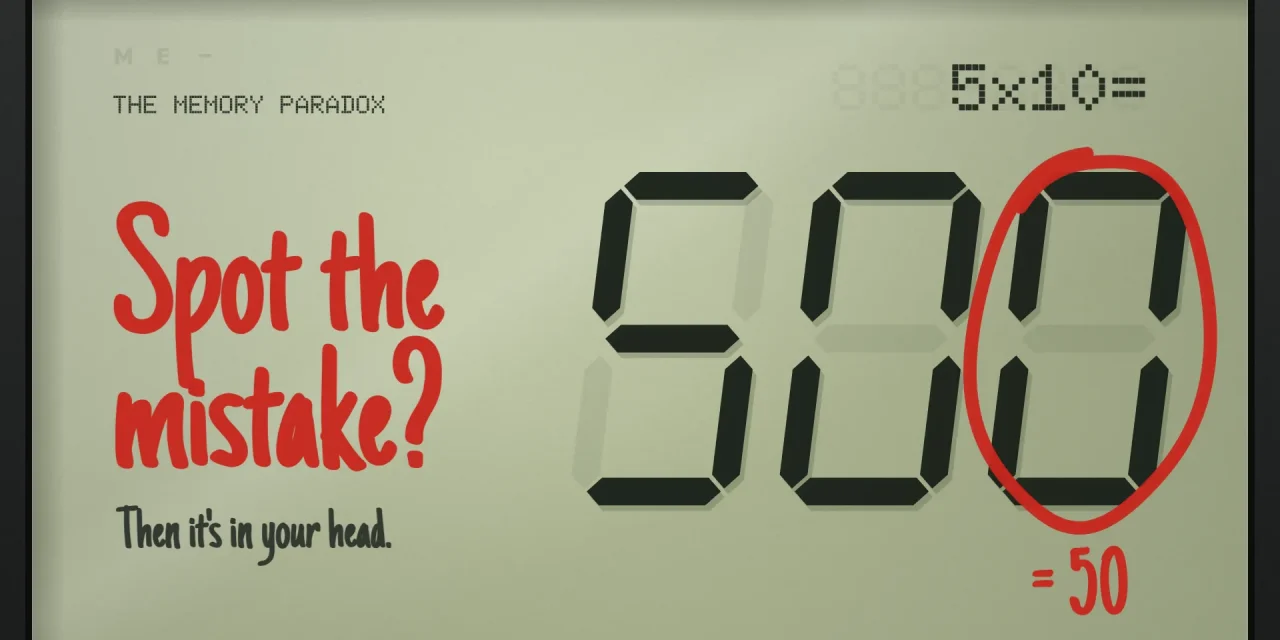
The strongest link in the argument concerns prediction errors. When an outcome differs from what you expected, dopamine neurons send a signal that tags the connections involved for updating. Type 5 × 10, see 500, and you feel at once that something is off. You only feel it because you already expect 50. Without the expectation there is no surprise and no learning signal. The authors give the example of a nurse who never internalised her times tables and does not notice that the dose on her screen is ten times too high.
Knowing where to find it is not knowing it
The brain organises knowledge in schemas, networks that link new information to what you already know and generate expectations. According to the authors, people who look everything up mostly retain a pointer, the fact that the information exists somewhere and roughly what it is about. A pointer feels like knowledge but lacks the schema you need to think with it. It is like doing a jigsaw by checking the picture on the box for every piece. Each piece goes in the right place, but the picture never forms in your head.
AI amplifies people who already know a lot
People with a solid knowledge base use AI as an amplifier. They spot what is missing, refine the prompt and catch errors. People still building that base risk mistaking the fluency of the AI for their own understanding. The authors call this metacognitive laziness, after a 2024 study in which students wrote better essays with ChatGPT but knew no more afterwards than students without help.
What the 2025 and 2026 evidence shows
When the paper appeared, its AI section rested on a handful of small studies. Since then, larger trials with pupils, students and professionals have been published. Most point the same way.
Better homework, worse exams
The first large experiment came from Hamsa Bastani and colleagues at Wharton and has since appeared in PNAS. Nearly a thousand secondary school pupils in Türkiye practised maths with a standard ChatGPT interface, with a version designed not to hand out answers, or without AI. With the standard version they scored 48% higher during practice. On the exam without AI they scored 17% lower than pupils who never had access. The version with guardrails largely removed that damage.
In June 2026 the largest real-world evidence followed. David Strömberg, Victor Lei and Yanhui Wu tracked 26,811 pupils in a county in central China for 30 months, with their homework, monthly tests and entrance exams. Six months after adopting AI, homework scores were 18% higher and time per assignment had fallen from 64 to 45 minutes. Closed-book monthly tests fell by 20% over the same period. On the entrance exams for senior high school and university, the losses reached 24% and 18%, but only became fully visible after about two years.
Three details make the study especially useful. The losses sat with the four in five AI users who finished homework unusually fast with high scores, which points to outsourcing. The other users spent as long as classmates without AI and did as well on exams. The pupils hit hardest were those who performed best beforehand. And once pupils used AI, good homework scores no longer said anything about what they actually knew.
Ten minutes is enough to change how people work
How fast this happens was shown in April 2026 by researchers from Carnegie Mellon, Berkeley, Oxford, MIT and UCLA. In three randomised experiments with 1,222 participants, one group received ten to fifteen minutes of help from a GPT-5 assistant on fractions or reading comprehension. Afterwards everyone solved three problems alone. In the first experiment the AI group solved 57% and the control group 74%, and the AI group gave up more often. In an exploratory analysis, people who had only asked the assistant for hints did as well as the control group.
That does not mean ten minutes of AI makes you less intelligent, as some headlines suggested. The test came straight after a single short session. What the study does show is that your sense of how much effort a problem deserves shifts quickly.
The same pattern at work
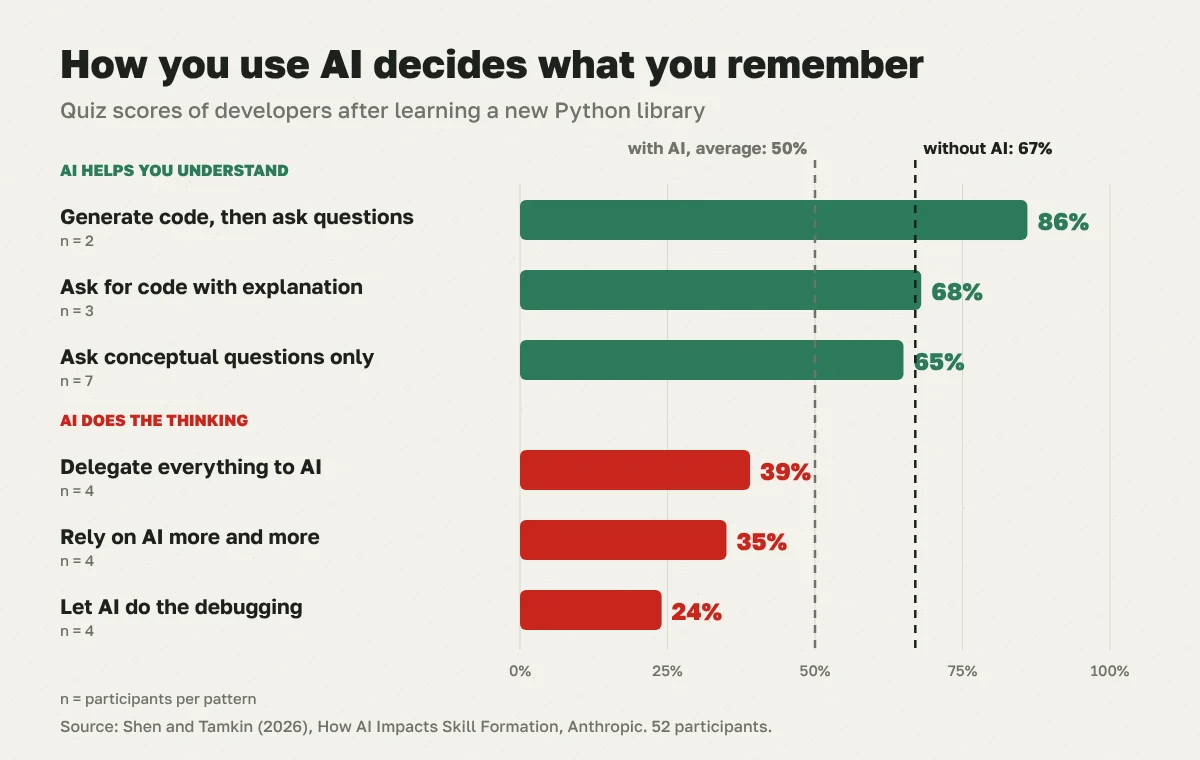
At Anthropic, Judy Hanwen Shen and Alex Tamkin studied how 52 mostly junior developers learned a new Python library. With AI help they scored 50% on a quiz afterwards, without AI 67%. They were not significantly faster with AI either. The biggest gap was in debugging, the very skill needed to check code an AI wrote. How people used the AI made the difference.
Surveys of knowledge workers show the same tendency. In a Microsoft Research survey of 319 knowledge workers, people thought less critically the more they trusted the AI, and more critically the more they trusted themselves. In four endoscopy centres in Poland, the adenoma detection rate of experienced endoscopists in procedures without AI fell from 28.4% to 22.4% a few months after they started working with an AI system. That is an observational study, so a warning sign rather than proof. We covered the wider effect earlier in our piece on cognitive offloading.
| Study | Who | With AI during the task | Without AI afterwards |
|---|---|---|---|
| Bastani et al., PNAS 2025 | nearly 1,000 pupils | 48% better in practice | 17% lower on the exam |
| Strömberg et al., 2026 | 26,811 pupils, 30 months | homework 18% better, 30% faster | tests 20% lower, entrance exams 18 to 24% lower |
| Liu et al., 2026 | 1,222 online participants | 10 to 15 minutes of help | fewer problems solved, more giving up |
| Shen and Tamkin, 2026 | 52 developers | not significantly faster | quiz 50% versus 67% |
| Contractor and Reyes, 2026 | students in proctored sessions | free use of AI | 0.27 standard deviations better, still after a week |
Where the paper overreaches
The core of the argument holds up. Some claims in the chapter are weaker than its tone suggests.
- The IQ decline. The authors link falling IQ scores in rich countries, among people born after the mid-1970s, to schooling that dropped memorisation and to digital tools. Norwegian data show the decline also occurs within families, so it is environmental rather than genetic. Which environmental factor drives it remains open. The authors write that timing is not causation, yet the chapter sometimes reads more certain than that.
- The Google effect. The paper cites Betsy Sparrow’s 2011 study, which found that people remember where information is stored rather than the information itself. A key experiment from that study failed to replicate in the large 2018 replication project. Sparrow pointed to design differences, but the effect is less settled than the chapter suggests.
- The MIT brain scans. The paper cites Your Brain on ChatGPT from the MIT Media Lab, in which people who wrote with ChatGPT showed the weakest brain connectivity and struggled to quote their own essays. It is still a preprint. Eighteen people took part in the decisive fourth session, and a published comment raises concerns about the sample, the EEG analysis and the reporting. The researchers themselves warn against overreading it.
- The education debate. Besides a review, the chapter is a case for explicit instruction and memorisation, and against discovery learning. That is one side of a debate that has run for decades. Readers get a strong position, not a neutral survey.
When AI helps people learn
The studies that find harm have one thing in common: the AI supplied the answer. Where the AI made people think first, the problem shrank or reversed.
- Bastani’s tutor version, which gave hints instead of solutions, largely removed the exam penalty.
- At Harvard, 194 physics students learned more than twice as much in less time with an AI tutor that made them try first and kept its answers short than in an active-learning class. That was one course at one university, measured over the short term.
- Zara Contractor and Germán Reyes had students learn an unfamiliar topic in proctored sessions, with or without AI. With AI they scored 0.27 standard deviations higher on knowledge tests, still a week later. Students who used AI to explain concepts gained most. Those who let it write the text lost their advantage as soon as the AI was removed.
The OECD’s Digital Education Outlook 2026 sums it up: completing a task well with AI does not automatically mean learning. Tools designed with a clear learning purpose do markedly better than a general chatbot. Our guide on collaborating with AI without losing control of your work covers the same principle for teams.
The augmentation trap for European employers
Michael Caosun and Sinan Aral of MIT Sloan put the workplace version of the paradox into an economic model in April 2026. Whoever decides to deploy AI captures the productivity gain now. The erosion of expertise comes later and lands on the worker. When managers are short-termist, or when a worker’s skills also matter outside the job, heavy offloading can leave the worker worse off than if AI had never arrived. They call this the augmentation trap.
The evidence above shows where the trap bites hardest. It is not the senior specialist who already knows the field. It is the junior analyst, developer, auditor or clinician who would normally build expertise by doing the routine work that AI now takes over. The Chinese study adds an uncomfortable detail: the strongest performers had the most to lose. In practice, the people with the most potential may have the most to lose.
For Europe this matters twice. Many sectors here depend on human review by design, from audit and financial supervision to medicine and engineering. And European regulation increasingly assumes that a competent human can check what an AI produces. If the pipeline of competent humans thins out, that assumption weakens quietly.
What Europe’s rules ask, and what they leave to you
The EU AI Act has required AI literacy since February 2025. The Digital Omnibus on AI, in force since 27 July 2026, softened Article 4. Providers and deployers now have to take measures that support AI literacy among their staff, rather than ensure a sufficient level of it. AI systems that evaluate learning outcomes in education count as high-risk, with obligations that now apply from 2 December 2027, as set out in our overview of the AI Act after the Digital Omnibus.
None of that protects the skills people need to work without AI. AI literacy is about understanding and using the tools, not about keeping the expertise that makes their output checkable. Education systems are starting to act. Flanders, for example, is rolling out new minimum targets for primary schools from the 2026-2027 school year, under which pupils learn what AI is and how to prompt a school-provided tool, and its education minister has called for more pen-and-paper learning and clear limits on AI. For employers, skill formation remains their own responsibility.
What European organisations can do now
- Measure unaided performance. Output with AI tells you little about skill, as the homework scores in China showed. Build short checks without AI into onboarding and certification, especially for roles that review AI output.
- Make attempt-first the norm. Ask juniors to write their own approach, estimate or draft before they consult the AI. That creates the expectation a prediction error needs.
- Default to tutor modes for learning. ChatGPT, Gemini and Claude each offer a study or learning mode that asks questions instead of answering at once. Use them in training and for staff in their first months in a role.
- Ask for explanations, not answers. Across four of the studies above, using AI for hints and explanations was the difference between learning and losing ground. Make that explicit in your AI guidelines.
- Keep the apprenticeship tasks. Decide which routine tasks juniors still do by hand, at least for a while, because those tasks are where expertise is built. Debugging, reconciliations and first drafts of analysis are good candidates.
- Review by explaining back. In code and document reviews, have the author explain what the AI-generated part does and why it is right. People who cannot explain it have not learned it.
- Use AI to quiz, not only to summarise. Retrieving knowledge from memory strengthens it more than rereading. Let the AI test your people on what they just learned, spaced over days and weeks.
Frequently asked questions
What is the memory paradox in one sentence?
The better AI gets at remembering and looking things up for you, the more your own knowledge is worth, because the brain needs that knowledge to notice errors, learn and check the AI.
Does AI make us less intelligent?
Not by itself. The research shows that AI which takes over the work harms learning, while AI which explains, gives hints or asks questions can strengthen it. It depends on how you use it.
Is the MIT study Your Brain on ChatGPT reliable?
It is an interesting signal, not proof. It has not been peer reviewed, the fourth session had eighteen participants and other researchers question parts of the analysis. Larger studies with exam scores point the same way.
Does the EU AI Act require organisations to protect employees’ skills?
No. Article 4 asks providers and deployers to support AI literacy, which concerns understanding and using AI systems. Keeping the expertise needed to work and check output without AI is left to organisations themselves.
What is cognitive offloading?
Cognitive offloading means shifting mental work to a tool, such as a calendar, a calculator or a chatbot. That is normal and often useful. It becomes a problem when the tool also takes over the learning itself.
The better AI gets, the more your own knowledge is worth
The most striking finding from China is that the strongest pupils lost the most. They were capable enough to let AI finish their homework smoothly, and so had the most practice to lose. The authors of the memory paradox note on their first page that they used ChatGPT, Claude and Scite.ai to find literature for the chapter. That can work, because they know the field well enough to see what is missing. AI multiplies what you already know. People who know a lot gain time. People who know little risk handing over the very practice their knowledge was supposed to come from.