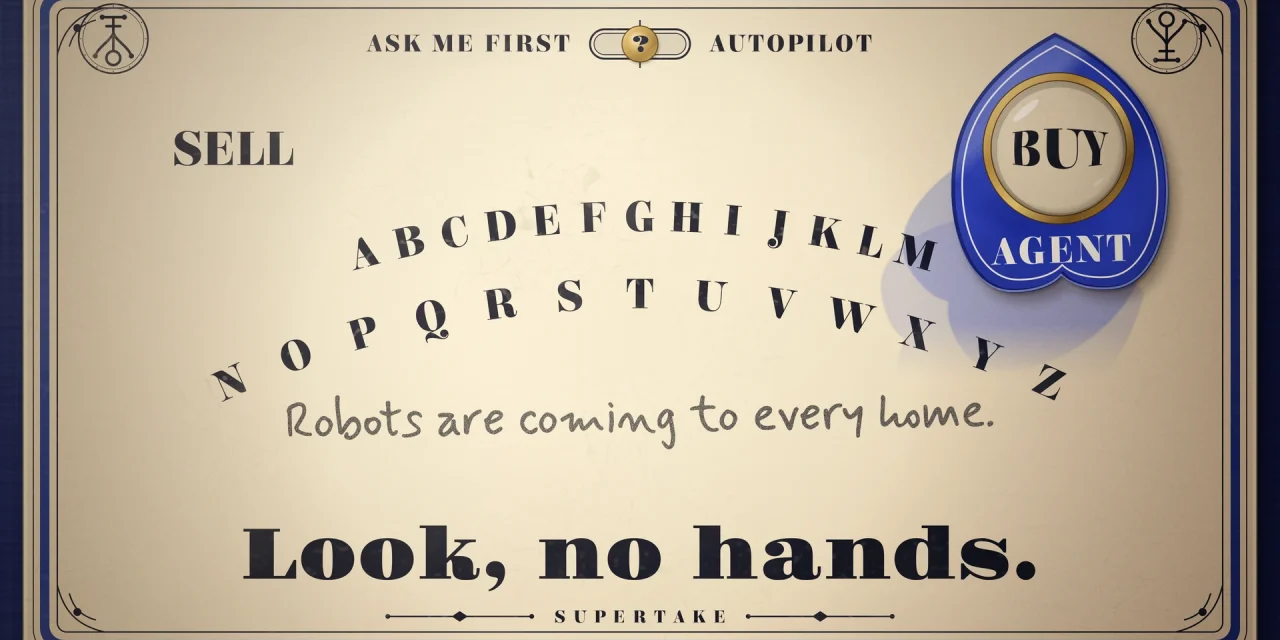
Supertake turns a belief about the future into a stock portfolio that an AI agent builds and, if you let it, trades on its own. The New York start-up announced a $20 million seed round on 23 November, and for now it works only through Robinhood and Coinbase. For European brokers, banks and wealth platforms, the interesting question is not how clever the agent is but who is accountable when it trades. Under MiFID II, a service that trades a client’s portfolio at its own discretion is portfolio management, a licensed activity, and ESMA has made clear that a disclaimer on its own does not change what a service is.
What Supertake does
You describe, in plain language, how you think the world will change. Supertake calls that a take. The AI asks follow-up questions, sharpens the idea into something investable and builds a portfolio from it, with weights per position and a cash reserve. According to TechCrunch, those portfolios currently hold stocks, although on 24 November the best-performing take also held a triple-leveraged fund betting on falling chip stocks. One example from the article: a take that looksmaxxing and longevity will trend becomes a basket of pharma and cosmetics companies.
Orders go to the user’s own brokerage account at Robinhood or Coinbase. Supertake’s terms say it never holds client money or securities; execution, clearing and custody stay with the broker. There are two modes. In Ask me first, the default for real money, the user approves every trade. Autopilot is opt-in and lets the agent trade without per-trade approval, within a per-trade limit and other limits that start as presets the user can change.
Then the social layer kicks in. Takes appear on a leaderboard ranked by return, and other users can invest alongside them. Supertake’s vision page says takemakers will share in the value their ideas create, even with little capital of their own, without explaining how.
CEO Lincoln Murr insists Supertake is not a prediction market and targets medium-term holdings. Shorts, derivatives, perpetuals and prediction markets through partners are on the roadmap.
Who is behind it
Michael Mignano, who co-founded Anchor and sold it to Spotify in 2019 for more than $150 million, incubated Supertake at Union Square Ventures, where he became a partner in April, and stays on as executive chairman. CEO Lincoln Murr and CTO John Peterson previously led AI product and engineering at Coinbase. Adjacent led the $20 million seed round, with Coinbase Ventures and Union Square Ventures, after a $2 million pre-seed. The beta opened in late September behind a waitlist. Supertake does not charge for its AI features today, though its terms say that may change.
The US model puts the risk on the customer
Supertake describes solid technical controls: the AI cannot deposit or withdraw money without explicit consent, drift limits keep portfolios balanced, allow and deny lists restrict what it may trade, users set trade size limits, activity is monitored in real time and the agent never sees brokerage credentials. That is the harness around the model doing the work, and it is the right instinct.
The legal design is a different story. The terms state that Supertake is “not currently a broker-dealer or investment adviser” and not a fiduciary, and that its content is informational and educational. It accepts no liability for investment losses, caps other liability at $1,000 or the fees paid in the last six months, whichever is greater, and sends disputes to arbitration under New York law.
The brokers take the same line. Robinhood, which opened its platform to third-party agents in May, says the customer assumes all risk for agent orders and that it does not supervise or audit those agents. When it unveiled its own Robinhood Agents in September, for eligible US customers according to Robinhood and for all of its roughly 29 million customers according to Fortune, it took the view that hosting agents is not financial advice, and Fortune noted that it remains unclear where liability falls when something goes wrong. By late September, agents were already transacting on Robinhood close to 30 million times a day.
How the same features read under MiFID II
Europe asks a different question. It does not start from what the software is, but from what service the client receives. ESMA’s supervisory briefing on copy trading is the closest guide, because a leaderboard of takes that others can follow closely resembles copy trading, with an AI in the middle. Mapped feature by feature, the picture looks like this.
| Supertake feature | What happens | Likely reading under MiFID II |
|---|---|---|
| Ask me first | The agent proposes trades and the client approves each one | No discretion, so not portfolio management. A proposal tailored to the client can be a personal recommendation, which is investment advice. |
| Autopilot | The agent trades within client limits without per-trade approval | Discretion under a mandate, which points to portfolio management. ESMA says limits such as stop-losses do not change that, and neither does an approval window that executes automatically when it lapses. |
| Investing alongside a take | Followers can follow or replicate a takemaker’s portfolio | Depending on the design, copy trading can be portfolio management, advice or execution only. Where one firm serves followers and has a direct link to copied traders, ESMA considers it “highly unlikely” that it only provides execution. |
| Rewards for takemakers | Popular takes earn their authors a share of value | Depending on how they are structured, payments to copied traders can give rise to conflicts of interest, and commission-based payments may be treated as inducements. |
| “Not investment advice” notices | Disclaimers on the site and in the terms | ESMA’s guidance on the definition of advice says a disclaimer is unlikely to change the nature of the service and cannot on its own prevent it being treated as advice. |
ESMA stresses that each case is assessed on its own facts, so this is a reading, not a verdict. But the direction is clear. Once a service qualifies as advice or portfolio management, the firm must assess suitability for each client, keep every trade within the mandate and act in the client’s best interest. ESMA’s 2024 statement on AI in investment services adds that a firm’s decisions remain the responsibility of its management body, whether a person or an AI tool takes them, and that using AI for advice or portfolio management requires a heightened level of diligence.
The EU AI Act matters less here than many expect. Its list of high-risk uses covers creditworthiness and pricing in life and health insurance, not robo-advice or trading. The heavy obligations for an investing agent come from financial services law, the same way they did in our analysis of why Claude can read bank accounts in the US but not yet in Europe.
Regulated brokers are opening up to agents
Supertake arrives in a crowded field. Coinbase launched Coinbase for Agents in June and extended it to US stocks and ETFs in September. Public has let users build an index from a sentence since 2025. eToro, which serves clients across Europe, began rolling out Agent Portfolios in March, where a user’s own agent trades on a separate sub-account with a set budget and risk limits. Its connectors for Claude, ChatGPT and Grok, launched in October and not offered in the US, Australia or Singapore, propose actions for the user to review and approve.
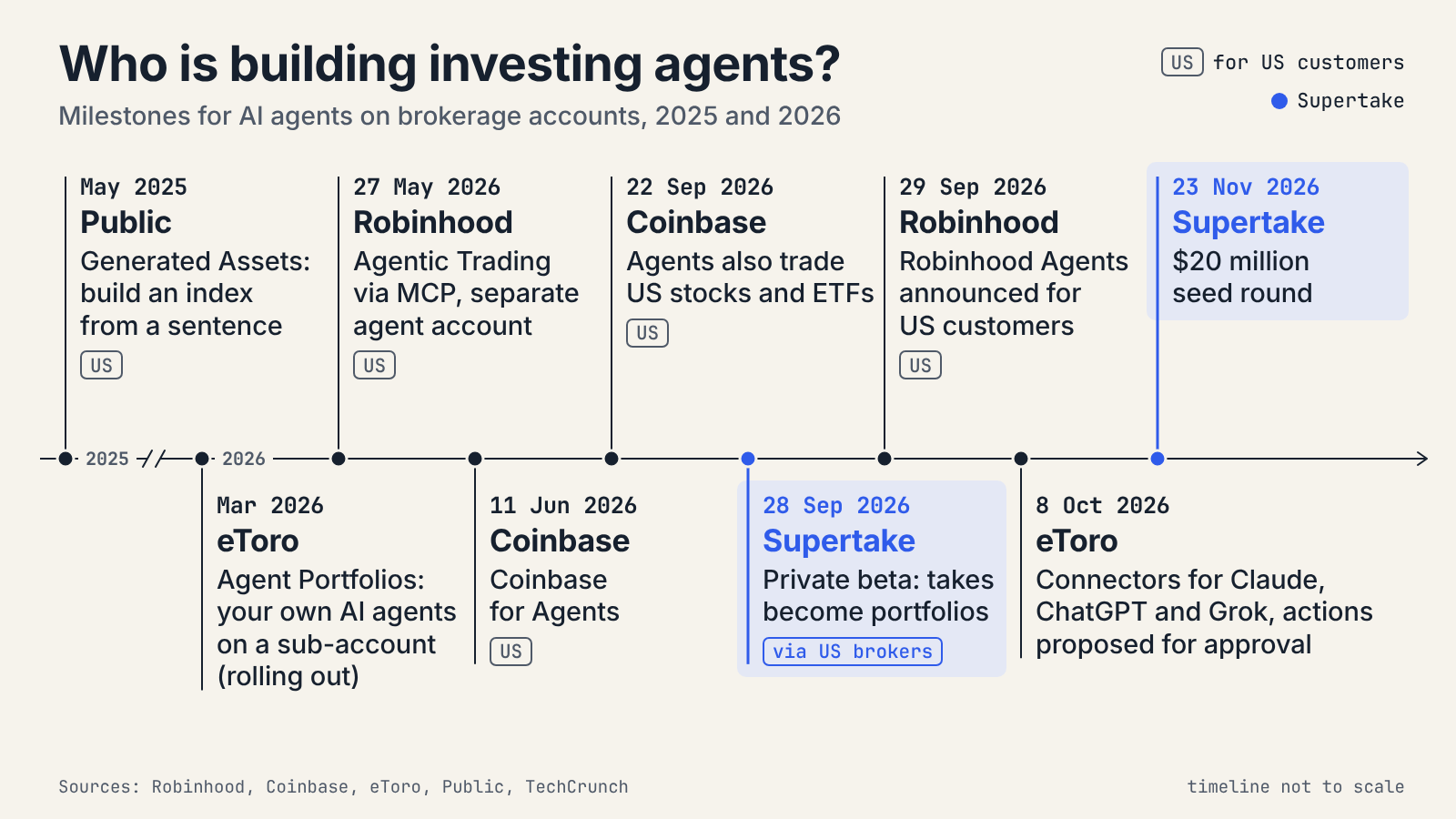
Robinhood’s European arm, licensed in Lithuania, offers EU customers stock tokens, either derivative contracts or tokenised debt securities that track US shares without giving any rights in them, and has not announced agentic trading for Europe. A European user cannot simply plug Supertake into a European account today.
A design pattern is emerging at several of them: a dedicated or isolated agent account holding only the money the user puts in, trade limits, an optional approval step and a record of what the user asked and what the agent did. Robinhood uses that record to resolve disputes. That is the same control logic our readers met with Claude Ship, where teams have to show who approved what.
Being right about a theme is not the same as making money
Supertake’s pitch rests on an appealing idea: if you are right about robots or AI chips, you profit by owning those companies. Thematic funds have been doing exactly that for decades, with sobering results. Morningstar found that of the thematic funds that existed fifteen years before the end of 2021, 78% had been liquidated or merged, 12% survived but lagged global equities and just under 10% survived and beat them.
Letting a language model trade does not fix that. In Nof1’s Alpha Arena, eight frontier models, including Claude, Gemini, ChatGPT, Grok and Qwen, each traded $10,000 in US tech stocks for two weeks across four contests. Together they lost about a third of their capital, and only six of 32 results were profitable. Given the same prompt, Qwen placed 1,418 trades and Grok 158.
The leaderboard raises its own European question. Supertake’s homepage ranks takes by return since each record began, over a few months at most, and shows practice takes with simulated results. Under the MiFID II Delegated Regulation, an investment firm that shows past performance of an instrument, index or service must not make it the most prominent feature, must cover the preceding five years, or the whole period if shorter, in complete 12-month periods, and must carry a prominent warning. Simulated past performance is only allowed for a financial instrument or an index. A leaderboard of two-month returns is exactly the kind of marketing those rules were written to restrain.
Herding is the other risk. In a report published in April, the Dutch regulator AFM said that self-learning trading systems can produce patterns that resemble coordinated behaviour, without the parties having consulted each other or intended it. A leaderboard that pulls many followers into the same take, executed by agents in the same minutes, is a small-scale version of that scenario.
What European firms should settle before they ship an investing agent
- Qualify each mode separately. An approval mode and an autopilot mode are different services. Decide which licence each one needs before launch, not after.
- Write the mandate down. A take already states an objective and a scope. Add the limits, the excluded assets and the conditions for stopping, and make it the client’s documented mandate.
- Run suitability per take. A theme is a concentrated bet. Check it against the client’s profile, not only against the platform’s risk limits.
- Isolate and log. Give the agent its own account and limits, and keep a record of instructions, proposals, approvals and executions that a supervisor can read.
- Treat the leaderboard as marketing. Apply past-performance rules, separate simulated from real results and show costs.
- Watch the crowd. Monitor how many agents act on the same take at the same time, and be ready to throttle.
Questions about Supertake
Which AI models does Supertake use?
Supertake does not name them. It refers to frontier AI models and trading agents, governed by its own software that directs and limits what the AI can do.
What are practice takes?
Takes run without real money. Their results are simulated and, according to the terms, leave out fees, taxes and real-world execution. They appear on the homepage alongside real-money takes, which is one more reason to read the labels.
Would crypto takes fall under different EU rules?
Supertake’s terms already allow cryptocurrencies in a take, and the company plans to add perpetuals and other derivatives. Crypto-assets that are not financial instruments fall under MiCA, while derivatives such as perpetual futures remain financial instruments under MiFID II. ESMA said in April 2025 that its MiFID copy-trading guidance applies mutatis mutandis under MiCA when deciding which crypto-asset service is provided, so the same questions about advice and portfolio management come back.
Can a European firm offer something like this today?
Yes, if it holds the licence that fits the service and builds the controls in. eToro’s Agent Portfolios and approval-based connectors show one regulated model, although there the agent belongs to the user, so eToro does not take the investment decisions itself.
In Europe, the mandate is the product
The most useful thing Supertake invented may be the take itself. A written thesis, a scope and a set of limits is very close to what a European portfolio mandate should look like. A US start-up can treat that sentence as content and push the risk to the user. A European firm can turn the same sentence into a documented mandate, with a suitability check and an audit trail, and sell a licensed service built on it. Agentic investing will reach Europe either way. The firms that get there first will be the ones that can show, for every trade, who decided and under which mandate.