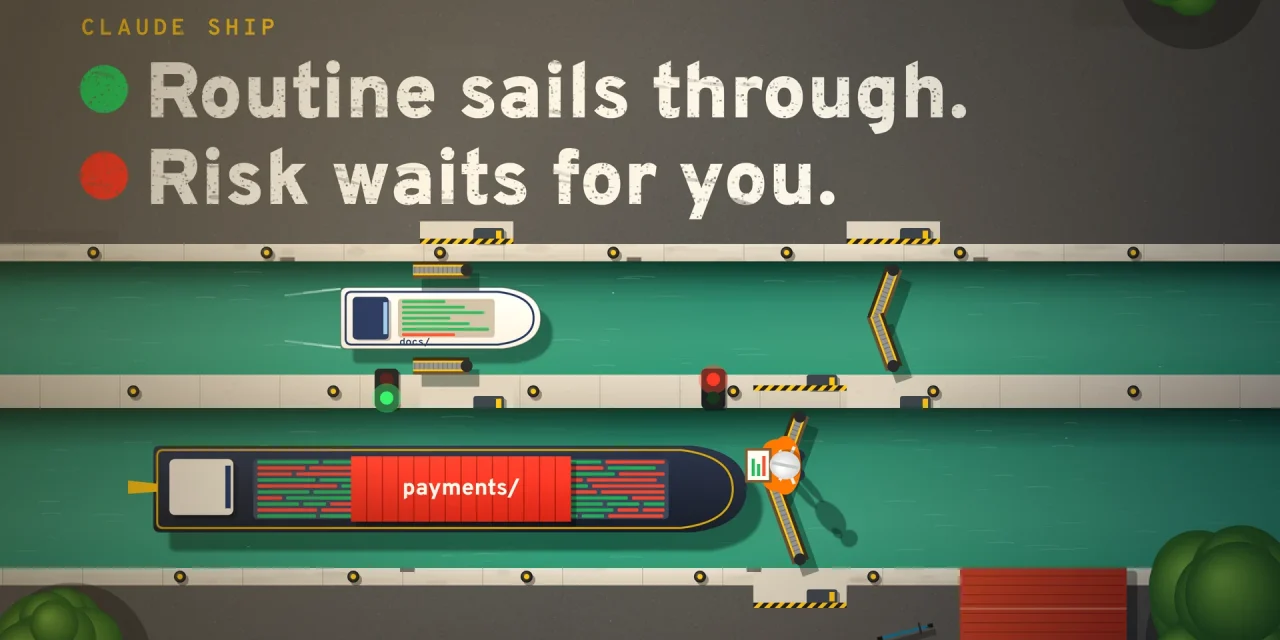
Claude Ship is a set of three AI agents from Anthropic that review a GitHub pull request, fix what fails and, where a policy file in the repository allows it, approve the change. It launched in beta on 23 November 2026 for Claude Team and Enterprise organisations. Code review by AI is not new. What is new is that an agent can now hold the approval, and for European organisations that turns a developer tool into a change-management question: who approved this change, and was that approver independent of whoever wrote it?
What follows covers what each agent does, what the policy file can and cannot express, the cases where a change still merges without a person, and how the setup maps to DORA, ISO 27001 and the questions your auditors will ask.
What Claude Ship does
According to Anthropic’s documentation, each agent owns one step:
- Code Review reads a change against the surrounding code and posts findings such as logic errors, security vulnerabilities and broken edge cases as inline comments, ranked by severity. It has been generally available since 15 October.
- PR Steward works on failing checks, merge conflicts and review comments, and pushes commits with its fixes. It is in public beta.
- Claude Approvals is a check that applies an approval policy your team writes and reports who still has to approve. Where the policy allows it, Claude posts an approving review. It is also in public beta.
Developers can also type /ship in Claude Code. Claude then opens the pull request if there is none, reviews the change and keeps working on feedback and failing checks. The developer still does the merge. In the announcement, Anthropic explains the motivation with its own numbers: on the Claude Code team, merged pull requests more than doubled between June and September while the share that had to be reverted fell by more than 40%. Anthropic adds that Claude’s review is one layer of a wider process there.
The fixer cannot approve, and that split is deliberate
The design separates the agent that changes code from the agent that signs off. PR Steward acts on GitHub as the Claude GitHub App, and Anthropic’s service refuses its requests to approve a pull request, change branch protection or rulesets, write check runs, delete a branch or push tags. After every push it comments on what it changed and how to undo it.
Merging, turning on auto-merge and force-pushing are a different matter. Anthropic leaves those to GitHub’s branch rules, with two checks on the commands Claude runs, and the documentation is candid that a command written another way can pass both. The control that holds is branch protection that requires reviews, with the Claude GitHub App kept off every bypass list.
For the approval itself, Claude Approvals reads a policy file on the default branch, finds the rules that apply to each changed file and takes the strictest verdict. Anthropic calls it a smarter CODEOWNERS file. The check blocks a merge only once you make it a required check in GitHub.
What the policy file can express
The policy lives in .claude/approvals.yml. Each rule names paths and says how many people have to approve and whether Claude approves, comments or blocks. A rule can be lowered by a condition, for example when Code Review passes or when a classifier you write in plain language rates the change as low risk. This short policy, adapted from the policy reference, keeps two people on everything and asks for someone other than the author on the payments service:
version: 1
mode: observe
rules:
  - purpose: "A change takes two people, and Claude doesn't approve."
    paths: ["**"]
    verdict: { claude: comments, seats: 2 }
    advisory: [claude/code_review]
  - purpose: "Payments needs a reviewer who is not an author."
    paths: ["services/payments/**"]
    verdict: { claude: comments, seats: [{ count: 1, from: [humans, "!pr/authors"] }] }
A few properties matter for governance. The author of a pull request can fill one seat, so seats: 2 means the author plus one other person. Files that control review, such as policy files, classifier definitions, REVIEW.md and any CODEOWNERS file, are protected and normally need a person. Other control files, such as .github/ workflows, CLAUDE.md and .mcp.json, are not protected unless you write a rule for them. And a policy change in an open pull request applies none of its own rules: the rules on the default branch decide.
Classifiers add judgement and a new attack surface. A classifier run reads text the author wrote, and Anthropic warns that this text can try to steer the answer. For paths that matter, the documentation recommends a rule that asks for a person and reads no classifier.
Where a change can still merge without a person
The documentation lists the cases where nobody but the author looked at a change:
- The Claude Approvals check is not required in GitHub, or the policy is still in observe mode.
- The policy asks for
seats: 1, which the author alone fills, orseats: 0, which lets a bot’s pull request merge with no person involved. - A GitHub branch rule requires one approval, and Claude’s approving review counts as that approval.
- A rule says
claude: approveswithout reading Code Review, so Claude can approve a change nothing has reviewed. - Auto-merge or a merge queue is on, with a policy that requires no person.
One subtlety deserves a line in your control description. Approvals counts a machine user, meaning a user account that a script or an agent drives, as a person. An agent that commits under such an account can therefore fill a human seat, unless you exclude its login in the rule.
What DORA, ISO 27001 and your auditors will ask
No European rule names AI reviewers, but several describe what a change approval must be. For financial entities under DORA, Article 17 of Delegated Regulation (EU) 2024/1774 requires an ICT change management procedure with mechanisms that keep the functions approving changes independent from those requesting and implementing them. It also asks for documented change details, fall-back procedures and a verification that ICT security requirements are met. ISO/IEC 27001:2022 covers the same ground with control A.5.3 on segregation of duties and A.8.32 on change management, and SOC 2 does so in criterion CC8.1. We used the same clause-by-clause approach for what AI changes in ISO 22301.
| What an auditor looks for | What Claude Ship gives you | What you still have to add |
|---|---|---|
| An approver independent of the implementer | A fixer that cannot approve, and an approval check driven by a written policy | A human approver who is not an author on in-scope systems, and a position on whether an agent from the same vendor counts as an independent function |
| Documented change details and reasons | A check title and a comment with the reasons on every evaluated pull request | Retention of that evidence outside GitHub if your audit trail lives elsewhere |
| Fall-back procedures | A comment after every PR Steward push on how to undo it | Rollback and feature-flag procedures for what reaches production |
| Verification of security requirements | Code Review findings and Important findings that can block approval | Security scans, SAST and CI that run independently of the agent |
| A controlled policy | Protected policy files that need a person to change | An owner, an approval route and a review cycle for .claude/approvals.yml itself |
The analysts quoted by InfoWorld point the same way. Gartner’s Nitish Tyagi warns that non-deterministic models are unsuitable as the only quality gate and suggests giving review agents separate identities linked to the responsible team. IDC’s Deepika Giri suggests restricting automated approval to low-risk changes, keeping security scans and CI independent, and giving every merge a designated human owner. A cautious reading for regulated teams is to let Claude approve only in a documented low-risk tier and keep a non-author human on anything that touches in-scope systems. That is our reading, not legal advice, so check it with your compliance function and auditor.
Data, plans and the exclusions that hit regulated teams
Claude Ship needs a Claude Team or Enterprise plan and repositories on GitHub. GitLab and Bitbucket are not supported. The agents are not available to organisations with Zero Data Retention enabled, the HIPAA configuration applied or customer-managed encryption keys, and Approvals cannot start under the FERPA or Access Transparency settings. If your organisation negotiated Zero Data Retention or customer-managed keys, check those exclusions before anything else.
Where the work runs also differs per agent. PR Steward works in a cloud session on Anthropic’s infrastructure by default, with an option to run it in a self-hosted environment. Custom classifier runs are cloud sessions on Anthropic’s infrastructure, and if your organisation requires self-hosted compute, a rule reads an error instead of an answer. The /ship command runs locally with the developer’s own GitHub credentials. Anthropic warns that anyone who can merge to the base branch or push to that developer’s branch can then run code on the developer’s machine. Our piece on AI agent sandboxes covers why the exits matter more than the walls.
What it costs and how to cap it
There is no seat price for Claude Ship. Each agent bills tokens to the organisation’s usage credits, separately from the plan. Code Review has no flat price per review, and cost scales with review depth, change size and how often reviews run. When it launched in March 2026, Anthropic gave an average of $15 to $25 per review. PR Steward has no spend limit of its own until an Owner sets one. Approvals has no base charge, but classifier runs and the reviews a policy asks for are billed, including in observe mode, and a custom classifier stops at an estimated $10 per run unless you set a lower budget. Eligible Enterprise organisations can claim $10,000 to $50,000 in Code Review credits until 15 January 2027, valid for 30 days after the claim.
A rollout plan an auditor can follow
- Write the policy before the YAML. Define risk tiers in your change-management procedure, name the paths in each tier and record who approved that procedure.
- Start in one repository with spend limits. Turn on Code Review first, then PR Steward on manual start, as Anthropic recommends.
- Run Approvals in observe mode as an evidence period. Compare what the check would decide with what your reviewers decided, and keep the comparison.
- Protect in-scope paths with a non-author human and exclude machine-user logins from human seats.
- Enforce and lock down GitHub. Make Claude Approvals a required check with the Claude app as its source, keep the app off bypass lists and dismiss stale approvals when new commits arrive.
- Measure what supervisors care about. Track change failure rate, reverts and defects that escaped review next to cycle time, and keep your dependency and security controls outside the agent.
Frequently asked questions
Can Claude Ship merge code on its own?
Claude Ship does not merge by itself. PR Steward cannot approve, and Claude Approvals posts an approving review only where your policy allows it. Whether a change then merges depends on your branch rules, auto-merge and merge queue settings in GitHub.
Does Claude’s approval satisfy DORA’s independence requirement?
DORA does not name tools. It requires that the functions approving changes are independent of those requesting and implementing them. Whether an approval by an agent from the same vendor that wrote or fixed the code meets that bar is for your compliance function and supervisor to judge. Keeping a non-author human on in-scope systems is the safer position.
Does Claude Ship work with GitLab or Bitbucket?
No. Claude Ship works with repositories on GitHub. PR Steward also supports a connected GitHub Enterprise Server instance.
Can we test it without letting it decide anything?
Yes. In observe mode the Claude Approvals check shows what the policy would decide, Claude does not approve and the check normally does not block a merge. Those runs are still billed.
The approver is now a configuration file
The most useful detail is not in the launch post. In an engineering write-up, the Claude Code team describes its own rules: low-risk changes can merge once automated and security checks pass, a classifier sets the risk tier from the change rather than the author, and an agent’s approval never counts as a person’s. The team judges success by human time saved without more reverts or incidents. For European organisations the lesson is that .claude/approvals.yml becomes a control document. Treat a change to it like a change to your change-management policy, with an owner, an approval and a review date, because whoever can edit that file decides who approves everything else.