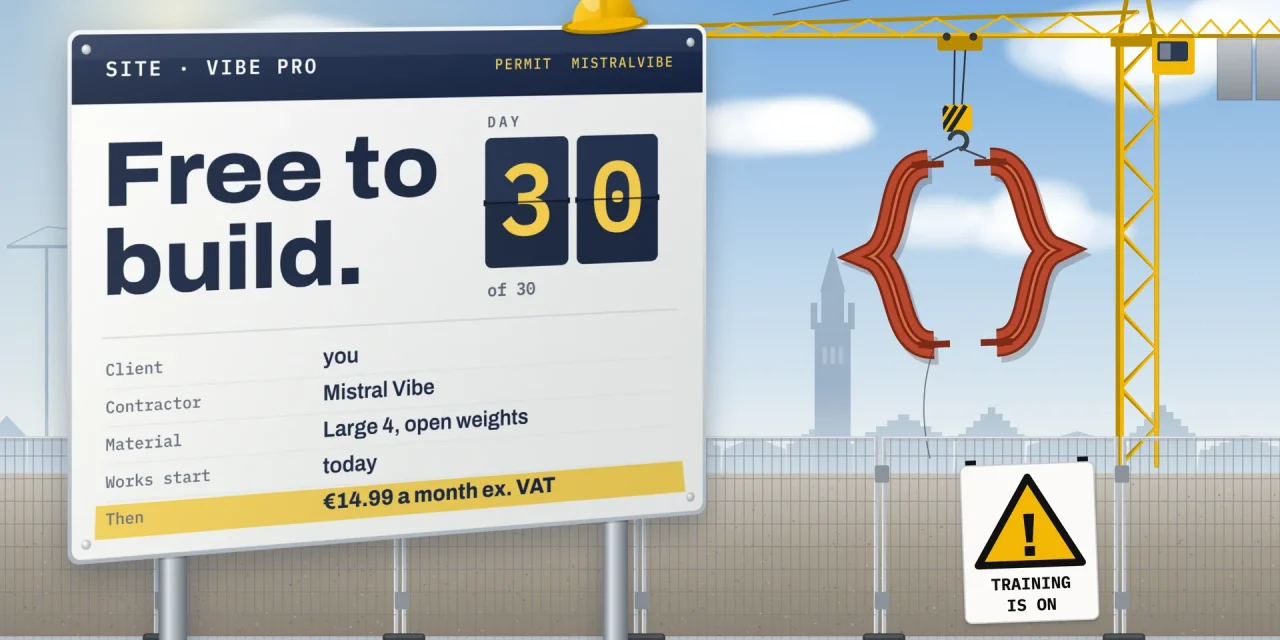
Since 23 November, anyone in Europe can get a month of Mistral Vibe Pro for free with the code MISTRALVIBE. For a developer, that is a cheap way to try a European coding agent that costs a fraction of Claude Code per task, while scoring clearly lower. For an organisation, the offer lands on personal accounts, where training on your conversations is switched on by default and nobody in IT can see who signed up.
So the useful question is less whether Vibe is good enough and more who decides how it gets used. Three things are worth settling before your developers redeem the code: which repositories are allowed, which plan they use, and which settings are switched off on day one.
What Mistral is giving away, and why now
This is Mistral’s second attempt in a week. On 17 November it offered three free months of Vibe Pro with the code LECHONK, first come, first served. According to Mistral, that capacity was gone in under an hour, and more codes were added the next day, TestingCatalog reported. On 23 November Mistral replaced the drops with an uncapped offer: one month for anyone in Europe, under the line “European product, European model, European inference.”
Redeeming it requires a payment card. Without cancellation, the plan renews at €14.99 a month before VAT, Frandroid notes, which also points out that Mistral never defines which countries count as Europe.
The timing follows the launch of Vibe Desktop on 17 November, a macOS and Windows app that runs several coding agents side by side, each in its own Git worktree, with diff review and pull request tracking in one window. Rival desktop coding apps from Anthropic and OpenAI have been live since spring, so the free month is also a way to get developers to switch tools while the app is new. Vibe itself is the renamed Le Chat: one subscription covers a work assistant and Vibe Code, which runs in the terminal, in VS Code, JetBrains and Zed, on the web and on the desktop.
What “European” covers, layer by layer
The slogan bundles three claims. Each holds, but each has an edge that matters for procurement.
- Product. Mistral is a Paris company, and the Vibe CLI is open source under Apache 2.0. You can read what the agent does on your machine.
- Model. In the desktop app, Mistral Large 4, nicknamed Le Chonk, is the default for paying users, Mistral says on GitHub. Its weights are open and it was trained from scratch on European infrastructure. But Vibe also offers GLM-5.3 from China’s Z.ai, hosted on Mistral’s servers, according to Frandroid. European inference does not mean every model you pick is European.
- Inference. Mistral says your data is hosted in the EU by default. The contractual version of that promise is a separate API product, regional endpoints such as api.eu.mistral.ai, and even there Mistral notes that regional inference does not cover storage of all control-plane data. A personal Vibe subscription is not that contract.
How sovereign Large 4 is once you run it yourself, from chips to licence, is covered in our analysis of Mistral Large 4.
An eleventh of the price, 17 points behind
Mistral calls Vibe with Le Chonk the strongest pairing of an open model and an agent harness. By its own numbers, Large 4 scores 41% on Terminal-Bench 4.0 and 19.7% on FrontierCode 2.0, the best results among open models. Outside measurements come in lower. AlphaSignal cites independent Terminal-Bench runs of 25 to 26%.
The most useful comparison is the Coding Agent Index from Artificial Analysis, which tests the model and the agent together on three benchmarks, three attempts per task. Vibe with Large 4 scores 41. Claude Code with Claude Fable 5.2 scores 58, and OpenCode with GLM-5.3 scores 40. The gap reverses on cost. At API prices, an average task costs $1.34 with Vibe, $5.41 with OpenCode and GLM-5.3, and $15.47 with Claude Code.
Two practical notes. An average task in the index takes 49 minutes, so speed belongs in your evaluation. And the harness matters as much as the model, as harness adapters showed this week. A score from a benchmark run tells you little about your own repositories.
The governance gap is the account, not the model
The free month is an individual Pro plan. According to Mistral’s help article, updated this week, only Enterprise customers are opted out of training by default. Individual users have to switch it off themselves, and on Team plans an administrator can disable it for the whole organisation. The Vibe and API toggles are separate. Older documentation pages that described Pro conversations as excluded from training now redirect to that article.
That creates a familiar pattern. A developer redeems the code on a personal account, opens a company repository in a local session, and the agent works with your files and shell under settings nobody in the organisation chose. Audit logs and SAML SSO are Enterprise features, so there is no central record either. The agent can read whatever the shell can read, including .env files. Agent sandboxes help, but only if someone sets them up.
Three decisions close most of the gap:
- Scope. Allow the trial on test repositories, open source work and code without secrets, or say no. Silence is also a decision, just not yours.
- Plan. If Vibe passes the trial, move users to Team at $24.99 per user per month before tax, where an administrator controls training for everyone, rather than a set of personal Pro accounts.
- Settings. Training off in both the Vibe and the API toggle on day one, no production credentials in reach, and cloud sessions only for code you could share with Mistral anyway.
Once agents start opening pull requests, the review chain becomes the control that matters, the same point we made about Claude Ship.
A 30-day evaluation that ends in a decision
A month is enough to answer one question: does the lower price outweigh the extra review time on your code? A simple dual run does that.
- Days 1 to 3. Redeem, switch training off, set a calendar reminder for day 25. Pick five to ten closed tickets with known solutions: bugs, small features and reviews.
- Week 1 and 2. Run each ticket in Vibe and in your current tool. Record wall-clock time, minutes of human review, whether the diff was merge-ready and, from the usage page, what it consumed.
- Week 3. Test what is new. Run three tasks in parallel worktrees, and send one to a cloud session. Cloud sessions always run on Mistral Medium 3.5, whatever model you use locally, so compare the two.
- Week 4. Decide by day 25, then cancel or move to a Team plan before day 30.
Measuring on your own work rather than on vendor charts is the method Epoch AI argues for, and it is the only way to know whether 17 points matter for the tickets you actually have.
Frequently asked questions
Is Vibe Pro really free?
For one month. You register a payment card, and without cancellation the plan continues at €14.99 a month before VAT.
Who is eligible?
Mistral says anyone in Europe. It publishes no list of countries, so check the redeem page if you are outside the EU.
Can a company use the offer for its team?
The offer covers the individual Pro plan. Team is a separate plan at $24.99 per user per month before tax, with admin controls such as an organisation-wide training switch.
Does Vibe keep my code in the EU?
Mistral says data is hosted in the EU by default. For a contractual choice of processing region, Mistral offers regional endpoints on its API, which is a different product from the Vibe subscription.
The cheap part is the tokens
At $1.34 a task, the agent itself is almost free, with or without the promotion. What costs money is the review time on weaker output and the risk of company code sitting in personal accounts under default settings. Europe’s sovereignty pitch is strongest when teams apply European rules to it themselves: a clear scope, an account the organisation controls and training switched off. That takes an afternoon, and it is worth doing before the code spreads through your team.