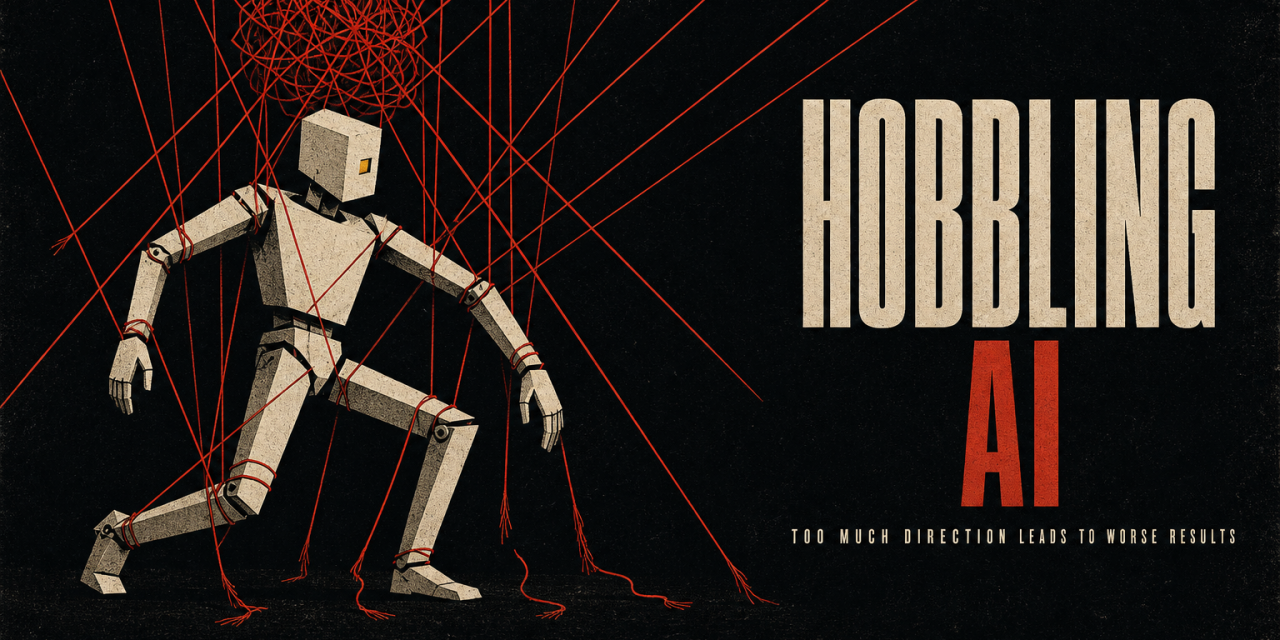
Hobbling is what happens when a model could do the work well, but your instructions, guardrails and workflow will not let it. The capability is there. The output is mediocre anyway. Most teams that complain about disappointing AI results are not running into a model limitation. They are running into a self inflicted one, built out of long system prompts, rigid templates, blocked tools and review steps that strip away anything unexpected.
The term comes from the observation that raw model capability and delivered performance are two different things. Unhobbling means removing the artificial limits between them. Hobbling is the reverse, and it is far more common than people admit, because every single constraint feels reasonable when you add it.
What hobbling looks like in practice
Imagine hiring an experienced analyst and then handing over a script that dictates the exact order of every sentence, forbids asking clarifying questions, blocks access to the database and requires the final memo to fit in six bullet points of maximum twelve words each. You would get something. It would not be analysis. It would be form filling.
That is the shape of most enterprise AI deployments. The model is not allowed to search, not allowed to run code, not allowed to write more than a fixed number of words, not allowed to reason before answering, not allowed to say it lacks information. Then someone concludes that AI is not ready for serious work.
The gap between capability and elicitation
A model has latent skill that only appears under the right conditions. Give it room to think before it answers and reasoning quality rises. Give it tools and it verifies instead of guessing. Give it context about the audience, the goal and the failure modes you care about and it makes better judgement calls. None of this changes the weights. It changes how much of the existing capability actually reaches your document.
Hobbling closes that gap from the wrong side. Every restriction you add narrows the space the model is allowed to explore, and quality lives in that space. The frustrating part is that the damage is invisible. You never see the better answer you prevented. You only see the flat one you received, and you assume that is the ceiling.
Signs you are hobbling your model
- Your prompt is mostly prohibitions. Long lists of things not to do crowd out the description of what good looks like.
- You dictate method instead of outcome. You specify the steps rather than the standard the result has to meet.
- Output length is capped arbitrarily. Complex questions get squeezed into a template built for simple ones.
- Reasoning is suppressed. You demand an immediate answer with no space to work through the problem.
- Tools are switched off by default. The model has to rely on memory for facts it could have checked.
- Every task uses the same rigid format. A comparison, a summary and a risk assessment all arrive as the same five headings.
- You never let it ask. Ambiguity gets resolved by guessing instead of by a single clarifying question.
Why extra instructions make output worse
Instruction saturation
Attention is finite. A prompt with forty rules does not get forty rules followed. It gets the loudest ones followed and the subtle ones ignored, and the subtle ones are usually the ones about quality. Your rule about avoiding a specific word competes with your instruction to reason carefully, and the word rule wins because it is easier to satisfy.
Conflicting rules
Constraints accumulate over months. Someone adds a demand for brevity, someone else adds a requirement to justify every claim, a third person insists on a formal register and a fourth wants a friendly tone. The model resolves the contradiction by producing something bland enough to violate nothing. Blandness is the normal output of an over specified brief.
A shrinking solution space
Good answers often live in the part of the space you did not think of. When you prescribe structure, sequence and phrasing, you have already decided what the answer resembles. The model can only fill in your assumption. If your assumption is wrong, the output is confidently wrong in exactly the shape you asked for.
Anchoring on your first idea
Detailed prompts encode the framing you had before you understood the problem. A model given room to reframe will sometimes tell you that the question is the issue, that the metric is misleading or that two of your requirements cannot both hold. A hobbled model never gets there, because disagreement was not one of the permitted output formats.
Guardrails are not handcuffs
Removing constraints is not the same as removing control. There is a real difference between a guardrail and a handcuff, and it comes down to what the constraint touches.
Guardrails limit consequences. They cover which systems can be written to, which data can leave the environment, what requires human approval and what must be logged. They say nothing about how the thinking is done. Handcuffs limit the thinking itself. They dictate sentence structure, forbid intermediate reasoning, fix word counts and force a single template on unlike problems.
Keep the guardrails. Question the handcuffs. Most organisations do the opposite, because handcuffs are cheap to write into a prompt and guardrails require actual engineering.
How to steer without hobbling
Specify the standard, not the script. Describe what a strong result achieves, who reads it and how you will judge it. Let the model choose the route. A quality bar travels across tasks. A step by step script does not.
Give context generously. Background, constraints that are genuinely real, previous attempts that failed and why. Context expands capability. Rules contract it. When in doubt, add a paragraph of context instead of another prohibition.
Allow thinking and verification. Let the model reason before committing, and let it use search, code execution or your internal data to check claims. A model that can verify makes fewer confident errors than one forced to recall.
Permit questions and pushback. One clarifying question up front is cheaper than three rounds of revision. Explicitly allow the model to flag missing information or contradictory requirements.
Prune your prompt. Treat every instruction as costing something. Remove one, run the same tasks and compare. Many rules were added to fix a single bad output from an older model and have been quietly degrading everything since.
When tight constraints are the right choice
Not all narrowing is hobbling. Structured output feeding a downstream system needs a fixed schema. Regulated language needs exact wording. Classification tasks with a defined label set need those labels and nothing else. Formats that carry legal weight need to be reproducible.
The test is simple. Ask whether the constraint exists because the destination requires it, or because someone once did not trust the model. The first is engineering. The second is superstition that has been promoted to policy.
Measure it instead of debating it
Hobbling is an empirical question, not a philosophical one. Take twenty representative tasks, keep the graded outputs and run them through your current prompt and a stripped down version that states the goal, the audience and the quality bar. Score both blind. Teams that do this routinely find that the shorter brief with more context and fewer prohibitions wins on accuracy and usefulness, while the long brief only wins on compliance with rules that nobody actually needed.
The bottleneck moves rather than disappears
Unhobbling has a cost that rarely gets mentioned. Once a model is allowed to reason, use tools and choose its own structure, it produces work that is genuinely harder to check. Uniform output is easy to skim precisely because it is uniform. Substantive output demands a reviewer who understands the subject. So the constraint shifts from the prompt to the organisation, and the real limit on AI performance turns out to be how much judgement you have available to verify it. Teams that treat evaluation as seriously as they treat prompting are the ones who ever see what their models can do.