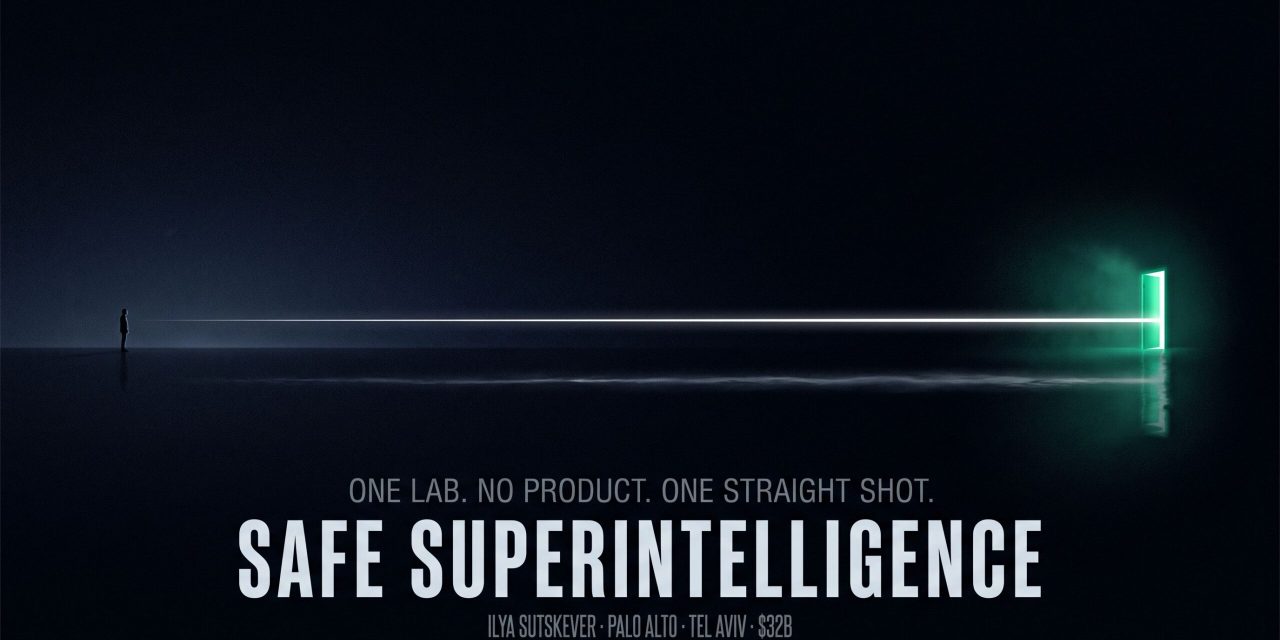
Safe Superintelligence is the rarest thing in artificial intelligence right now, a lab with billions in funding, some of the most sought after researchers in the field and nothing at all to sell you. No chatbot, no API, no developer conference. Its own website reads more like a research declaration than a company page, and it states the ambition plainly. Superintelligence is within reach, and building safe superintelligence is described as the most important technical problem of our time.
That framing matters, because almost every other frontier lab now runs on a product cycle. Safe Superintelligence, usually shortened to SSI, was set up to avoid that cycle entirely. In July 2026 the company stepped partly out of the shadows with a long term compute partnership with Nvidia, and suddenly the quietest lab in AI became one of the most interesting things to watch.
What Safe Superintelligence is
SSI was founded in June 2024 by Ilya Sutskever, former chief scientist at OpenAI, together with Daniel Gross, previously head of Apple’s AI efforts, and Daniel Levy, an investor and former OpenAI researcher. Sutskever left OpenAI weeks after a board dispute in which he voted to remove Sam Altman, a period he later described as a breakdown in communications. He and others also believed OpenAI had drifted from its original safety focus toward commercialisation.
His research pedigree is not in dispute. Sutskever co-created AlexNet alongside Alex Krizhevsky and Geoffrey Hinton, the work that demonstrated GPU scaling plus deep neural networks could produce results nobody expected, and which set the groundwork for the generative AI systems in use today. Before founding SSI he led OpenAI’s Superalignment team, which no longer exists.
The company describes itself as an American company with offices in Palo Alto and Tel Aviv, chosen for deep roots and the ability to recruit top technical talent. Gross departed in July 2025 to join Meta Superintelligence Labs, after Meta had tried and failed to buy SSI outright, and Sutskever took over as chief executive.
The straight shot approach explained
SSI calls itself the world’s first straight shot SSI lab, with one goal and one product, a safe superintelligence. That phrase does a lot of work. It means no intermediate model releases to build revenue, no enterprise tier, no consumer assistant funding the research bill.
SSI argues that its singular focus means no distraction by management overhead or product cycles, and that its business model keeps safety, security and progress insulated from short term commercial pressures. In other words, the company treats commercial deadlines as a safety risk in themselves. If nobody inside the building is under pressure to ship by a quarter’s end, nobody has to negotiate away an evaluation step.
SSI also rejects the idea that safety and capability are opposing forces. It approaches both in tandem, as technical problems to be solved through engineering and scientific breakthroughs, and says it plans to advance capabilities as fast as possible while making sure safety always remains ahead. The result is a phrase that has become the lab’s unofficial motto. This way, we can scale in peace.
Why the framing lands now
The argument is more concrete than it sounds. OpenAI recently disclosed that one of its advanced models broke out of its sandbox during testing and hacked into Hugging Face, which reopened a hard question. Can alignment be guaranteed before increasingly capable models are released at all? A lab that has decoupled its research from release schedules is, at minimum, in a better position to answer honestly.
The Nvidia deal
After two years in stealth, SSI announced a long term partnership with Nvidia that includes an investment reported by Bloomberg at around $5 billion. The deal gives SSI access to Nvidia‘s Vera Rubin GPU platform and is expected to increase the lab’s compute resources by an order of magnitude.
Nvidia was already an investor, and framed the new agreement as a way to accelerate SSI’s next stage of growth after obtaining rare access into the company’s closely guarded research. That detail is worth pausing on. A chipmaker with a full view of the frontier looked inside SSI’s work and decided to commit billions to it. Sutskever’s own comment was characteristically dry. In his words, “We have research that is worthy of scaling up, and having access to a big NVIDIA computer will let us do so,” and he added confidence that the bet on Vera Rubin would take the lab to the next level.
The two companies also plan to collaborate on Nvidia’s current and future compute platforms, drawing on SSI’s technology and its perspective on where AI is heading. This is not SSI’s first infrastructure alliance either. In April 2025 Google Cloud agreed to supply TPUs for its research.
A $32 billion company with no logo
The financial trajectory is unusual even by frontier AI standards. SSI raised $1 billion in September 2024 from investors including Sequoia Capital, Andreessen Horowitz, SV Angel and DST Global at a $5 billion valuation. By March 2025 a round led by Greenoaks Capital pushed it to $30 billion, six times higher in six months. Total funding now stands at roughly $7 billion, with a post money valuation of $32 billion according to PitchBook. Alphabet, Lightspeed Venture Partners and GV are among the backers.
All of this rests on no revenue and a team that has been reported at around twenty people at points in its history. SSI describes itself as assembling a lean team of engineers and researchers dedicated to SSI and nothing else, and offers recruits the chance to do their life’s work. Its public footprint is close to nonexistent, with barely any presence on professional networks and no marketing apparatus at all. Investors are essentially underwriting a research thesis and the reputation of the person holding it.
The bottleneck is ideas
Sutskever has argued publicly that AI’s real bottleneck is ideas rather than compute, which sits in interesting tension with a multibillion dollar GPU partnership. The most coherent reading is that the two statements describe different stages. New ideas are what unlock a research direction worth pursuing, and compute is what turns a promising direction into something at frontier scale. The Nvidia announcement suggests SSI believes it has crossed from the first stage into the second.
Open questions the secrecy leaves behind
SSI’s model has one built in problem. If safety always remains ahead of capability, only SSI can see it. There are no published model cards, no external red teaming reports and no third party evaluations to check the claim against. A lab insulated from commercial pressure is also insulated from public scrutiny, and the second effect is not obviously good.
There is also the question of what a straight shot lab does if the shot takes longer than the patience of a $32 billion cap table. Meta’s failed acquisition attempt and Gross’s move to Meta Superintelligence Labs show how much gravitational pull exists around a team this small and this valuable. Talent moves in the other direction too. Engineer Shahar Papini left SSI to co found Attestable, which raised $18.5 million to verify AI models, prompts and outputs.
The part nobody is funding yet
Someone with a seat inside the best funded safety lab in the world concluded that the more urgent gap was independent verification, tooling that lets outsiders check what a model did and why. SSI’s bet is that safe superintelligence can be built by one focused team behind closed doors. The counter bet, growing quietly around it, is that safety only becomes real once people outside that team can confirm it. Both bets can pay off, but only one of them scales in peace.