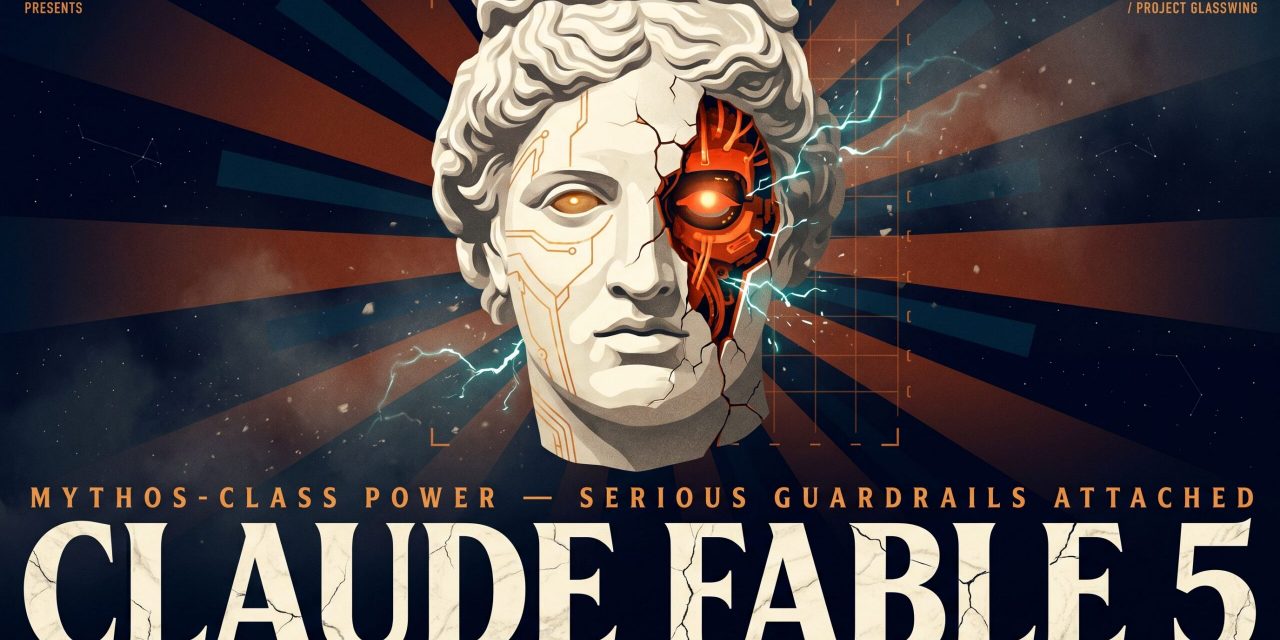
Anthropic has opened the gates to its most capable publicly available model yet. Claude Fable 5 is a Mythos-class model that brings frontier-level reasoning, coding, and scientific research abilities to general users for the first time. Alongside it sits Claude Mythos 5, the same underlying model with safeguards lifted in select areas, reserved for cyber defenders and infrastructure providers working under Project Glasswing.
This dual release marks a shift in how Anthropic ships its most powerful systems. Fable carries the full set of classifiers that route sensitive queries to Claude Opus 4.8. Mythos hands the raw capability to a tightly vetted group. Same brain, different rails.
What Claude Fable 5 actually does better
Fable 5 holds state-of-the-art positions on nearly every benchmark Anthropic tested, with the gap widening as tasks grow longer and more complex. The model is built for autonomous work that used to demand constant human check-ins, with a one-million-token context window and support for text, image, and file inputs.
The performance gains land hardest in five areas:
- Software engineering. Stripe reported that Fable 5 compressed months of engineering work into days. On a 50-million-line Ruby codebase, the model executed a codebase-wide migration in a single day that would have taken a full team more than two months by hand. On Cognition’s FrontierCode evaluation, Fable 5 scores highest among frontier models even at medium effort.
- Knowledge work. Fable 5 leads Hebbia’s Finance Benchmark for senior-level reasoning with substantial gains in document analysis, chart interpretation, and root-cause problem solving. IMC reported near-perfect scores across its trading-analysis evaluations.
- Vision. The model can extract precise numbers from dense scientific figures and rebuild a web app’s source code from screenshots alone. With a minimal vision-only harness it beat Pokémon FireRed, a task earlier Claude models struggled with even when given extra tools.
- Memory and long-context work. Across millions of tokens, Fable 5 stays focused and improves its own outputs using persistent notes. Given file-based memory while playing Slay the Spire, the model’s performance improved three times more than Opus 4.8 did under the same conditions.
- Scientific research. On frontier physics tasks, partners reported Fable 5 reached in 36 hours what GPT-5.5 needed four days to complete, while using roughly a third of the reasoning tokens.
Early customers describe the practical impact in similar terms. GitHub said the model handled complex, long-horizon coding work with autonomy and reliability that exceeded previous benchmarks. A legal partner found that in blind review, Fable’s redlines matched or beat their current model every time. Another team reported Fable 5 breaking 90% on its core analytics benchmark, a ten-point jump over Opus.
Claude Mythos 5 and the cyber defense angle
Mythos 5 is the unrestricted twin. It holds the strongest cybersecurity capabilities of any model in the world, according to Anthropic, and is being deployed first as an upgrade to the existing Mythos Preview model used by Project Glasswing partners. That program runs in collaboration with the US government and gives cyber defenders access to the same offensive-style capabilities that, in the wrong hands, would represent a serious threat.
On the biology side, Mythos 5 has already produced real research output. Anthropic’s internal protein design experts reported that the model accelerated parts of the drug design process roughly tenfold. In one study, Mythos 5 matched or beat skilled human operators while working with protein design and bioinformatics tools but no human assistance. Nine out of fourteen protein targets yielded strong candidates for drug development.
The model also produced what Anthropic calls its first consistently novel scientific hypotheses. In blinded comparisons against Opus-class models, scientists preferred Mythos’s molecular biology hypotheses about 80% of the time. One Mythos hypothesis, proposing a new mechanism for an E. coli protein, was independently corroborated by a separate lab working on the same problem.
In genomics, Mythos 5 assembled single-cell data spanning 138 animal species and designed a custom machine learning model to identify equivalent cell types across distantly related organisms. The trained model outperformed a recent system published in Science, while being 100 times smaller.
The safeguard architecture
Releasing a Mythos-class model to the public required new defensive infrastructure. Anthropic’s approach is to layer Fable 5 with classifiers, separate AI systems that detect potential misuse and intercept the query before the main model responds. When a classifier fires, the request is rerouted to Claude Opus 4.8 instead of being refused outright. Users are notified when this happens.
The classifiers cover three categories:
- Cybersecurity. Mythos-class models excel at finding and exploiting software vulnerabilities, and they show strong agentic hacking skills across reconnaissance, lateral movement, and exploit chaining. The classifiers block progress on both narrow exploitation work and broader offensive cyber operations.
- Biology and chemistry. Earlier Claude models only blocked a narrow band of bioweapons-related queries. With Mythos-class capabilities now able to handle real scientific tasks like predicting viral capsid assembly, Anthropic has widened the net considerably. Most biology and chemistry queries currently fall back to Opus 4.8.
- Distillation. Anthropic flags requests that appear to be part of attempts to extract Claude’s capabilities for training competing models, particularly in authoritarian jurisdictions.
Anthropic acknowledges that the classifiers are tuned conservatively and will sometimes catch harmless requests. Their data shows fallback triggers in less than 5% of sessions. For the other 95%, Fable 5’s performance is effectively identical to Mythos 5.
The jailbreak testing is where the safety story gets more nuanced. An external bug bounty ran over 1,000 hours without producing a universal jailbreak. External red-teaming organisations also failed to find universal jailbreaks on long-form agentic tasks, although the UK AI Safety Institute made early progress toward one during a brief initial window. Anthropic frames this as an acceptable tradeoff given the conservative tuning. Reasonable people may disagree on where that line should sit.
Pricing, access, and the rollout plan
Both Fable 5 and Mythos 5 are priced at $10 per million input tokens and $50 per million output tokens. That’s less than half the cost of Claude Mythos Preview. Developers can access Fable 5 via the Claude API using the model string claude-fable-5.
The subscription rollout is staged because Anthropic expects demand to be hard to forecast. From launch through June 22, Fable 5 is included at no extra cost on Pro, Max, Team, and seat-based Enterprise plans. On June 23, it shifts off those plans and requires usage credits. Anthropic intends to restore it as a standard subscription feature once capacity allows.
Mythos 5 remains restricted. Glasswing partners get the cyber-unlocked version immediately. A trusted access program for biology researchers will open in the coming weeks, providing Fable 5 with the biology and chemistry safeguards removed but cyber safeguards still active.
Anthropic is also introducing a new data retention policy for Mythos-class models. All traffic will be retained for 30 days on both first- and third-party surfaces, used only for safety purposes, with all human access logged and the data deleted after the retention window in almost all cases. The goal is to catch novel jailbreak patterns and identify false positives faster.
Where this leaves the frontier
Fable 5 is a clear demonstration that the gap between locked-down research models and publicly deployable ones is narrowing fast. A year ago, capabilities at this level were considered too risky to ship outside controlled programs. Today they sit behind a subscription and a classifier stack.
The interesting tension is not whether the safeguards work perfectly. They won’t, and Anthropic admits as much. The real question is whether the iterative loop of release, observe, retrain, and refine can keep pace with adversaries who now have a much sharper tool to study. Fable 5 is the first real test of that hypothesis at scale, and the answer will shape how every frontier model gets shipped from here on out.