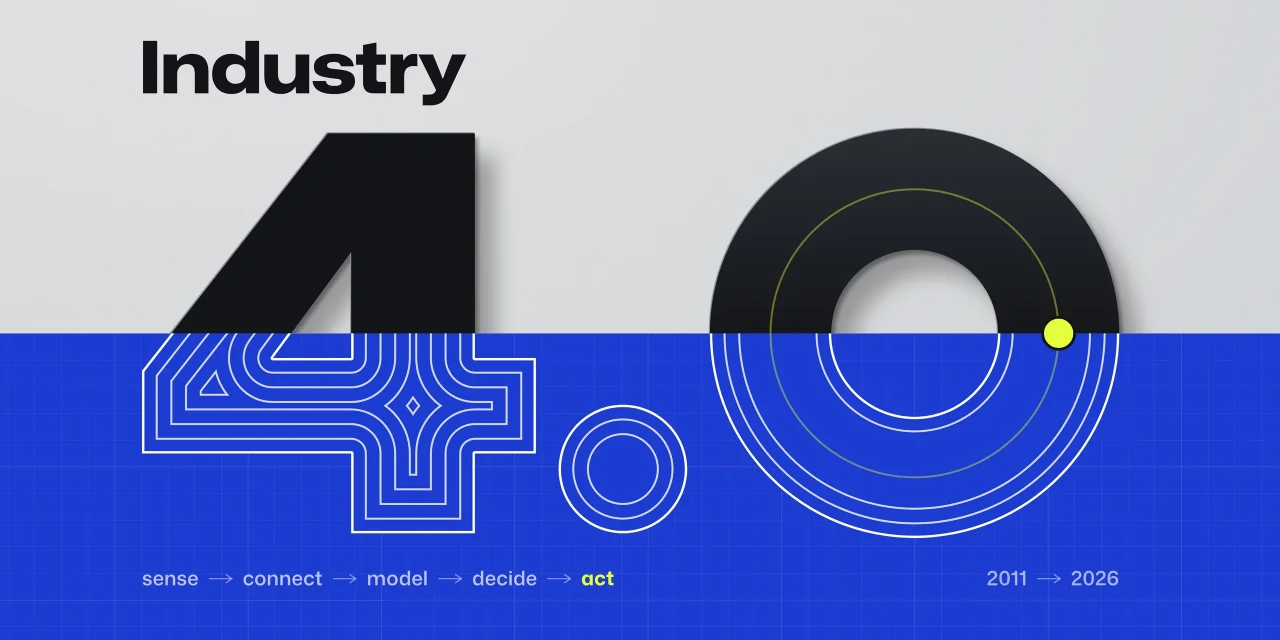
Industry 4.0 is the digital transformation of manufacturing and related industries, in which machines, products, people and IT systems are connected so that a plant can sense what is happening, decide what to do and act on it, often without waiting for a person. The term was introduced publicly in April 2011, in an engineering weekly and at Hannover Messe. Fifteen years later, the idea has grown from connected machines and dashboards into factories where AI agents propose and carry out steps, robots work next to people, and data moves across companies through shared data spaces.
This guide explains what Industry 4.0 means, how it works, which technologies it uses, where it really stands in 2026, and what the EU rules coming in 2026, 2027 and 2028 mean for manufacturers and machine builders. It ends with a practical way to start and a map of i-SCOOP’s deeper articles on each topic.
Industry 4.0 in short
- What it is: the fourth industrial revolution in manufacturing, built on cyber-physical systems. Physical machines get a digital counterpart, and the two form one loop of data and action.
- What is new compared with Industry 3.0: automation used to stop at single machines and lines. Industry 4.0 connects machines, plants, suppliers and customers, so decisions use data from the whole value chain.
- Core technologies: the industrial Internet of Things, cloud and edge computing, data analytics and AI, digital twins, autonomous and collaborative robots, additive manufacturing, augmented reality and industrial cybersecurity.
- Where it stands in 2026: 59% of manufacturers in a global survey use smart manufacturing technology in daily operations and 18% are still in pilot mode. Large companies are far ahead of small ones.
Where the term Industry 4.0 comes from
Industry 4.0 started as a German policy project. In December 2010, Wolfgang Wahlster of the German Research Center for Artificial Intelligence (DFKI) proposed the name to Henning Kagermann of acatech and Wolf-Dieter Lukas of the federal research ministry, as a catchier label for “cyber-physical production systems”. The three published the first article on Industrie 4.0 in VDI nachrichten on 1 April 2011, and Wahlster presented the term at the opening of Hannover Messe on 3 April 2011, in front of Chancellor Angela Merkel and about 3,000 executives, as Wahlster recalls in an interview with DFKI. The “4.0” refers to the fourth industrial revolution and, on purpose, to the way software versions are numbered.
The Industrie 4.0 working group handed its final recommendations to Chancellor Merkel at Hannover Messe 2013. The Plattform Industrie 4.0 started at the same time, first run by the industry associations Bitkom, VDMA and ZVEI and, from 2015, by government, industry, unions and science together. The concept then spread under other names: the Industrial Internet in the US (championed by GE and the Industrial Internet Consortium), smart manufacturing, and the Fourth Industrial Revolution, a broader term that Klaus Schwab’s World Economic Forum made the theme of its 2016 Annual Meeting in Davos, covering society as a whole, not only industry.
The usual timeline behind the “4.0” goes like this. Industry 1.0 is mechanisation with water and steam, symbolised by the first mechanical loom in 1784. Industry 2.0 is mass production with electricity, with the first conveyor line, in the slaughterhouses of Cincinnati, in 1870. Industry 3.0 is automation with electronics and IT, starting with the first programmable logic controller, the Modicon 084, in 1969. Industry 4.0 adds cyber-physical systems and the Internet of Things on top of that automation. For how the theme developed at the fair in later years, see our Hannover Messe 2017 overview.
How Industry 4.0 works
At the heart of Industry 4.0 is the cyber-physical system: a machine, product or process with sensors, software and a network connection, plus a digital model that mirrors it. The physical side produces data, the digital side turns that data into decisions, and the decisions go back to the physical side as actions. That loop is what separates a connected factory from a factory that only has more screens.
In practice, the loop has five steps:
- Sense. Sensors, machine controllers and smart sensors measure temperature, vibration, speed, energy use, quality and position.
- Connect. The data travels over industrial networks, private 5G or Wi-Fi to edge computers and the cloud. Open standards such as OPC UA and MQTT let machines from different vendors talk to each other. This is where IT and OT convergence becomes concrete.
- Model. A data platform and a digital twin give the data context: which machine, which order, which product version, which supplier.
- Decide. Analytics and AI detect patterns, predict failures and optimise schedules. In 2026, AI agents increasingly propose and execute the next step instead of only flagging a problem.
- Act. A machine setting changes, a robot adjusts its path, a maintenance order is created or a supplier receives a call-off, and the effect is measured again.
Two kinds of integration make the loop bigger. Vertical integration connects the shop floor with the systems above it, from controllers and SCADA to manufacturing execution systems (increasingly as cloud MES) and ERP. The classic automation pyramid, with its strict layers, turns into a network in which each level can use data from every other level. Horizontal integration connects a plant with other plants, suppliers, logistics partners and customers, which is where the digital supply chain comes in.
Researchers Mario Hermann, Tobias Pentek and Boris Otto summed up what such systems need in four design principles for Industrie 4.0 scenarios (2016): interconnection, information transparency, technical assistance and decentralised decisions. An earlier working paper by the same authors listed six that are still widely quoted: interoperability, virtualisation, decentralisation, real-time capability, service orientation and modularity. Both lists work as a checklist. A system that cannot exchange data with others, has no digital model, or cannot react in time is not Industry 4.0, whatever the label on the box says.
The technologies behind Industry 4.0
In 2015, Boston Consulting Group listed nine technologies that became known as the nine pillars of Industry 4.0. The list still structures most discussions, but each pillar has moved on.
| Technology (BCG, 2015) | What it does | What changed by 2026 |
|---|---|---|
| Industrial Internet of Things | Connects machines, sensors and products | Cheaper sensors, private 5G and edge computing; the hard part is now data quality and context. See industrial IoT. |
| Big data and analytics | Finds patterns in production data | Machine learning is standard; AI agents act on the results. See industrial data and analytics. |
| Cloud | Shares data and computing across sites | Hybrid set-ups with edge computing for anything that needs millisecond reactions. |
| Horizontal and vertical integration | Links systems inside and between companies | Industrial data spaces such as Catena-X and Factory-X make cross-company data exchange practical. |
| Simulation | Tests changes virtually before doing them | Grew into digital twins of products, lines and whole factories. |
| Autonomous robots | Automate handling, assembly and transport | 5 million industrial robots in operation, cobots next to people and humanoids in early pilots. |
| Additive manufacturing | Prints parts layer by layer | Used for tooling, spare parts and short series. See additive manufacturing. |
| Augmented reality | Overlays instructions on the real world | Used for remote support, training and maintenance. See AR and VR in Industry 4.0. |
| Cybersecurity | Protects connected production | Reporting duties under the Cyber Resilience Act since September 2026, security requirements from December 2027. See OT and ICS cybersecurity. |
Two things are missing from the 2015 list because they barely existed in factories then: AI that generates and reasons, and the data spaces that let companies share data without handing it over. Both are now central, and both are covered below.
Is AI part of Industry 4.0?
Yes. AI was always implied in the “decide” step, but in 2026 it has become the main way the loop gets faster. Three layers are now in use side by side:
- Analytical AI for quality inspection with machine vision, predictive maintenance, energy optimisation and scheduling. This is the most mature layer.
- Copilots that answer questions about machines, write PLC code or summarise shift reports for engineers and operators.
- AI agents that carry out multi-step work themselves. At Hannover Messe in April 2026, Siemens launched its Eigen Engineering Agent for automation engineering in TIA Portal, and analysts at IoT Analytics named industrial AI agents moving from advice to execution the first trend of the fair.
Deloitte’s 2026 manufacturing outlook calls agentic AI the foundation for physical AI, meaning robots with more autonomy, and cites a Manufacturing Leadership Council survey in which 22% of manufacturers plan to use physical AI within two years, against 9% today (Deloitte). The International Federation of Robotics is more cautious: in its World Robotics 2026 summary it states that general-purpose physical AI systems are not yet industry-grade.
The practical question is less whether to use AI than where it may act on its own. A copilot that drafts a change is low risk. An agent that changes a recipe on a running line needs the same controls as a human engineer: limits on what it may touch, a log of what it did and a person who signs off. Deloitte’s 2026 outlook expects more than 81% of manufacturing task hours to remain human-driven, so most of the value comes from people and AI working on the same loop.
Where Industry 4.0 stands in 2026
After 15 years, Industry 4.0 is mainstream in large companies and patchy everywhere else. These are the most useful recent numbers:
- From pilots to operations. In Rockwell Automation’s 2026 State of Smart Manufacturing survey of 1,560 respondents from manufacturers in 17 countries, 59% actively use smart manufacturing technology to support operations and only 18% are still in pilot mode. Nine in ten call digital transformation essential (Rockwell Automation).
- The size gap in Europe. In 2025, 19.95% of EU enterprises with ten or more employees used AI. The figure was 55% for large enterprises, 30% for medium-sized ones and 17% for small ones. Among large firms that use AI, 33% apply it to production processes, against 19% of small AI users (Eurostat).
- Robots. Factories installed 603,307 industrial robots in 2025, 11% more than a year earlier, and the number in operation reached a record 5 million. China took 59% of new installations. The EU installed 60,500, 11% fewer than in 2024 (IFR, TNW).
- Front-runners. The World Economic Forum’s Global Lighthouse Network, which recognises the most advanced factories and value chains, reached 238 sites in June 2026, and the Forum describes AI moving from isolated pilots to a core operating capability at the new sites (WEF).
- Investment. In Deloitte’s 2025 survey of 600 executives at large US manufacturers, 80% planned to spend at least 20% of their improvement budgets on smart manufacturing.
Read together, the numbers show two speeds. Large manufacturers and the Lighthouse sites are scaling AI across plants, while many small and mid-sized companies are still connecting their machines. For a supplier, that gap is a risk: customers increasingly expect data, traceability and digital ordering as part of the deal.
Benefits of Industry 4.0
Large US manufacturers that implemented smart manufacturing report average gains of 10% to 20% in production output, 7% to 20% in employee productivity and 10% to 15% in unlocked capacity, according to the same Deloitte survey. Behind those averages sit a few concrete mechanisms:
- Less unplanned downtime, because condition data shows wear before a machine fails.
- Better quality, because inspection happens on every part, in real time, instead of on samples.
- Flexible production, so smaller batches and customised products cost less to make.
- Faster decisions across the supply chain, because planners see stock, orders and capacity in one place. Our guide to Logistics 4.0 and supply chain management goes deeper.
- Lower energy use and emissions, because energy is measured per machine and per product, which also feeds sustainability reporting.
- Safer, less repetitive work, when robots and cobots take over heavy or monotonous tasks.
Industry 4.0 examples
The clearest examples come from the World Economic Forum’s Global Lighthouse Network, where sites are admitted on measured results. A few from the cohort announced in June 2026 (WEF):
| Site | Results reported to the WEF |
|---|---|
| Schneider Electric, El Paso (United States) | On-time delivery up from 61% to 97%, lead times down by up to 35% |
| Rockwell Automation, Singapore | Units per person-hour up 43%, defects down 35%, time-to-competency 67% shorter |
| Merck Biotech Development Center, Fenil-sur-Corsier (Switzerland) | Laboratory labour productivity up 67%, speed to patient cut by 50% |
| Unilever, Haridwar (India) | Changeovers 40% faster, minimum order quantities down 40%, service levels at 99% |
| Saudi Aramco, Hawiyah NGL complex (Saudi Arabia) | Production volumes up 26%, overall equipment effectiveness up 44% |
The numbers are what the companies reported, not independent audits, but they show the pattern: the biggest gains come where data, automation and changed ways of working are combined on one problem, such as delivery reliability or changeover time.
Challenges and risks
The same connectivity that makes Industry 4.0 work also creates its biggest problems.
- Cyberattacks on production. Dragos counted 119 ransomware groups that hit 3,300 industrial organisations in 2025, up from 80 groups a year earlier, and manufacturing accounted for more than two-thirds of the victims (Dragos). The attack on Jaguar Land Rover stopped its production from 1 September 2025 for more than a month and, according to the Cyber Monitoring Centre, cost the UK economy an estimated £1.9 billion and affected more than 5,000 organisations (Security Affairs). Read more on smart factory security.
- Skills. More than a third of the executives in Deloitte’s survey named equipping workers with the right skills as their top concern. Data engineers who understand machines, and maintenance staff who understand data, are scarce.
- Brownfield reality. Most plants run machines of different ages and brands. Retrofitting sensors and making old controllers talk to new software takes more time than buying the software.
- Pilot purgatory. A successful pilot on one line does not scale by itself. Without common data models, governance and budget for the rollout, projects stall after the proof of concept.
- Data ownership. Machine builders, operators and software vendors all want the data a machine produces. The EU Data Act now gives users rights to that data, which changes contracts and business models.
- Impact on jobs. Automation removes some tasks and creates others. The net effect depends on whether companies retrain people, which is why the European Commission promotes Industry 5.0, a human-centric complement to Industry 4.0.
Industry 4.0 in Europe, data spaces and the 2026 to 2028 rules
Europe’s version of Industry 4.0 has two features that matter more every year: shared data infrastructure and regulation.
Data spaces. Germany, where the term was born, is still the reference market (see how German industry adopts the industrial IoT). Manufacturing-X is a German-funded initiative to build an open, federated data ecosystem for industry, following the blueprint of Catena-X in the automotive sector (Fraunhofer ISST). Its project for machine and plant builders, Factory-X, co-led by SAP and Siemens (SAP News), closed its research phase in June 2026 and published its software as open source, with the results moving into operational use within Manufacturing-X (computer-automation.de). The idea goes back to the Industrial Data Space: companies keep control over their data while sharing what partners need.
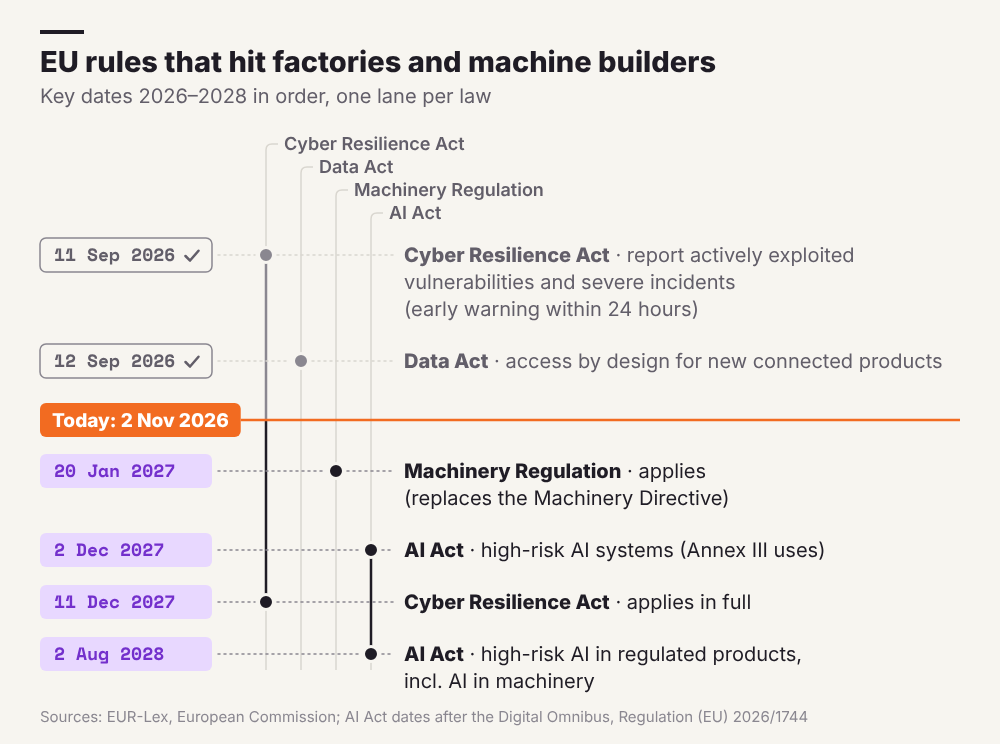
The rule clock. Several EU laws now turn parts of Industry 4.0 into obligations, with dates that are close:
| Date | Rule | What it means for industry |
|---|---|---|
| 11 Sep 2026 | Cyber Resilience Act, reporting | Manufacturers of products with digital elements must report actively exploited vulnerabilities and severe incidents, with an early warning within 24 hours (European Commission). |
| 12 Sep 2026 | Data Act, access by design | New connected products and related services must be designed so users can access the data they generate (Matheson). |
| 20 Jan 2027 | Machinery Regulation | Regulation (EU) 2023/1230 replaces the Machinery Directive, with new requirements for software, cybersecurity and AI-based safety components. |
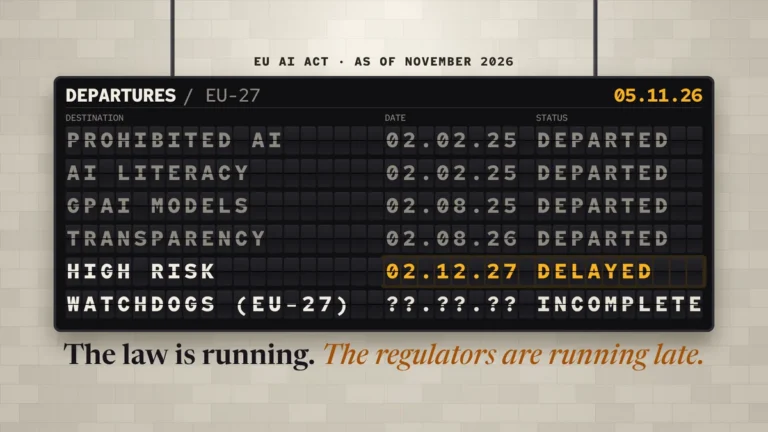
| 2 Dec 2027 | AI Act, high-risk uses | Obligations for high-risk AI systems in listed uses such as recruitment apply. |
| 11 Dec 2027 | Cyber Resilience Act, full application | Products with digital elements need to meet the security requirements to be sold in the EU. |
| 2 Aug 2028 | AI Act, AI in regulated products | Obligations for high-risk AI built into regulated products apply. For machinery, the AI requirements are to be added to the Machinery Regulation through a delegated act by that date (Regulation (EU) 2026/1744, the Digital Omnibus on AI). |
The pattern is that the law now asks for the same things Industry 4.0 promised: knowing what is connected, keeping software up to date, documenting data flows and controlling what automated systems may do. Companies that are already at the connectivity and transparency stages of their journey will find compliance much easier. The European AI security agenda explains the cybersecurity side in more detail.
Industry 4.0 vs Industry 5.0 and smart manufacturing
These terms describe overlapping ideas, not competing technologies.
- Industry 5.0 is a European Commission concept from 2021 that adds three goals to Industry 4.0: human-centric, sustainable and resilient. It uses the same technologies with a broader purpose. In April 2024 the Plattform Industrie 4.0 and the Research Council Industrie 4.0 called the term unnecessary, arguing that Industrie 4.0 had human-centricity and societal benefit as goals from the start. More in our Industry 5.0 explainer.
- Smart manufacturing is the term most used in the US for the same transformation inside factories. Industry 4.0 is wider and includes logistics, services and new business models.
- The Industrial Internet was GE’s term for connected industrial assets beyond manufacturing, such as power plants and aircraft engines. See the Industrial Internet and Industry 4.0.
- Society 5.0 is Japan’s vision for a technology-driven society as a whole. See Society 5.0.
How to get started with Industry 4.0
The most useful starting point is an honest view of where a company stands. The acatech Industrie 4.0 Maturity Index describes six stages. The first two, computerisation and connectivity, are digitalisation. Industry 4.0 starts at the third stage, when data shows what is happening in real time.
Each stage answers a harder question: what is happening (visibility), why it is happening (transparency), what will happen (predictive capacity) and how the system can respond by itself (adaptability). The Smart Industry Readiness Index (SIRI), launched by Singapore’s Economic Development Board in 2017 and now run by the International Centre for Industrial Transformation (INCIT), offers a similar assessment with certified assessors (EDB).
A practical first year usually looks like this:
- Pick one business problem with a number attached, such as unplanned downtime on a bottleneck line, scrap rate or energy cost per unit. Technology choices follow from that.
- Connect what you already have. Most machines already produce data; the work is getting it out in a usable form and giving it context.
- Secure the connection before you scale it. Map your OT assets, segment the network and decide who may access machines remotely. Check whether your products fall under the Cyber Resilience Act and the Machinery Regulation.
- Build one data model across sites, so a second line or plant does not start from zero. This is what gets companies out of pilot purgatory.
- Train people alongside the rollout, operators and maintenance staff first. They decide whether the loop closes in daily work.
- Add AI where the data is ready, starting with copilots and analytics and moving to agents for well-defined tasks with clear limits and logging.
Industry 4.0 by sector
The principles are the same everywhere, but the priorities differ by sector. i-SCOOP has in-depth articles on several of them:
- Discrete manufacturing: smart manufacturing and the smart factory, lights-out manufacturing and total quality management.
- Consumer goods: CPG manufacturing.
- Energy and utilities: smart grids and substation automation.
- Mining: connected mining.
- Operations technology across sectors: operational technology (OT).
Frequently asked questions about Industry 4.0
When did Industry 4.0 start?
The term was introduced in April 2011, in an article in VDI nachrichten on 1 April and at the opening of Hannover Messe on 3 April. The technologies behind it, such as connected controllers and industrial networks, developed during the decade before.
Is Industry 4.0 the same as the fourth industrial revolution?
Mostly. Industry 4.0 is the manufacturing-focused concept from Germany. The Fourth Industrial Revolution, popularised by the World Economic Forum in 2016, is broader and includes the effect of digital, physical and biological technologies on society as a whole. In many countries, “IR 4.0” or “4IR” is used for both.
What are the nine pillars of Industry 4.0?
The nine technologies Boston Consulting Group named in 2015: the industrial Internet of Things, big data and analytics, the cloud, horizontal and vertical system integration, simulation, autonomous robots, additive manufacturing, augmented reality and cybersecurity. AI and data spaces are the main additions since then.
What are the disadvantages of Industry 4.0?
High upfront costs for brownfield plants, a larger attack surface for cyberattacks, dependence on scarce skills, unclear data ownership between partners, and projects that stall after a pilot. Good governance and a step-by-step approach reduce most of these risks.
Is Industry 4.0 still relevant in 2026?
Yes. The term is 15 years old, but most companies are still in the middle of the transformation, and AI agents, robots and EU rules on data and cybersecurity make the next steps more urgent, not less.
The next 15 years start with the data you already have
In 2011, the hard part of Industry 4.0 was imagining it. In 2026, the technology is available off the shelf, including AI agents that can act on what they see. What decides who benefits is less glamorous: clean machine data with context, secure connections and people who trust the loop enough to let it act. The EU rules arriving in 2027 and 2028 ask for exactly those basics. Companies that build them now get compliance and a faster factory from the same work.