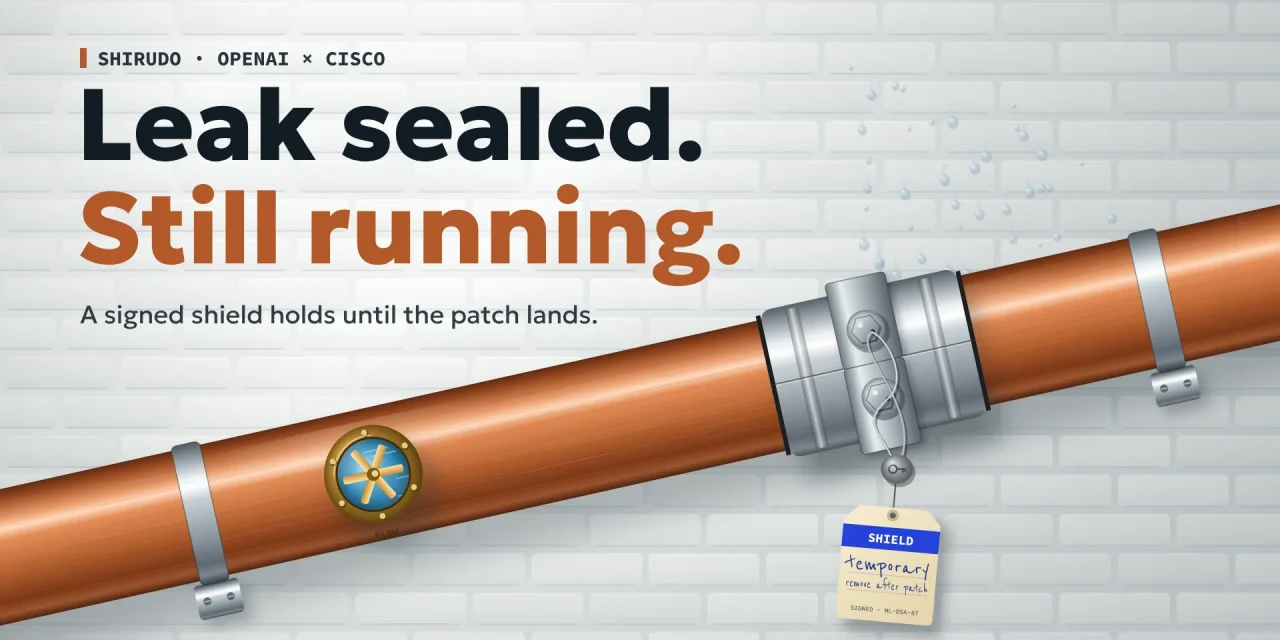
Shirudo is an open-source security runtime for Linux that OpenAI and Cisco released on 23 November 2026. It loads a small, signed program into a running kernel or Java process that blocks one exploit path, and keeps it there until the real patch is installed. In the launch test, a shield written by OpenAI’s Codex stopped a Java4Shell attack on a live Elasticsearch service without a restart.
The AI part gets the headlines. For European organisations, the trust model underneath matters more. On a Shirudo machine, only BPF programs signed with the operator’s key can enter the kernel, even when root tries to load them. A TPM chip keeps a tamper-evident record of every shield that is loaded or removed. Key custody, the approval of shields and their expiry therefore become the controls to design before anyone runs a pilot. This article explains how Shirudo works, what it takes to run today, where it stops and what to govern.
Why a shield instead of a patch
Patching is slow for reasons that have little to do with laziness. A fix has to be built, tested against your workloads and rolled out, often with a restart that someone has to schedule. OpenAI puts that at days or weeks. On Cisco’s network switches the whole cycle can take months, as John Fastabend of Cisco told kernel developers this year, according to LWN. Greg Brockman, OpenAI’s president, summed up the problem in the announcement: “finding a bug today doesn’t mean you can patch every system tomorrow”.
Attackers do not wait for the change window. Google’s M-Trends 2026 report estimates the mean time to exploit at minus seven days, which means serious flaws are on average exploited a week before a patch exists, as the Cloud Security Alliance summarises it. We described the same pressure on open-source dependencies in how AI has made open-source patching a race.
Java4Shell, tracked as CVE-2026-114938, shows how AI speeds up the discovery side as well. According to Calif, its researcher Quang Luong found the flaw in OpenJDK’s Base64 decoder with Codex in about an hour, built a working exploit in roughly two more and spent under $200 on tokens. The bug affects OpenJDK 17.0.6 and later on x86-64 servers with AVX-512 support and can lead to remote code execution in applications such as Jenkins, Jira and Keycloak.
Blocking the vulnerable operation outright is rarely an option, because the exploit and normal traffic often use the same operation. Almost every Java service decodes Base64. A useful shield refuses the malicious input and lets everything else through.
What Shirudo actually does
Shirudo is built on BPF, also known as eBPF. These are small programs that the Linux kernel checks with its own verifier and runs at defined points, such as the security hooks the kernel calls before it allows an operation. Shirudo calls its units upatches, and OpenAI and Cisco call the ones that close a vulnerability shields. A upatch is plain BPF C, often only a few lines, or a signed Java agent for application code. The documentation follows one upatch through its life.
- The operator builds the upatch and signs it with a post-quantum ML-DSA-87 key that stays on the operator host. Shirudo refuses any other type of key.
- The signed package goes to an ordinary OCI registry, the kind that stores container images. The design does not trust the registry: it can withhold or replay packages, but it cannot forge one.
- Targets pull updates on a timer, about once a minute by default. Nothing on a target listens for incoming connections.
- The kernel checks the signature against a sealed keyring before its verifier runs. After start-up, it accepts BPF from user space only through such a signed loader.
- A register in the TPM records every load and unload, and the operator verifies that record offline with evidence the TPM signs.
The consequence deserves attention. According to the security model, root on the machine cannot load its own BPF, detach a shield or change Shirudo’s state without the signing key. That closes a known gap, because attackers also use BPF to hide and to read kernel memory. It also means that whoever holds the signing key can put code into the kernel of every machine that trusts it.
Two shields from the launch
The tutorials walk through two real vulnerabilities, both shipped in the source code and tested in the project’s CI.
- Copy Fail, CVE-2026-31431, a local privilege escalation in the kernel’s crypto interface that was disclosed in April. The shield refuses the one splice into an AF_ALG socket that the exploit needs, inside a kernel security hook. Every other use of the socket carries on, on the kernel that booted.
- Java4Shell. Here the shield is a signed Java agent that guards the JDK’s Base64 decoder and rejects the malformed input before the decoder sees it. Neither the JDK nor the application changes. In Isovalent’s test against Elasticsearch 9.5.5, the shield attached to the running process and the exploit failed.
Once the fixed kernel or JDK is in place, the operator appends a signed delete. The list of operations only grows, so both the addition and the removal stay on record.
The mechanism goes beyond patching. The repository also ships an application sandbox that stops an Apache server from running other programs, connecting to the internet or writing new .php files, and an observability package that records program executions, connections and DNS lookups and exports them over OpenTelemetry. Readers who followed our piece on AI agent sandboxes will recognise the idea: the rules sit in the kernel, around a process that was never changed.
Where AI agents come in
Isovalent, the Cisco company behind the Cilium and Tetragon projects, describes Shirudo as a rewrite of Tetragon built for agents. The reasoning is practical. Agents write code well and handle consoles and policy languages built for people badly, so Shirudo has no configuration language at all. Daniel Borkmann and John Fastabend, two of its maintainers, argued at the Linux Plumbers Conference in Prague in October that agents will be the natural authors of BPF patches, working in a close loop with an operator.
Isovalent’s workflow has four steps. An agent finds a vulnerability or reads a disclosure. It builds a reproducer and a mitigation and tests until the exploit fails. The signed shield then rolls out to affected machines, with an autonomy level you set, and hit counts show how often someone tried the exploit afterwards. OpenAI stresses that security teams decide what gets deployed. The launch follows OpenAI’s Daybreak programme for defenders, and it answers a problem that models such as Claude Mythos 5.2 have made urgent: flaws are now found faster than people can fix them.
That human decision carries more weight than it may seem. The kernel verifier proves that a BPF program is memory-safe. It does not prove that the program is a correct mitigation, and Shirudo explicitly does not judge what a upatch does. A shield that blocks too much takes a service down. One that blocks too little gives false comfort.
What it takes to run today
Shirudo is pre-release. There are no stable releases, and its own FAQ says it is not ready for production. The system requirements are steep:
- a bpf-next development kernel with the signed-loader interface and the patches the project carries, so no standard distribution kernel qualifies yet;
- a TPM 2.0 on every target, as there is no mode without one;
- Secure Boot with a signed and measured kernel image, which the security model assumes;
- clang 23 on the operator host;
- x86-64 for now, since CI runs the full tests only there, arm64 boots the test VM locally and no riscv64 target has booted yet.
Two practical consequences follow. Tools that load their own BPF, such as Cilium, Falco and bpftrace, do not run on a Shirudo target as they are, so their logic would have to ship as signed upatches. And one of the first reactions on Hacker News made the obvious point: an organisation that already runs full measured boot can usually patch quickly too.
The cost on the machine itself is small. In the project’s test VM, initialisation in early boot took 1.17 seconds, no Shirudo process runs between commands and loading a small upatch took about half a second.
What European organisations should govern
Shirudo turns emergency mitigation into a software supply chain of its own, with signed artifacts, a registry and an approval step. That is where governance belongs, well before a pilot.
| Control | Why it matters | Owner and regulatory hook |
|---|---|---|
| Custody of the signing key | The key decides what runs in every kernel that trusts it. Anything it ever signed will load, so a stolen key is a fleet-wide problem | CISO; NIS2 Art. 21 on cryptography and access control |
| Approval of AI-written shields | The verifier checks safety, not correctness. A person signs off on scope, test evidence and which machines get the shield | Security engineering with the service owner |
| An end date for every shield | A shield covers the time until the fix. Without a removal date it becomes permanent kernel code that nobody owns | Platform team; vulnerability management policy |
| Evidence of what ran where | TPM attestation shows which shields were loaded and removed on which machine, which helps with incident reports and audits | Security operations; CRA Art. 14 and NIS2 incident reporting |
| Data and agent access | Shirudo sends nothing unless you configure it. The agent that writes shields is another matter: decide where it runs and which code, logs and telemetry it sees | CISO and DPO; GDPR where logs contain personal data |
| Where to use it first | Fleets with the longest patch cycles, such as embedded and edge devices, network appliances and Java estates that are hard to restart | CTO; CRA for manufacturers of connected products |
The regulatory hooks are our own reading, not quotes from the texts. For manufacturers, the timing is concrete: since 11 September 2026, the Cyber Resilience Act requires an early warning within 24 hours for actively exploited vulnerabilities in their products, a clock we covered in how AI is rewriting the security agenda. A tested shield is a credible first mitigation to report alongside that warning.
What to do in the coming weeks
- Patch Java4Shell first. Fixed OpenJDK and Oracle builds shipped on 17 November, and Calif lists the interim JVM flag -XX:-UseBASE64Intrinsics for hosts you cannot update yet.
- List the systems you cannot patch within a week, and the reason for each: a restart window, a vendor image, a device in the field.
- Check whether those systems have a TPM 2.0 and could boot a signed, measured kernel image. That is the real entry ticket.
- Let one engineer try the VM quickstart or Isovalent’s lab, and follow the technical webinar on 15 December.
- Write a one-page shield policy: who may propose a shield, who approves it, who holds the key, how long a shield may live and how its removal is verified.
A shield buys time, not an exemption
The most valuable output of an AI-built shield may not be the shield itself. It is the reproducer and the test that prove the exploit fails, because the same test tells you when the real patch works. Keep them with the shield. And treat every active shield as a dated IOU. The worry raised on Hacker News, that teams will keep adding shields and stop patching, is exactly the risk that governance has to prevent. Shirudo shortens the gap between finding a flaw and fixing it. It does not close that gap, and the TPM record will show precisely how long you let it stay open.
Frequently asked questions
Is Shirudo free to use?
Yes. The code is open source under the BSD 2-Clause licence and its BPF programs are dual-licensed under BSD and GPL. The source is on GitHub. OpenAI and Cisco have not announced a paid version.
Does Shirudo send data to OpenAI or Cisco?
Not by itself. Without a configured registry, upatch tree or telemetry endpoint, it sends nothing, and telemetry goes only to the OpenTelemetry collector you name. An AI agent you use to write shields is a separate tool with its own data flows.
Does it replace kernel updates or live patching?
No. A shield covers the time until a machine runs a fixed kernel or runtime. The project positions it as a complement to traditional kernel live patching, with faster rollout and the same mechanism for kernel and user space.
Can we run it in production now?
Not yet. It is pre-release, needs a development kernel with extra patches and a TPM 2.0 on every machine, and only x86-64 is tested in CI. A lab pilot and a shield policy are realistic steps today.