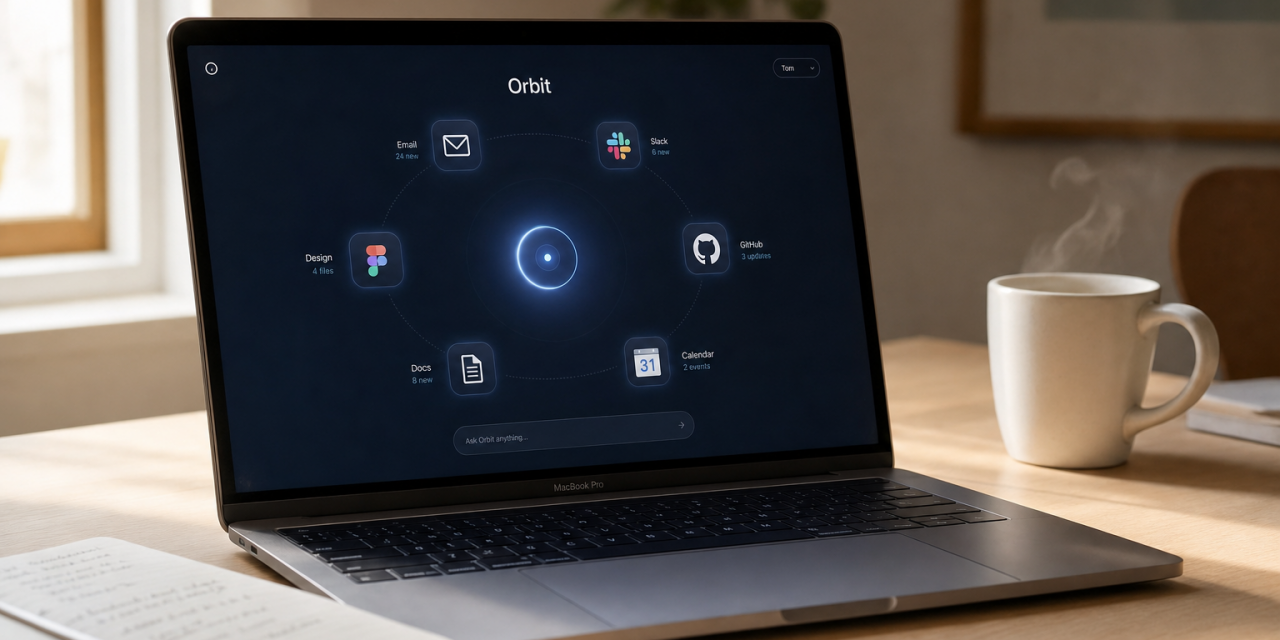
Orbit proactive assistant looks like Anthropic’s next step for Claude Cowork, a work layer that notices what matters before you ask. Based on code references reported by TestingCatalog, Orbit is being prepared as a proactive briefing and insights system for Claude, with connectors for Gmail, Slack, GitHub, Calendar, Drive, Figma, and other work tools.
Claude Cowork is already built around delegation. You give it a goal, and it works across your desktop, local files, folders, and applications to produce a deliverable. Orbit adds a different capability: surfacing useful context before you have defined the task. If Claude Cowork is about getting work done, Orbit appears to be about noticing which work needs attention.
What Orbit proactive assistant appears to be
Orbit has not been formally announced by Anthropic at the time of writing. The strongest public clues come from TestingCatalog, which found references across recent web and mobile builds. For now, Orbit reportedly appears as a toggle in settings, which often suggests a feature is being staged before wider release.
The discovered descriptions point to an opt in assistant that is aware of your time zone and generates personalized briefings. These briefings would draw from connected tools and turn scattered updates into actionable insights. The reported connector list is especially revealing:
- Gmail for messages, threads, and follow ups
- Slack for team conversations and decisions
- GitHub for pull requests, issues, releases, and code activity
- Calendar for meetings, deadlines, and schedule context
- Drive for documents, spreadsheets, and shared files
- Figma for design work, comments, and product collaboration
TestingCatalog also mentions references to Orbit apps and the ability to pin favorites for quick access. That suggests Orbit may not only produce morning summaries, but also organize recurring workflows into small reusable surfaces. The exact product shape is still unclear, yet the direction is easy to read: Anthropic is exploring a more ambient Claude experience for people who work across many tools.
Why Orbit fits Claude Cowork
Orbit would complement that model because many high value tasks start with awareness. You may not know that a customer complaint is buried in Slack, that a pull request is blocked, that a design comment changed the scope of a feature, or that a meeting later today needs a briefing doc. A proactive assistant can notice those signals and prepare the next step.
In that sense, Orbit would not replace Claude Cowork. It would make Claude Cowork easier to delegate to. A good briefing could become the starting point for an action: summarize this thread, draft the reply, compare these documents, prepare the meeting notes, or identify what changed since yesterday.
How proactive briefings could change daily work
The practical value of Orbit depends on whether it can separate signal from noise. A proactive assistant that simply repeats notifications will be ignored. A useful one should connect context across tools and explain why something deserves attention.
For developers
GitHub support is one of the most important details in the reported connector list. It points to a product that is not limited to inbox management. Orbit could brief a developer on pull requests waiting for review, issues linked to current work, failing checks, or discussions that changed implementation details overnight.
Because Orbit is also expected to connect with Claude Code, the assistant could become a bridge between awareness and execution. A briefing might identify a failing workflow, summarize the related commits, and suggest where Claude Code could investigate. That would make Orbit more workflow aware than a generic daily digest.
For product and design teams
Figma support suggests Anthropic is also thinking about design and product collaboration. A product manager could start the day with a summary of new design comments, Slack decisions, customer feedback, and calendar commitments. A designer could see which files received comments, which decisions are unresolved, and which engineering discussions might affect the design.
The value is not just speed. It is continuity. Product work often breaks because decisions are scattered across messages, documents, mockups, and meetings. Orbit could help reconstruct that thread before important context is lost.
For operations and research teams
Claude Cowork already fits tasks like scanning documents, extracting structured information, and assembling reports. Orbit could make those tasks more timely. For example, it could notice that a shared Drive folder has new source files before a weekly meeting, or that a Slack channel contains unresolved feedback that should be summarized.
In these cases, the proactive layer does not need to act on its own. It only needs to prepare a useful briefing and suggest what can be delegated next.
Orbit versus ChatGPT Pulse and Gemini proactive assistance
Orbit is part of a broader move toward proactive AI assistants. PCWorld notes that ChatGPT Pulse already provides personalized morning briefings for some users, drawing from chats, memory, Gmail, and Calendar. Google is also reportedly working on proactive assistance for Gemini, using signals from Google services, notifications, contacts, messages, and what appears on screen.
The difference is positioning. ChatGPT Pulse is framed around personal briefings. Gemini’s reported version appears closely tied to the Google ecosystem. Orbit, based on the current evidence, seems more focused on work execution and production workflows. GitHub and Figma are not casual additions. They suggest Anthropic wants Orbit to understand the environment where software, documents, designs, and decisions move forward.
That fits Anthropic’s recent product direction. Claude Cowork is not just a place to talk to AI. It is designed to complete work on the desktop with human oversight. Orbit could become the sensing layer above that system, while Claude Cowork remains the doing layer.
The trust problem Orbit must solve
Proactive AI sounds useful until it becomes intrusive. The line between helpful briefing and unwanted surveillance is thin. Orbit will need clear controls over which apps it can access, when it runs, what it stores, and how it explains its conclusions.
Anthropic’s Claude Cowork messaging emphasizes human oversight. Consequential decisions remain with the user. That principle will be even more important for Orbit because proactive systems operate before a user gives a direct command. Users need to know why a topic was surfaced and which sources were used.
Three details will likely decide whether Orbit feels trustworthy:
- Permission clarity so you can choose exactly which tools Orbit can read
- Source transparency so every insight can be traced back to emails, files, issues, messages, or events
- Notification discipline so Orbit does not interrupt unless the context is genuinely useful
The best version of Orbit would be calm and selective. It would not try to predict everything. It would reduce the mental burden of checking six apps before doing meaningful work.
What to watch next
Anthropic’s Code with Claude event in San Francisco starts on May 6, with later dates in London and Tokyo. TestingCatalog suggests the recent build activity looks closer to late preparation than early experimentation, but that does not guarantee a public launch during the event.
If Orbit is announced, the most important questions will be practical rather than flashy. Which plans get access? Will it run on desktop, mobile, or both? How deep are the app connectors? Can teams configure shared briefings? How does it handle sensitive files and private messages? Can users turn proactive behavior into Claude Cowork tasks with one handoff?
Those details will determine whether Orbit becomes a useful work companion or just another feed of AI generated summaries.