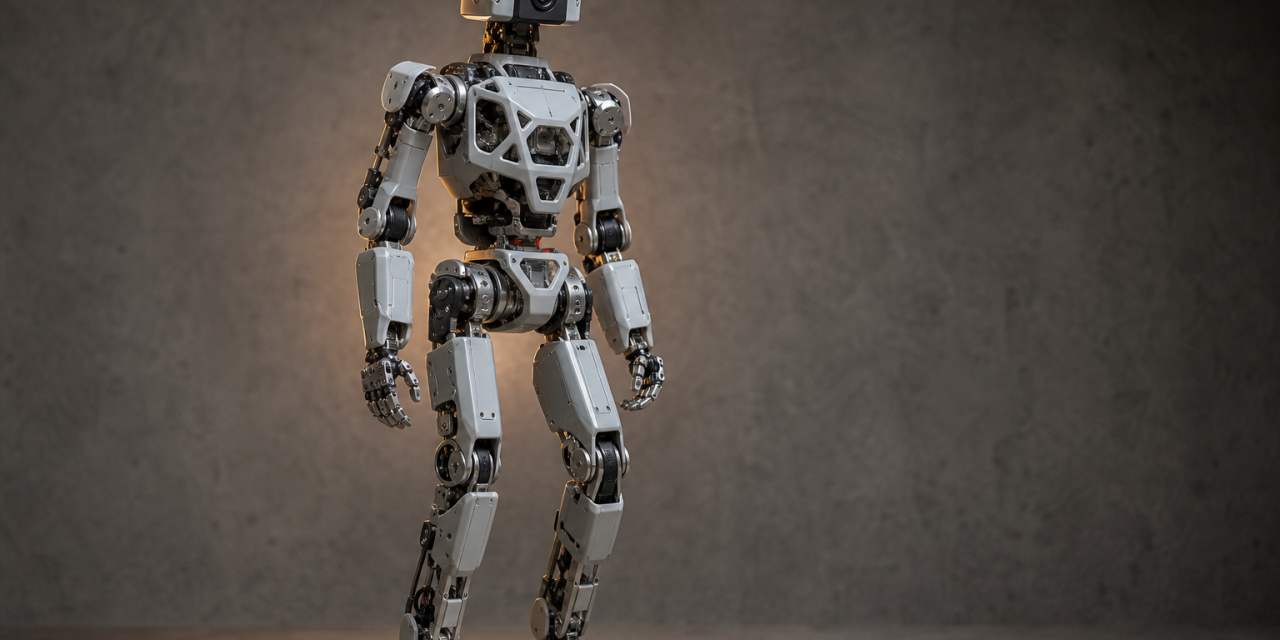
The Asimov v1 humanoid robot is not being presented as a polished household assistant. It is something more useful for engineers, researchers and serious builders: a reproducible humanoid platform with open hardware, open software and enough technical transparency to study how a modern biped actually works.
Menlo Research describes Asimov as an open source humanoid that you can build, train and customize. The official Asimov site focuses on three practical ideas: a body with compliant passive toes, a 25 actuator system with up to 120 Nm peak torque and a sensory setup that lets the robot see, listen and speak through a monocular camera, microphone and speakers.
What the Asimov v1 humanoid robot is designed to be
Asimov v1 is a 1.2 meter, 35 kg bipedal humanoid robot. Its public repository describes 25 actuated degrees of freedom plus two passive toe joints. That matters because humanoid movement is not only about having motors. It is also about distributing compliance, ground contact and balance across the body in a way that can survive real floors, real timing delays and real mechanical tolerances.
The robot’s structure uses 7075 aluminum for load bearing components and MJF PA12 nylon for selected printed parts. This material choice suggests a platform meant for repeatable fabrication rather than one off lab craftsmanship. Builders still need machining, assembly skill and patience, but the design is not hidden behind a proprietary enclosure.
The open release includes mechanical CAD, electrical CAD, a MuJoCo simulation model and onboard software. That is the core of the project’s value. If a humanoid robot cannot be inspected, simulated and modified, it becomes difficult to learn from. Asimov v1 takes the opposite path by making the robot’s design part of the product.
Hardware choices that reveal the robot’s priorities
The Asimov v1 humanoid robot uses a modular architecture with major subassemblies for the limbs, torso, head and related systems. The public technical material lists arm joints for shoulder pitch, roll and yaw, plus elbow and wrist yaw. The robot also includes a waist yaw joint and a two degree neck with yaw and pitch.
Its compute stack is split across a Raspberry Pi 5 for media and networking and a Radxa CM5 for motion control. That separation is sensible. Speaking, network access and camera handling have different timing needs than joint control. Walking robots need predictable control loops, and mixing every task onto one general compute layer can create avoidable complexity.
The sensor suite is modest but practical. The repository lists a 2MP monocular camera, a quad microphone array, IMUs, microphone input, speaker output and motor joint state feedback. This does not make Asimov a fully autonomous general purpose worker out of the box. It gives builders a foundation for perception, speech interaction, state estimation and locomotion experiments.
- Height 1.2 meter
- Weight 35 kg
- Actuation 25 actuated degrees of freedom plus 2 passive toe joints
- Peak torque up to 120 Nm according to the official Asimov site
- Compute Raspberry Pi 5 and Radxa CM5
- Sensing monocular camera, microphones, IMUs and joint state feedback
- Materials 7075 aluminum and MJF PA12 nylon
Why compliant passive toes matter
The official Asimov site gives unusual prominence to compliant passive toes. That may sound like a small detail, but foot mechanics are central to bipedal locomotion. A rigid foot can make every floor contact abrupt. A compliant toe gives the robot a more forgiving interface with the ground, especially during push off and landing phases.
For a humanoid platform aimed at walking research, passive compliance can reduce the burden on software. Control policies still need to stabilize the body, but the mechanics can absorb part of the impact and help shape contact forces. In plain terms, better feet can make the control problem less hostile.
Open source robotics without the black box
Menlo Research positions Asimov as part of a broader effort to build a robot labor force that extends what people can do. That is an ambitious framing, but the more immediate contribution is technical transparency. The Asimov v1 repository gives builders access to the files needed to build, simulate and customize the robot. Additional reporting notes that the project uses CERN OHL S 2.0 and GPL 2.0 style licensing for hardware and software elements.
This is important because humanoid robotics is often shown through polished demo videos while the engineering details remain inaccessible. Asimov v1 lowers that barrier. A researcher can inspect the geometry. A builder can study the bill of materials. A software developer can run the simulation model. A team can compare its own locomotion policies against a shared physical design.
Open source does not mean easy. It means the hard parts are visible.
The DIY kit and the self source route
Asimov v1 is available in two broad paths. The official project materials describe a DIY kit with a 499 dollar deposit and a 15,000 dollar target price, with shipping targeted for summer 2026. The kit is intended to include unassembled bill of materials components, power supply and cabling, spare parts, edge and control boards, networking and power distribution boards, sensors, a wireless emergency stop, safety guidance and build documentation.
The second path is self sourcing. Builders can pull the bill of materials and fabricate or source the required parts themselves. This is more flexible, but it also transfers more risk to the builder. Precision machining, wiring harnesses, calibration, actuator sourcing and safety procedures all become part of the project.
For a robotics lab, self sourcing may be attractive because it allows deeper modification. For an individual builder, the kit may reduce procurement friction. Neither route should be mistaken for assembling a consumer gadget. A 35 kg biped with high torque actuators deserves careful handling, testing and respect for failure modes.
Simulation is where Asimov becomes more than hardware
Menlo Research has published technical themes around sim to real locomotion and reinforcement learning, including writing on teaching a humanoid to walk and using noise to bridge the sim to real gap. That context matters because a humanoid robot is only useful if its simulated behavior can transfer to the physical machine.
The inclusion of a MuJoCo simulation model gives the project a practical path for locomotion policy training. Builders can test control strategies before risking physical hardware. Supplementary reporting also notes processor in the loop simulation and the deliberate use of noise and timing imperfections to make training less idealized. The basic idea is simple: if the simulated robot only learns in a perfect world, the real robot will expose every shortcut.
For Asimov v1, the simulation model may become as valuable as the CAD. Mechanical drawings let you build the body. Simulation lets you iterate on how that body moves.
Who Asimov v1 is really for
The Asimov v1 humanoid robot is best understood as a platform for serious experimentation. It is relevant for university labs, robotics startups, independent engineers, controls researchers and makers who already have experience with complex electromechanical systems.
It is less suitable for anyone expecting a finished humanoid helper. The available information points to a builder oriented robot, not a consumer appliance. That distinction is healthy. Humanoid robotics needs more shared platforms before it can produce reliable everyday machines at scale.
Where it could be useful first
- Testing locomotion policies on a shared bipedal hardware design
- Studying actuator coordination across a full humanoid body
- Developing perception and speech interfaces for embodied robots
- Teaching students how mechanical design, electronics and control software interact
- Benchmarking sim to real methods on reproducible hardware